Is the Stock Market Lying to You? Sentiment vs Reality in 2026
By Alpesh Patel OBE, Founding Principal of Rootbridge Capital and author
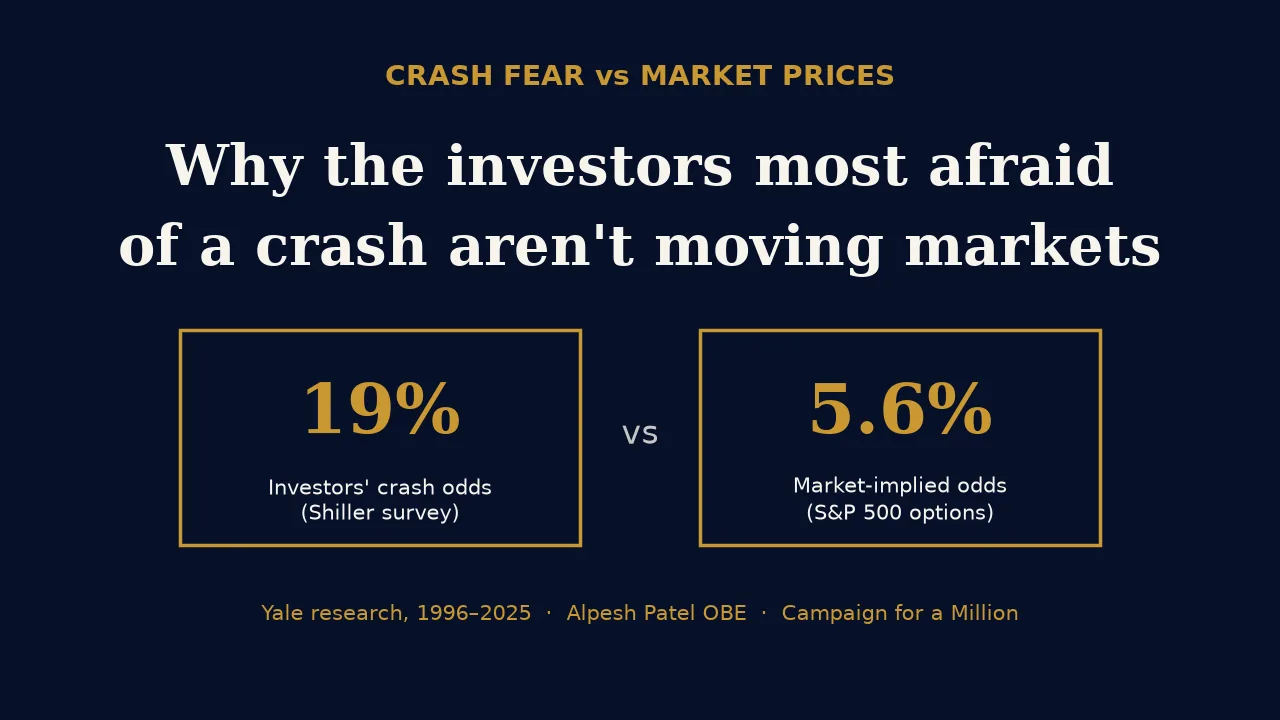
Short answer: No. The market isn't lying to you, but the headlines often are, or at least they're telling you a story. The S&P 500 sits near record highs while 84% of its members are at least 10% below their own highs. That isn't a hidden crash, and it isn't a bubble. It's a normal, healthy market. The investors who get hurt are the ones who read too much into one number and act on it.
This week's webinar landed in a noisy week: Microsoft and Alphabet results, the Federal Reserve, oil and the UK Budget. Here's how I separate the noise from the data.
Headlines aren't a reason to act
Six of the major indices I track were showing bearish momentum at the start of the week. Does that worry me? "It is not something which in and of itself causes me anything other than to say, 'Hmm, let's keep an eye on this.'"
Earnings headlines matter if you're a trader. If you're an investor, they mostly don't. As I said in the webinar: "A week in the markets is noise." So I watch the trend, not the day.
84% of stocks in correction, yet the index is near a record
A correction means a fall of 10% or more from a high. Right now, 84% of S&P 500 stocks are in correction territory, while the index itself is close to an all-time high.
Two stories are tempting, and both are wrong:
- "The market is over-exuberant." If it were, you wouldn't see most stocks sitting well below their highs.
- "There's a hidden crash going on." If there were, the index wouldn't be near a record.
My reading is that this looks fairly healthy, but it isn't an early warning of a crash either. "Biggest problem private investors have is they read too much into data."
A 10% drop is normal, not a crash
Private investors see a 10% fall and panic, because 10% sounds like a big number. But these falls happen often. "That'd be like saying it's raining in London in October. It must be monsoon season."
Are we due a 10% drop? Quite possibly. Should you wait for it before investing? No. "It's like waiting for a train. Oh, I've just missed the train to Waterloo, but I'll just wait for it to come back." Sometimes it never comes back.
Price isn't the same as value
An all-time high doesn't make a share expensive. Value depends on two things: the price, and the profits behind it. If profits are rising fast, a share can be cheap even at a record price.
The forward price-to-earnings ratio (P/E) shows how many dollars you pay for each dollar of expected future profit. On the figures I showed this week:
- Micron was on a forward P/E of about four.
- Nvidia was on about thirteen.
- Walmart was on about twenty-five.
That's why I'm wary of the "AI bubble" headline. A supermarket on a much higher multiple than the leading AI chip maker doesn't fit the story. Call it a bubble if you like. "I couldn't care less what you call it." Markets can still fall on momentum alone.
Cheap doesn't mean "buy" either. Valuation is only one factor. "If you only look at valuation, you find a cheap company with no momentum. It's not bloody gonna move 'cause it's got no momentum." That's why I look at value, growth and momentum together rather than relying on one factor.
The divorce test
If a cheap share could triple, why not put everything into it? Because you'd fail what I call the divorce test: "It's the point at which you tell your spouse, 'I've put all our money in one stock,' and he or she turns around and says to you, 'I'd like a divorce now, please, you nut job.'"
Not even Warren Buffett puts everything in one stock. With 40 shares, each one starts at 2.5% of your money. With 20, each is 5%.
Think portfolio, not stocks
In any given month, even a strong portfolio will have roughly half its shares going down. Investors who watch individual lines panic and sell the goose that lays the golden egg.
There are two separate pains to prepare for:
- Drawdown is how far the portfolio falls from its peak. "Drawdown is what causes panic."
- Time underwater is how long it takes to get back to that peak. "Underwater is what causes boredom."
Look at a portfolio's historic drawdowns before you invest, and assume they'll happen again. If you couldn't live with them, don't hold that portfolio, whatever it returned in the past. And don't let a paper gain become "my precious".
Once you've seen a number on your statement, losing part of it hurts more than never having seen it at all. Daniel Kahneman won a Nobel Prize for showing that.
Don't book your holidays off the market
Most of a year's gains often come in a few short bursts, and the rest of the time you're either bored or worried. The best strategy is usually to stay calm through all of it. "Don't book your holidays based on what the market's doing. Book it on what's in your bank account."
The same goes for leverage. Sharp falls can happen while you're away, so: "People who go on vacation should not do leverage."
Read the mood without trading it
This week's free app is Alpesh's Market Mood. Every day it reads CNBC, Bloomberg and Reuters, the sources the biggest money in the market follows, and runs a sentiment analysis showing the top stories and which way the mood is leaning.
I don't trade off it. It gives me a quick read on the noise so I can set it against the data. It's free at the top of alpeshpatel.com.
Watch the full webinar
In the replay I also cover AI profit margins, Barclays, why the best companies often don't pay dividends, valuation heatmaps for US and global shares, a fund that went nowhere for five years, November seasonality, and viewer questions on fill-or-kill orders and how to buy an index.
Want a second pair of eyes on your portfolio?
If the headlines have you wondering whether to act, start with the data on what you actually own: how concentrated it is, and how far it could fall.
Book a call with my team and we'll go through it with you.
This article is for education and information only. It is not personal financial advice or a recommendation to buy or sell any investment. The value of investments can fall as well as rise and you may get back less than you invest. Past performance is not a guide to future returns. If you are unsure, seek independent financial advice.
Important: this article is education and information only. It is not financial advice or a personal recommendation, and it does not take your circumstances into account. The value of investments and pensions can fall as well as rise, and you may get back less than you put in. Past performance is not a reliable indicator of future results. Figures were correct when the article was written and may have changed. If you are unsure what is right for you, speak to a regulated financial adviser.