Legal & General Pension Fund Review 2026: Is Your Old L&G Pot Growing Fast Enough?
Legal & General is one of the largest investment managers in the world. But size does not mean your pension pot is working hard enough.
With over £1.3 trillion in assets under management, L&G is a fixture in the UK pension landscape. Millions of working professionals hold an old L&G pension from a previous employer, a personal pension taken out years ago, or a group scheme they were enrolled into and never actively reviewed.
The name is familiar. The statements arrive annually. And the question of whether it is actually performing - compared to what is available elsewhere - almost never gets asked.
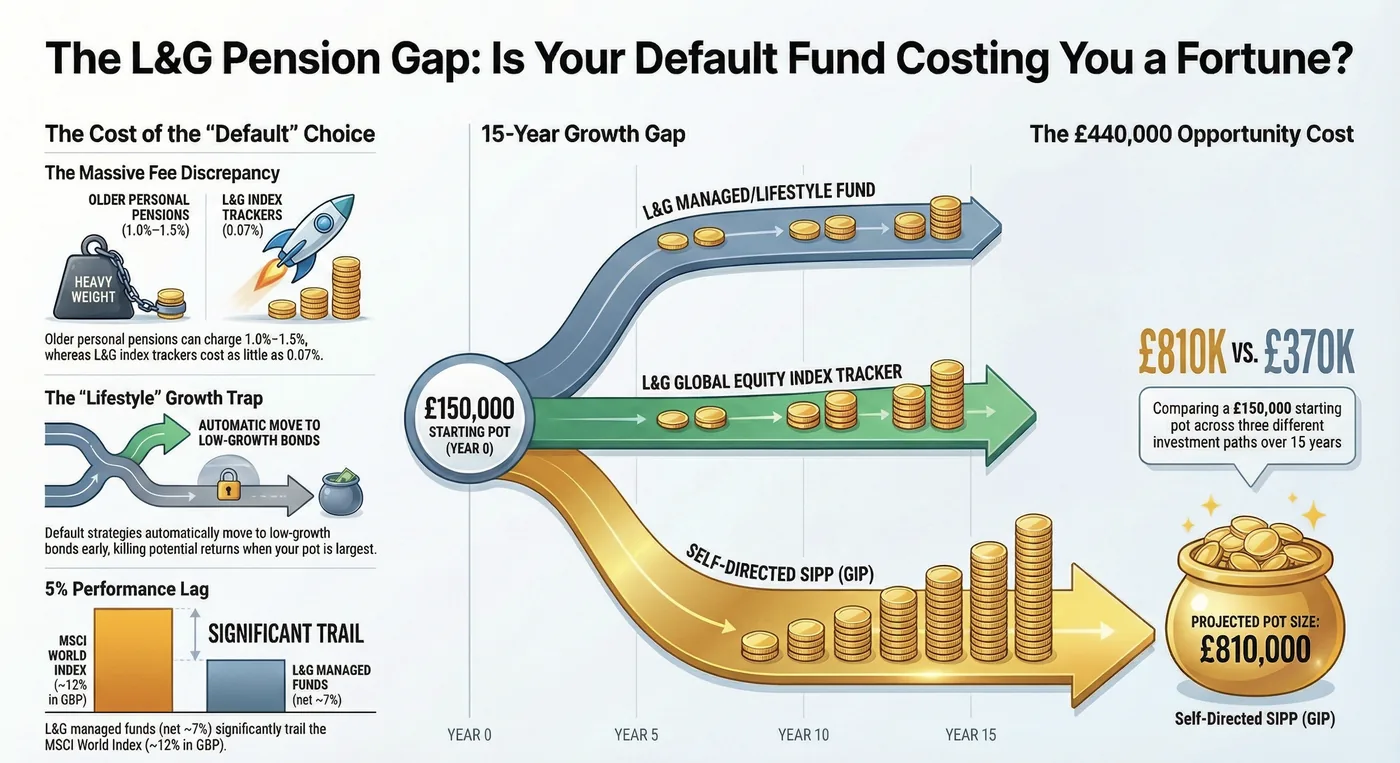
This review addresses that question directly. What are L&G managed pension funds actually returning? What do they cost? And what does the gap look like compounded over the next 15 years?
Alpesh Patel OBE is Founding Principal of Rootbridge Capital, a Bloomberg TV alumnus, Financial Times author, and former Visiting Fellow at Corpus Christi College, Oxford. Through the Great Investments Programme he has reviewed pension fund performance for hundreds of UK investors.
L&G's Position in the UK Pension Market
Legal & General Investment Management (LGIM) is one of Europe's largest asset managers, serving institutional and retail clients across the UK and globally. Its pension offering spans workplace defined contribution schemes, personal pensions, SIPPs, and annuities.
For workplace pension investors, L&G is typically the default provider for many mid-to-large employers who use L&G's group schemes. L&G's WorkSave Pension and MasterTrust products are among the most widely held in the UK corporate pension market.
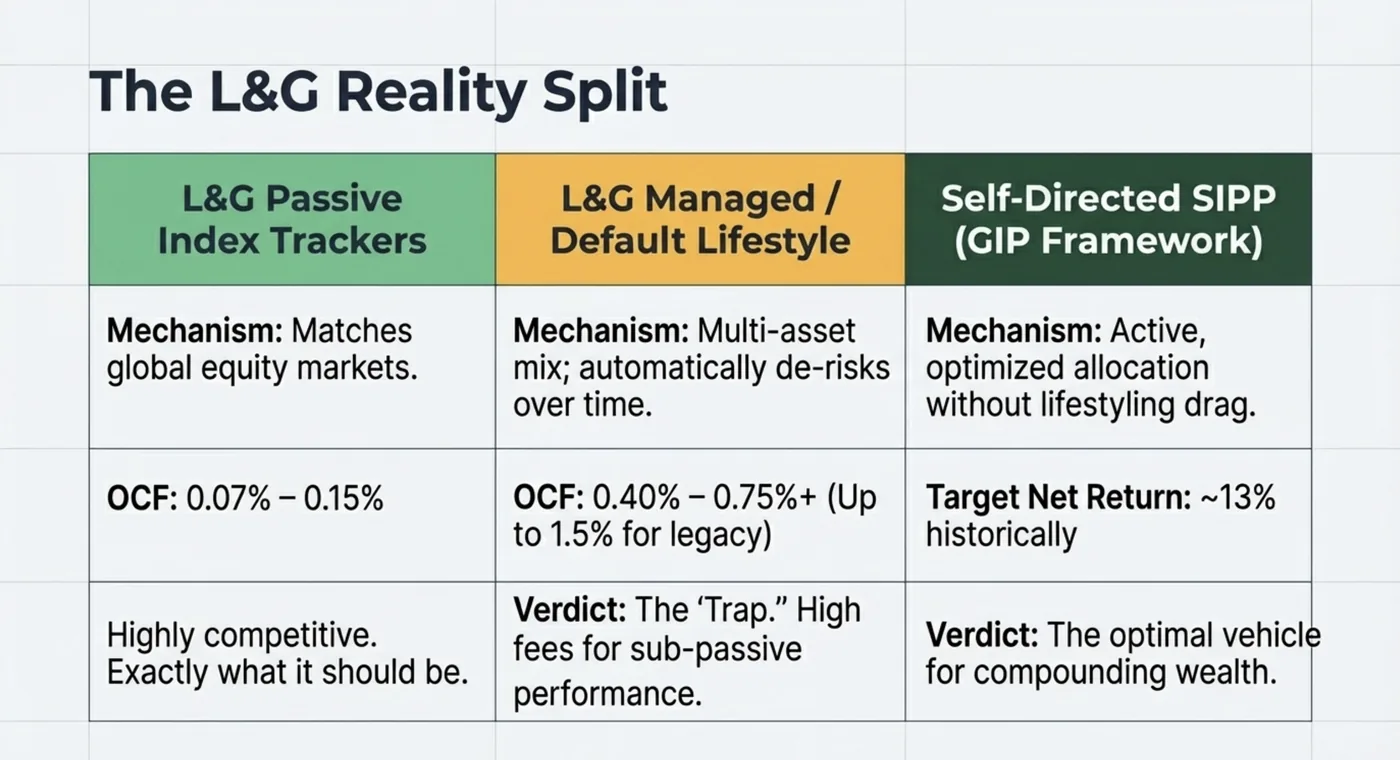
L&G is also one of the UK's leading passive fund managers. Their index tracker fund range including the L&G Global Equity Index fund is widely regarded as a low-cost, quality option.
The challenge is that most default pension investors are not in L&G's passive funds. They are in default lifestyle strategies and multi-asset managed funds, which carry higher charges and have a materially different performance track record.
L&G Pension Charges: What You Are Actually Paying
L&G's fund charges vary significantly by product and fund type. Their passive index tracker funds such as the L&G Global Equity Index carry ongoing charges figures (OCF) as low as 0.07% to 0.15% for institutional share classes. For retail investors in personal pensions and older workplace schemes, charges are materially higher.
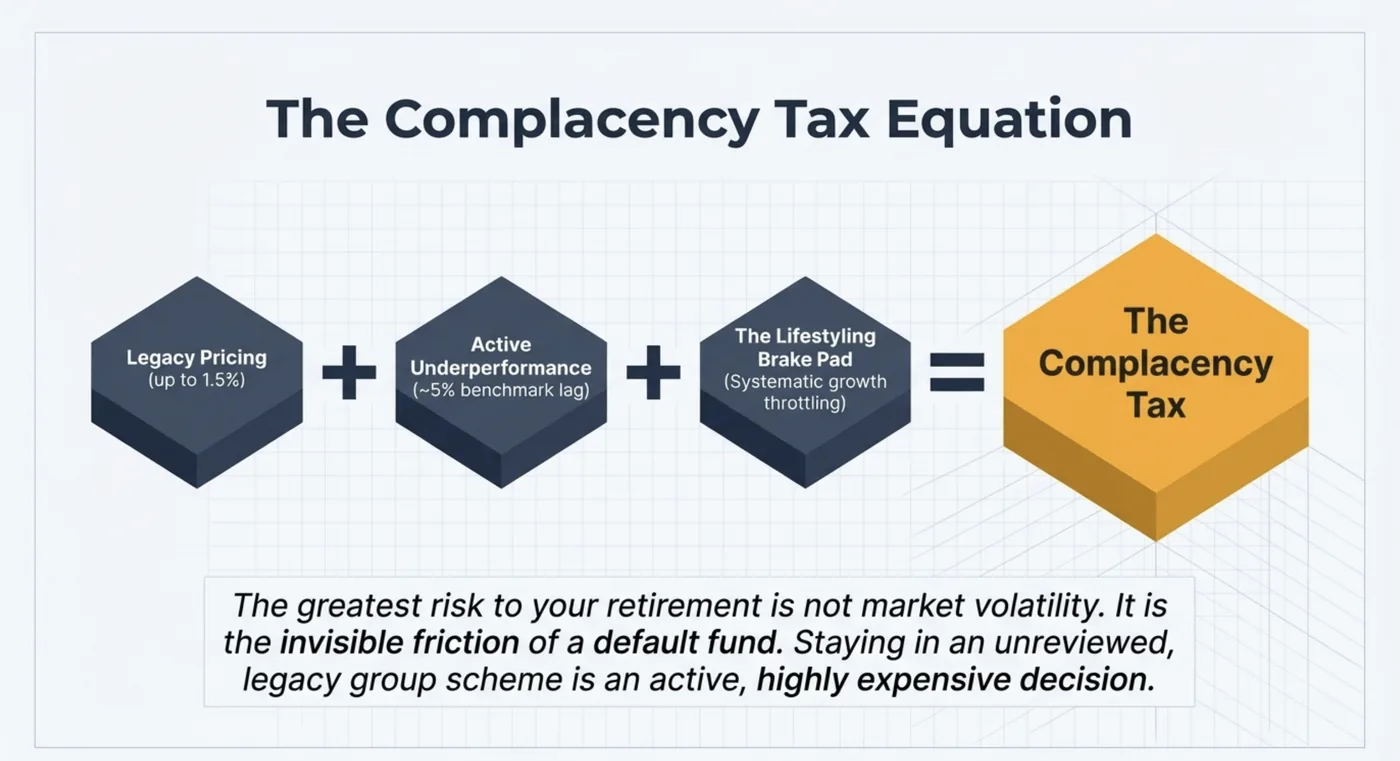
L&G's default lifestyle strategy funds which automatically shift from equities to bonds and cash as retirement approaches typically carry total charges of 0.40% to 0.75% per year in group schemes.
For older personal pension policies, total charges can run to 1.0–1.5% per year, particularly for legacy products taken out before the 2013 Retail Distribution Review. The FCA's charge cap of 0.75% applies to auto-enrolment workplace pension default funds, meaning some older L&G policies may exceed this threshold.
The practical test: locate your L&G policy number, log into your L&G account, and find the Key Features Document or fund fact sheet. Look for the OCF or total expense ratio. If it exceeds 0.5%, you are paying above what is necessary for passive equity exposure.
Legal General Pension Fund Performance: The Evidence
L&G's passive tracker funds have performed in line with their benchmarks — which is precisely what they should do, and why they remain among the better options available to UK pension investors.
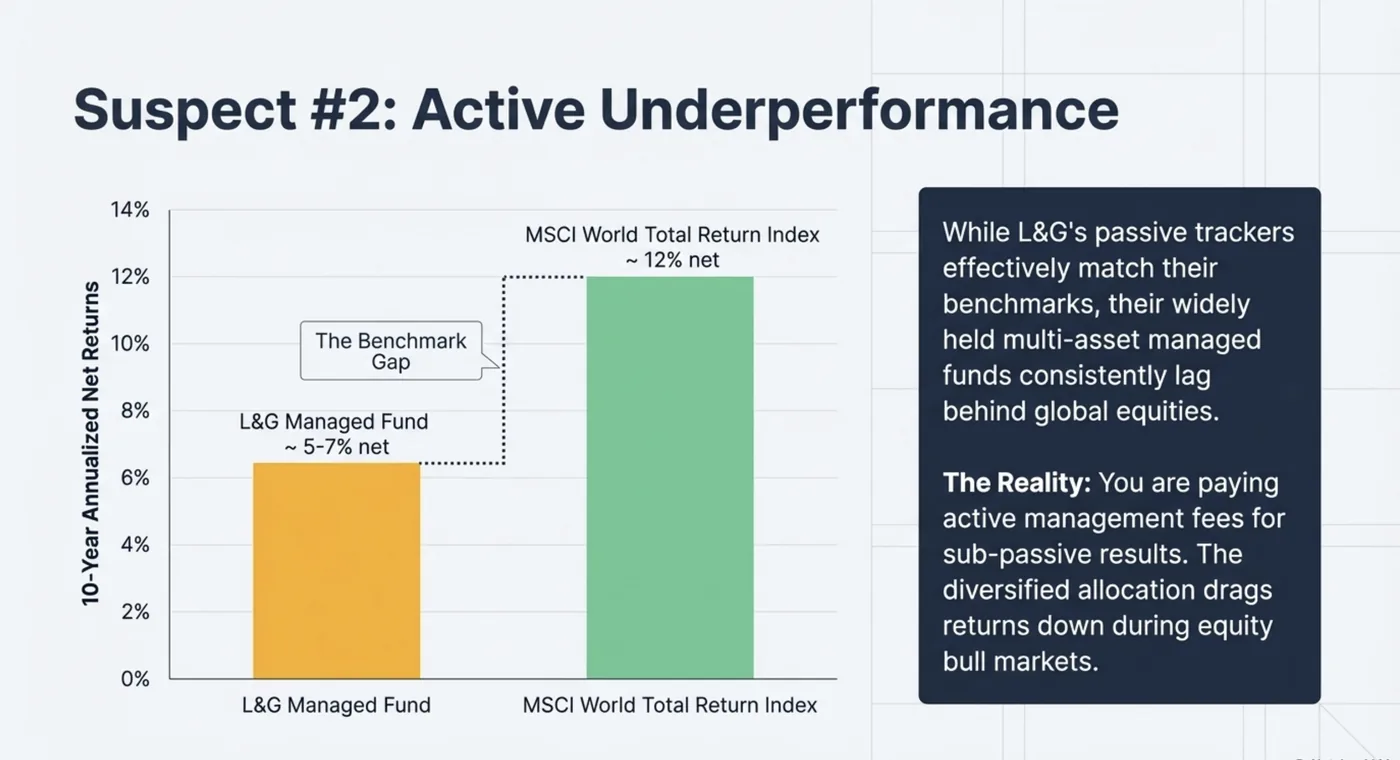
The problem lies in L&G's default lifestyle strategies and multi-asset managed funds. Independent analysis from Yodelar consistently shows that the majority of L&G's managed pension funds underperform their sector average over 1, 3, and 5-year periods.
L&G's Managed Fund — one of the most widely held funds in L&G personal pensions — has historically returned approximately 6–8% per year before charges over a 10-year period, depending on the share class and time period measured.
After charges of 0.75–1.0%, net returns have been approximately 5–7% per year. Against the MSCI World Total Return Index, which returned approximately 12% per year in GBP terms over the decade to 2024, the gap is substantial.
The Lifestyling Problem: When L&G Slows Down Your Pot
Like most major UK pension providers, L&G uses lifestyle strategies as the default for most members. Their Target Date Fund range and the L&G Multi-Asset Fund automatically reduce equity exposure as the investor approaches their selected retirement date, shifting toward bonds and cash.
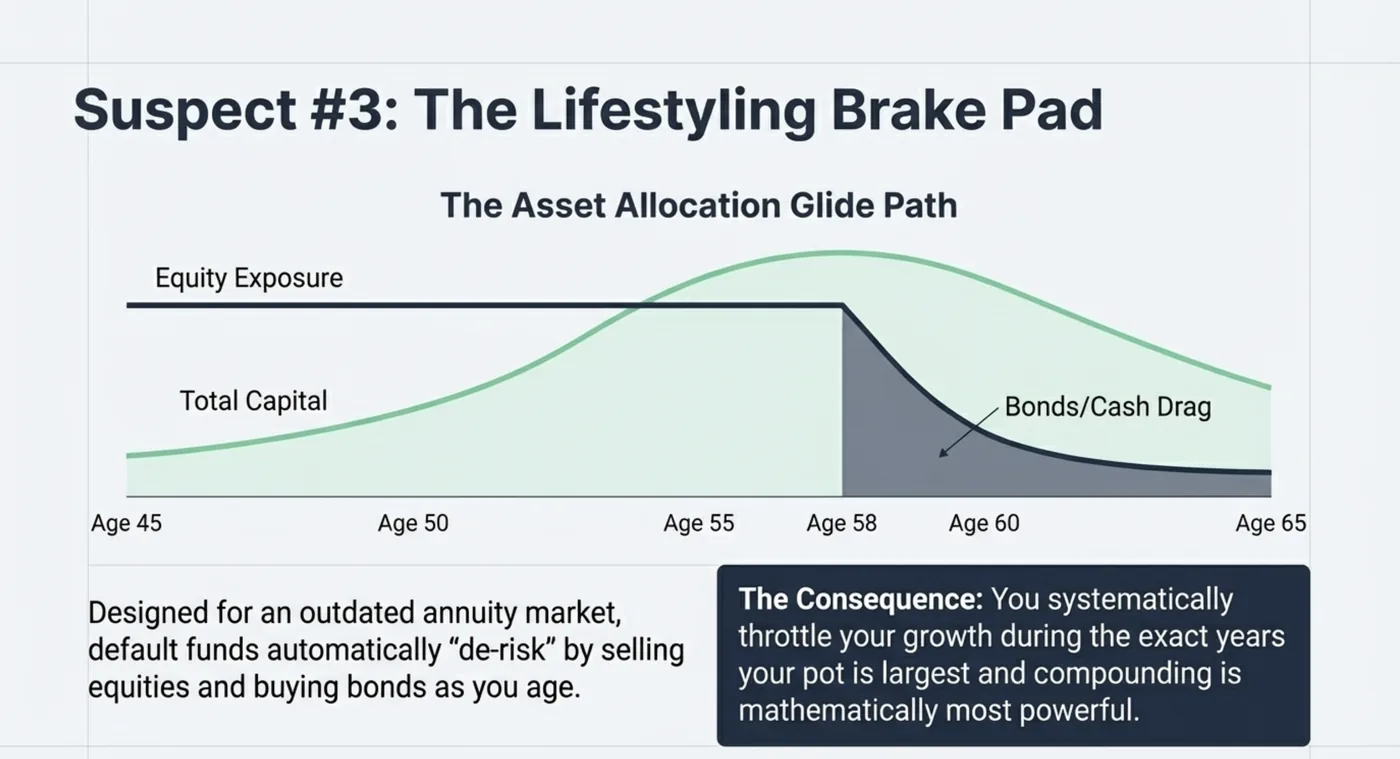
This mechanism was originally designed for investors planning to purchase an annuity at retirement. For the majority of modern pension investors who intend to draw down flexibly, it systematically reduces growth during the years when the pot is at its largest.
A 55-year-old in an L&G lifestyle strategy who has already been de-risked into a 50/50 equity/bond mix has sacrificed the majority of the growth potential of what is often their largest ever investment pot. This is not a failure of L&G specifically — it is a systemic issue with the lifestyle model that the FCA has noted in multiple reviews of workplace pension governance.
The 15-Year Gap: Three Scenarios on a £150,000 Pot
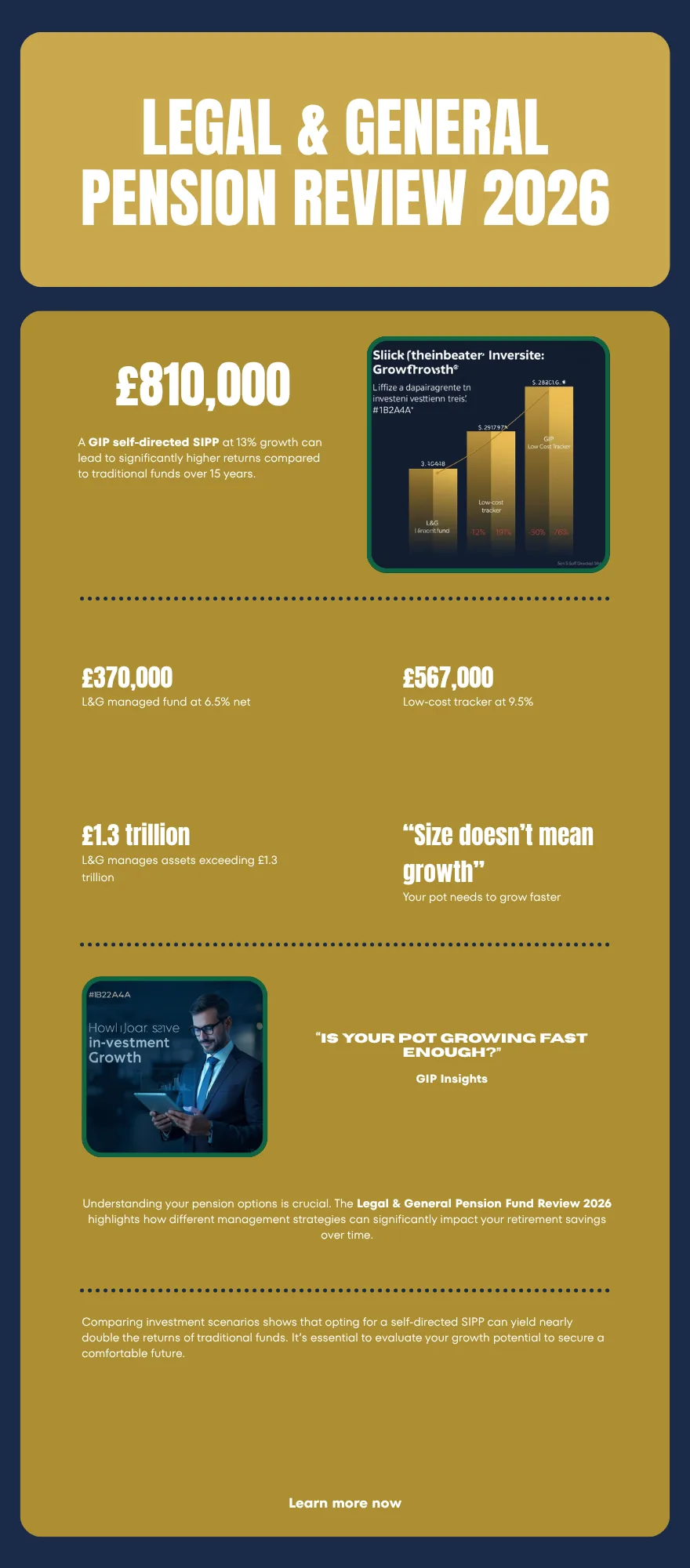
Take a £150,000 L&G pension pot with 15 years to retirement:
- L&G managed/lifestyle fund (~6.5% net after charges): grows to approximately £370,000
- L&G Global Equity Index tracker (9.3% net, low charge): grows to approximately £557,000
- GIP self-directed SIPP (13% net): grows to approximately £810,000
The gap between a typical L&G managed fund and a self-directed GIP approach over 15 years on a £150,000 pot is approximately £440,000.
Even switching within L&G from a managed fund to their own low-cost index tracker adds approximately £187,000 over the same period — at zero cost and minimal effort. Run your own numbers at alpeshpatel.com/tools.
How to Review Your L&G Pension in 10 Minutes
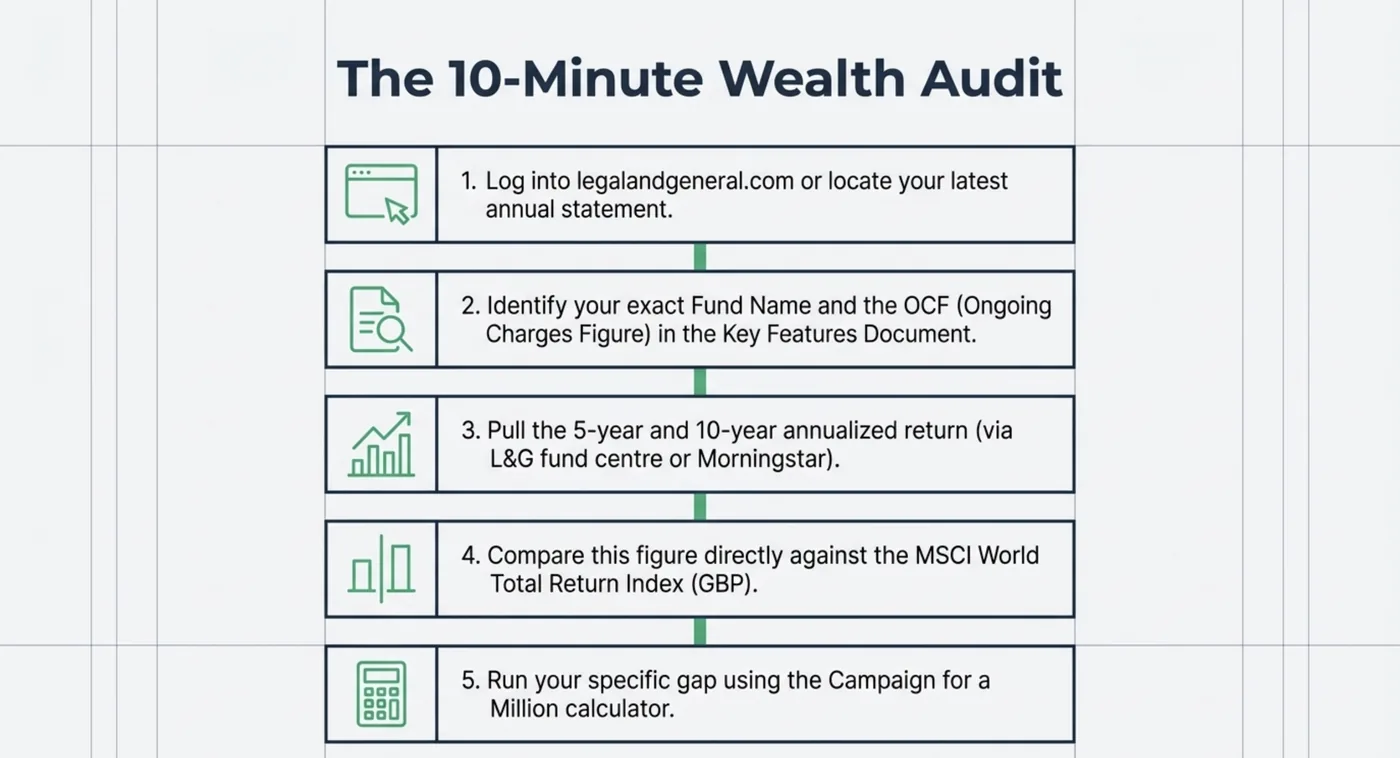
- Log into your L&G account at legalandgeneral.com or locate your most recent annual pension statement.
- Identify your current fund name and the OCF from the Key Features Document or fund fact sheet.
- Look up the 5-year and 10-year annualised return on L&G's fund centre or Morningstar.
- Compare to the MSCI World Total Return Index (GBP) over the same period — available free at msci.com.
- Enter your pot, return figure, and years to retirement into alpeshpatel.com/tools. Then repeat with 9.5% and 13% to see the gap.
Frequently Asked Questions: L&G Pension Review
Is my Legal & General pension performing well?
It depends entirely on which fund you are in. L&G's passive index tracker funds — such as the L&G Global Equity Index — have performed in line with global equity markets at very low cost, making them a strong option. Their managed and lifestyle funds have, on average, lagged both the index and their sector peers after charges. The only way to know for certain is to look up your specific fund's 5 and 10-year returns and compare to the MSCI World.
What charges does Legal & General pension have?
L&G's charges vary significantly by product. Passive index tracker funds in workplace schemes can be as low as 0.07–0.15%. Managed and lifestyle default funds in group schemes typically run 0.40–0.75% per year. Older personal pension policies may carry charges of 1.0–1.5% per year. Check your Key Features Document or annual statement for the OCF.
Can I transfer my L&G pension to a self-directed SIPP?
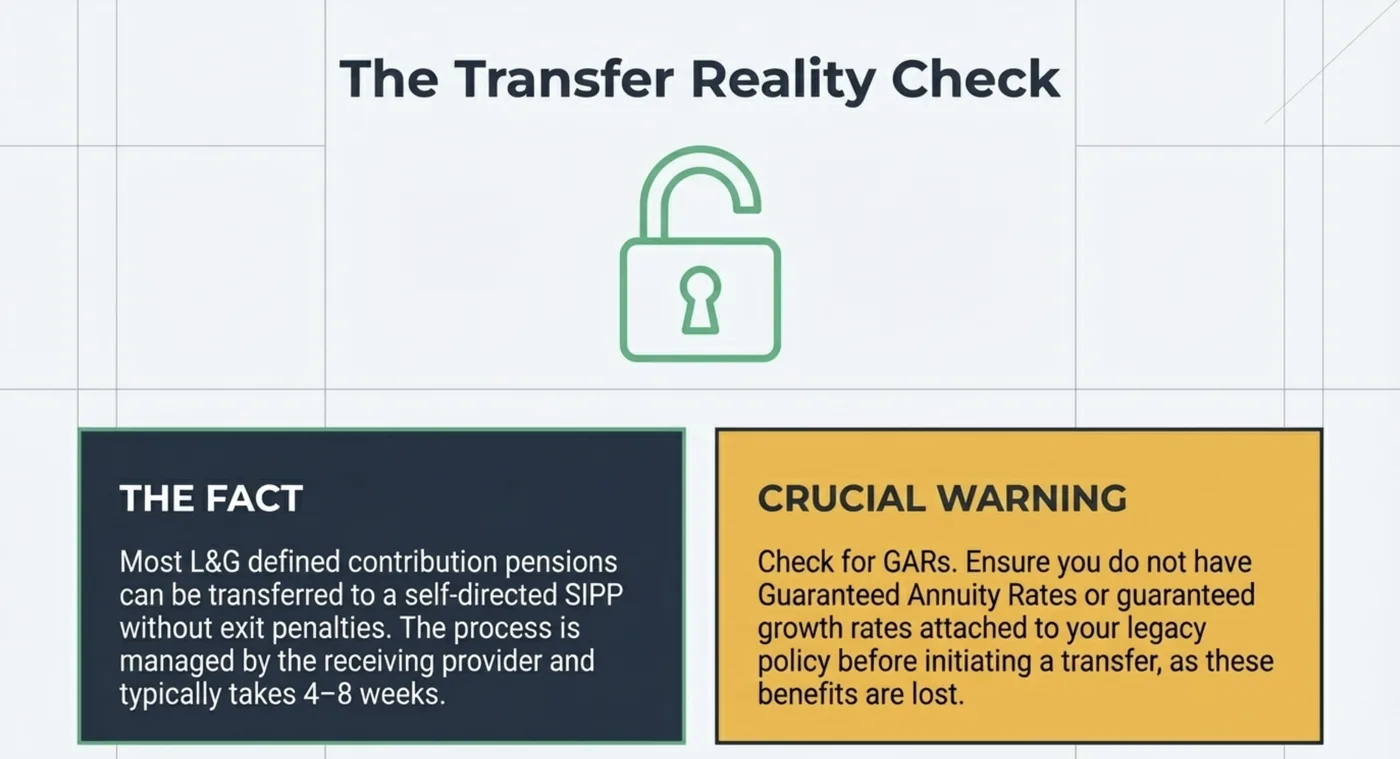
Yes. Most L&G defined contribution personal and group pensions can be transferred to a self-directed SIPP without exit penalty. The process is managed by the receiving SIPP provider and typically takes 4–8 weeks. Before transferring, confirm there are no guaranteed annuity rates (GARs) or guaranteed growth rates attached to your policy — these benefits are lost on transfer. Contact L&G directly or check your policy documents.
What is the L&G Multi-Asset fund?
The L&G Multi-Asset fund is a diversified managed fund holding equities, bonds, property, and cash in varying proportions. It is used as a default fund in several L&G workplace pension schemes. Like most multi-asset managed funds, it carries higher charges than a pure equity tracker and its diversified allocation has historically dragged returns below global equity market performance during equity bull markets.
Is Legal & General a good pension provider?
L&G is a legitimate, FCA-regulated, financially stable institution and a global leader in passive investment management. Their low-cost index trackers are genuinely competitive. The issue is that most default pension holders are not in those trackers — they are in managed or lifestyle strategies with higher charges and lower historical returns. The question is not whether L&G is trustworthy. It is whether your specific fund, at its specific charge, is the optimal home for your retirement savings.
If you hold an L&G pension and want to understand what it is actually returning and what the gap looks like, run your numbers at alpeshpatel.com/tools. For a personalised review of your L&G fund against the GIP framework, book a free portfolio review here.
Sources & Further Reading
S&P Dow Jones Indices — SPIVA UK Scorecard (2024). Active manager underperformance vs benchmark. spglobal.com/spdji/en/research-insights/spiva (opens in a new tab)
Financial Conduct Authority — Consumer Duty and workplace pension governance reviews. fca.org.uk (opens in a new tab)
Financial Times — Pension fund performance and the lifestyling problem. ft.com/personal-finance (opens in a new tab)
Yodelar — Independent UK pension fund performance rankings. yodelar.com (opens in a new tab)
PLSA — Retirement Living Standards (2024). Comfortable retirement income benchmarks for UK individuals. plsa.co.uk (opens in a new tab)
Morningstar UK — Fund performance data and OCF comparisons. morningstar.co.uk (opens in a new tab)
Legal & General — Fund Centre, Key Investor Information Documents, and pension product information. legalandgeneral.com/investments/fund-information (opens in a new tab)
MSCI — MSCI World Total Return Index (GBP). Benchmark reference for global equity returns. msci.com/world (opens in a new tab)
Disclaimer: This article is for educational purposes only. Performance projections are illustrative. This does not constitute personal financial guidance. All investing carries risk. Past performance is not a reliable indicator of future results. Always verify current charges and fund details directly with Legal & General before making any transfer decision.
Alpesh Patel OBE
Important: this article is education and information only. It is not financial advice or a personal recommendation, and it does not take your circumstances into account. The value of investments and pensions can fall as well as rise, and you may get back less than you put in. Past performance is not a reliable indicator of future results. Figures were correct when the article was written and may have changed. If you are unsure what is right for you, speak to a regulated financial adviser.