How to Retire Early in the UK: Exact Numbers, FIRE Strategy and the GIP Approach 2026
Most people’s retirement plan is to work until 65, hope the State Pension is still there, and live on whatever they’ve saved. FIRE is the alternative: a specific, calculable path to financial independence at a date you choose rather than a date the government determines.
The FIRE movement began in the US with the publication of Your Money or Your Life in 1992 and was codified for mainstream audiences by the community at Mr. Money Mustache and similar blogs in the 2010s.
In the UK, the FIRE community has been growing rapidly on Reddit (r/FIREUK has over 200,000 members), particularly among professionals in their 30s and 40s who are systematically building toward early retirement.
Alpesh Patel OBE is Founding Principal of Rootbridge Capital, a Bloomberg TV alumnus, Financial Times author, and former Visiting Fellow at Corpus Christi College, Oxford. The GIP framework is the investment engine behind multiple GIP members’ FIRE strategies.
Step 1: Calculate Your FIRE Number
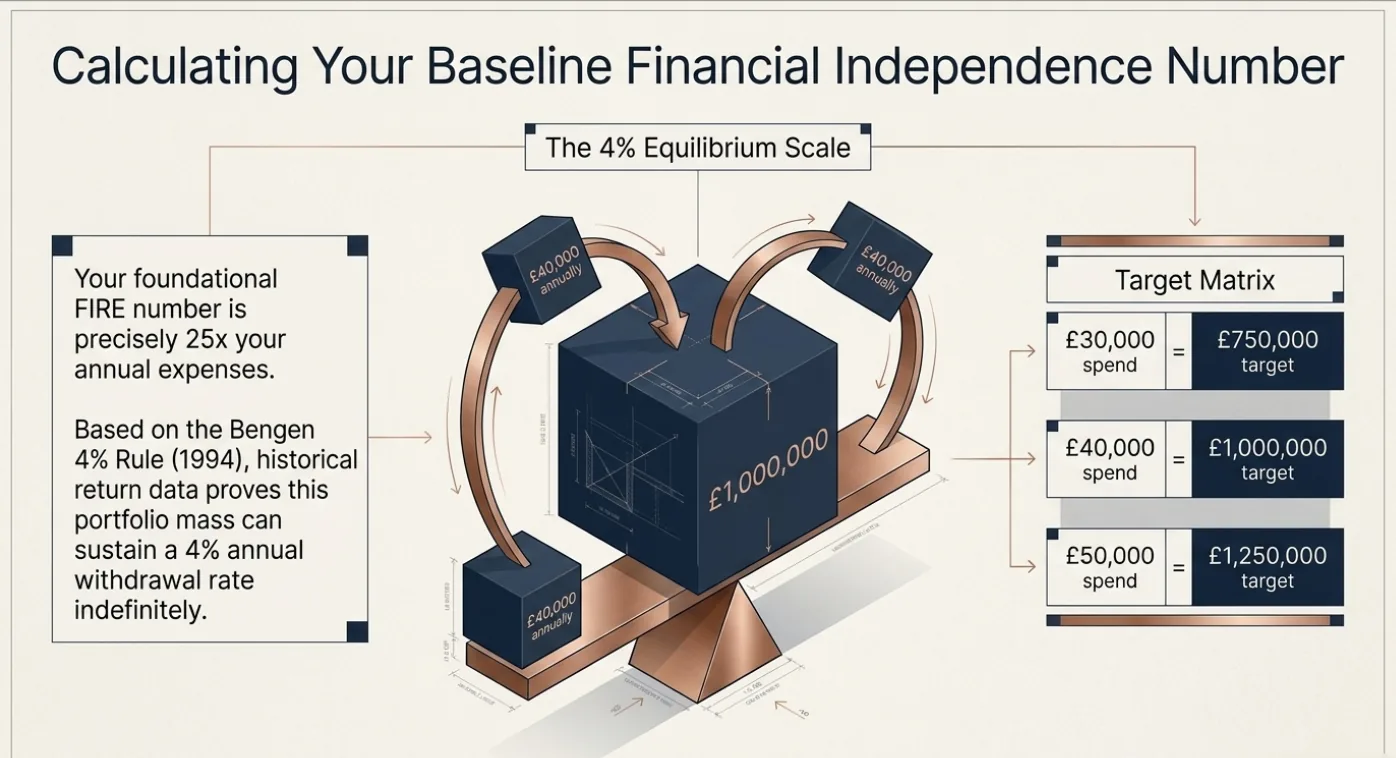
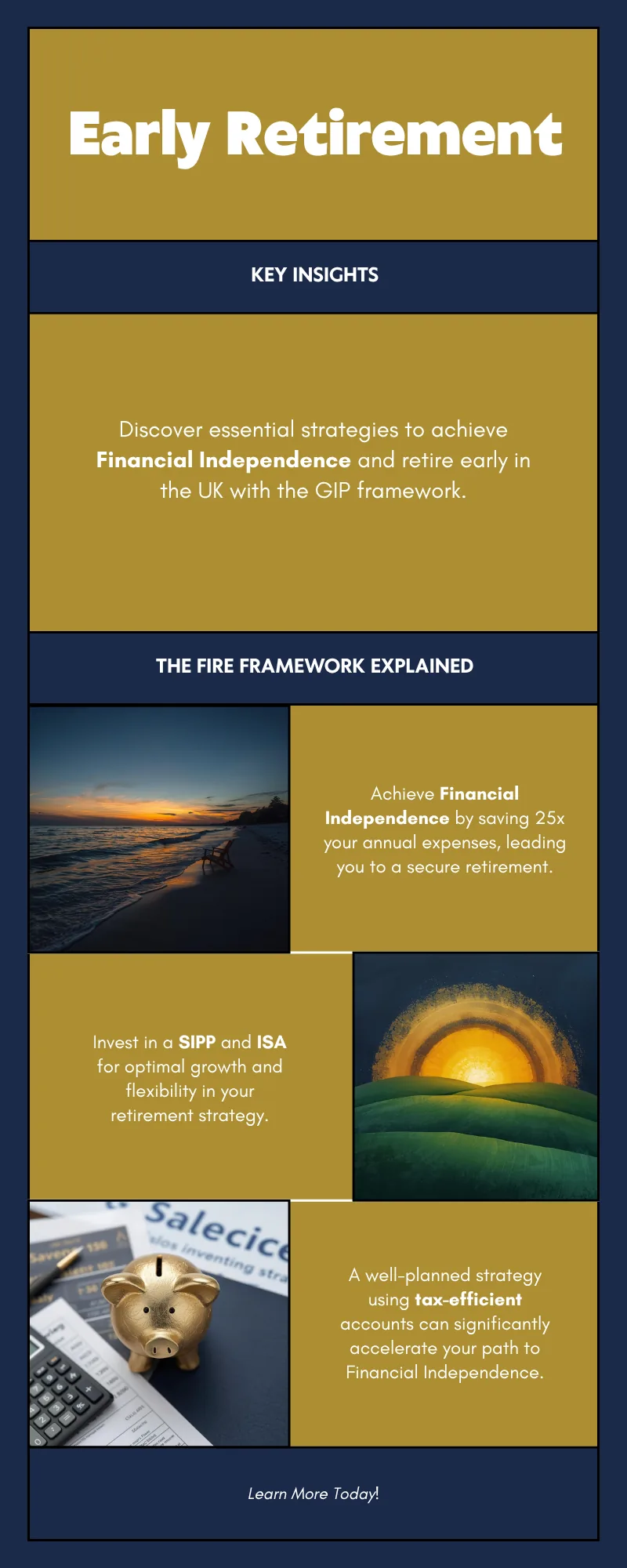
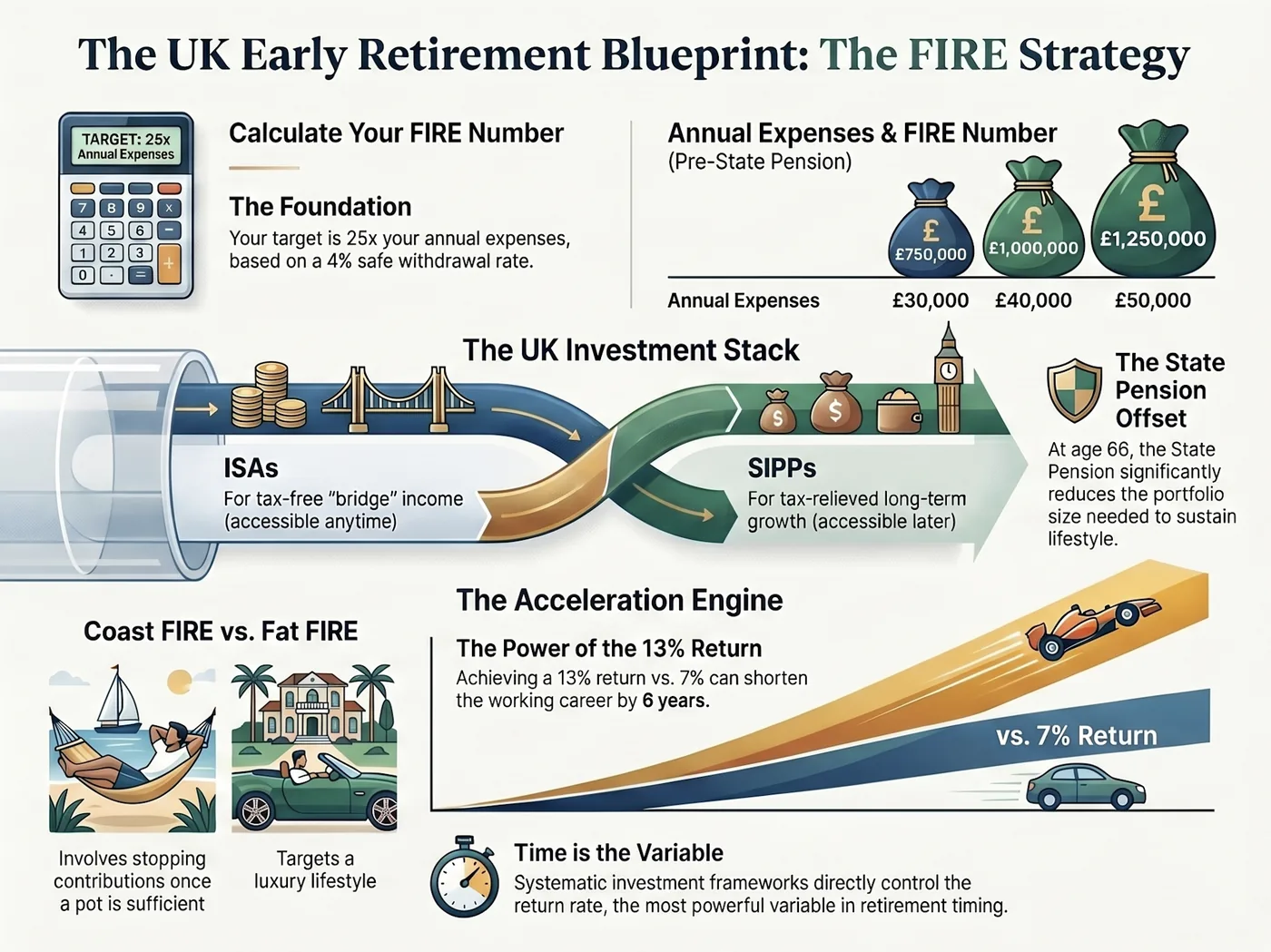
Your FIRE number is 25 times your annual expenses. This derives from the 4% rule — the finding that a portfolio can sustain 4% annual withdrawals indefinitely based on historical return data. If you spend £30,000 per year, your FIRE number is £750,000. If you spend £40,000, it is £1,000,000. If you spend £50,000, it is £1,250,000.
In the UK context, you can also subtract the State Pension from your annual expenses need once you reach State Pension age (currently 66). If you spend £40,000 and the State Pension covers £11,502, you only need your portfolio to generate £28,498 per year from pension age onward.
Your pre-State-Pension FIRE number (spending £40,000 from age 50–66) is £1,000,000. Your post-State-Pension number (spending the reduced £28,498) is £712,000. The State Pension reduces the size of the FIRE number significantly once you reach 66.
Step 2: The UK FIRE Vehicle Stack - SIPP, ISA, and GIA
The UK tax wrapper system is ideally structured for FIRE. The three-vehicle stack is: SIPP for pre-57 tax relief amplification and long-term compounding, ISA for flexible access before 57 with no tax on gains or income, and a small General Investment Account for bridge years between retirement and 57 where needed.
- SIPP: maximise contributions every year for tax relief. Cannot access until 57 (rising to 57 in 2028). The tax relief makes the SIPP the most efficient wealth-building vehicle. For someone retiring early at 50, the SIPP is building toward a very large income source that kicks in at 57.
- ISA: fill the £20,000 annual ISA allowance every year. No access age restriction. Tax-free income and gains. For early retirees, the ISA is the primary income source from retirement to 57 — the bridge between leaving work and being able to access the SIPP.
- GIA (general investment account): for any savings above the SIPP and ISA annual allowances. Subject to CGT on gains (now 18%/24% after the 2024 Budget). Minimise GIA holdings by maximising SIPP and ISA first.
Step 3: The Return Rate Is Everything - Why the GIP Framework Is the FIRE Engine
A 40-year-old with £100,000 in SIPP and ISA combined, contributing £2,000 per month gross, aiming for a FIRE number of £1,000,000:
- At 7% (default managed fund): reaches £1,000,000 in approximately 16 years. Retirement at 56.
- At 13% (GIP framework): reaches £1,000,000 in approximately 10 years. Retirement at 50 — six years earlier.
Six additional years of retirement. Six fewer years of working. That is the difference between a 7% and a 13% net return not on a huge pot, but on a normal professional savings rate. The return rate is the single most powerful variable in any FIRE calculation, and it is the only variable that a systematic investment framework directly controls.
UK FIRE Variants: Coast FIRE, Barista FIRE, Fat FIRE
- Coast FIRE: reach the point where your existing portfolio, left to compound without further contributions, will reach your FIRE number by conventional retirement age. You can then reduce your working hours, take a lower-paid job, or work part-time. Very achievable for UK professionals by their mid-40s.
- Barista FIRE: reach a portfolio large enough to cover most expenses, then work part-time to cover the remainder. The portfolio doesn’t need to support 100% of expenses.
- Fat FIRE: the GIP target profile. Reach a portfolio significantly above the minimum FIRE number to allow flexible, comfortable withdrawal rates without lifestyle compromise. At 13% growth, reaching Fat FIRE on a normal professional savings rate is achievable within 15–20 years from a standing start.
To calculate your personal FIRE number and model the GIP path to reaching it, book a free portfolio review here
Sources & Further Reading
Bengen, W.P. (1994) — 'Determining Withdrawal Rates Using Historical Data'. Journal of Financial Planning. The 4% rule underpinning the FIRE number calculation.
r/FIREUK — UK-specific FIRE community with over 200,000 members discussing savings rates, investment strategies, and early retirement milestones. reddit.com/r/FIREUK (opens in a new tab)
PLSA — Retirement Living Standards 2026/27. plsa.co.uk (opens in a new tab)
HMRC — ISA and pension wrapper rules, access age, and tax treatment. gov.uk/individual-savings-accounts (opens in a new tab)
Disclaimer: This article is for educational purposes only. All projections are illustrative. The 4% rule is based on historical data and is not a guarantee. All investing carries risk. This does not constitute personal financial guidance.
Alpesh Patel OBE
Important: this article is education and information only. It is not financial advice or a personal recommendation, and it does not take your circumstances into account. The value of investments and pensions can fall as well as rise, and you may get back less than you put in. Past performance is not a reliable indicator of future results. Figures were correct when the article was written and may have changed. If you are unsure what is right for you, speak to a regulated financial adviser.