Average Savings by Age UK: Pension Pot by Age and What to Aim For
When it comes to pensions, there’s no single benchmark. How much people save varies widely depending on income, career breaks, employer contributions, and when saving begins. Still, we can use data to establish some rough medians and guidelines.
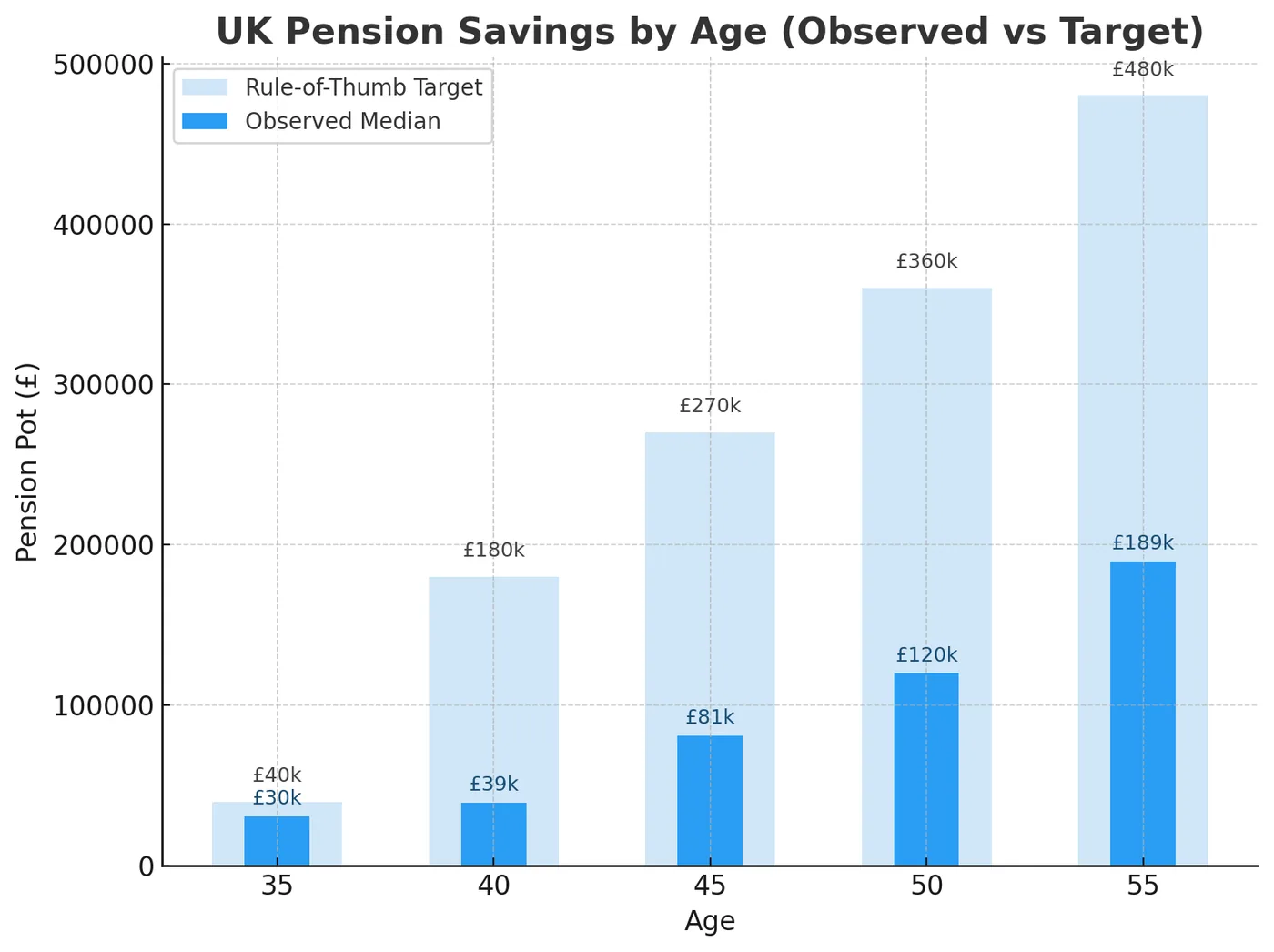
Pension Savings by Age (UK Context)
| Age | Typical / Median Pension Pot* | Commentary & caveats |
|---|---|---|
| ~ 35 | ~ £30,600 for ages 35–44 (median) | Note: that is across 35–44, so 35 is on the lower end of that. Many will have less; many start later. |
| ~ 40 | In that same 35–44 band, median ~ £30,600; some data suggests average/“typical” pension + other assets ~ £39,500 | Fidelity’s guideline: by 40 have ~ 3× your salary saved (in all retirement assets) |
| ~ 45 | For 45–54 band, median ~ £81,200 (private pension) | That’s just private pension — many also have other savings. |
| ~ 50 | In 45–54 band, median ~ £81,200; some guidance suggests people in 50s might have £120k+ in pension assets. | Fidelity suggests by 50 you should aim for ~ 6× salary in retirement assets (including pensions) |
| ~ 55 | For 55–64, median private pension ~ £189,700 | That number is for the whole 55–64 age bracket. Many earlier-retire, freeze contributions, or draw down. |
*Note: These figures are medians among people with pensions (i.e. excluding those with zero savings).
Alternative Survey Data
A Nuts About Money (March 2025) survey reports much higher averages:
- Age 30–39: ~£82,500
- Age 40–49: ~£120,000
- Age 50–59: ~£300,000
However, these samples skew toward more financially literate, higher savers. They are therefore optimistic compared to the broader population.
Rule-of-Thumb Pension Targets
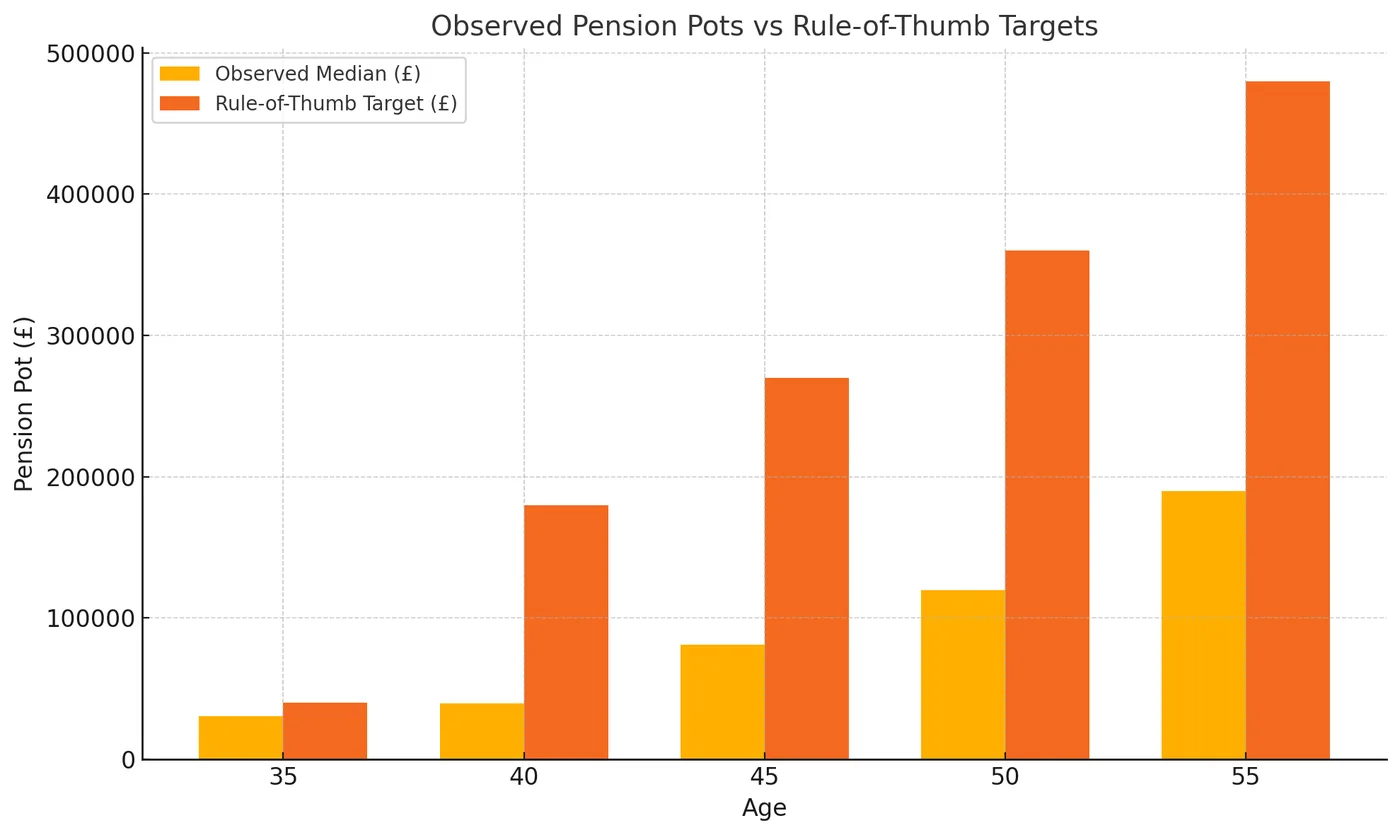
A widely cited guideline (e.g. Fidelity International, Alpesh Patel OBE):
- By 30: 1× salary
- By 40: 3× salary
- By 50: 6× salary
- By 60: 8× salary
These are aspirational targets, not averages.
UK State Pension Age
- Current: 66 (men and women)
- 2026–2028: rising to 67
- 2044–2046: legislated to rise to 68
- Reviews may alter this depending on demographics and government policy.
- In practice, the average effective retirement age is ~65 (many stop earlier or continue part-time).
Sources: GOV.UK (opens in a new tab), Insurance Hero
Life Expectancy in the UK
ONS data (2020–22):
- At birth: ~78.8 years (male), ~82.8 years (female)
- At age 65:
- Male: +18.3 years (~83.3 total)
- Female: +20.8 years (~85.8 total)
Because many live beyond averages, prudent planners assume lifespans into the mid-80s to early 90s.
Sources: Office for National Statistics, Pensions Policy Institute
Pension Pot Targets (Model, in Today’s Money)
Here’s a model for what savers might achieve if they start at age 25, with a 3% real return (5% nominal – 2% inflation).
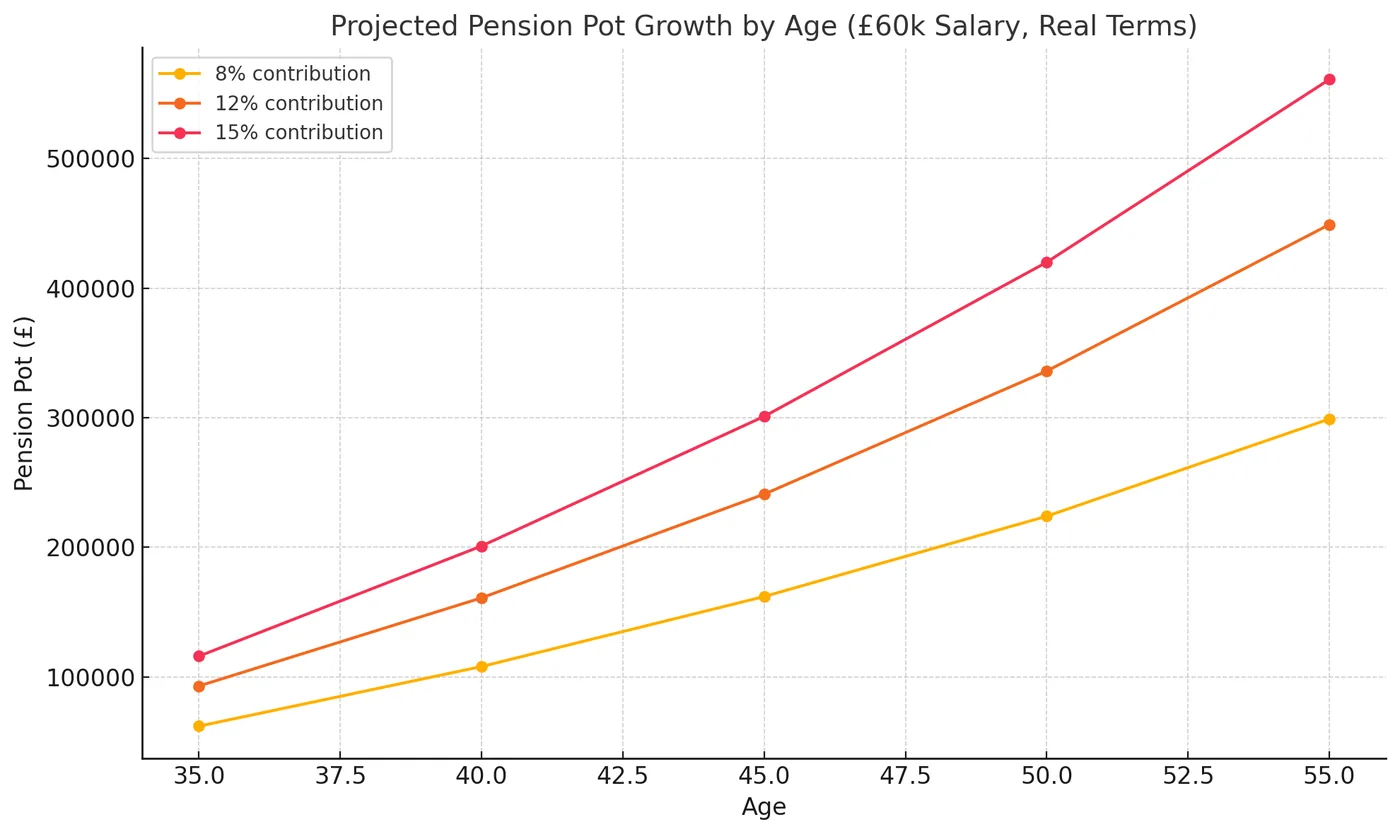
Example: £60k salary, 12% contribution
| Age | Pension Pot (approx) |
|---|---|
| 35 | £93k |
| 40 | £161k |
| 45 | £241k |
| 50 | £336k |
| 55 | £449k |
8% contributions: ~⅓ less
- 15% contributions: ~25% more
- Pots scale proportionally with salary
Assumptions: Contributions monthly, salary flat in real terms.
Sources: FCA projection rate framework (COBS); The Pensions Regulator
Practitioner Takeaways
- Many people are behind the benchmarks. For instance, a 40-year-old on £60k with only £50k in savings is below track.
- The real lever is contribution rate + low-cost investing, not market timing.
- Auto-enrolment (8%) is a start, but often insufficient for a comfortable retirement.
- Longevity risk is critical: plan for age 90+. Running out of money is far worse than leaving money behind.
Average Savings by Age UK: Reading the Numbers Properly
When people search for average savings by age, UK figures usually mix two different things: cash in a savings account and pension wealth. They are not the same, and for most people over 40 the pension is by far the larger asset. The average pension pot by age UK figures above are pension wealth only.
Pension pot by age data is grouped by age group, 35 to 44, 45 to 54 and so on, so treat any single number as a rough midpoint for the band. UK average savings by age tables have the same weakness. The spread inside each band is enormous, and the median tells you more than the mean.
The UK average retirement age
The UK average retirement age, the age people actually stop work, is about 65. That is close to the State Pension age, which is rising from 66 to 67 between 2026 and 2028. If you want to retire in the UK before you reach State Pension age, your own pension and savings have to cover the gap.
Early retirement also depends on when you can reach your pension. The minimum age to take money from a private or workplace pension is 55, rising to 57 from April 2028. Anyone planning to stop earlier needs money outside a pension, usually in an ISA.
The practical point is simple. Average savings by age tell you what other people have done, not what you need. Work out the income you want, then save money and invest it so your average pension pot is not average at all.
Pension Pot by Age: Quick Answers
What is the average age for retirement in the UK?
About 65, though the spread is wide. Plenty of people stop in their late 50s once they can reach a private pension, and many others wind down through part-time work rather than stopping on a single date. The State Pension age is 66 and rises to 67 between 2026 and 2028, so anyone leaving work before then has to fund the gap themselves.
What is a good pension pot at 50?
The rule of thumb in this article is six times your salary by 50, across all your retirement savings. On a £50,000 salary that is £300,000. Few people hit it, which is why the median figures above are so much lower. The target matters less than the direction of travel: if you are behind, the two levers you control are how much you pay in and how much you lose to fees.
Does the average pension pot include the State Pension?
No. Pension pot figures cover private and workplace defined contribution pensions only. The State Pension is paid on top and is worth far more than most people assume, because buying the same inflation-linked income privately would take a large pot. Check your State Pension forecast on GOV.UK before you decide how much your own savings need to cover.
How do I compare my savings with others my age?
Use the median, not the mean, and compare like with like. A cash savings figure and a pension figure are different things, and a 45-year-old with a final salary pension cannot be measured against someone relying on a SIPP. The more useful comparison is with your own target income, worked out from what you expect to spend in retirement.
Explore related guides
Pension drawdown explained: flexible retirement income (opens in a new tab)
SIPPs explained: how to choose a self-invested personal pension (opens in a new tab)
Explore the free investing and pension tools
Disclaimer: This article is for educational purposes only and does not constitute financial advice. Pension figures are illustrative and based on medians, surveys, and modelling assumptions which may not apply to individual circumstances. Always consult a qualified financial adviser before making investment or retirement decisions.
Sources
- PensionBee, Fidelity International, Nuts About Money (2025 surveys)
- The Pensions Regulator: auto-enrolment minimum contributions
- FCA: projection rate framework (Policy Statement PS23/5)
- GOV.UK (opens in a new tab): State Pension age
- ONS: National life tables (2020–22)
- Pensions Policy Institute
Alpesh Patel OBE
www.alpeshpatel.com
Important: this article is education and information only. It is not financial advice or a personal recommendation, and it does not take your circumstances into account. The value of investments and pensions can fall as well as rise, and you may get back less than you put in. Past performance is not a reliable indicator of future results. Figures were correct when the article was written and may have changed. If you are unsure what is right for you, speak to a regulated financial adviser.