How to Invest in AI With ETFs: The Two Checks I'd Make Before Buying
By Alpesh Patel OBE, Founding Principal of Rootbridge Capital and author
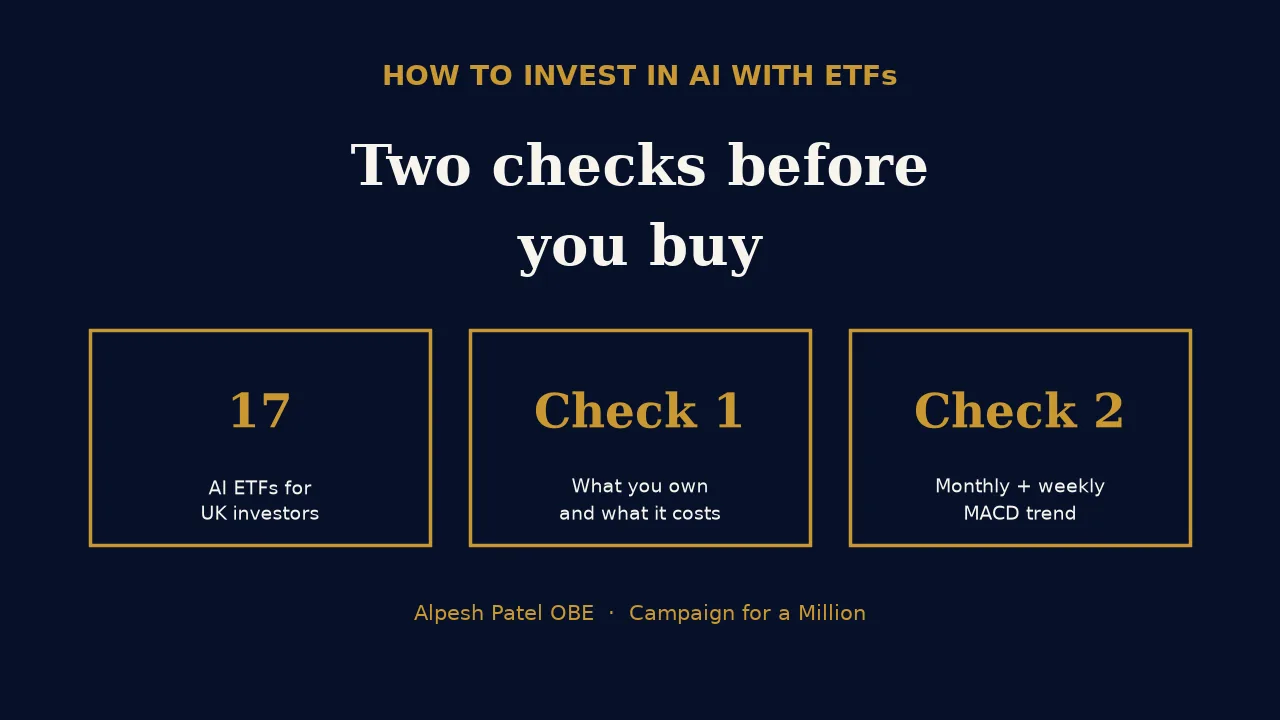
Short answer: UK investors can get exposure to artificial intelligence through around 17 UCITS ETFs, from the £7 billion Xtrackers fund down to funds with only a few million pounds in them. An ETF is a quick way to own the theme, but it buys the good, the bad and the overpriced together.
Before buying one, I'd check two things: what you actually own and what it costs, and whether the trend is on your side, which for me means the monthly MACD rising and the weekly MACD rising for timing. Right now the biggest AI ETFs pass the first trend test but not the second.
Why everyone wants to invest in AI
AI has moved from science fiction to company profits. It is used for analysing huge data sets, recognising patterns, automating work, driving cars, catching fraud and running parts of the financial markets. The companies selling the chips, the cloud computing and the software have been some of the best-performing shares of the past three years.
That's exactly why you need to be careful. When a theme is this popular, much of the good news can already be in the price.
What AI ETFs can UK investors buy?
According to justETF, as of 19 October 2026 there are 17 AI ETFs available to UK investors, tracking 16 different indices. These are the largest:
| ETF | Fund size | Yearly cost (TER) | Dividends |
|---|---|---|---|
| Xtrackers Artificial Intelligence & Big Data | £6,992m | 0.35% | Reinvested |
| L&G Artificial Intelligence | £1,478m | 0.49% | Reinvested |
| iShares AI Infrastructure | £1,105m | 0.35% | Reinvested |
| WisdomTree Artificial Intelligence | £1,088m | 0.40% | Reinvested |
| ARK Artificial Intelligence & Robotics | £235m | 0.75% | Reinvested |
| iShares AI Adopters & Applications | £219m | 0.35% | Reinvested |
| iShares AI Innovation Active | £211m | 0.73% | Reinvested |
| WisdomTree Physical AI, Humanoids and Drones | £154m | 0.45% | Reinvested |
Source: justETF, as of 19 October 2026. All are Irish-domiciled UCITS ETFs.
Notice how different they are. "Infrastructure" funds lean towards chips, data centres and power. "Adopters" funds own companies using AI rather than building it. Some are actively managed and cost twice as much. Two ETFs with "AI" in the name can behave very differently.
Check 1: what do you actually own, and what does it cost?
Before you buy any thematic ETF, open its factsheet and look at three things.
- The top ten holdings. Many AI funds are dominated by the same handful of giant US technology companies. If you already own a global or US tracker, you may own most of them already. Buying an AI ETF on top can leave you far more concentrated than you think.
- The cost. 0.35% a year against 0.75% sounds small. On £100,000 over ten years it's thousands of pounds, before any difference in returns.
- The size. Tiny funds are more likely to be closed or merged. That isn't a disaster, but it can force a sale at a time you didn't choose.
There's also a hard truth about thematic funds in general. Morningstar found that over the 15 years to December 2021, 78% of thematic funds worldwide were closed or merged, and fewer than 10% both survived and beat global stock markets. Themes get popular at the top. Funds get launched at the top. That's not a reason to avoid AI. It's a reason to have a rule for when you buy.
Check 2: is the trend on your side?
For a sector or theme ETF, I don't try to work out whether AI is "a bubble". I let the trend tell me. My rule is the same one I use for countries like China:
- Monthly MACD rising: the long-term trend is up.
- Weekly MACD rising: the short-term timing agrees.
- Both rising: that's when I'd consider buying. Monthly rising but weekly falling means hold if you own it, and wait before adding.
The MACD (moving average convergence divergence) compares a fast moving average of the price with a slow one. It lags, by design. I explain why that's a feature, not a flaw, in MACD signals: why they lag and how investors use them (opens in a new tab).
Here is where the three largest AI ETFs with long enough price histories stood on 19 October 2026:
| ETF | Monthly MACD | Weekly MACD | Price change in 2026 so far | My read |
|---|---|---|---|---|
| Xtrackers AI & Big Data (XAIX) | Rising | Falling | +35.8% | Trend intact. Wait for the weekly to turn up before adding. |
| L&G Artificial Intelligence (AIAI) | Rising | Falling | +41.1% | Same. |
| WisdomTree Artificial Intelligence (WTAI) | Falling, still above signal | Falling | +32.3% | Losing momentum. Not the moment to buy. |
Source: Yahoo Finance prices to 19 October 2026 (XAIX Xetra listing to 16 October), in each listing's trading currency. MACD (12,26,9) calculated by Alpesh Patel OBE. October's monthly bar is still forming and can change before month-end. Past performance is not a reliable indicator of future results.
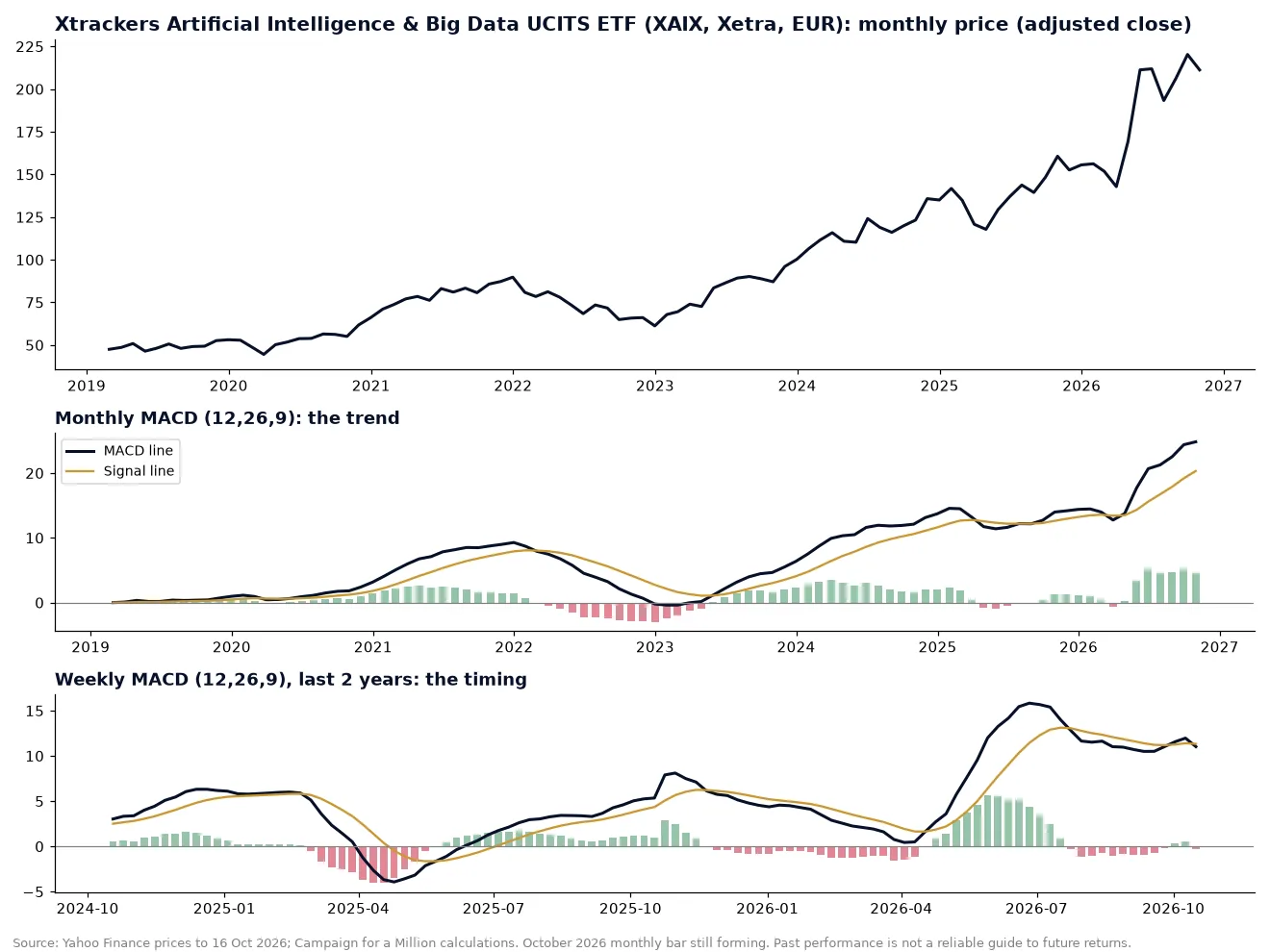
So AI's long-term trend is still up. But the weekly MACD has rolled over on all three. That's the pattern I'd expect in a healthy trend taking a breather, and it's also how the start of a bigger fall looks. The process doesn't have to guess which. If the weekly turns back up while the monthly is still rising, that's the timing signal. If the monthly turns down too, you stand aside.
It's worth knowing who is on the other side. Michael Burry has put almost his entire short position into put options on the Nasdaq-100 and the VanEck Semiconductor ETF, saying he believes we're "within 0-9 months of a significant top". I look at how his trade stacks up against the same rule in Michael Burry is buying China and shorting the Nasdaq: here's how I'd test that trade.
ETFs or individual AI shares?
An AI ETF owns the whole theme. That includes the companies turning AI into cash and the ones burning cash on it. On the Great Investments Programme we can go one step further.
- Screen the business first. We filter thousands of companies for value, growth and income, cash return on capital invested (CROCI) and the Sortino ratio, which measures return against downside risk. A company has to pass on its numbers, not on its story. Here's how that five-metric framework works (opens in a new tab).
- Then time the purchase. Only once a share passes the screen do we look at the chart.
- Have a crash rule for the whole portfolio. Mine is the Daddy Bear: when short- and medium-term averages fall across the S&P 500 and its biggest companies while interest rates are rising, as in 2022, I move to cash. Themes like AI tend to fall hardest when that happens.
That way, AI can be a big part of a portfolio without the portfolio becoming a bet on one story. For more on where the big money is moving, read big funds rotating out of AI in 2026 and is AI a bubble? (opens in a new tab)
You can also see the live picks we've actually given clients (not backtests) at shares.alpeshpatel.com.
Frequently asked questions
What is the biggest AI ETF in the UK?
As of 19 October 2026, the Xtrackers Artificial Intelligence & Big Data UCITS ETF is the largest available to UK investors, with about £7 billion in assets and a 0.35% yearly cost, according to justETF.
Can I hold an AI ETF in an ISA or SIPP?
Most UCITS ETFs listed on the London Stock Exchange can be held in a stocks and shares ISA or SIPP. Check with your platform, as availability varies.
Are AI ETFs a good long-term investment?
They give broad exposure to a powerful theme, but they're concentrated, often expensive compared with global trackers, and thematic funds as a group have a poor long-term record. Treat one as part of a portfolio with clear rules, not the whole portfolio.
Is it too late to invest in AI?
Nobody can know that. What you can do is wait for the trend to confirm before buying, size the position so a big fall wouldn't force you to sell, and have a rule for when you'd get out.
What's the difference between an AI ETF and buying AI shares directly?
An ETF buys every company in its index, good or bad. Buying shares directly lets you choose only companies that pass your own tests on profits, cash flow, value and risk, but it takes more work and a proper process.
Want a process for themes like AI, not just a hunch?
Book a call with my team. We'll look at what you already own, how concentrated you are in technology, and whether the Great Investments Programme makes sense for you.
Sources
- justETF (2026). How to invest in artificial intelligence using ETFs (opens in a new tab). Data as of 19 October 2026.
- Morningstar (2022). Beware Thematic Funds' Siren Song (opens in a new tab). 29 June 2022.
- Yahoo Finance (2026). Michael Burry Shifts Bearish Bets To Nasdaq, Semiconductor ETF Puts (opens in a new tab). 12 October 2026.
- Price data: Yahoo Finance, to 19 October 2026. MACD calculations by Alpesh Patel OBE.
Important: This article is for education only and is not personal financial advice or a recommendation to buy or sell any investment. This is general investment education only and is not regulated investment advice. The value of investments can go down as well as up, and you may get back less than you invest. Past performance is not a reliable indicator of future results. Thematic and sector funds are more concentrated than broad market funds and can be more volatile. Technical indicators describe past prices and do not predict future returns.
Important: this article is education and information only. It is not financial advice or a personal recommendation, and it does not take your circumstances into account. The value of investments and pensions can fall as well as rise, and you may get back less than you put in. Past performance is not a reliable indicator of future results. Figures were correct when the article was written and may have changed. If you are unsure what is right for you, speak to a regulated financial adviser.