Cautious, Balanced or Adventurous Pension? What the Labels Really Mean
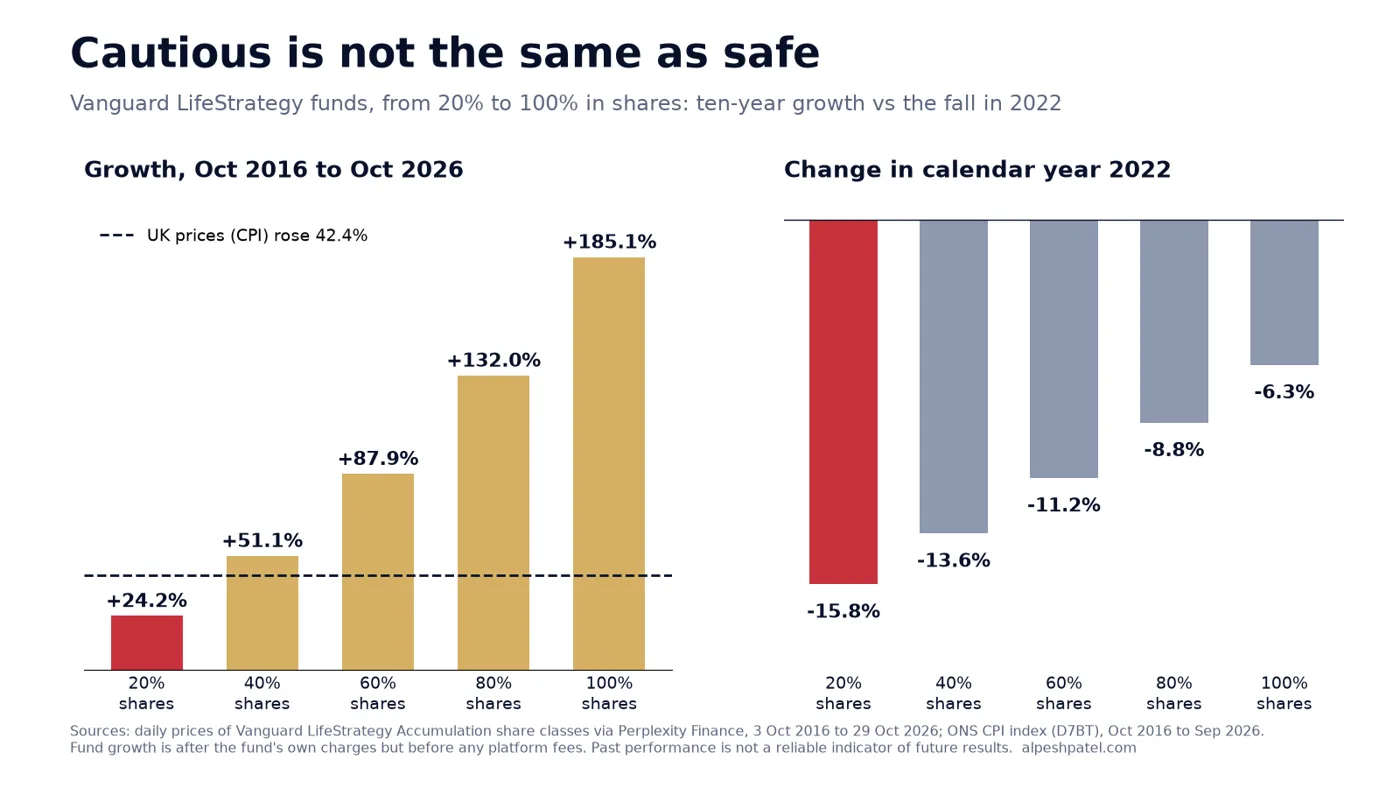
Is your pension cautious, balanced or adventurous? Most UK savers can answer that question in a second, because it is the label they ticked on a form. Far fewer can say what the label has actually done to their money. Over the ten years to October 2026, a widely held "cautious" fund with 20% in shares grew by 24.2%, while UK consumer prices rose 42.4% (opens in a new tab) over almost the same period. In real terms, the careful choice lost money.
It gets more uncomfortable. In 2022 that same 20% fund fell 15.8%, a bigger fall than its 100% shares sibling, which dropped 6.3%. It then took until February 2026 to climb back to its December 2021 peak. That is more than four years in which the "safe" option was underwater, while the "risky" option had long since recovered.
None of this means cautious funds are bad, or that everyone should own more shares. It means the label tells you very little on its own. This guide explains what cautious, balanced and adventurous pension funds really hold, what ten years of data shows about each, how the new FCA risk scores work, and the three checks I would make before choosing any of them.
Short answer: Cautious, balanced and adventurous pension funds differ mainly in how much they hold in shares versus bonds and cash. Cautious funds usually hold 20% to 35% in shares, balanced funds 40% to 60% and adventurous funds 80% or more. The label describes the mix, not the outcome. A cautious fund can still fall sharply and lose ground to inflation, so check holdings, real returns and the worst fall before you rely on it.
Not sure what your own pension is really invested in? Book your free call with Alpesh's team (opens in a new tab). We will walk you through how to read your fund's risk, charges and real return. There is nothing to buy on the call.
What do cautious, balanced and adventurous mean in a pension?
There is no single legal definition of "cautious", "balanced" or "adventurous". Each pension provider, platform and adviser uses the words in its own way, and two funds with the same label can hold very different things. That is the first reason to look past the name.
The closest thing to an industry standard comes from the Investment Association, which sorts mixed-asset funds into sectors by how much they hold in shares. Its sector definitions (opens in a new tab) set out four main groups:
- Mixed Investment 0-35% Shares: up to 35% in shares and at least 45% in fixed income and cash. This is where many "cautious" or "defensive" funds sit.
- Mixed Investment 20-60% Shares: between 20% and 60% in shares and at least 30% in fixed income and cash. This is often labelled "cautious" or "balanced".
- Mixed Investment 40-85% Shares: between 40% and 85% in shares, with no minimum in bonds or cash. This is typically "balanced" or "growth".
- Flexible Investment: no minimum or maximum in shares, and the manager can go up to 100%. Many "adventurous" funds sit here.
Notice the overlaps. A fund with 50% in shares could sit in either of two sectors, and could be called cautious by one firm and balanced by another. The labels describe a rough position on a dial, not a fixed setting.
Why the industry stopped calling funds "cautious"
The Investment Association's own sectors used to carry these labels. Until 2011 the 20-60% sector was literally called "Cautious Managed", and the 40-85% sector was "Balanced Managed". When the IMA and ABI harmonised the sectors on 30 November 2011 (opens in a new tab), they replaced the names with share ranges.
The ABI's Director of Financial Conduct Regulation explained why. The new names "will give consumers a better understanding of how their fund might be invested and dropping terms such as 'cautious' should encourage the industry to carefully consider the use of such terms in the future." Fifteen years on, the word "cautious" is still one of the most common labels on pension statements and platform menus.
Cautious vs balanced vs adventurous: ten years of real numbers
Words are easy to argue about, so I prefer to look at data. The cleanest comparison I know uses one fund family that offers the same approach at five different risk levels. Vanguard's LifeStrategy range holds a fixed mix of global shares and bonds, from 20% shares up to 100% shares, all at an ongoing charge of 0.20% (opens in a new tab). Because only the mix changes, the results show what the mix does.
I took daily prices of the Accumulation share classes from 3 October 2016 to 29 October 2026, using Perplexity Finance data. Accumulation units reinvest income, so the figures are after the fund's own charges but before any platform or adviser fees. Inflation is the ONS CPI index (opens in a new tab), which rose from 101.2 in October 2016 to 144.1 in September 2026, the latest month published.
| Fund (share of shares) | Growth over 10 years | After inflation | Calendar 2022 | Worst fall, peak to low | Back at the old peak | Illustrative FCA score |
|---|---|---|---|---|---|---|
| LifeStrategy 20% | +24.2% | -12.8% | -15.8% | -21.1% (Dec 2021 to Oct 2022) | Feb 2026 | 4 |
| LifeStrategy 40% | +51.1% | +6.1% | -13.6% | -18.7% (Dec 2021 to Oct 2022) | Dec 2024 | 4 |
| LifeStrategy 60% | +87.9% | +32.0% | -11.2% | -17.8% (Feb to Mar 2020) | Oct 2020 | 4 |
| LifeStrategy 80% | +132.0% | +62.9% | -8.8% | -22.6% (Feb to Mar 2020) | Nov 2020 | 5 |
| LifeStrategy 100% | +185.1% | +100.2% | -6.3% | -27.1% (Feb to Mar 2020) | Nov 2020 | 6 |
The "Illustrative FCA score" column is my own calculation using the FCA's new method, explained below. It is not a score published by Vanguard. Past performance is not a reliable indicator of future results, and a different ten years could look very different.
Three things the table shows
First, the cautious fund lost money in real terms. £10,000 in the 20% fund became about £12,420. But it would have needed about £14,240 just to keep pace with prices. For someone who chose "cautious" to protect their savings, that is a quiet but real loss of buying power.
Second, the cautious fund's worst fall was not small. The 20% fund fell 21.1% from its peak on 7 December 2021 to its low on 14 October 2022. That is close to the 22.6% fall in the 80% fund during the Covid crash. The difference is what happened next. The 80% fund was back at its peak by November 2020, within eight months of the low. The 20% fund needed until 18 February 2026, more than four years after its peak.
Third, the funds fell at different times for different reasons. The adventurous funds took their worst hit in March 2020, when shares crashed. The cautious funds took theirs in 2022, when bonds crashed. Cautious did not mean "falls less". It meant "falls in a different kind of crisis".
Why did cautious pension funds fall so hard in 2022?
Bonds are the main ingredient of a cautious fund. When interest rates rise sharply, the price of existing bonds falls, and longer-dated bonds fall the most. That is exactly what happened in 2022.
The Bank of England raised Bank Rate from 0.1% in December 2021 to 5.25% by August 2023 (opens in a new tab). Bonds that had been bought when rates were near zero were suddenly worth much less. A fund that was 80% bonds had nowhere to hide, while a fund that was 100% shares was cushioned by companies that could raise prices with inflation.
The lesson is not that bonds are dangerous. Bonds still play an important role, and from today's higher starting yields their maths looks very different from 2021. The lesson is that every asset has its own kind of bad year. A label that only measures how much a fund wobbles from week to week can miss the risk that matters most to you.
How the new FCA risk and return score works
If you have looked at a fund factsheet, you may have seen a risk number from 1 to 7. That came from the old UK PRIIPs and UCITS disclosure rules. The FCA has now repealed the PRIIPs Regulations and replaced them with the Consumer Composite Investments rules (opens in a new tab), and fund documents are moving to a new "product summary".
Under the FCA's final rules in PS25/20 (opens in a new tab), funds will show a "risk and return score" on a scale of 1 to 10, rather than 1 to 7. The score is based mainly on how much the fund's price has moved up and down, measured over ten years of weekly prices instead of five. Firms could start using the new summaries from 6 April 2026, and the full regime applies from 8 June 2027.
The bands, taken from Table 1 of the policy statement, look like this:
| Score | Annual volatility (how much the price swings) |
|---|---|
| 1 | Below 0.5% |
| 2 | 0.5% to under 2% |
| 3 | 2% to under 5% |
| 4 | 5% to under 9% |
| 5 | 9% to under 12% |
| 6 | 12% to under 16% |
| 7 | 16% to under 20% |
| 8 | 20% to under 30% |
| 9 | 30% to under 50% |
| 10 | 50% and above |
What the score misses
I applied the same method to the LifeStrategy funds, using weekly prices over the ten years in the table above. The 20% fund's annual volatility was 5.5%, the 40% fund's was 6.7% and the 60% fund's was 8.6%. All three land on a score of 4. The 80% fund scored 5 and the 100% fund scored 6.
Think about what that means. Three funds with the same score of 4 produced ten-year results ranging from a 12.8% loss after inflation to a 32.0% gain. The score measured the bumps in the road accurately. It did not measure where the road led.
To be fair, the FCA knows this. Its rules say the product summary must include a narrative about the risks and the conditions in which the product is likely to do better or worse. They also suggest firms explain that past data may not be a reliable guide and that even a low score still carries risk. The score is a useful start. It is not the whole answer, and it says nothing about inflation.
How should you choose between cautious, balanced and adventurous?
This is where a label tempts people into a shortcut. You tick "balanced" because you are not reckless and not timid, and the decision is made. A better approach starts with what the money has to do, then works back to the mix. These are the three checks I make on any pension fund, whatever it is called.
Check 1: Look at what the fund actually holds
Open the latest factsheet and find the asset allocation. How much is in shares, and which shares? How much is in bonds, and are they government or corporate, short-dated or long-dated? How much is in cash or "alternatives"? Two funds called "balanced" can have very different answers.
Pay particular attention to long-dated bonds in a fund you think of as low risk. They were the source of most of the 2022 pain. Also check how much sits in the UK versus overseas, and whether overseas holdings are currency-hedged. These details drive results far more than the word on the front.
Check 2: Measure the real return, not just the return
Ask what the fund has returned over five and ten years, after all charges and after inflation. Fund factsheets usually show the first part. You need to do the second yourself, using the ONS CPI figures (opens in a new tab) or the inflation rate on your pension statement.
Then add your platform or adviser charges. A fund charging 0.20% inside a wrapper charging 1% a year is really a 1.2% a year investment. I showed what that does over time in what 1% a year really costs your portfolio. If the real return after every layer of cost is close to zero, the fund is preserving your money at best, not growing it.
Check 3: Know the worst fall, and how long recovery took
Volatility is an average. What hurts people is the single worst stretch. Look up the fund's maximum drawdown, the biggest fall from a peak to a low, and how long it took to recover. Then ask yourself honestly whether you could live through that without selling.
This matters more than any label, because the biggest risk to a pension is often the saver's own reaction. Selling after a fall turns a temporary loss into a permanent one. I cover how professionals think about this in Sharpe vs Sortino vs Calmar ratio, and in my research paper Exit or Hold.
Should I move to a cautious fund as I get closer to retirement?
Many workplace pensions do this automatically. It is called lifestyling: as you approach your selected retirement age, the scheme gradually moves you out of shares and into bonds and cash. The logic made sense when most people bought an annuity on the day they retired, because a sudden fall just before buying would lock in the loss.
Today many people keep their pension invested well into retirement through drawdown. For them, the money may need to last 25 or 30 years, and inflation becomes the slow, constant risk. Moving too much into cautious assets too early can swap one risk for another. The 2022 numbers above show that "lower risk" assets can also fall at the worst possible moment.
There is no single right answer, which is why this is not a decision to make from a label. What matters is when you need the money, how you plan to take it, what other income you have, and how much of a fall you could tolerate. If you are unsure whether your scheme is lifestyling you, check your annual statement or ask the provider directly. My guide to living off your investments compares the main withdrawal approaches.
What the labels hide in workplace and old pensions
Most people never choose a fund at all. They are put in their employer's default fund, which is often a multi-asset fund with a friendly name. That is not automatically a problem, but it means many pensions are run on a label nobody has examined.
Old pensions from previous jobs are worth a particular look. Many sit in managed or "with-profits" funds chosen years ago, and their charges and holdings may never have been reviewed since. I have reviewed several of the most common ones, including the Scottish Widows CS8 pension portfolios and the Vanguard LifeStrategy 100 fund. The pattern is consistent: the name on the fund rarely tells you what you need to know.
Frequently asked questions
What is the difference between a cautious, balanced and adventurous pension?
The main difference is the split between shares and bonds or cash. Cautious funds typically hold 20% to 35% in shares, balanced funds around 40% to 60% and adventurous funds 80% or more. There is no legal definition, so always check the factsheet rather than relying on the name.
Is a cautious pension fund safe?
No investment fund is safe in the sense that a bank deposit is. In 2022, Vanguard's LifeStrategy 20% fund fell 15.8% as bond prices dropped, and it lost value after inflation over the ten years to October 2026. Cautious funds usually move less from week to week, but they can still suffer large falls and long recoveries.
What risk number is my pension fund?
Fund documents have usually shown a score from 1 to 7. Under the FCA's new Consumer Composite Investments rules, product summaries show a "risk and return score" from 1 to 10, based on ten years of price swings, with the full regime applying from 8 June 2027. Treat the score as one input, alongside holdings, charges and real returns.
Is a balanced pension fund a good middle ground?
A balanced fund can suit people who want growth but cannot stomach the full swings of the stock market. In the data above, the 60% fund beat inflation by 32.0% over ten years and scored the same 4 as the 20% fund. Whether it suits you depends on your timeline and how much of a fall you could live through without selling.
What to do next
- Find your fund's name and factsheet. Log in to your pension provider or check your latest statement, then download the factsheet and note the share and bond split.
- Work out the real return. Take the five- and ten-year returns, subtract your platform or adviser charges and compare with UK inflation over the same period.
- Find the worst fall. Look up the maximum drawdown and recovery time, and ask yourself whether you would have held on.
- Check for lifestyling. If you are within 15 years of your selected retirement age, find out whether your scheme is moving you into bonds automatically.
- Use a checklist. My free DIY pension review checklist walks you through these checks step by step.
Want a second pair of eyes on your pension's risk label? Book your free call with Alpesh's team (opens in a new tab). We will show you how to check what your fund holds, what it has really returned and how it behaves in a bad year. There is nothing to buy on the call.
About Alpesh Patel OBE
Alpesh Patel OBE is Founding Principal of Rootbridge Capital, an author and Dealmaker for the UK Government's Department for Business. He is a former Visiting Fellow in Business, Corpus Christi College, Oxford University, where he worked on technology to improve financial education. Watch his free investing education on YouTube (opens in a new tab).
Sources
- Office for National Statistics, CPI index 00: all items, 2015=100 (D7BT) (opens in a new tab), release of 21 October 2026.
- The Investment Association, Fund sector definitions (opens in a new tab).
- The Investment Association, IMA and ABI harmonise managed/mixed investment sectors (opens in a new tab), 30 November 2011.
- Vanguard UK, LifeStrategy 20% Equity Fund Gross Accumulation (opens in a new tab) (ongoing charge).
- Vanguard UK, LifeStrategy 100% Equity Fund Accumulation (opens in a new tab) (ongoing charge).
- Fund prices: daily closing prices of Vanguard LifeStrategy 20%, 40%, 60%, 80% and 100% Equity Accumulation share classes, 3 October 2016 to 29 October 2026, via Perplexity Finance.
- Bank of England, Monetary Policy Report, August 2023 (opens in a new tab).
- Financial Conduct Authority, PRIIPs Regulation page (opens in a new tab), updated 7 April 2026.
- Financial Conduct Authority, PS25/20: Final rules for Consumer Composite Investments (opens in a new tab).
- Alpesh Patel OBE, Cautious, Balanced or Adventurous? Check These 3 Things (opens in a new tab), YouTube, 30 October 2026.
Important: This article is for education only and is not personal financial advice or a recommendation to buy or sell any investment. This article is general investment education only and is not regulated investment advice. The value of investments can go down as well as up, and you may get back less than you invest. Past performance is not a reliable indicator of future results.
Important: this article is education and information only. It is not financial advice or a personal recommendation, and it does not take your circumstances into account. The value of investments and pensions can fall as well as rise, and you may get back less than you put in. Past performance is not a reliable indicator of future results. Figures were correct when the article was written and may have changed. If you are unsure what is right for you, speak to a regulated financial adviser.