Cheapest SIPP for Drawdown in 2026: HL vs AJ Bell vs Fidelity vs ii vs Vanguard
Which SIPP is cheapest for drawdown? It is a question that matters more than most people realise. Once you stop working and start taking an income from your pension, you stop adding new money. Every pound of platform fees now comes straight out of your retirement income, year after year, for decades.
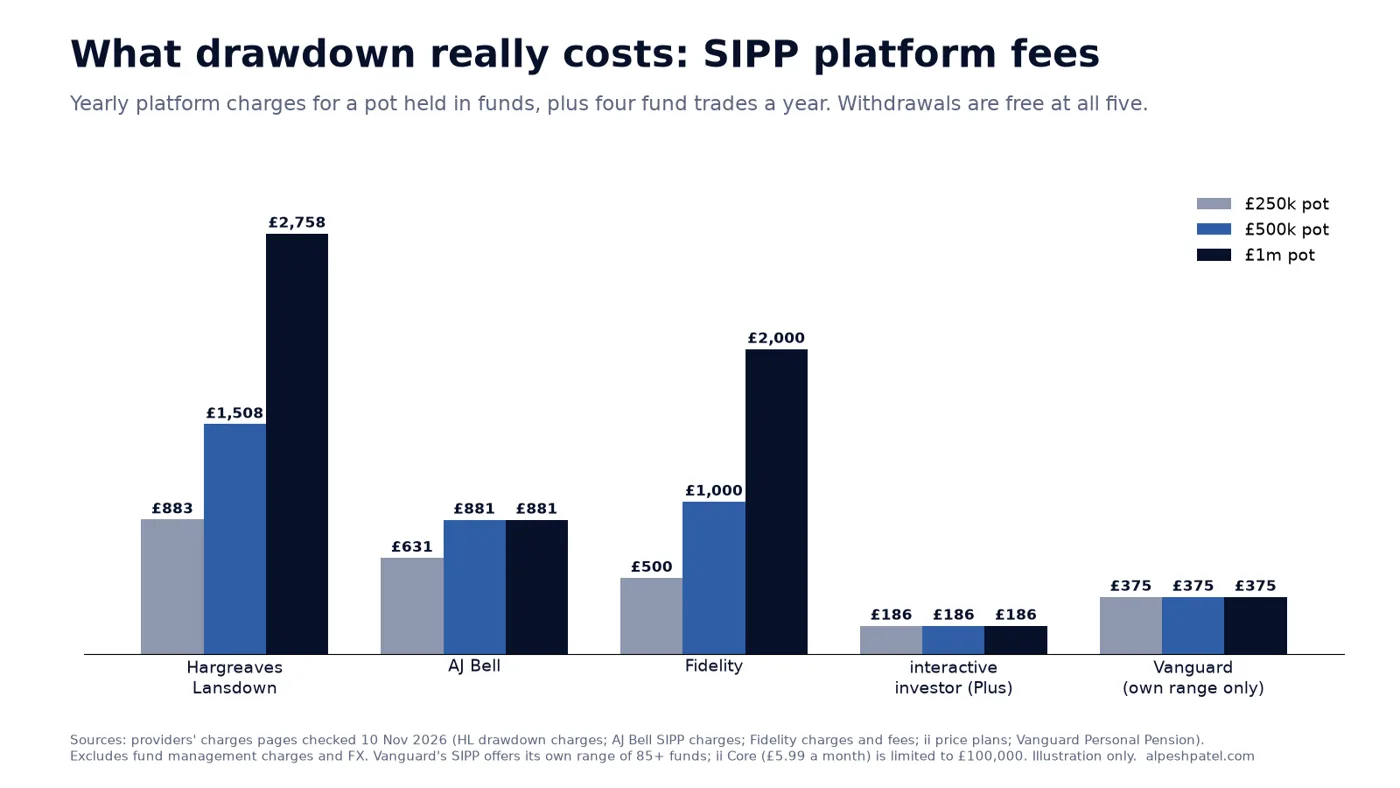
The good news is that none of the five big platforms I compare here charges to set up drawdown or to take withdrawals. The bad news is that their yearly charges vary enormously. For a £500,000 pension held in funds, the yearly platform bill ranges from about £186 at interactive investor to about £1,508 at Hargreaves Lansdown, based on each provider's published charges on 10 November 2026.
That gap is about £1,300 a year. On a cautious drawdown income of 3.9% of £500,000, or £19,500 a year, it is the difference between losing 1% of your income to platform fees and losing nearly 8%. In this guide I set out the real numbers at £250,000, £500,000 and £1 million, explain why the answer changes with what you hold, and share the checks I would make beyond price.
Short answer: For drawdown pots held in funds above about £100,000, interactive investor's flat £14.99 a month Plus plan is usually the cheapest of the big five, at about £186 a year. Vanguard caps its charge at £375 a year and can be cheaper for smaller pots, but only offers its own funds. For pots held mainly in ETFs and shares, Fidelity, AJ Bell, HL and ii all cost under £200 a year because their share charges are capped.
Not sure what your pension platform is really costing you in retirement? Book your free call with Alpesh's team (opens in a new tab). We will show you how to add up every layer of charges on your SIPP and compare them like for like. There is nothing to buy on the call.
Do SIPP platforms charge for drawdown?
Not any more, at least not among the biggest names. A decade ago, many providers charged a set-up fee for drawdown, a yearly drawdown administration fee and sometimes a fee for each withdrawal. Many providers have since dropped them.
All five platforms in this comparison now say they do not charge extra for drawdown itself:
- Hargreaves Lansdown says on its drawdown charges page (opens in a new tab) that it is free to set up drawdown and free to adjust your withdrawals at any time.
- AJ Bell says on its SIPP charges page (opens in a new tab) that withdrawals are free and it does not charge a withdrawal fee when you put your pension into drawdown.
- Fidelity lists no annual admin charge for capped or flexible drawdown on its charges and fees page (opens in a new tab).
- interactive investor says on its income drawdown page (opens in a new tab) that there are no charges for taking an income and it is all covered by the monthly fee.
- Vanguard says on its Personal Pension page (opens in a new tab) that it does not charge any extra fees when you start to take money from your pension.
None of the five charges an exit fee for transferring out either. So the real cost of drawdown is the ordinary yearly platform charge, plus dealing costs when you sell investments to fund your income. That is where the differences lie.
SIPP drawdown charges compared: the 2026 numbers
The platforms charge in two very different ways. Some take a percentage of your pot every year, so the bill grows as your pot grows. Others charge a flat monthly fee, so the bill stays the same whether you have £150,000 or £1.5 million.
Here are the yearly account charges for funds, taken from each provider's own pages:
| Platform | Yearly charge on funds | Fund dealing (online) |
|---|---|---|
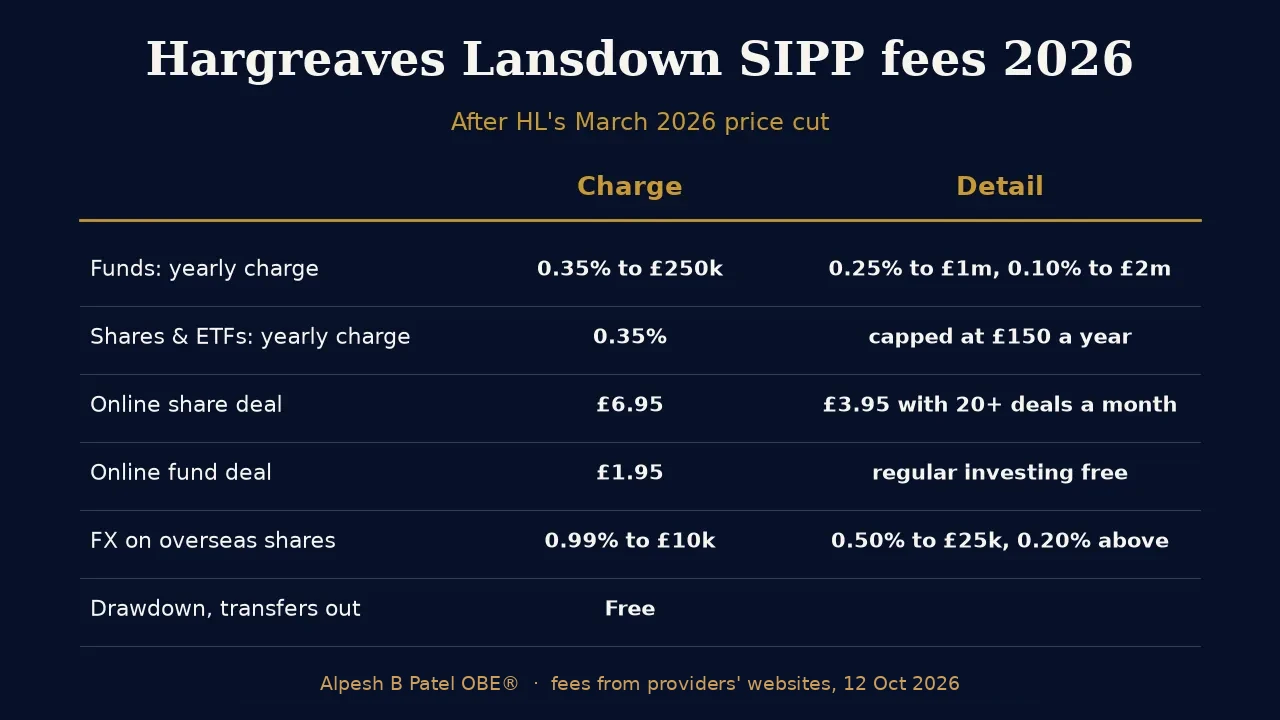
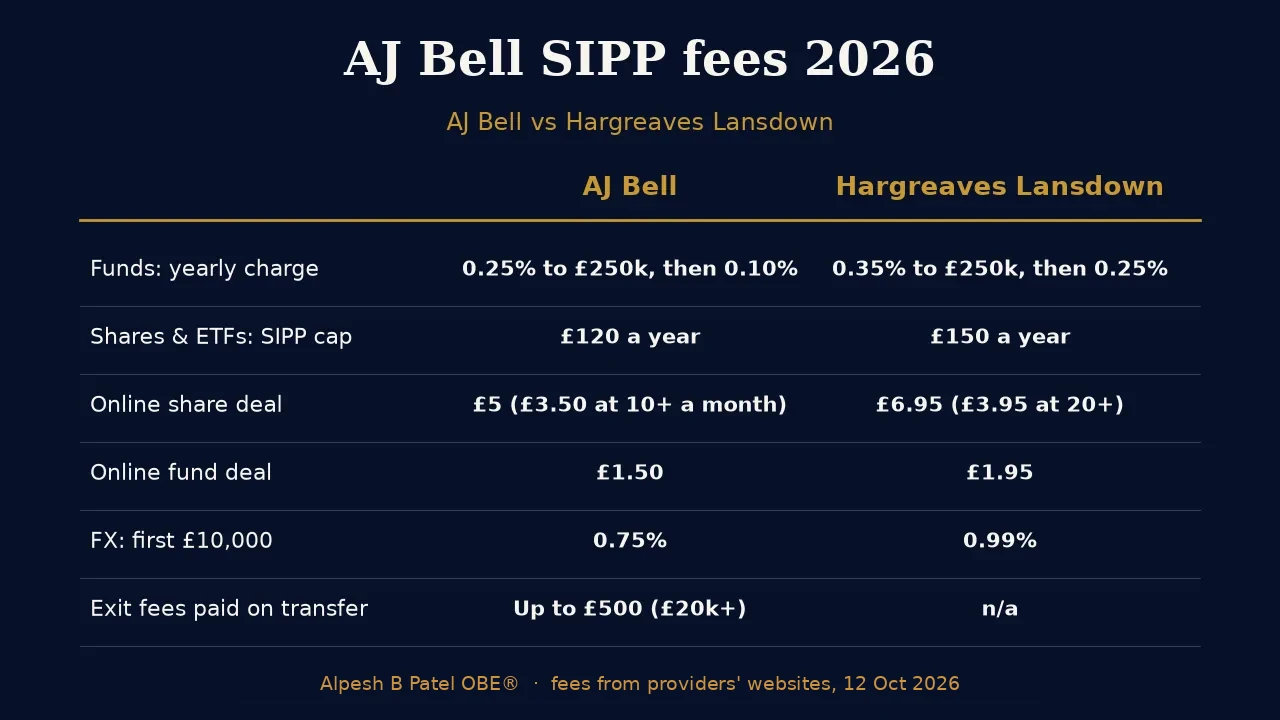
| Hargreaves Lansdown | 0.35% up to £250,000, 0.25% from £250,000 to £1m, 0.10% from £1m to £2m, nothing above £2m | £1.95 a trade |
| AJ Bell | 0.25% up to £250,000, 0.10% from £250,000 to £500,000, nothing above £500,000 | £1.50 a trade |
| Fidelity | 0.35% below £250,000, 0.20% from £250,000, nothing on investments over £1m (maximum £2,000 a year) | No charge |
| interactive investor | Core £5.99 a month (up to £100,000), Plus £14.99 a month (no limit), Premium £39.99 a month | £1.49 on Plus, free on Premium |
| Vanguard | £4 a month below £32,000, then 0.15% capped at £375 a year | Vanguard funds only |
The ii plan prices come from its SIPP page (opens in a new tab) and its announcement of the new price plans (opens in a new tab), which took effect on 1 February 2026. The Core plan is limited to portfolios of up to £100,000, so larger pensions need Plus or Premium.
What a funds-based drawdown pot costs each year
To make the comparison fair, I worked out the yearly platform cost for a pension held entirely in funds, including four one-off fund trades a year. That is roughly what someone might do to rebalance and top up a cash buffer for withdrawals.
| Pot size (funds) | HL | AJ Bell | Fidelity | ii (Plus) | Vanguard |
|---|---|---|---|---|---|
| £250,000 | £883 | £631 | £500 | £186 | £375 |
| £500,000 | £1,508 | £881 | £1,000 | £186 | £375 |
| £1,000,000 | £2,758 | £881 | £2,000 | £186 | £375 |
These figures cover platform charges and fund dealing only. They exclude each fund's own ongoing charge, which you pay wherever you hold it, and any foreign exchange costs. Fidelity's 0.20% rate applies to the whole pot once it reaches £250,000, which is why its cost at exactly £250,000 is lower than at £249,000.
What an ETF and shares drawdown pot costs each year
The picture changes completely if you hold ETFs, investment trusts and shares rather than funds. Most percentage-based platforms cap the charge on these investments:
| Platform | Yearly charge on ETFs and shares | Online share deal | Yearly cost with four trades |
|---|---|---|---|
| Hargreaves Lansdown | 0.35%, capped at £12.50 a month | £6.95 | £177.80 |
| AJ Bell | 0.25%, capped at £10 a month | £5.00 | £140.00 |
| Fidelity | 0.35% (0.20% from £250,000), capped at £7.50 a month | £7.50 | £120.00 |
| interactive investor (Plus) | Included in £14.99 a month | One free trade a month | £179.88 |
For an ETF-based pension, every one of these four costs less than £200 a year, whatever the size of the pot. That is why the "cheapest SIPP" question has two answers. It depends on what you hold. Vanguard is left out of this table because its SIPP only offers Vanguard's own range.
Hargreaves Lansdown vs AJ Bell for drawdown
This is the comparison people search for most, so it is worth looking at closely. Both are large, well-known platforms with strong service. Neither charges for drawdown or withdrawals. The difference is in the tiers.
For funds, AJ Bell's charge drops faster and stops sooner. At £500,000, HL charges about £1,500 a year in platform fees and fund trades, against about £881 at AJ Bell. At £1 million the gap widens to almost £1,900 a year, because AJ Bell charges nothing on funds above £500,000 while HL keeps charging 0.25% up to £1 million.
For ETFs and shares, the two are close. HL caps its charge at £150 a year and AJ Bell at £120 a year. AJ Bell's £5 share deal is also cheaper than HL's £6.95. If you trade rarely, the difference is small. I compare the two in more detail in AJ Bell vs Hargreaves Lansdown, and review each in my Hargreaves Lansdown SIPP review and AJ Bell SIPP review.
Why platform fees matter more in drawdown
When you are saving, platform fees feel small because your contributions and growth swamp them. In drawdown, they behave differently. They are paid from a pot that is shrinking, or at best growing slowly, and they come out every year, in good markets and bad.
A simple way to see the effect is to compare the fee with your income rather than with your pot. On a £500,000 pension, a cautious withdrawal rate of 3.9%, the figure Morningstar's retirement research (opens in a new tab) suggests for a 30-year retirement, gives £19,500 a year. A £1,508 platform bill is 7.7% of that income. A £186 bill is about 1%.
Over a long retirement, the difference compounds. The money you save on fees stays invested and keeps growing, and the money you pay out is gone for good. I show how this adds up over time in what 1% a year really costs your portfolio.
The cheapest SIPP is not always the best SIPP for drawdown
Price is the easiest thing to compare, so it tends to dominate. But drawdown is a long relationship, and other things matter too. These are the questions I would ask of any platform before moving a retirement pot.
Can you hold what you want to hold?
Vanguard's low cap comes with a big limit: you can only pick from its own range of funds. That may suit you perfectly if you want a simple, low-cost global tracker or a LifeStrategy-style fund. It will not suit you if you want individual shares, investment trusts or funds from other managers. My Vanguard LifeStrategy 100 review looks at one of its most popular options.
How easy is it to take money out?
Check how each platform handles the mechanics of retirement income. Can you set up regular monthly withdrawals online? Can you take tax-free cash in stages rather than all at once? Can you keep part of your pension uncrystallised and move only some of it into drawdown? All five platforms here offer drawdown, but the online tools and the way they handle partial withdrawals vary.
What happens to your cash?
In drawdown, many people hold one to two years of spending in cash, so they are not forced to sell investments after a market fall. The interest each platform pays on SIPP cash differs and changes often. On a cash buffer of £30,000 or £40,000, a difference of one or two percentage points is worth more than many of the fee gaps above.
What does it cost in foreign exchange?
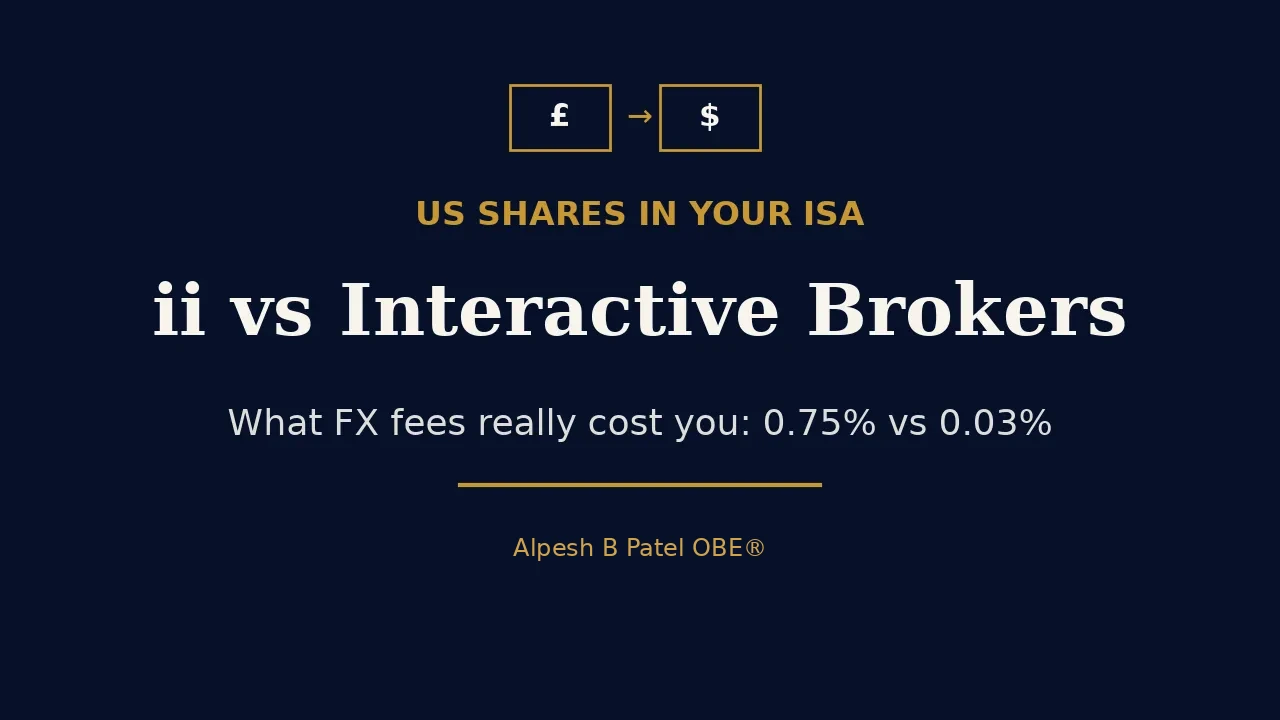
If you hold US shares or ETFs priced in dollars, FX charges can dwarf the platform fee. ii's Plus plan, for example, charges 0.75% FX up to £50,000 (opens in a new tab) of each trade. I look at this in detail in ii vs Interactive Brokers: what FX fees really cost you.
How much help do you want?
Some retirees are happy managing everything online. Others want to phone someone when they are making a big decision, such as a large withdrawal or a change in beneficiaries. Service quality is harder to measure than price, but it matters most in exactly the moments when you need it.
How I would choose a SIPP for drawdown
I do not recommend platforms, and the right choice depends on your own pot and habits. What I can share is the process I teach. It takes five steps and an afternoon with a spreadsheet.
- List what you hold. Split your pension into funds, ETFs and investment trusts, individual shares and cash. The mix decides which pricing model is cheapest.
- Estimate your activity. Count how many trades you made in the last year, and how many withdrawals you plan to take. Most drawdown investors trade a handful of times a year.
- Calculate the yearly cost at each platform. Use each provider's own charges page, not a comparison site, and work it out at your pot size today and at a larger size if you expect growth.
- Compare the fee with your income. Divide the yearly cost by the income you plan to take. If platform fees take more than a few per cent of your income, it is worth a closer look.
- Check the non-price factors. Investment choice, online tools for withdrawals, interest on cash, FX costs and service. Then decide whether any saving is worth a transfer.
Remember that transferring a pension takes time, usually several weeks, and you may be out of the market if the transfer is made in cash. Ask whether the new platform can accept your investments "in specie", meaning moved across as they are without selling.
Frequently asked questions
Which SIPP is cheapest for drawdown in 2026?
For a pension held in funds of more than about £100,000, interactive investor's Plus plan at £14.99 a month, or about £180 a year, is usually the cheapest of the big five. Vanguard charges 0.15% capped at £375 a year, which is cheaper than ii for pots below about £120,000, but it only offers Vanguard funds. For ETF and share portfolios, Fidelity, AJ Bell, HL and ii all cost under £200 a year.
Is Hargreaves Lansdown or AJ Bell cheaper for drawdown?
For funds, AJ Bell is cheaper at every pot size in this comparison: about £631 a year at £250,000 against about £883 at HL, and about £881 at £1 million against about £2,758. For ETFs and shares, the two are close, with yearly charges capped at £120 at AJ Bell and £150 at HL.
Do I pay a fee to take money out of my SIPP?
Not at the five platforms compared here. HL, AJ Bell, Fidelity, interactive investor and Vanguard all say they do not charge to set up drawdown or to take withdrawals. You still pay the ordinary yearly platform charge and any dealing costs when you sell investments.
Should I move my pension to a cheaper SIPP before drawdown?
It can be worth it, but only after checking the full picture. Compare the yearly saving with any costs or time out of the market during the transfer, and make sure you will not lose valuable features such as a guaranteed annuity rate or protected tax-free cash. Older workplace and personal pensions sometimes carry benefits that are lost on transfer.
What to do next
- Find your current charges. Log in to your SIPP and download the latest annual statement, which should show the costs and charges you paid in pounds.
- Work out your yearly cost elsewhere. Use the tables above and each provider's own charges page to estimate what you would pay at your pot size.
- Divide by your income. Compare the yearly platform cost with the income you plan to draw. That shows the real weight of the fee.
- Check the details that matter in retirement. Investment choice, withdrawal tools, cash interest and FX costs.
- Read the related guides. My posts on six withdrawal strategies compared and cautious, balanced or adventurous pension funds cover what to hold once you are in drawdown.
Want a second pair of eyes on your drawdown costs? Book your free call with Alpesh's team (opens in a new tab). We will walk you through how to compare platform, fund and FX charges on your own pension, so you can see what you are really paying. There is nothing to buy on the call.
About Alpesh Patel OBE
Alpesh Patel OBE is Founding Principal of Rootbridge Capital, an author and Dealmaker for the UK Government's Department for Business. He is a former Visiting Fellow in Business, Corpus Christi College, Oxford University, where he worked on technology to improve financial education. Watch his free investing education on YouTube (opens in a new tab).
Sources
- Hargreaves Lansdown, Drawdown charges and interest rates (opens in a new tab), checked 10 November 2026.
- AJ Bell, SIPP charges and rates (opens in a new tab), checked 10 November 2026.
- Fidelity, Investment fees and charges (opens in a new tab), checked 10 November 2026.
- interactive investor, Personal Pension (SIPP) (opens in a new tab) and SIPP income drawdown (opens in a new tab), checked 10 November 2026.
- interactive investor, interactive investor launches new price plans (opens in a new tab), 8 December 2025.
- Vanguard UK, Personal Pension (opens in a new tab), checked 10 November 2026.
- Morningstar, What's a safe retirement withdrawal rate for 2026? (opens in a new tab)
- Alpesh Patel OBE, The SIPP Fee Trap – Don't Pick the Wrong Platform (opens in a new tab), YouTube, 25 March 2026.
Important: This article is for education only and is not personal financial advice or a recommendation to buy or sell any investment, or to use any platform. This article is general investment education only and is not regulated investment advice. Platform charges change often, so always check each provider's current charges before making a decision. The value of investments can go down as well as up, and you may get back less than you invest. Past performance is not a reliable indicator of future results.
Important: this article is education and information only. It is not financial advice or a personal recommendation, and it does not take your circumstances into account. The value of investments and pensions can fall as well as rise, and you may get back less than you put in. Past performance is not a reliable indicator of future results. Figures were correct when the article was written and may have changed. If you are unsure what is right for you, speak to a regulated financial adviser.