What Does It Cost to Run Your Own Portfolio? Platform, Dealing and FX Charges in Pounds
On a recent call with my team, someone with a seven-figure portfolio asked a question that sounds simple: if I stop paying someone to manage my money, what will it actually cost me to run it myself? Not in percentages. In pounds, every year.
It is the right question, because the answer is usually much smaller than people expect. The FCA has found that total annual fees for holistic financial advice, covering both advice and investment charges, come to approximately 1.9% (opens in a new tab). On £500,000, that is £9,500 a year.
This article works out the cost to run your own portfolio from the published charges pages of six platforms: AJ Bell, Hargreaves Lansdown, interactive investor, Interactive Brokers, Fidelity and Vanguard. It covers platform fees and caps, dealing, FX, fund charges and stamp duty, for illustrative £250,000, £500,000 and £1 million portfolios.
Short answer: In these illustrative examples, the cost to run your own portfolio of £500,000 ranges from about £340 to £2,700 a year, depending on the platform and whether you hold funds, ETFs or individual shares. A managed arrangement at 1.5% to 2% would cost £7,500 to £10,000. FX charges and platform fees on funds are the biggest swing factors.
Thinking about running your own portfolio but not sure where to start? Book your free call with Alpesh's team. We will show you how self-directed investors pick, size and review their investments with a written process. There is nothing to buy on the call.
What are the costs of running your own portfolio?
When you run your own money, you pay five kinds of cost. Most are small on their own. Together, and depending on the choices you make, they can differ by thousands of pounds a year.
- Platform fee. The yearly charge for holding your account. It is either a percentage, often with a lower rate or a cap above certain sizes, or a flat monthly fee.
- Dealing commission. A charge each time you buy or sell.
- FX fee. A charge for converting pounds into dollars or another currency when you buy overseas shares, and back again when you sell.
- Fund charges. The ongoing charges figure (OCF) of any fund or ETF you hold. The fund manager takes this, not the platform.
- Stamp duty. When you buy UK shares electronically you usually pay 0.5% Stamp Duty Reserve Tax (opens in a new tab). It does not apply when you buy units in a unit trust or an OEIC from the fund manager.
What do the main UK platforms charge?
Here are the main charges, taken from each platform's own pages on 20 November 2026. SIPP charges are shown because portfolios of this size are often held mainly in a pension. Where the ISA charge differs, it is noted.
| Platform | Platform fee on funds | Platform fee on shares and ETFs | Online share deal | Fund deal | FX on US shares |
|---|---|---|---|---|---|
| AJ Bell | 0.25% to £250k, 0.10% £250k–£500k, nil above | 0.25%, max £10 a month in a SIPP (£3.50 in an ISA) | £5 | £1.50 | 0.75% first £10k, 0.50% next £10k, 0.25% above |
| Hargreaves Lansdown | 0.35% to £250k, 0.25% £250k–£1m, 0.10% £1m–£2m, nil above | 0.35%, max £12.50 a month | £6.95 (£3.95 after 20+ trades the previous month) | £1.95 | 0.99% to £10k, 0.50% £10k–£25k, 0.20% above |
| interactive investor | Flat: Core £5.99 a month (to £100k), Plus £14.99, Premium £39.99 | Included in flat fee | £3.99 (Premium £2.99) | £3.99 Core, £1.49 Plus, free Premium | 0.75% Core; Plus 0.75% first £50k, 0.25% above; Premium 0.25% |
| Interactive Brokers | Not modelled | No platform fee; ISA minimum activity fee £3 a month | UK 0.05%, min £3; US $0.005 a share, min $1 | Not modelled | About 0.03% on auto-conversion |
| Fidelity | 0.35% to £250k; 0.20% on the whole amount from £250k; max £2,000 a year | 0.35% (0.20% from £250k), max £7.50 a month | £7.50 | Free | 0.75% to £10k, 0.50% £10k–£20k, 0.25% above |
| Vanguard | 0.15%, max £375 a year | Vanguard ETFs only | Not offered | Free | Not offered |
Source: AJ Bell SIPP charges (opens in a new tab), AJ Bell ISA charges (opens in a new tab), AJ Bell international dealing (opens in a new tab), Hargreaves Lansdown SIPP charges (opens in a new tab), Hargreaves Lansdown overseas dealing (opens in a new tab), interactive investor charges (opens in a new tab), Interactive Brokers stock commissions (opens in a new tab), Interactive Brokers currency conversion (opens in a new tab), Interactive Brokers ISA (opens in a new tab), Fidelity charges (opens in a new tab) and Vanguard fees (opens in a new tab), all checked 20 November 2026. interactive investor includes a SIPP, ISA and trading account in each plan. Interactive Brokers' SIPP is only available through third-party SIPP administrators, whose fees vary, so its figures here are for its ISA.
How much does it cost to run a fund portfolio?
Start with the simplest set-up: the whole portfolio in index funds. The example uses a global index fund with an OCF of 0.23%, the charge on the Vanguard FTSE Global All Cap Index Fund (opens in a new tab), and four fund deals a year. It is an example of a broad fund, not a recommendation.
| Illustrative yearly cost, funds | £250,000 | £500,000 | £1 million |
|---|---|---|---|
| AJ Bell | £1,206 | £2,031 | £3,181 |
| Hargreaves Lansdown | £1,458 | £2,658 | £5,058 |
| Fidelity | £1,075 | £2,150 | £4,300 |
| interactive investor (Plus) | £755 | £1,330 | £2,480 |
| Vanguard | £950 | £1,525 | £2,675 |
| Managed at 1.5% (illustrative) | £3,750 | £7,500 | £15,000 |
| Managed at 2% (illustrative) | £5,000 | £10,000 | £20,000 |
Illustrative. Platform fee plus fund dealing plus 0.23% OCF. interactive investor's Plus plan includes one free trade a month, which covers the four fund deals.
Fund charges are the same wherever you hold the fund, so the differences come from the platform fee. Percentage platforms get expensive on large fund portfolios: Hargreaves Lansdown's tiered charge alone is about £2,750 a year on £1 million in funds. The flat fee at interactive investor and the £375 cap at Vanguard hardly change as the portfolio grows.
How much does it cost to hold ETFs instead?
Many investors miss this one. Most percentage platforms cap the fee on shares, ETFs and investment trusts, but not on funds. Holding a similar global index through an ETF can cut the platform bill sharply.
This example uses an ETF with a 0.14% OCF, the charge on the Vanguard FTSE All-World UCITS ETF (opens in a new tab), with four trades a year and no FX charge assumed.
| Illustrative yearly cost, ETFs | £250,000 | £500,000 | £1 million |
|---|---|---|---|
| AJ Bell | £490 | £840 | £1,540 |
| Hargreaves Lansdown | £528 | £878 | £1,578 |
| Fidelity | £470 | £820 | £1,520 |
| interactive investor (Plus) | £530 | £880 | £1,580 |
| Interactive Brokers | £386 | £744 | £1,464 |
| Managed at 1.5% (illustrative) | £3,750 | £7,500 | £15,000 |
| Managed at 2% (illustrative) | £5,000 | £10,000 | £20,000 |
Illustrative. Capped platform fee plus four trades plus 0.14% OCF. Interactive Brokers includes the £3 monthly ISA minimum, less commissions paid. Excludes the bid-offer spread on each trade.
On £1 million at Hargreaves Lansdown, the platform fee drops from about £2,750 in funds to £150 in ETFs. Once the platform fee is capped, the fund's own charge is most of what you pay. That is where a few hundredths of a percent matter.
How much does it cost to buy UK and US shares directly?
Now a stock-picker's portfolio: no funds, just individual shares. The example assumes 20 trades a year, 10 in UK shares and 10 in US shares, half of them buys and half sells. Each trade is 2% of the portfolio: £5,000, £10,000 or £20,000.
| Illustrative yearly cost, direct shares | £250,000 | £500,000 | £1 million |
|---|---|---|---|
| AJ Bell | £720 | £1,220 | £1,985 |
| Hargreaves Lansdown | £909 | £1,529 | £2,294 |
| Fidelity | £740 | £1,240 | £2,005 |
| interactive investor (Plus) | £712 | £1,212 | £2,227 |
| interactive investor (Premium) | £730 | £980 | £1,495 |
| Interactive Brokers | £178 | £338 | £683 |
| Managed at 1.5% (illustrative) | £3,750 | £7,500 | £15,000 |
| Managed at 2% (illustrative) | £5,000 | £10,000 | £20,000 |
Illustrative. Includes capped platform fee, 20 deals, FX on 10 US trades and stamp duty of 0.5% on five UK buys (£125, £250 and £500), plus the £1.50 PTM levy on UK trades over £10,000. interactive investor Plus assumes 12 free monthly trades; Premium includes 10 free trades a month. Interactive Brokers assumes about $1 commission a US trade at an exchange rate of $1.30 to the pound.
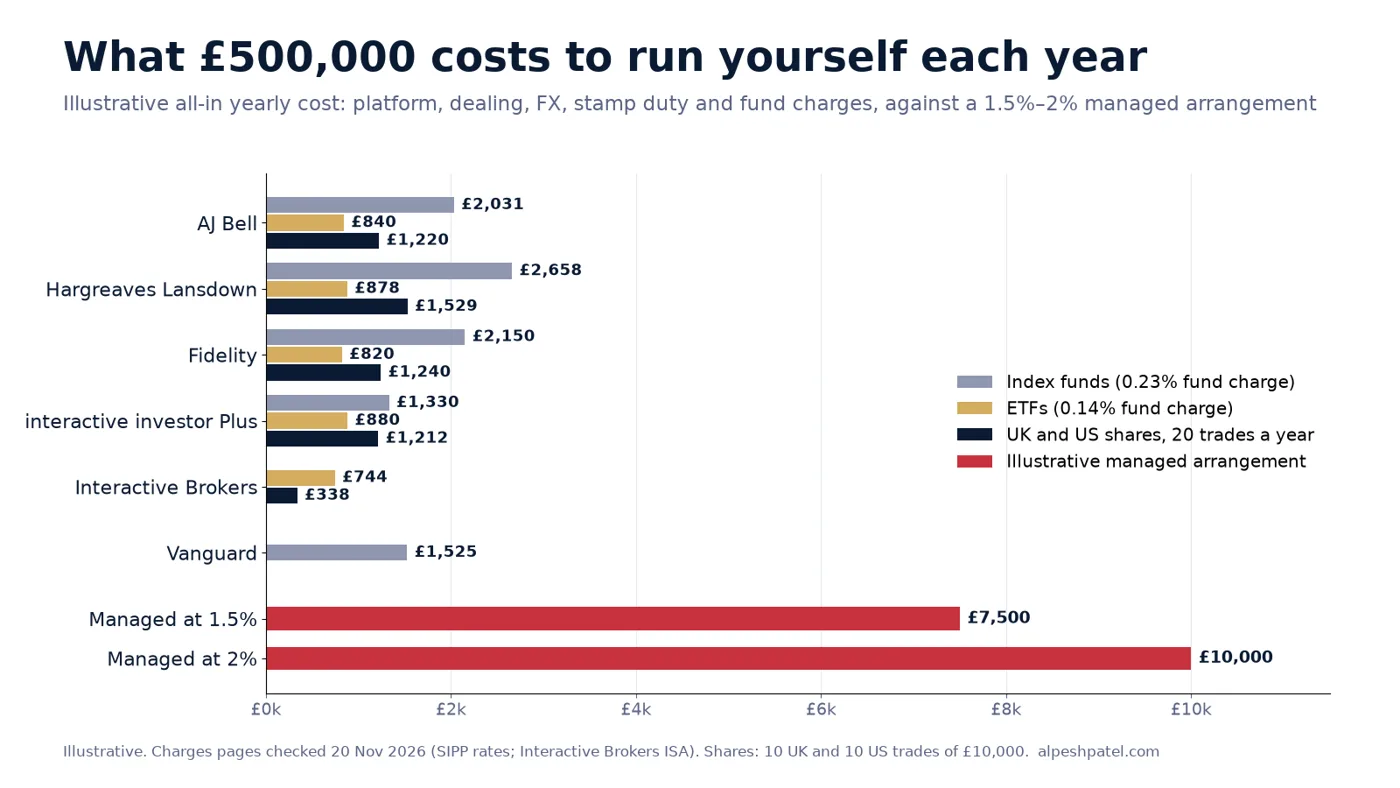
Look at where the money goes. On £500,000 at AJ Bell, £750 of the £1,220 is FX. At Hargreaves Lansdown, FX is about £990. At Interactive Brokers it is about £30. Stamp duty is the same on every platform, so the only way to cut it is to trade less.
FX is the cost most investors underestimate. My comparison of interactive investor vs Interactive Brokers on FX fees goes deeper on this.
Source: platform charges pages above, checked 20 November 2026. Illustrative; the managed figures are a simple 1.5% and 2% of £500,000.
How does this compare with a managed portfolio?
The red bars in the chart are the point of the exercise. At 1.5% to 2%, a managed arrangement costs £7,500 to £10,000 a year on £500,000 and £15,000 to £20,000 on £1 million. In every one of the self-directed examples above, the yearly cost is a fraction of that.
The FCA's own estimate puts total annual fees for holistic financial advice at approximately 1.9% (opens in a new tab). Its research also found that the average ongoing advice charge alone was 0.8% a year (opens in a new tab), before platform and fund costs.
A managed service does give you something for that money: someone else making the decisions. The question is whether you would rather pay for that every year, or learn a process and keep the difference compounding in your own portfolio. My piece on what 1% a year really costs in wealth management fees shows what that does over time.
ISA or SIPP: does the wrapper change the cost?
Sometimes. Hargreaves Lansdown, Fidelity and Vanguard charge the same in an ISA and a SIPP. AJ Bell caps its share charge at £3.50 a month in an ISA against £10 a month in a SIPP, so the ISA is cheaper for ETFs and shares.
interactive investor includes a SIPP, ISA and trading account in each monthly plan, so you pay one fee for all three. Interactive Brokers runs its own ISA, with a £3 monthly minimum activity fee, but its SIPP only runs through approved third-party SIPP administrators, whose fees you need to check separately.
You can only add £20,000 a year to ISAs (opens in a new tab), so larger portfolios usually sit across a SIPP, an ISA and sometimes a general account. Price the whole mix, not just one account. For pensions, my guide to the cheapest SIPP for drawdown compares the main platforms on pot size.
How do I compare platforms for the shares I want to buy?
The cheapest platform depends on what you hold and how you trade. Before choosing, work through this checklist with your own numbers.
- What will you hold? Funds, ETFs, UK shares, US shares or a mix. Percentage fees on funds and caps on shares are the biggest fork in the road.
- How big is the account, and in which wrappers? Check the tiers and caps for each wrapper, and whether the platform adds your accounts together.
- How often will you trade? Count a realistic number of trades a year and multiply by the dealing charge, less any free trades in a plan.
- How much is overseas? Multiply your yearly US buys and sells by the FX rate. If this is a large number, it may decide everything else.
- Can you buy what you want? Check that the platform offers the specific shares, ETFs and markets you plan to use, and in the wrapper you need.
- What does it cost to leave? Check transfer-out and exit charges. AJ Bell, Hargreaves Lansdown and Vanguard say they do not charge to transfer out; check the others before you move.
My comparisons of AJ Bell vs Hargreaves Lansdown and the best stocks and shares ISA platforms cover individual platforms in more detail.
Cheap costs are only half the job
A low-cost platform does not make you a good investor. What matters more is a written process: how you pick each investment, how much you put into each one, and when you sell or rebalance.
That is the real case for running your own money. You control every decision, you can see every holding and every charge, and you can build a portfolio around your own risk profile instead of a model built for thousands of clients. The savings above only count if your process keeps you invested sensibly.
You can model how costs and returns affect your own plan with the free calculators on my tools page, or check the range of outcomes your portfolio could face with Portfolio Odds (opens in a new tab).
What to do next
- Write down what you hold. Split it into funds, ETFs, UK shares and overseas shares, and note which wrapper each sits in.
- Count last year's trades. Separate UK and overseas trades, and note their typical size.
- Price three platforms. Use the tables above as a template, then check every figure on the platform's own charges page.
- Check your FX bill. If you buy US shares, work out what you paid in FX last year. It is often the largest single cost.
- Write your process. One page on how you pick, size and sell. My guide to running your own SIPP is a good place to start.
Want help building a process to run your own portfolio? Book your free call with Alpesh's team. We will talk through how self-directed investors keep costs down and decisions clear. There is nothing to buy on the call.
Frequently asked questions
What is the cheapest way to run your own portfolio in the UK?
It depends on what you hold. In these illustrative examples, ETFs on a platform with a capped share charge, or individual shares on Interactive Brokers, cost the least. For large fund portfolios, a flat fee or a low cap usually beats a percentage charge.
Why are ETFs cheaper than funds on some platforms?
Platforms such as AJ Bell, Hargreaves Lansdown and Fidelity cap their yearly charge on shares and ETFs but not on funds. On a large portfolio, the same index held as an ETF can cost hundreds or thousands of pounds less a year in platform fees.
How much does FX cost when buying US shares?
On the platforms here it ranges from about 0.03% at Interactive Brokers on auto-conversion to 0.99% on the first £10,000 of each deal at Hargreaves Lansdown. On a £10,000 trade, that is about £3 against about £99.
Do I pay stamp duty on ETFs and funds?
You usually pay 0.5% Stamp Duty Reserve Tax when you buy UK shares electronically. GOV.UK says you do not pay it when you buy units in a unit trust or shares in an OEIC from the fund manager. Check the treatment of any specific ETF before you buy.
Is it cheaper to manage my own portfolio than to pay a manager?
On costs alone, yes, by a wide margin in these examples: hundreds or a few thousand pounds a year against £7,500 to £10,000 for a 1.5% to 2% arrangement on £500,000. Whether it is better for you depends on having a process you will follow.
About Alpesh Patel OBE
Alpesh Patel OBE is Founding Principal of Rootbridge Capital, an author and Dealmaker for the UK Government's Department for Business. He is a former Visiting Fellow in Business, Corpus Christi College, Oxford University, where he worked on technology to improve financial education.
Sources
- AJ Bell, SIPP charges and rates (opens in a new tab) (checked 20 November 2026)
- AJ Bell, Stocks and shares ISA charges (opens in a new tab) (checked 20 November 2026)
- AJ Bell, International dealing (opens in a new tab) (checked 20 November 2026)
- Hargreaves Lansdown, SIPP charges and interest rates (opens in a new tab) (checked 20 November 2026)
- Hargreaves Lansdown, Overseas share dealing (opens in a new tab) (checked 20 November 2026)
- interactive investor, Our charges (opens in a new tab) (checked 20 November 2026)
- interactive investor, Personal Pension (SIPP) (opens in a new tab) (checked 20 November 2026)
- Interactive Brokers UK, Stock commissions (opens in a new tab) (checked 20 November 2026)
- Interactive Brokers UK, Spot currency commissions (opens in a new tab) (checked 20 November 2026)
- Interactive Brokers UK, Stocks and Shares ISA (opens in a new tab) (checked 20 November 2026)
- Interactive Brokers UK, SIPP accounts (opens in a new tab) (checked 20 November 2026)
- Fidelity, Charges and fees (opens in a new tab) (checked 20 November 2026)
- Vanguard, Fees explained (opens in a new tab) (checked 20 November 2026)
- Vanguard, FTSE Global All Cap Index Fund (opens in a new tab) (checked 20 November 2026)
- Vanguard, FTSE All-World UCITS ETF (opens in a new tab) (checked 20 November 2026)
- GOV.UK, Tax when you buy shares (opens in a new tab)
- GOV.UK, Individual Savings Accounts (opens in a new tab)
- Financial Conduct Authority, CP22/24: Broadening access to financial advice for mainstream investments (opens in a new tab) (November 2022)
- Financial Conduct Authority, Evaluation of the impact of the Retail Distribution Review and the Financial Advice Market Review (opens in a new tab) (December 2020)
- Alpesh Patel OBE, Which Are The Best SIPPS For Aspiring Millionaires (opens in a new tab) (YouTube)
Important: This article is for education only and is not personal financial advice or a recommendation to buy or sell any investment. This article is general investment education only and is not regulated investment advice. The value of investments can go down as well as up, and you may get back less than you invest. Past performance is not a reliable indicator of future results.
Important: this article is education and information only. It is not financial advice or a personal recommendation, and it does not take your circumstances into account. The value of investments and pensions can fall as well as rise, and you may get back less than you put in. Past performance is not a reliable indicator of future results. Figures were correct when the article was written and may have changed. If you are unsure what is right for you, speak to a regulated financial adviser.