Global Equity Index Fund for Retirement Income? Why It Won't Pay the Bills on Its Own
A prospect filled in our form recently. Under "What is your goal?" they wrote: "Generate retirement income." Under "What do you hold?" they wrote: "global developed equity index fund." Those two answers sit uneasily together, and I suspect thousands of UK savers would write exactly the same thing.
A global developed equity index fund is a sensible, low-cost way to own a slice of the world's largest listed companies. It is not, by itself, an income plan. The MSCI World index, which many of these funds track, fell 57.46% from 31 October 2007 to 9 March 2009, and its dividend yield on 30 October 2026 was 1.54% (MSCI World Index factsheet (opens in a new tab)). If you need 5% a year to pay the bills, most of that money has to come from selling units, whatever the market is doing that month.
Meanwhile, savers are drawing hard on their pots. In 2025/26, 46% of pensions with regular withdrawals were drawn at an annual rate of 8% or more, according to FCA data reported by Pensions Age (opens in a new tab).
Short answer: A global equity index fund does not "generate" retirement income in any reliable sense. Its dividends are small (MSCI World yielded 1.54% in October 2026), many share classes reinvest them rather than pay them out, and the fund can fall by more than half. Income comes from a plan: money set aside for near-term spending, a withdrawal rule, and growth assets you never have to sell in a crash.
Is your pot built to pay the bills, or just to grow? Book your free call with Alpesh's team. We will look at what you hold, when you need the money and the disciplined process for turning a portfolio into spending you can rely on. There is nothing to buy on the call.
Why "generate retirement income" is the wrong question
The phrase suggests a machine: put money in, income comes out. Equity funds do not work like that. A fund's total return is made of two parts, the dividends the companies pay and the change in the share prices. The dividends are the small, steady part. The price change is the large, volatile part.
When people say they want a fund to "generate income", they usually mean they want to spend a set amount every month. That is a spending need, not a feature of a fund. The right questions are:
- How much do I need each year, after tax, in today's money?
- When does each part of that need start and stop?
- How much of it is covered by reliable income, such as the State Pension, a final-salary pension or an annuity?
- How large a fall could my portfolio take in the year I need to sell, without wrecking the plan?
Answer those, and the choice of fund becomes a much smaller decision. Skip them, and even a good fund can fail you at exactly the wrong moment.
Do global equity index funds actually provide income?
Less than most people assume, for three reasons.
The dividend yield is small
On 30 October 2026, the MSCI World index had a dividend yield of 1.54% (MSCI (opens in a new tab)). On a £400,000 pot, that is about £6,160 a year before fund charges. If you need £20,000 a year from the pot, the dividends cover less than a third. The remaining £13,840 or so has to come from selling units.
The yield is low partly because of what the index owns. The United States made up 72.77% of the MSCI World index on that date, and many of the largest US companies pay small dividends or none, preferring buybacks and reinvestment (MSCI (opens in a new tab)). "Global" here mostly means American.
Many share classes do not pay income at all
Index funds usually come in two versions. Income (distributing) units pay the dividends out to you. Accumulation units reinvest them inside the fund, so the unit price rises instead and nothing lands in your account. Inside workplace pensions and many SIPPs, accumulation units are the default. If that is what you hold, the fund is paying you exactly nothing. Any "income" is you, or your provider, selling units.
Dividends can be cut
Companies cut dividends when profits fall, which tends to happen in the same recessions that knock share prices down. So even the small income stream is not guaranteed in the years you most need it.
Can a global equity index fund fall more than you expect?
Yes. Broad diversification across 1,248 companies, the number in the MSCI World index on 30 October 2026, protects you from one company going bust (MSCI (opens in a new tab)). It does not protect you from the whole market falling together, which is what happens in a crisis.
| MSCI World index (US dollars) | Figure |
|---|---|
| Largest fall (maximum drawdown) | -57.46% |
| Period of that fall | 31 Oct 2007 to 9 Mar 2009 |
| Return in 2022 | -17.73% |
| Return in 2018 | -8.20% |
| 10-year annualised return to 30 Oct 2026 | 13.50% |
| Annualised return since 31 Dec 1987 | 8.98% |
| Dividend yield, 30 Oct 2026 | 1.54% |
Source: MSCI World Index factsheet (opens in a new tab), 30 October 2026. Index figures in US dollars, before fund charges. Returns in sterling will differ. Past performance is not a reliable indicator of future results.
The last ten years have been unusually kind. The index returned 13.50% a year over the decade to October 2026, against 8.98% a year since 1987. A saver who has only seen the recent decade may be planning on returns, and on smoothness, that history does not promise.
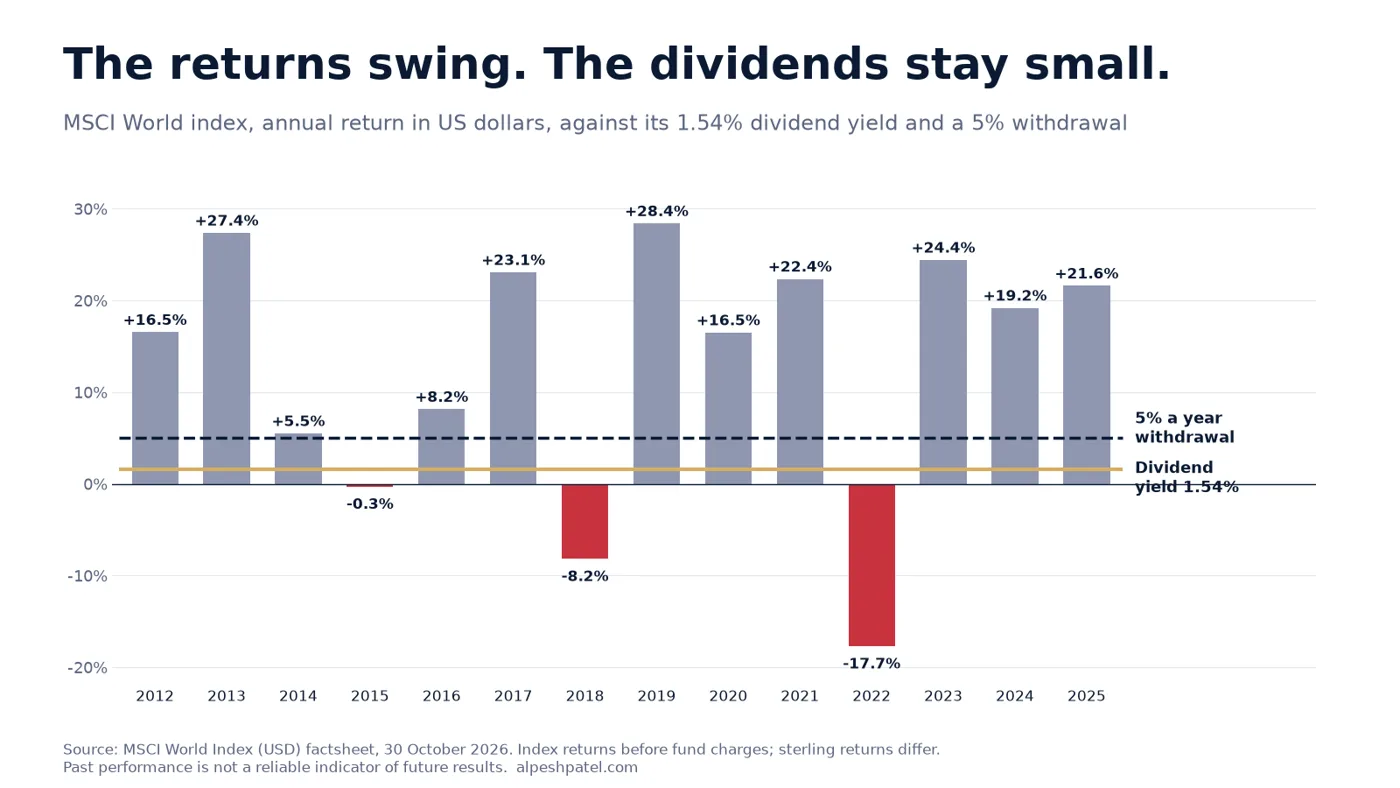
Look at the chart. In most years the return dwarfs a 5% withdrawal. In 2015, 2018 and 2022 it did not, and in those years a saver taking 5% was selling units that had already fallen in price.
What is sequence of returns risk?
Sequence of returns risk (SOR) is the danger that poor returns arrive early in retirement, just as you start withdrawing. While you are saving, the order of good and bad years does not change where you end up. Once you are withdrawing, it matters enormously, because every unit you sell in a fall is gone and cannot recover with the market.
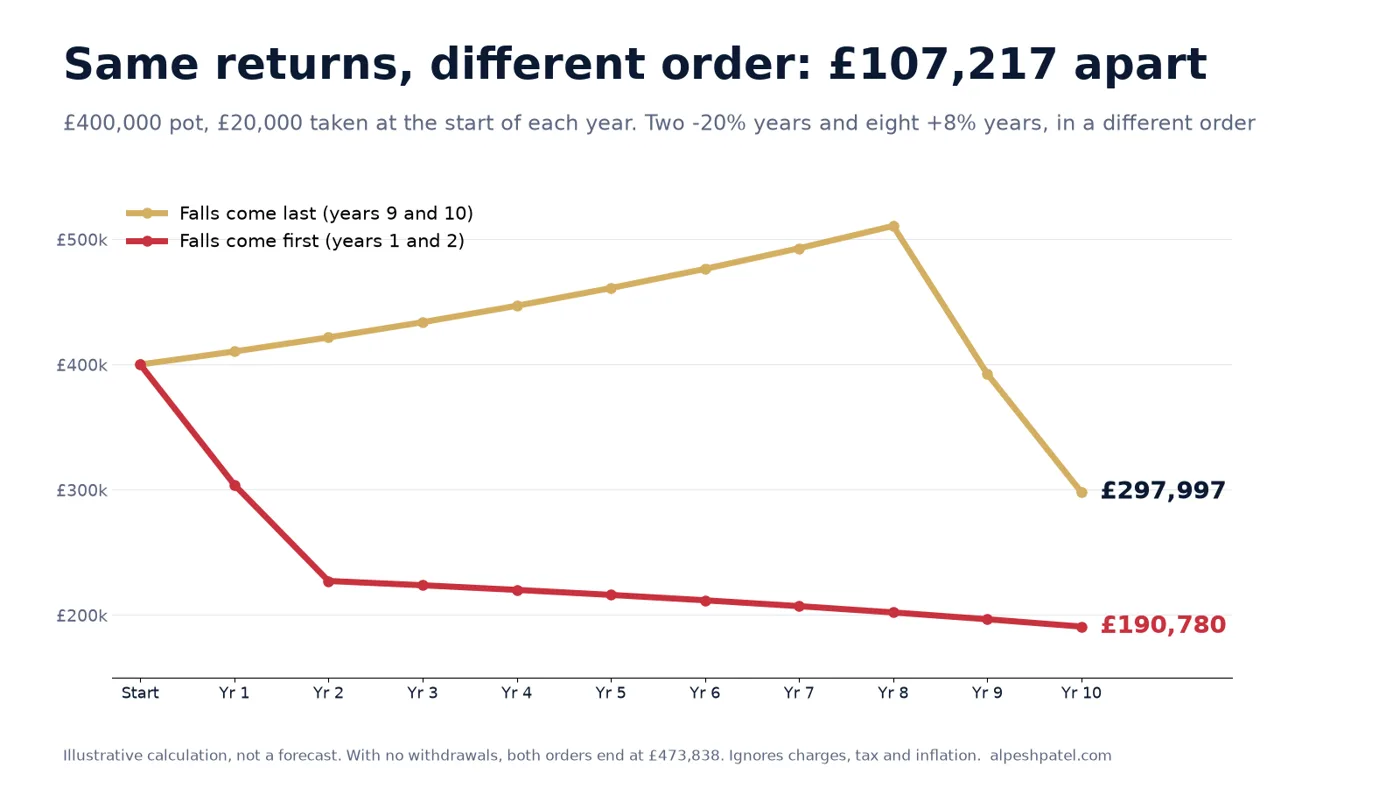
Here is a simple illustration. Two savers each start with £400,000 and take £20,000 at the start of every year, a 5% withdrawal. Over ten years, both get exactly the same returns: two years of -20% and eight years of +8%. The only difference is the order.
- Falls come last: the pot ends at £297,997.
- Falls come first: the pot ends at £190,780.
That is £107,217 apart, from identical returns. Had neither saver withdrawn anything, both would have ended with £473,838. The withdrawals turned the order of returns into the deciding factor. These are my own illustrative figures, not a forecast, and they ignore charges, tax and inflation.
A single global equity fund gives you no defence against this. When you need £20,000 in a year the fund is down 20%, the only way to raise it is to sell 20% cheaper units.
Why you need money set aside
The practical answer to sequence of returns risk is to separate the money you will spend soon from the money you are investing for the long term.
- Spending money: cash or short-dated, high-quality bonds covering the next few years of withdrawals from the pot. This is not there to grow. It is there so you never have to sell shares in a crash to pay the bills.
- Growth money: shares or equity funds you do not expect to touch for many years, which can ride out a fall and recover.
- A refill rule: written down in advance. For example, top up the spending money from growth assets after good years, and draw it down without refilling after bad ones.
How many years to hold depends on your spending gap, your other income and how long past falls have taken to recover. The MSCI World's 2007 to 2009 fall took about 16 months to reach its low, and recovering the lost ground took considerably longer. A buffer that covers one year of withdrawals would have been spent long before the recovery.
This also changes how you think about "income". Dividends and interest flow into the spending pot. The rest is a planned, rules-based sale of growth assets at times you choose, not times the market chooses for you.
Use the free tools to put numbers on it
The free tools linked from alpeshpatel.com are built for exactly these questions:
- Pension Plan (opens in a new tab): what your pot could be worth when you need it, and what changes if contributions or growth assumptions change.
- FIRE (opens in a new tab): when retiring early might be affordable, and how sensitive that date is to weaker returns.
- Portfolio Odds (opens in a new tab): the odds your portfolio loses money over different periods, under its growth and volatility assumptions.
- Probability (opens in a new tab): the chances of losing money in shares as time, expected return and volatility change.
Run a weaker-return scenario and one where a large fall arrives in your first two years of withdrawals. If the plan only works when the first few years are good, it is not yet a plan. My guide to building a retirement income walks through the steps, and living off your investments: six withdrawal strategies compared sets out the main withdrawal rules side by side.
Control and transparency: holding a portfolio directly
A single global index fund is simple, but you cannot change what is inside it. You cannot reduce the US weighting, hold more of the companies that pay higher dividends, or keep two years of withdrawals in cash within the same fund. You own what the index owns, in the proportions it sets.
For investors who want control and transparency, and have the time, inclination and discipline, holding a portfolio directly is the alternative. With your own portfolio of funds and individual shares, you can:
- see every holding, its weight and its cost;
- decide your exposure to any one market, sector or company;
- keep separate spending and growth money, each with a clear job;
- write down rules for what you buy, how much, and when you sell or rebalance.
The trade-off is responsibility. A portfolio you can change at any time is only an advantage if you follow a written process instead of reacting to every headline. That process, how to pick, size and sell, is what I teach. It is not about tips.
A global equity index fund can be a perfectly good growth engine within such a portfolio. The mistake is asking it to be the whole plan.
What to do next
- Check which units you hold. Look at your statement or platform for "Acc" or "Inc" after the fund name. If it is accumulation, the fund is not paying you anything.
- Write down your spending gap and its dates. What you need each year, minus reliable income, before and after your State Pension starts.
- Size your spending money. Decide how many years of withdrawals from the pot you want held outside shares, so a crash does not force a sale.
- Stress-test the first five years. Use Portfolio Odds (opens in a new tab) and Pension Plan (opens in a new tab) with a large fall in years one and two.
- Decide whether you want control. If you want to see and choose what you own, learn a process for running a portfolio directly. My review of the L&G Lifetime Advantage Fund covers the same choice from the other side: letting a manager decide for you.
Want a plan that pays the bills through a bad market? Book your free call with Alpesh's team. We will look at your spending gap, your money set aside and a disciplined process for owning a portfolio you can see and control.
Frequently asked questions
Is a global equity index fund good for retirement income?
It can be a good growth holding, but it is not an income plan by itself. The MSCI World index yielded 1.54% in October 2026, so most withdrawals above that have to come from selling units, including in years when prices have fallen.
How much can a global equity index fund fall?
The MSCI World index fell 57.46% in US dollars between 31 October 2007 and 9 March 2009, and 17.73% in 2022. Diversification across more than 1,200 companies protects you from single-company failures, not from the whole market falling together.
What is sequence of returns risk in simple terms?
It is the risk that poor returns arrive early in retirement while you are withdrawing money. In my illustration, two £400,000 pots with identical returns and £20,000 annual withdrawals ended £107,217 apart, purely because of the order of the good and bad years.
How much cash should I keep in retirement?
There is no single answer. Many investors hold several years of the withdrawals they need from their portfolio in cash or short-dated bonds, so they are not forced to sell shares after a fall. The right amount depends on your spending gap, other income and tolerance for falls.
What is the difference between accumulation and income units?
Income units pay dividends out to you. Accumulation units reinvest them in the fund, raising the unit price instead. If you hold accumulation units, any money you take out comes from selling units.
About Alpesh Patel OBE
Alpesh Patel OBE is Founding Principal of Rootbridge Capital, an author and Dealmaker for the UK Government's Department for Business. He is a former Visiting Fellow in Business, Corpus Christi College, Oxford University, where he worked on technology to improve financial education.
Sources
- MSCI, MSCI World Index (USD) factsheet (opens in a new tab), 30 October 2026
- Pensions Age, Total value withdrawn from pension pots surges by over 20% in 2025/26 (opens in a new tab), reporting FCA Retirement Income Market Data 2025/26
- Financial Conduct Authority, Retirement income market data (opens in a new tab)
- Alpesh Patel OBE, Build a retirement income
- Sequence of returns illustration: author's own calculation, £400,000 pot, £20,000 withdrawn at the start of each year, two years of -20% and eight years of +8%
Important: This article is for education only and is not personal financial advice or a recommendation to buy or sell any investment. This article is general investment education only and is not regulated investment advice. The value of investments can go down as well as up, and you may get back less than you invest. Past performance is not a reliable indicator of future results.
Important: this article is education and information only. It is not financial advice or a personal recommendation, and it does not take your circumstances into account. The value of investments and pensions can fall as well as rise, and you may get back less than you put in. Past performance is not a reliable indicator of future results. Figures were correct when the article was written and may have changed. If you are unsure what is right for you, speak to a regulated financial adviser.