Is £600,000 Enough to Retire at 60 in the UK? The 2026 Numbers
Is £600,000 enough to retire at 60? It is one of the most common questions I hear from people in their fifties, and it usually comes with a hopeful tone. £600,000 sounds like a lot of money. It is far more than most people ever save, and it feels like it should buy freedom.
The honest answer is that it can, but the numbers are tighter than most people expect. Using annuity quotes from 5 November 2026, £600,000 at age 60 could buy a level income of about £44,484 a year before tax, or about £29,526 if you want that income to rise with inflation. The State Pension, worth £241.30 a week in 2026/27 (opens in a new tab), will not start until 67 for anyone who is 60 today.
That seven-year gap is the part most plans underestimate. In this guide I work through what £600,000 can really pay, what lifestyle that buys, how tax changes the picture, and the process I would use to decide whether it is enough for you.
Short answer: A £600,000 pension at 60 can fund a moderate retirement for a single person in the UK, and a comfortable one from 67 if you buy a level annuity and accept that inflation will erode its value. Using a cautious 3.9% withdrawal rate, it pays about £23,400 a year before tax until the State Pension starts at 67. The seven-year gap before the State Pension is the real test of the plan.
Wondering whether your own pension is enough to retire on? Book your free call with Alpesh's team (opens in a new tab). We will show you how to stress-test your numbers, from tax-free cash to withdrawal rates, so you can see where the plan is strong and where it is stretched. There is nothing to buy on the call.
How much income does a £600,000 pension pot give at 60?
There are two main ways to turn a pension pot into income. You can buy an annuity, which pays a guaranteed income for life. Or you can keep the money invested and draw an income from it, known as drawdown. Most people end up using one, the other, or a mix of both.
Annuity income from £600,000 at 60
Annuity rates are the easiest place to start, because they are quoted daily. Hargreaves Lansdown's best-buy annuity table (opens in a new tab), using quotes from 5 November 2026, shows the best income a 60-year-old in good health could buy with £100,000:
- Single life, level, no guarantee: £7,414 a year.
- Single life, inflation-linked (RPI), five-year guarantee: £4,921 a year.
- Joint life, 50% to a spouse, level, no guarantee: £7,081 a year.
Scale those up to £600,000 and you get about £44,484 a year from a level annuity, or about £29,526 from one that rises with inflation. If you are married and want half the income to continue to your partner, a level joint-life annuity pays about £42,486.
Waiting makes a real difference. The same table shows a 65-year-old would get £8,209 a year per £100,000 on a level annuity, almost 11% more than at 60. You are buying five fewer years of payments, so each year pays more.
Drawdown income from £600,000 at 60
With drawdown, the question is how much you can take each year without running out. The best-known answer is the "4% rule", which suggests you can take 4% of your pot in the first year and raise it with inflation after that. On £600,000, that would be £24,000 a year.
The latest research is a little more cautious. Morningstar's retirement income study (opens in a new tab) puts the highest safe starting withdrawal rate at 3.9%, for someone who wants the same inflation-adjusted income for 30 years with a 90% chance of not running out. That is with 30% to 50% of the portfolio in shares. On £600,000, 3.9% is £23,400 a year before tax.
Two points matter here. First, Morningstar's research is based on US markets and dollar assets, so it is a guide rather than a rule for UK investors. Second, it found that people willing to vary their spending from year to year could start at a withdrawal rate of nearly 6%. Flexibility is worth a lot of income.
What retirement lifestyle does £600,000 buy?
Income only means something when you compare it with spending. The most widely used yardstick in the UK is the PLSA's Retirement Living Standards (opens in a new tab), which estimate what different lifestyles cost each year:
| Lifestyle | Single person | Couple |
|---|---|---|
| Minimum | £13,900 | £22,500 |
| Moderate | £32,700 | £45,400 |
| Comfortable | £45,400 | £62,700 |
These are spending figures, not income. The PLSA is clear that you need enough income after tax to cover them, so you will usually need a higher gross income to reach each level.
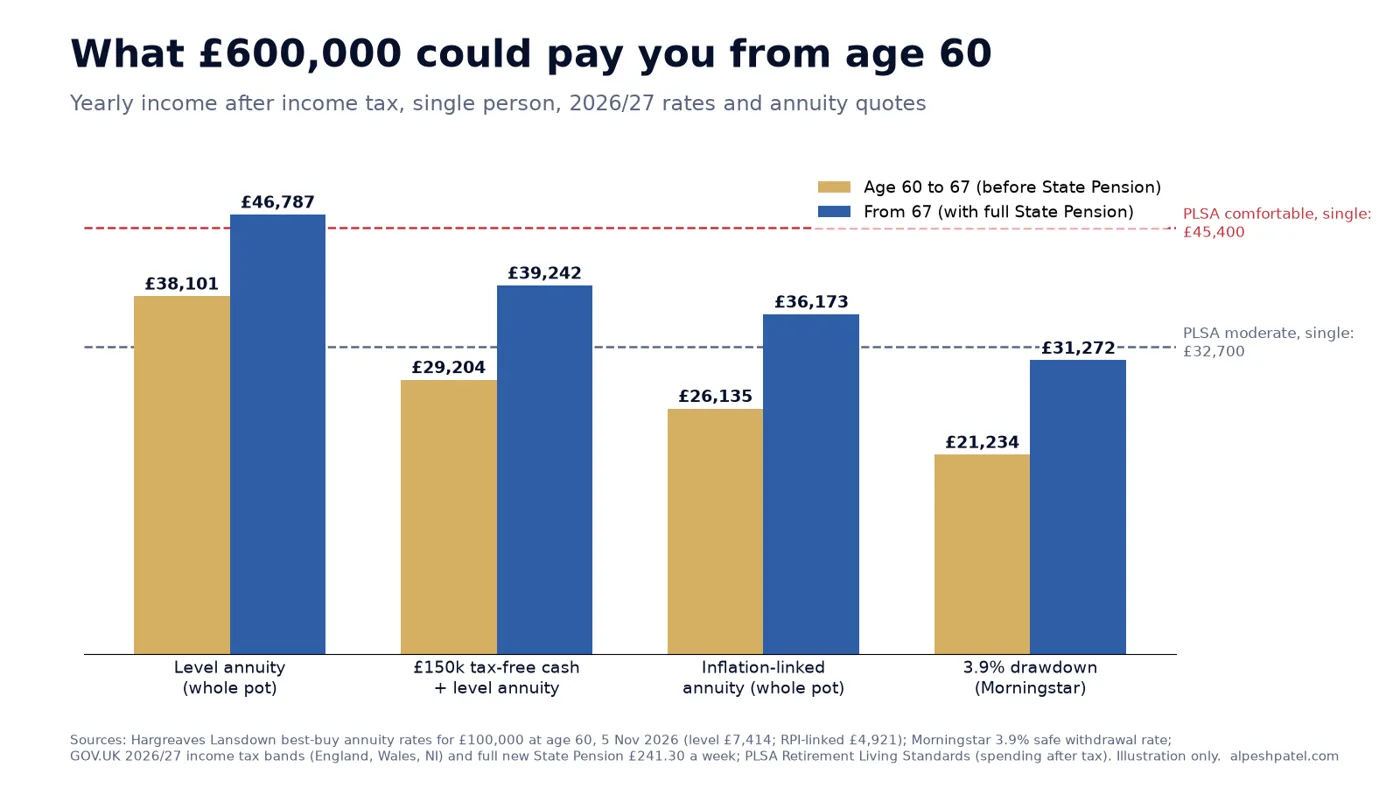
The chart puts the options side by side. It shows yearly income after income tax for a single person, using 2026/27 tax bands for England, Wales and Northern Ireland, first from 60 to 67 and then once the full State Pension starts.
| Option at 60 (single person) | Income before tax | After tax, age 60 to 67 | After tax, from 67 with State Pension |
|---|---|---|---|
| Level annuity, whole £600,000 | £44,484 | £38,101 | £46,787 |
| £150,000 tax-free cash, level annuity on £450,000 | £33,363 | £29,204 | £39,242 |
| Inflation-linked annuity, whole £600,000 | £29,526 | £26,135 | £36,173 |
| 3.9% drawdown | £23,400 | £21,234 | £31,272 |
The figures use GOV.UK income tax bands (opens in a new tab): no tax on the first £12,570, 20% up to £50,270 and 40% above that. Rates are different in Scotland. The State Pension figure is the full new State Pension of £12,547.60 a year.
Reading the table honestly
A level annuity on the whole pot just clears the PLSA comfortable standard once the State Pension arrives. But "level" means the income never rises. At 3% inflation, £46,787 would buy roughly what £30,000 buys today after about 15 years. You are swapping security now for a slowly shrinking lifestyle later.
The inflation-linked annuity is the opposite trade. It starts lower, below the moderate standard until 67, but it keeps its buying power for life. The drawdown option starts lowest of all, because a 3.9% rate is designed to survive bad markets over 30 years.
The seven-year gap: why retiring at 60 is harder than at 67
This is the part of the plan that catches people out. The State Pension age is rising from 66 to 67 between 2026 and 2028 (opens in a new tab). Anyone born after 5 March 1961 reaches State Pension age at 67, which includes everyone who is 60 today.
So if you retire at 60, your pension pot has to do all the work for seven years. Then, from 67, the State Pension takes some of the strain. That shape matters a great deal for how much you can spend.
Here is a simple way to see it. To spend the PLSA moderate standard of £32,700 a year after tax, a single person needs roughly £37,700 a year before tax. From 60 to 67, all of that has to come from the pot, which is about 6.3% of £600,000 a year. From 67, the State Pension covers £12,547.60, so the pot only needs to supply about £25,200, or around 4.2% of the original £600,000.
In other words, a moderate retirement from 60 on £600,000 is demanding in the first seven years and much easier afterwards. Over those seven years you would draw around £264,000 before tax, before any investment growth. The rest of the pot then has to last for the remaining decades.
How long does your money need to last?
According to the ONS national life tables (opens in a new tab), a 65-year-old in the UK can expect to live another 18.7 years for men and 21.2 years for women, based on 2022 to 2024 data. Those are averages. Roughly half of people will live longer, and a 60-year-old should plan for a retirement of 30 years or more.
That is why I treat the end of the plan as seriously as the start. Running out of money at 85 is a far bigger problem than spending a little less at 62.
What about the 25% tax-free lump sum?
You can usually take up to 25% of your pension as a tax-free lump sum (opens in a new tab), up to a maximum of £268,275. On a £600,000 pot, that is £150,000 tax-free.
The lump sum is valuable, but it is not free money. Every pound you take out is a pound that no longer produces pension income. In the table, taking £150,000 cash cuts the level annuity income from £44,484 to £33,363 a year before tax.
What you do with the cash decides whether that was a good trade. Using it to clear a mortgage can lower your spending needs for good. Leaving it in a current account usually loses ground to inflation. You can also take tax-free cash in stages, with 25% of each withdrawal tax-free, which can help keep more of your income in the basic-rate band.
Is £600,000 enough for a couple to retire at 60?
For a couple, the maths often looks better than it does for one person. Two full State Pensions would add about £25,095 a year once both partners reach 67. Two people also get two personal allowances, so the same total income is taxed less.
Against that, the PLSA standards for couples are higher: £45,400 for moderate and £62,700 for comfortable. If £600,000 is the couple's combined pension, the seven years before the State Pension will be tight at the comfortable level. If both partners have their own pensions as well, the picture can change completely.
How I would decide whether £600,000 is enough
I do not think there is a single right answer to this question, and anyone who gives you one without seeing your numbers is guessing. What I can share is the process I teach for working it out. It has five steps.
Step 1: Start with spending, not the pot
Work out what you actually spend now, and what will change in retirement. Many people spend less on commuting and work clothes, but more on travel and hobbies in the early years. The PLSA standards are a useful sense check, but your own figure is the one that matters.
Step 2: Map the income by stage
Split retirement into stages: before the State Pension, after the State Pension and later life. Write down where the income comes from in each stage. This makes the seven-year gap visible, rather than hiding it in an average.
Step 3: Build a floor, then add flexibility
Many retirees find peace of mind in covering essential bills with guaranteed income. That could be the State Pension plus a smaller annuity. The rest of the pot can then stay invested in drawdown for flexible spending, where you can cut back in bad years. A cash buffer of one to two years of spending can stop you selling investments after a market fall.
Step 4: Stress-test the bad years
The biggest risk in drawdown is a sharp market fall early in retirement, when the pot is largest. Test what happens if your investments fall 20% in your first two years. If the plan only works when markets behave, it is not a plan yet.
Step 5: Check the costs and the investments
Charges matter more in retirement, because you are no longer adding money to make up for them. A 1% annual fee on £600,000 is £6,000 a year, roughly a quarter of the 3.9% drawdown income. I explain this in what 1% a year really costs your portfolio. It is also worth checking what your fund actually holds, as I set out in cautious, balanced or adventurous pension.
Frequently asked questions
How much income will £600,000 give me at 60?
Using Hargreaves Lansdown annuity quotes from 5 November 2026, £600,000 could buy about £44,484 a year before tax from a level single-life annuity, or about £29,526 from an inflation-linked one. A cautious 3.9% drawdown rate would give £23,400 a year before tax.
Can I retire at 60 with £600k in the UK?
Many single people could fund a moderate retirement on £600,000 from 60, especially once the State Pension starts at 67. The first seven years are the hardest, because the pot pays for everything. Your spending, health, other income and investment approach decide whether it works for you.
Is it better to take an annuity or drawdown with £600,000?
It depends on what you value. An annuity gives certainty for life but little flexibility, while drawdown keeps your money invested and flexible but exposes you to market falls. Many people combine the two: guaranteed income for essentials and drawdown for everything else.
When can I get my State Pension if I am 60 now?
If you are 60 today, you were born after 5 March 1961, so your State Pension age is 67 under the current timetable. The full new State Pension is £241.30 a week in 2026/27, or £12,547.60 a year. You can check your own date on GOV.UK.
What to do next
- Write down your real spending. Use your bank statements from the last 12 months, then adjust for what will change when you stop work.
- Get your State Pension forecast. Check your forecast and State Pension age on GOV.UK, and fill any gaps in your National Insurance record if it makes sense.
- Map the seven-year gap. Work out how much your pot needs to pay between retirement and State Pension age, and test it with and without investment growth.
- Compare annuity quotes and drawdown. Get a real annuity quote for your age and health, and compare it with a cautious drawdown rate.
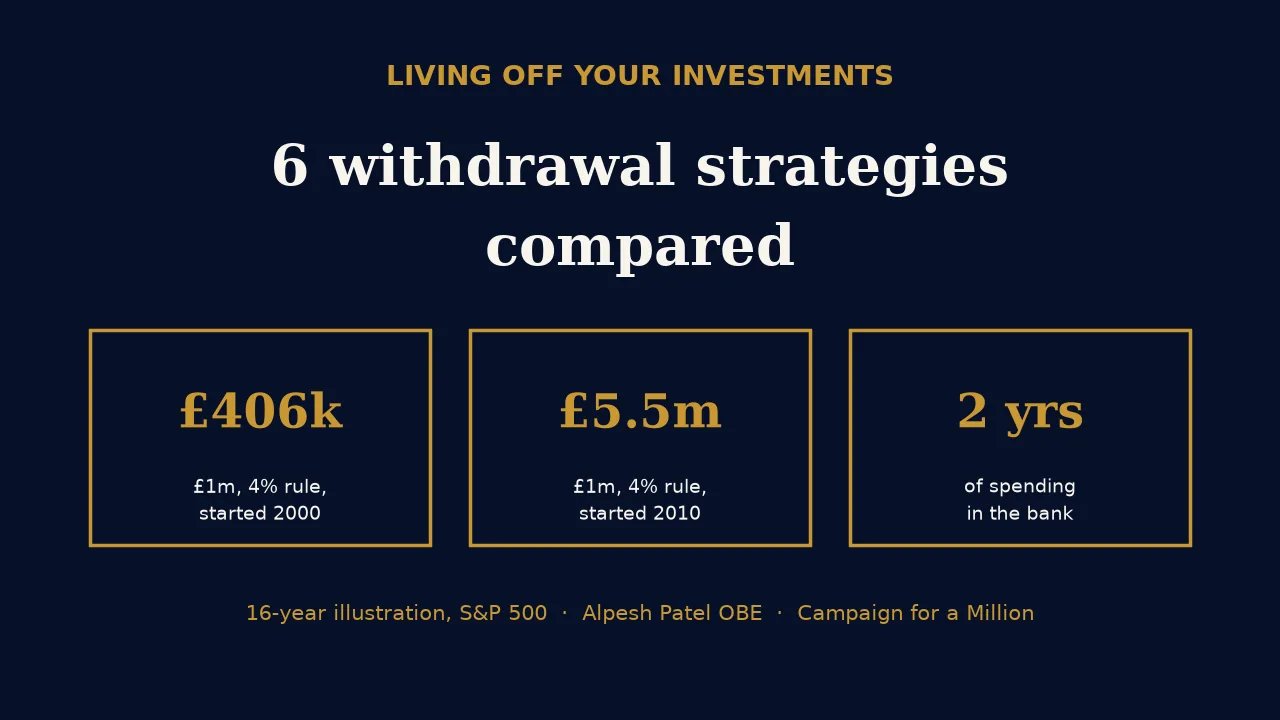
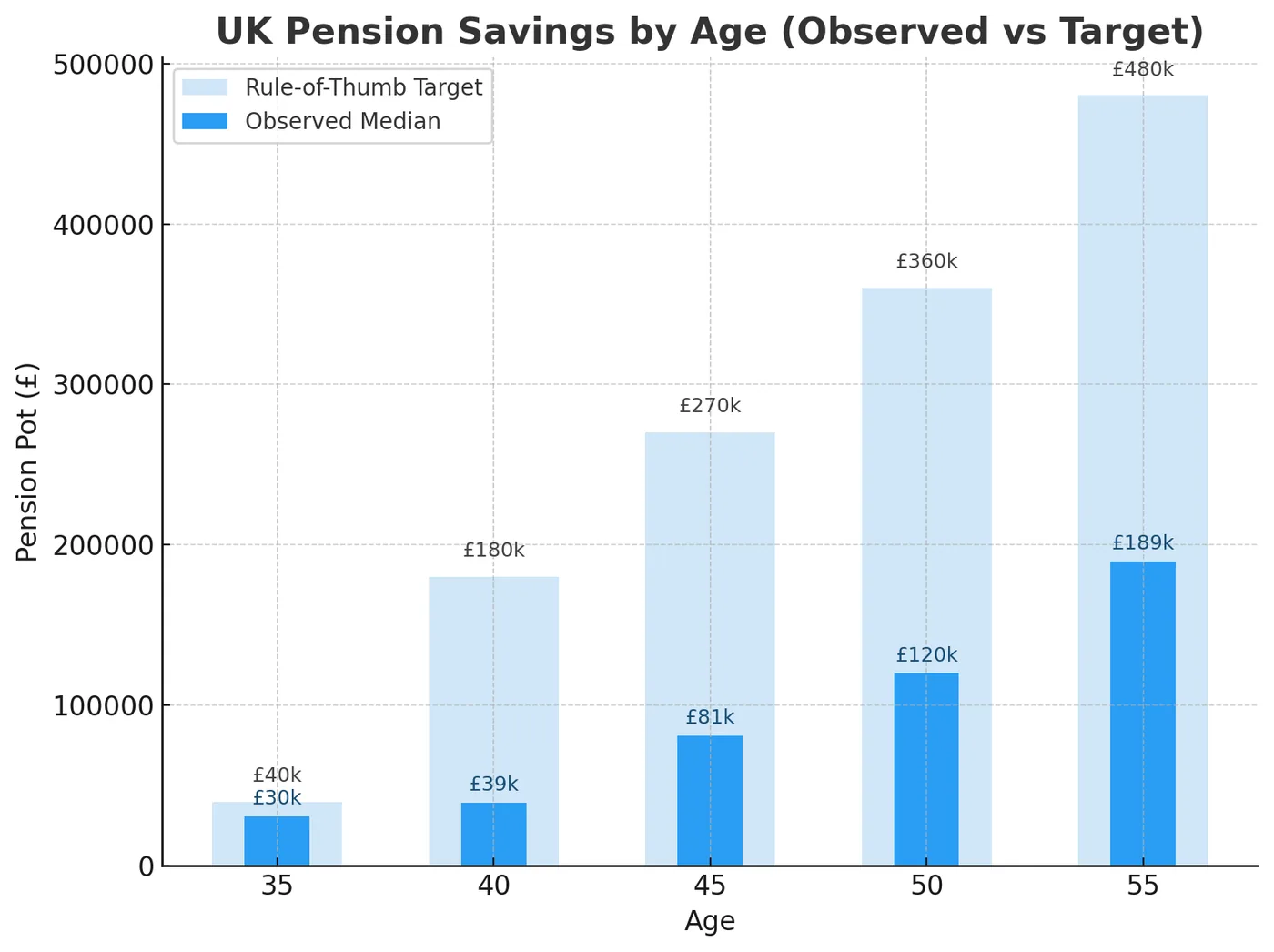
- Read the related guides. My posts on retiring on £250k, six withdrawal strategies compared and pension savings by age go deeper on each step.
Want to know if your pension can carry you from 60? Book your free call with Alpesh's team (opens in a new tab). We will walk you through how to map your income by stage, stress-test the early years and check what your investments are really costing. There is nothing to buy on the call.
About Alpesh Patel OBE
Alpesh Patel OBE is Founding Principal of Rootbridge Capital, an author and Dealmaker for the UK Government's Department for Business. He is a former Visiting Fellow in Business, Corpus Christi College, Oxford University, where he worked on technology to improve financial education. Watch his free investing education on YouTube (opens in a new tab).
Sources
- Hargreaves Lansdown, Best annuity rates (opens in a new tab), quotes dated 5 November 2026.
- Morningstar, What's a safe retirement withdrawal rate for 2026? (opens in a new tab)
- Pensions and Lifetime Savings Association, Retirement Living Standards (opens in a new tab).
- GOV.UK, Benefit and pension rates 2026 to 2027 (opens in a new tab).
- GOV.UK, State Pension age timetable (opens in a new tab).
- GOV.UK, Income Tax rates and Personal Allowances (opens in a new tab).
- GOV.UK, Lump Sum Allowance (opens in a new tab).
- Office for National Statistics, National life tables: life expectancy in the UK, 2022 to 2024 (opens in a new tab).
- Alpesh Patel OBE, Everything Changes Once You Save £500k In Retirement Savings (opens in a new tab), YouTube, 28 October 2026.
Important: This article is for education only and is not personal financial advice or a recommendation to buy or sell any investment. This article is general investment education only and is not regulated investment advice. Annuity rates change daily and depend on your age, health and postcode. Tax rules can change and depend on your circumstances. The value of investments can go down as well as up, and you may get back less than you invest. Past performance is not a reliable indicator of future results.
Important: this article is education and information only. It is not financial advice or a personal recommendation, and it does not take your circumstances into account. The value of investments and pensions can fall as well as rise, and you may get back less than you put in. Past performance is not a reliable indicator of future results. Figures were correct when the article was written and may have changed. If you are unsure what is right for you, speak to a regulated financial adviser.