L&G Lifetime Advantage Fund: Why a Retirement Date Is Not a Plan
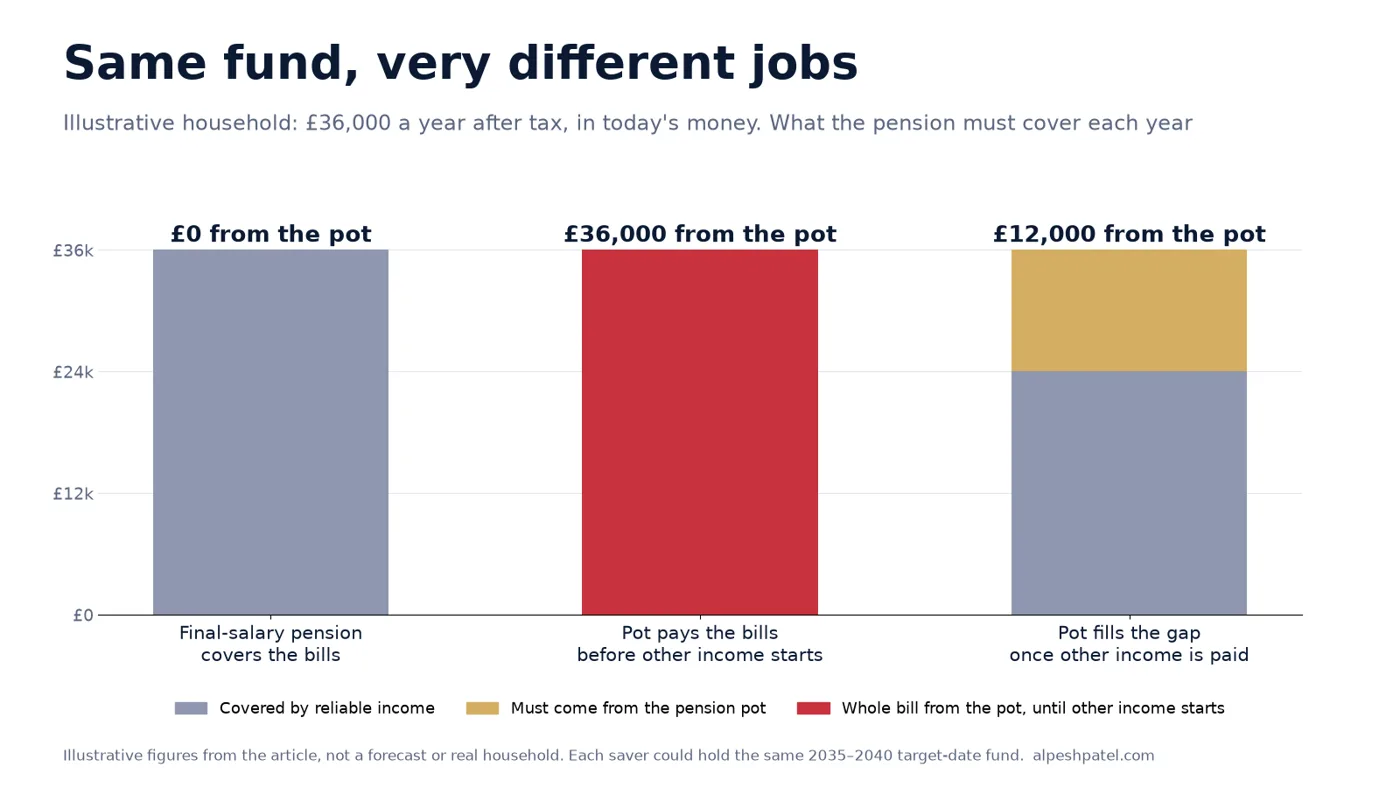
Two people plan to retire in 2038. One has a final-salary pension that covers the household bills and can leave their workplace pension invested for years. The other will need that pot to pay the bills as soon as their salary stops. Both could be invested in the L&G 2035–2040 Lifetime Advantage Fund. A bad year in the markets would have very different consequences for each of them.
That is the limitation of using a retirement date to choose a pension portfolio. The date tells you roughly when someone plans to stop working. It tells you very little about how much money they will need, when they will take it or how much of a loss they can absorb.
The L&G fund has a clear purpose. It spreads the money across different investments and adjusts the mix as retirement approaches, aiming to grow members’ retirement income in real terms while managing downside risk. For someone who wants their pension professionally managed with minimal involvement, that is a reasonable proposition. The price of that convenience is accepting the manager’s decisions about what you own and how your risk changes over time. L&G Lifetime Advantage Funds (opens in a new tab)
Short answer: The L&G Lifetime Advantage Fund is a target-date pension fund that sets and adjusts your mix of shares, bonds, cash and private assets by retirement date. That suits hands-off savers whose finances fit its glide path. It cannot see your other pensions, savings or spending dates, so check its allocation, what drove returns and your total charges before relying on it.
Not sure whether your pension fund fits the job you need it to do? Book your free call with Alpesh's team. We will look at your spending dates, your other assets and the disciplined process for building a portfolio around them. There is nothing to buy on the call.
You can choose the fund. L&G chooses the portfolio.
L&G decides how much the fund holds in shares, bonds, cash and other investments. It also decides how that mix evolves as the target date approaches. You may be able to select another fund within your workplace scheme. Inside this fund, however, you cannot ask L&G to keep your share allocation higher because your other pensions cover the bills, or to set aside cash because you plan to take a lump sum in three years. L&G Fund Centre (opens in a new tab)
That matters because a sensible allocation for the fund can still be a poor fit for the household. If your ISA already holds mostly shares, you might want the pension to do more of the defensive work. If you hold substantial cash elsewhere and expect to draw on the pension gradually over 25 years, you may be comfortable keeping more of it invested for growth. L&G can rebalance the fund. It cannot see the rest of your balance sheet.
A factsheet tells you more about what you own than why it moved
L&G publishes fund information and explains the investment strategy. The difficulty comes when you want to look through the fund to see the assets underneath and understand what drove your return. The strategy can hold other funds and invest in private markets. Private assets tend to be harder to sell and their values are typically estimated periodically. A steadier reported price can partly reflect how the assets are valued. It takes more work to tell how much risk you are carrying. L&G fund range profile (opens in a new tab)
I would ask three questions:
- What is my fund’s allocation today, including its actual private-market exposure?
- Which holdings contributed most to the last year’s gains or losses?
- What did I pay in total, in pounds, including any charges levied separately by my scheme?
Start with the fund code on your statement. L&G lists several versions with very similar names. L&G Fund Centre (opens in a new tab)
A strong year deserves credit. A short record deserves caution.
L&G’s WorkSave Mastertrust chair’s statement reported that the PMC 2035–2040 Lifetime Advantage Fund 3 returned 14.96% in the year to 31 March 2026, 6.44 percentage points ahead of its comparator. The same table had no three- or five-year figures. Those are encouraging early results for that version. They leave open the question that matters most to someone approaching retirement: how does the strategy hold up through a sustained fall when you are taking money out? L&G WorkSave Mastertrust chair’s statement (opens in a new tab)
The same statement gives that version a launch date of 15 May 2024, which is why there is no longer record to judge. L&G WorkSave Mastertrust chair’s statement (opens in a new tab)
| L&G PMC 2035–2040 Lifetime Advantage Fund 3 | Figure |
|---|---|
| Return, year to 31 March 2026 | 14.96% |
| Ahead of its comparator by | 6.44 percentage points |
| Three-year and five-year annualised returns | Not shown (N/A) |
| Launch date | 15 May 2024 |
Source: L&G WorkSave Mastertrust (RAS) chair’s statement 2026 (opens in a new tab). Past performance is not a reliable indicator of future results.
I would judge the fund against its own comparator and a low-cost portfolio with broadly similar exposure to shares and defensive assets, over the same dates and after charges. Then I would look at how far each fell in difficult markets and how long it took to recover. A US equity index can tell you what US shares did. Comparing it directly with a mixed pension fund tells you much less about whether the manager earned their keep.
Start with how much you need, and when
Suppose you expect to spend £36,000 a year after tax, in today’s money, and other reliable income will cover £24,000 once it is all in payment. Your portfolio has to cover the £12,000 annual gap from that point. If your State Pension or another source of income starts several years after you stop working, work out that earlier gap separately. You may have two different spending needs from the same portfolio, with very different deadlines.
The free tools linked from alpeshpatel.com let you put numbers on those decisions. Use Pension Plan (opens in a new tab) to explore what changes when you alter contributions or growth assumptions. Use FIRE (opens in a new tab) to test when early retirement might be affordable. Portfolio Odds (opens in a new tab) helps you explore the chance of a loss under its assumptions. Run a weaker-return scenario and one where you stop working earlier than planned. You want to know which assumption makes the plan buckle while you still have time to change it. If you are relying on a single equity fund to pay those bills, read why a global equity index fund won't pay the bills on its own. Retirement income planning guide
What self-directed investors gain, and what they take on
If you have the time, inclination and discipline to manage your own investments, you can choose from a range of portfolios and see what each is designed to do. You could use a simple mix of broad listed funds, separate money for near-term withdrawals from money invested for longer-term growth, or build a diversified portfolio of funds and individual shares. How much flexibility you have inside your workplace pension depends on the scheme.
With a transparent portfolio, you can see the holdings, their weights and the published fund costs. You can decide how much exposure you want to any one market and check whether two funds with different names own much the same companies. You can write down when you will rebalance and what would justify a change. That last part matters. A portfolio you can change at any time is only an advantage if you can resist changing it every time the market gives you a fright.
The L&G fund may suit someone who values an automatically managed portfolio and whose finances broadly fit the way it adjusts risk. For a willing and able self-directed investor, the attraction is being able to build around your own spending dates, see what you own and judge whether every holding earns its place. Before choosing either route, put a figure and a date on the first withdrawal your portfolio will have to fund. That figure will tell you more about the job your pension has to do than the date printed in the fund’s name.
What to do next
- Find your exact fund. Take the fund code from your statement and look it up in the L&G Fund Centre (opens in a new tab), as several versions have near-identical names.
- Ask the three questions. Today’s allocation including private markets, what drove the last year’s return, and your total cost in pounds.
- Put a figure and a date on your first withdrawal. Work out the gap before and after your State Pension or other income starts.
- Stress-test the plan. Run a weaker-return and an earlier-retirement scenario in Pension Plan (opens in a new tab), FIRE (opens in a new tab) and Portfolio Odds (opens in a new tab).
- Compare like with like. Judge the fund against its comparator and a low-cost portfolio with similar exposure, after charges, including how far each fell and how long it took to recover. My earlier review, L&G Target Date Fund: Steady, Safe and Subpar, shows how.
Want a disciplined process built around your own spending dates? Book your free call with Alpesh's team. We will show you how to see what you own, set money aside for near-term withdrawals and judge whether every holding earns its place.
Frequently asked questions
What is the L&G Lifetime Advantage Fund?
It is a range of L&G target-date funds used in workplace pensions, each named after a band of retirement years such as 2035–2040. L&G spreads the money across shares, bonds, cash and other investments, including private markets, and adjusts the mix as the target date approaches.
How has the L&G 2035–2040 Lifetime Advantage Fund performed?
L&G’s WorkSave Mastertrust chair’s statement reported that the PMC 2035–2040 Lifetime Advantage Fund 3 returned 14.96% in the year to 31 March 2026, 6.44 percentage points ahead of its comparator. It launched on 15 May 2024, so no three- or five-year figures were shown. Past performance is not a reliable indicator of future results.
Can I change the mix of investments inside a target-date fund?
No. Inside the fund, L&G decides the allocation and how it changes over time. You may be able to choose a different fund within your workplace scheme, or manage a portfolio yourself in a pension that allows it.
Why does my retirement date not tell me which fund to choose?
The date tells you roughly when you plan to stop working, not how much you will need, when you will take it or how large a loss you can absorb. Two savers retiring in the same year can need very different portfolios.
About Alpesh Patel OBE
Alpesh Patel OBE is Founding Principal of Rootbridge Capital, an author and Dealmaker for the UK Government's Department for Business. He is a former Visiting Fellow in Business, Corpus Christi College, Oxford University, where he worked on technology to improve financial education.
Sources
- Legal & General, Lifetime Advantage Funds (opens in a new tab)
- Legal & General, Workplace employee Fund Centre: Lifetime Advantage (opens in a new tab)
- L&G Asset Management, Lifetime Advantage Fund range product profile (opens in a new tab)
- Legal & General, WorkSave Mastertrust (RAS) chair’s statement 2026 (opens in a new tab), performance to 31 March 2026
- Alpesh Patel OBE, Build a retirement income
Important: This article is for education only and is not personal financial advice or a recommendation to buy or sell any investment. This article is general investment education only and is not regulated investment advice. The value of investments can go down as well as up, and you may get back less than you invest. Past performance is not a reliable indicator of future results.
Important: this article is education and information only. It is not financial advice or a personal recommendation, and it does not take your circumstances into account. The value of investments and pensions can fall as well as rise, and you may get back less than you put in. Past performance is not a reliable indicator of future results. Figures were correct when the article was written and may have changed. If you are unsure what is right for you, speak to a regulated financial adviser.