Should I Combine My Pensions? 7 Checks Before You Consolidate Old Pots in 2026
Should I combine my pensions? It is one of the most common questions I hear from investors in their forties, fifties and sixties. Most of them have worked for several employers, and each job has left a pension behind. The Department for Work and Pensions has long estimated that people have on average 11 jobs during their working life (opens in a new tab), which can mean as many workplace pensions to keep track of.
Many of those pots are simply forgotten. The Pensions Policy Institute estimates there are now 3.3 million lost pension pots containing £31.1 billion (opens in a new tab) in the UK. The average lost pot is worth £9,470. That is real money sitting in default funds, often with charges nobody has looked at for a decade.
Combining pensions can cut costs, make your money easier to manage and help you invest with a clear process. But it can also destroy value if you move a pot that carries a guarantee, an exit fee or an employer contribution. In this guide I set out the seven checks I would make before consolidating, explain what the new small pots rules in the Pension Schemes Act 2026 mean for you, and show how to avoid the scams that target people doing exactly this.
Short answer: Combining pensions usually makes sense when your old pots are ordinary defined contribution pensions with higher charges, weak funds and no special features. Before you move anything, check each pot for exit fees, guaranteed annuity rates, protected tax-free cash, a protected pension age and employer contributions. Never transfer a final salary pension worth over £30,000 without regulated advice, and never act on a cold call.
Not sure whether your old pensions are worth combining? Book your free call with Alpesh's team (opens in a new tab). We will show you how to list your pots, compare their real costs and spot the features you should never give up. There is nothing to buy on the call.
Why so many UK savers have scattered pension pots
Automatic enrolment, which started in October 2012, has been a success at getting people saving. But every new employer usually means a new pension scheme. When you leave, the pot stays behind, contributions stop and the money keeps sitting in whichever fund it was defaulted into.
The government's own figures show how big the problem has become. Its September 2026 consultation, Small Pots: a pathway for consolidation (opens in a new tab), says there are around 13 million deferred small pension pots worth less than £1,000, holding over £4 billion in total. That number is growing by around one million a year, and the Department for Work and Pensions estimates that these pots cost the industry £240 million a year in administration, costs that ultimately fall on members.
Lost pots are a separate and larger problem. The Pensions Policy Institute's Lost Pensions 2024 (opens in a new tab) report found that the number of lost pots rose from about 1.62 million in 2018 to about 3.29 million in 2024. The money in them rose from £19.4 billion to £31.1 billion.
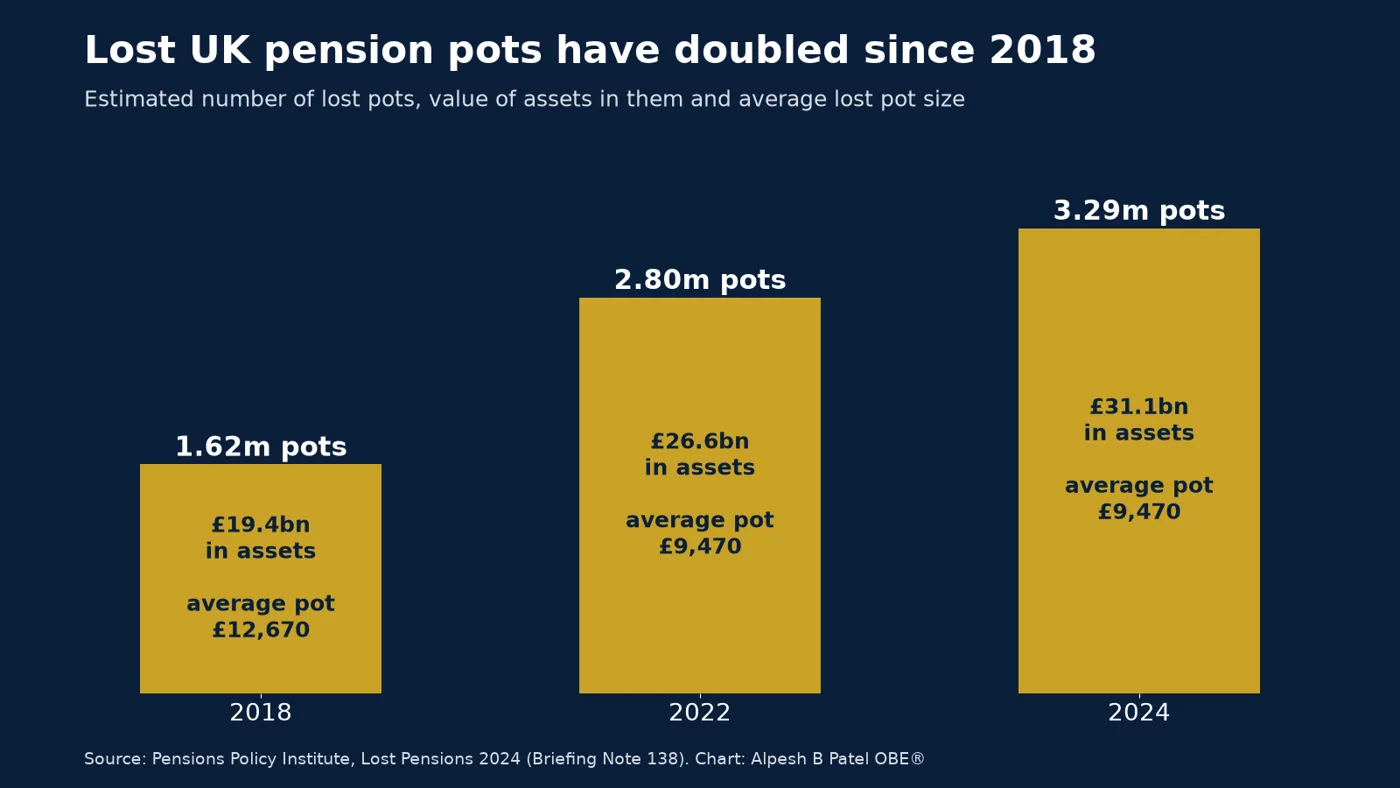
The same report says the average lost pot is largest among people aged 55 to 74, at £13,620. That is the age group closest to retirement, and the one that can least afford to leave money drifting.
What are the benefits of combining pensions?
There are three good reasons to bring old pots together. None of them is a guarantee of better returns, but each one tilts the odds in your favour.
Lower charges, compounded over decades
Charges matter more than most people think. Workplace default funds used for automatic enrolment have been subject to a charge cap of 0.75% a year (opens in a new tab) since April 2015. Older personal pensions and pre-2012 schemes may not be covered by that cap, and some charge well over 1% once fund and policy charges are added together.
Here is my own illustration of why it matters. It assumes a £100,000 pot, 5% a year growth before charges and no new contributions over 20 years. The growth rate is an assumption for comparison only, not a forecast.
| Total yearly charge | Pot after 20 years | Difference against 0.3% |
|---|---|---|
| 0.3% | £249,856 | – |
| 0.75% | £228,242 | £21,614 less |
| 1.0% | £217,015 | £32,841 less |
The gap between a 0.3% and a 1% charge is nearly a third of the original pot. That is the cost of not looking. My post on what 1% a year really costs your portfolio goes into this in more detail.
One clear picture of your money
With five pots in five places, most people cannot answer simple questions. How much do I have? What is it invested in? What am I paying? Is it doing better or worse than a sensible benchmark?
When the money is in one place, you can see your total asset mix, check your risk and track performance properly. That is the starting point for any disciplined investing process.
Better fund choice
Many old workplace pots sit in the scheme's default fund. Some of these are fine. Others have lagged for years. I have reviewed several popular ones, including the Scottish Widows CS8 pension portfolios and the Aviva pension funds, and the differences between the best and worst options are large.
The 7 checks before you combine pensions
This is where people go wrong. The benefits of combining are real, but so are the things you can lose. MoneyHelper's guidance on transferring defined contribution pensions (opens in a new tab) warns that if the new scheme does not offer the same features as your existing pension, you will lose those benefits by moving.
That is why I would work through these seven checks for every pot, in writing, before moving a penny. Most take one phone call or email to each provider.
1. Is it a defined contribution or a defined benefit pension?
This is the most important question. A defined contribution pension is a pot of money invested in funds. A defined benefit pension, often called a final salary pension, promises you a set income for life.
Giving up a guaranteed income for life is rarely a good idea. The law reflects that. The Pensions Regulator says that where the transfer value of safeguarded benefits is more than £30,000 (opens in a new tab), schemes must check that the member has taken advice from an adviser regulated by the Financial Conduct Authority before the transfer goes ahead. If any of your pots is a final salary pension, treat it separately and get regulated advice.
2. Are there exit fees?
Some older personal pensions charge you to leave. The good news is that these fees are now limited for many savers. The FCA capped early exit charges at 1% (opens in a new tab) of the pot's value for existing contract-based personal pensions, including workplace personal pensions, for people aged 55 and over from 31 March 2017.
If you are under 55, the cap may not apply, so ask the provider in writing for the exact exit charge. Then compare it with the yearly saving from moving. A one-off 1% fee can be worth paying if it cuts your charges by 0.5% a year for 15 years. It is not worth paying if the saving is tiny.
3. Is there a guaranteed annuity rate?
Some older policies, often taken out in the 1980s and 1990s, promise a guaranteed annuity rate. MoneyHelper says these might let you convert your pension into a higher guaranteed income (opens in a new tab) than you could get elsewhere. If you transfer, the guarantee is usually lost for good.
The only way to know is to read the policy documents or ask the provider directly. Ask a simple question: "Does this policy include any guaranteed annuity rate or guaranteed minimum pension?"
4. Is there protected tax-free cash or a protected pension age?
Some older schemes allow you to take more than the usual 25% as tax-free cash. Some let you access your pension before the normal minimum pension age. MoneyHelper lists a protected normal minimum pension age (opens in a new tab) as one of the special features to check before moving.
These protections are often tied to the scheme. Move the pot on your own and you may lose them. Ask each provider whether either applies, and get the answer in writing.
5. Is there a with-profits bonus or a market value reduction?
With-profits funds smooth returns over time and may add a final bonus at a set date. Leave early and you may lose that bonus, or face a market value reduction that cuts your transfer value. MoneyHelper flags with-profits bonuses (opens in a new tab) as a feature to check before any transfer.
If you hold an old with-profits policy, such as a PruFund-type fund, my Prudential pension fund review explains what to look for. Ask the provider for the transfer value with and without any market value reduction, and the date of any guaranteed bonus.
6. Is your employer still paying in?
Do not move your current workplace pension while you are still working there. MoneyHelper notes that many employers will not pay their contribution into a different scheme (opens in a new tab). Losing your employer's contribution is almost always a bad trade.
The usual approach is to keep your current workplace pension running and consider combining only the pots from previous employers. You can always revisit the decision when you leave.
7. Is the pot small enough to cash in under the small pot rules?
If a pot is worth less than £10,000 and you plan to take it all in one go, it may be better left where it is. MoneyHelper explains that small pot rules (opens in a new tab) let you take the whole pot as one lump sum with 25% tax-free, without reducing your annual allowance for tax relief or your lump sum allowance.
Merge that pot into a bigger one and you lose the option. For people near retirement, that can be worth more than the saving on charges.
What the Pension Schemes Act 2026 means for small pots
The government is now acting on tiny forgotten pots. The Pension Schemes Act 2026 (opens in a new tab) sets up a system in which small defined contribution pots of £1,000 or less, held in default arrangements of automatic enrolment schemes, will be automatically moved to an authorised consolidator if no contributions have been paid for at least 12 months.
The detail is still being worked out. The Department for Work and Pensions' consultation (opens in a new tab) closes on 17 November 2026. It says the government's ambition is for small pot consolidation to be operational from 2030, when about 20 million small dormant pots could be in scope.
Three points matter for you:
- You will be able to opt out. The consultation says members keep the ability to opt out or choose their own consolidator, with a notice period of at least 30 days before any transfer.
- It is only for very small default pots. Pots above £1,000, self-select investments, pre-2012 pots, SIPPs and pots with guarantees are excluded in the first phase.
- It does not do the thinking for you. A consolidator will tidy up tiny pots, but it will not check whether your larger pots are in good funds or charging too much.
There is a second change on the way. Schemes had to connect to the pensions dashboards system by 31 October 2026 (opens in a new tab). The Pensions Dashboards Programme expects the free MoneyHelper Pensions Dashboard (opens in a new tab) to be open to the public in the 2027/28 financial year. That will make finding old pots much easier, but you do not need to wait for it.
How to find lost pensions today
You can start now, for free. The government's Pension Tracing Service (opens in a new tab) lets you search for contact details of workplace and personal pension schemes. It will not tell you whether you have a pension or how much it is worth, but it will tell you who to contact.
Before you search, gather a list of every employer you have worked for, with rough dates, and any old paperwork. Old payslips and P60s often show the scheme name. Then contact each scheme and ask for:
- the current value and transfer value;
- the fund or funds you are invested in;
- all charges, in pounds and as a percentage;
- any exit fees, guarantees, bonuses or protections;
- the type of pension (defined contribution or defined benefit).
Put the answers in one simple table. That table is the single most useful thing you can create before making any decision.
How to avoid pension transfer scams
People moving pensions are a prime target for fraud. Action Fraud figures cited by The Pensions Regulator (opens in a new tab) show £17.7 million lost to pension fraud, an average of £47,000 per victim.
MoneyHelper is blunt: do not transfer your pension or invest because of a cold call, visit, email or text (opens in a new tab), because it is likely to be a scam. You could lose your money and face a large tax bill.
The warning signs to watch for:
- unexpected contact about a "free pension review";
- promises of high or guaranteed returns;
- pressure to act quickly or "before the rules change";
- offers to release cash before age 55;
- overseas or unusual investments you do not understand;
- anyone who is not on the FCA Register (opens in a new tab).
Your current provider must also carry out checks before a transfer. MoneyHelper says that if a provider is worried the new scheme may be a scam, it can stop the transfer or delay it until you have booked a free Pension Safeguarding Guidance appointment. Those checks are there to protect you, so do not see them as red tape.
Where should you combine your pensions?
If the seven checks come back clear, the next question is where to move the money. The main choices are your current workplace pension, if it accepts transfers in, or a self-invested personal pension (SIPP).
A current workplace scheme can be cheap and simple, especially if it has a low-cost default fund. A SIPP gives you much wider investment choice and full control, but the charges vary a lot between providers. My guide to the cheapest SIPP for drawdown in 2026 compares the yearly cost at HL, AJ Bell, Fidelity, interactive investor and Vanguard at different pot sizes.
The platform matters less than what you do with the money once it arrives. Combining five pots into one poorly chosen fund just gives you one bigger problem. The point of consolidating is to give yourself a clear, disciplined process: a sensible asset mix, a benchmark to measure against and a regular review.
How I would approach combining pensions
When I look at someone's scattered pensions, I follow the same order every time. The process matters more than any single fund choice.
- List everything. Every pot, its value, fund, charges and type, in one table.
- Rule out the pots that should not move. Final salary pensions, pots with guarantees or protections, pots your employer still pays into and small pots you may want to cash in under the small pot rules.
- Compare the rest honestly. Look at total charges and performance against a fair benchmark over five and ten years, not just the last year.
- Decide the destination and the investment plan together. Where the money goes and how it will be invested are one decision, not two.
- Move in stages if needed. Transfers can take weeks. Request transfers as cash or in specie, understand any time out of the market and check every transfer arrives in full.
Frequently asked questions
Is it a good idea to combine pensions?
It often is for ordinary defined contribution pots with higher charges and no special features, because it can cut costs and make your money easier to manage. It is usually a bad idea for final salary pensions, pots with guaranteed annuity rates or protected tax-free cash, and pots your employer still pays into. Check each pot in writing first.
Do you lose money when you combine pensions?
You can, if you pay an exit fee, lose a guarantee or are out of the market while the transfer is processed. Exit charges for people aged 55 and over in existing contract-based personal pensions are capped at 1% by the FCA. Compare any one-off cost with the yearly saving before deciding.
How do I find old pensions I have lost track of?
Use the free government Pension Tracing Service at gov.uk to find contact details for old schemes, then contact each one with your name, date of birth, National Insurance number and employment dates. The MoneyHelper Pensions Dashboard is expected to be available to the public in the 2027/28 financial year.
Will the government combine my small pensions automatically?
Under the Pension Schemes Act 2026, small dormant default pots worth £1,000 or less in automatic enrolment schemes are due to be moved to authorised consolidators, with the government aiming for this to work from 2030. You will be able to opt out. Larger pots will not be moved for you.
What to do next
- Trace every pot. Use the Pension Tracing Service (opens in a new tab) and old paperwork to list every scheme you have been in.
- Ask each provider the same questions. Value, funds, charges, exit fees, guarantees, protections and pension type, in writing.
- Build one table. Put every answer side by side so you can compare like for like.
- Rule out the pots that should stay. Use the seven checks above.
- Read the related guides. My guide to combining old pensions and the post on pension savings by age in the UK will help you see whether you are on track.
Want a second pair of eyes on your old pensions? Book your free call with Alpesh's team (opens in a new tab). We will walk you through how to compare your pots, spot the features worth keeping and build a clear investing process for the money you bring together. There is nothing to buy on the call.
About Alpesh Patel OBE
Alpesh Patel OBE is Founding Principal of Rootbridge Capital, an author and Dealmaker for the UK Government's Department for Business. He is a former Visiting Fellow in Business, Corpus Christi College, Oxford University, where he worked on technology to improve financial education. Watch his free investing education on YouTube (opens in a new tab).
Sources
- Pensions Policy Institute, Briefing Note 138: Lost Pensions 2024 (opens in a new tab) and full report (PDF) (opens in a new tab).
- Department for Work and Pensions, Small Pots: a pathway for consolidation (opens in a new tab), 15 September 2026.
- The Pensions Regulator, Pension Schemes Act 2026 (opens in a new tab).
- The Pensions Regulator, Dealing with transfer requests (opens in a new tab).
- The Pensions Regulator, Fighting pension fraud reference slides (PDF) (opens in a new tab), March 2025.
- Financial Conduct Authority, FCA introduces cap on early exit pension charges (opens in a new tab).
- Financial Conduct Authority, FCA Register (opens in a new tab).
- GOV.UK, Review of the default fund charge cap and standardised cost disclosure (opens in a new tab).
- GOV.UK, New Pension Tracing Service website launched (opens in a new tab) and Find pension contact details (opens in a new tab).
- GOV.UK, Pensions dashboards: guidance on connection (opens in a new tab).
- Money and Pensions Service, Pensions Dashboards Programme progress update, June 2026 (PDF) (opens in a new tab).
- MoneyHelper, Transfer or combine defined contribution pensions (opens in a new tab).
- Alpesh Patel OBE, You Don't Know Why Your Pension Is Underperforming (opens in a new tab), YouTube.
Important: This article is for education only and is not personal financial advice or a recommendation to buy or sell any investment. This article is general investment education only and is not regulated investment advice. The value of investments can go down as well as up, and you may get back less than you invest. Past performance is not a reliable indicator of future results.
Important: this article is education and information only. It is not financial advice or a personal recommendation, and it does not take your circumstances into account. The value of investments and pensions can fall as well as rise, and you may get back less than you put in. Past performance is not a reliable indicator of future results. Figures were correct when the article was written and may have changed. If you are unsure what is right for you, speak to a regulated financial adviser.