Goldman Sachs Research, November 2026: Five Signals for Investors, Explained
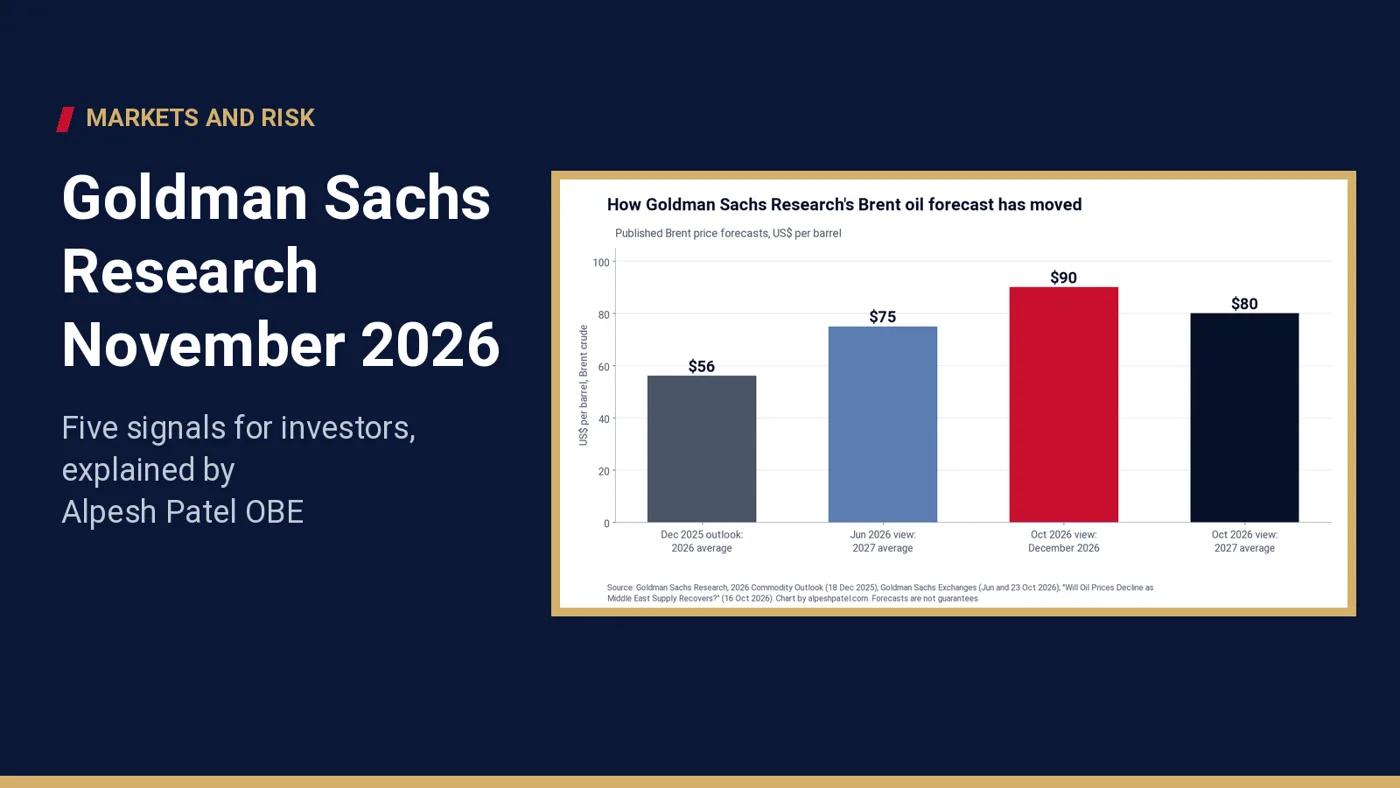
On 18 December 2025, Goldman Sachs Research told its clients that Brent crude would average $56 a barrel in 2026 (opens in a new tab). Ten months later, after a war in the Gulf, the same team expects Brent to end this year at $90 and to average $80 in 2027 (opens in a new tab). That is not a criticism. It is the single most useful thing to know before you read any bank's research.
Years ago, Goldman turned down my fund. "Come back when you've got £50m," I was told. "I'll just check my other pocket," I replied. Today, much of the research its clients once paid for sits free on its website, and this month's Goldman Sachs research is some of the most relevant I have read all year: Germany's export rebound, China's AI race, a defence "supercycle", oil, bond yields, luxury goods and US housing.
So I have read the November material for you and pulled out five signals, grouped into three ideas you can actually use. This is education. No tips, no forecasts of my own, and one rule throughout: research is an input to your process, never a substitute for it.
Short answer: Goldman Sachs Research's latest work (October 2026) says the AI investment boom is spreading to industrial exporters, networking and small businesses; security spending looks structural rather than cyclical; and bond yields and oil remain the main risks. It forecasts Brent at $80 in 2027 and US mortgage rates easing only to 6.4%.
Want help turning bank research like this into a process you can actually follow? Book your free call with Alpesh's team (opens in a new tab). We will show you how to test a theme, size a position and decide in advance when to sell. There is nothing to buy on the call.
What is Goldman Sachs Research saying in November 2026?
Goldman's own summary is that investment cycles are now moving through the real economy in five ways: trade, technology, financing costs, energy and consumer demand. I have kept their five themes but grouped them into three questions an investor should ask.
| Theme | Goldman's headline number | Source |
|---|---|---|
| German exports | Real exports to grow 3.5% in 2026 and 2.4% in 2027 | Goldman Sachs Research (opens in a new tab) |
| AI networking | Optical networking market to grow about 9x to US$154bn, mainly by 2028 | Goldman Sachs Research (opens in a new tab) |
| Small-business AI | 86% of surveyed graduates use AI; 42% use it for financial analysis and planning | 10,000 Small Businesses report (opens in a new tab) |
| Oil | Brent $90 in December 2026; $80 average in 2027 | Goldman Sachs Research (opens in a new tab) |
| Bond yields | Higher rates to cut US growth by 0.2pp in 2027, or about 0.5pp if yields stay put | Top of Mind, Issue 152 (opens in a new tab) |
| Luxury goods | Revenue growth of 6% in 2026, rising to 7% in 2027 | Goldman Sachs Research (opens in a new tab) |
| US housing | 30-year mortgage rate 7.32% (22 October), forecast 6.4% in 2027 | Goldman Sachs Research (opens in a new tab) |
The three questions are simple. Where is the AI money actually going? Is the security spending boom real? And what could knock the whole thing off course?
Signal one: the AI boom is spreading beyond the famous names
Most private investors' AI exposure is a handful of US giants, usually through a tracker fund. Goldman's October research is a reminder that the money those giants spend has to land somewhere, and much of it lands in places most people never look.
German exports are turning a corner
Start in Hamburg's container port rather than Silicon Valley. Germany's exports had been a drag on growth since the 2022 energy crisis, and for most of the period since 2000 they grew far less than foreign demand. Goldman now expects real exports to grow by a "robust" 3.5% in 2026 and 2.4% in 2027 (opens in a new tab), helped by renewed trade with the US and EU and by the global AI build-out.
"We are more optimistic about German export performance than at the start of 2026," wrote Goldman economist Niklas Garnadt. He also warned that competition from Chinese exporters will keep weighing on German exports in the medium term, particularly in third markets.
Why it matters: AI spending has second-order beneficiaries. Industrial suppliers, electronics makers and equipment exporters can win business from data-centre construction without being software companies at all.
China's AI race is moving past the model
In China, Goldman's Ronald Keung says the performance gap between leading AI models is narrowing, especially in coding. "The key may be in cost efficiencies and on the harness layer," he said in Goldman's October report on China's AI models (opens in a new tab). The harness layer is the ecosystem around a model that lets it reach data and follow real business workflows.
The same report says China's semiconductor industry is progressing faster than the market expected, though shortages of GPUs, local foundry capacity and chip-making equipment remain.
Why it matters: if models become similar, the money may shift from whoever builds the cleverest model to whoever makes AI cheap, reliable and useful inside a business.
The bottleneck nobody photographs: optical networking
An AI cluster is thousands of chips that must talk to each other at enormous speed. Goldman calls networking the next "mega trend" in AI infrastructure and expects a roughly ninefold expansion in the optical networking market to US$154bn (opens in a new tab), mainly by 2028, as chips are linked by optical modules and co-packaged optics.
Why it matters: AI performance depends on more than the accelerator chips that get the headlines. As clusters grow, the cables and switches connecting them can become the constraint, and a separate pool of investment.
Small businesses are already using AI to make decisions
My favourite detail this month comes from a fuel distributor outside Atlanta. Marie Hunter, president of KRG Oil Company, asked her AI agent to cost a small modification to a few customers' fuel tanks. It came back with a plan for a whole new product line (opens in a new tab). She named the agent Billi Jean.
That one story sits on top of hard numbers. In a survey of 2,473 graduates of Goldman's 10,000 Small Businesses programme, 86% use AI, up from 56% in 2024 (opens in a new tab). Use for financial analysis and business planning has jumped from 18% of AI users to 42%. Yet only 15% have fully built AI into their core operations.
Why it matters: adoption is no longer the question. The gap between using a chatbot and redesigning a business around AI is where the next wave of spending, and disappointment, will come from.
Signal two: the security supercycle looks structural
The Goldman Sachs Global Institute's report, The Security Supercycle (opens in a new tab), argues that geopolitical competition, active conflict and new technology are driving a long investment cycle in defence and resilience. Its point is that this is about more than bigger military budgets.
Goldman highlights four strands:
- Rearmament: a higher baseline of demand for credible defence capability.
- AI-enabled systems: cheap unmanned platforms are "changing the economics of warfare", with capital flowing to defence-tech start-ups as well as established contractors.
- Dual-use technology: drones for inspecting critical infrastructure and distributed power systems that serve both military and civilian users.
- Resilience: sovereignty, strategic autonomy and secure supply chains, backed by industrial policy and cross-border partnerships.
Goldman expects the strongest opportunities to earn a "readiness premium": businesses with scarce capabilities that customers must keep paying for through the cycle. Its separate German outlook expects German defence spending to reach 3.3% of GDP by 2029 (opens in a new tab).
Why it matters: the theme reaches well beyond defence contractors, into advanced manufacturing, energy technology and the supply chains behind both. It is also a theme where enthusiasm can run well ahead of earnings, so it needs the same scrutiny as AI.
Signal three: rates and oil decide how long the good times last
The first two signals are about where money is flowing. The third is about what could interrupt it. Goldman's research is unusually clear that bond yields and oil are the risk multipliers for everything above.
Higher bond yields: resilient, but not risk-free
Goldman's Top of Mind report (Issue 152, 13 October 2026) (opens in a new tab) asks how worried investors should be about higher yields. Its baseline has the Federal Reserve raising rates once more in December, then cutting three times from the second half of 2027, with 10-year Treasury yields falling to 4.4% by the end of 2027.
On that path, higher rates subtract only about 0.2 percentage points from US growth in 2027. If rates stay near current levels, the drag more than doubles to just over 0.5 points. The report also asks the question that matters most for AI investors: can an increasingly interconnected, and increasingly borrowed, AI investment boom withstand higher financing costs?
Why it matters: rates are the channel through which everything else is priced. The durability of AI spending, company borrowing and share valuations all depend on where yields go next.
Oil: a surplus in the forecast, a risk premium in the price
Goldman estimates the oil market went from a 7.2 million barrels a day supply deficit in March to just 0.3 million in September (opens in a new tab), as non-Gulf production rose and global demand fell by about 1.3 million barrels a day against its 2025 average. It expects a surplus in the fourth quarter of 2026 and in 2027, which it calls "the key driver" of its forecast for lower prices.
Daan Struyven, Goldman's head of oil research, estimates Brent still carries a risk premium of roughly $27 a barrel (opens in a new tab) and says the risks to the forecast are "clearly skewed to the upside": shipping attacks, damage to oil infrastructure, or a premium that refuses to fade.
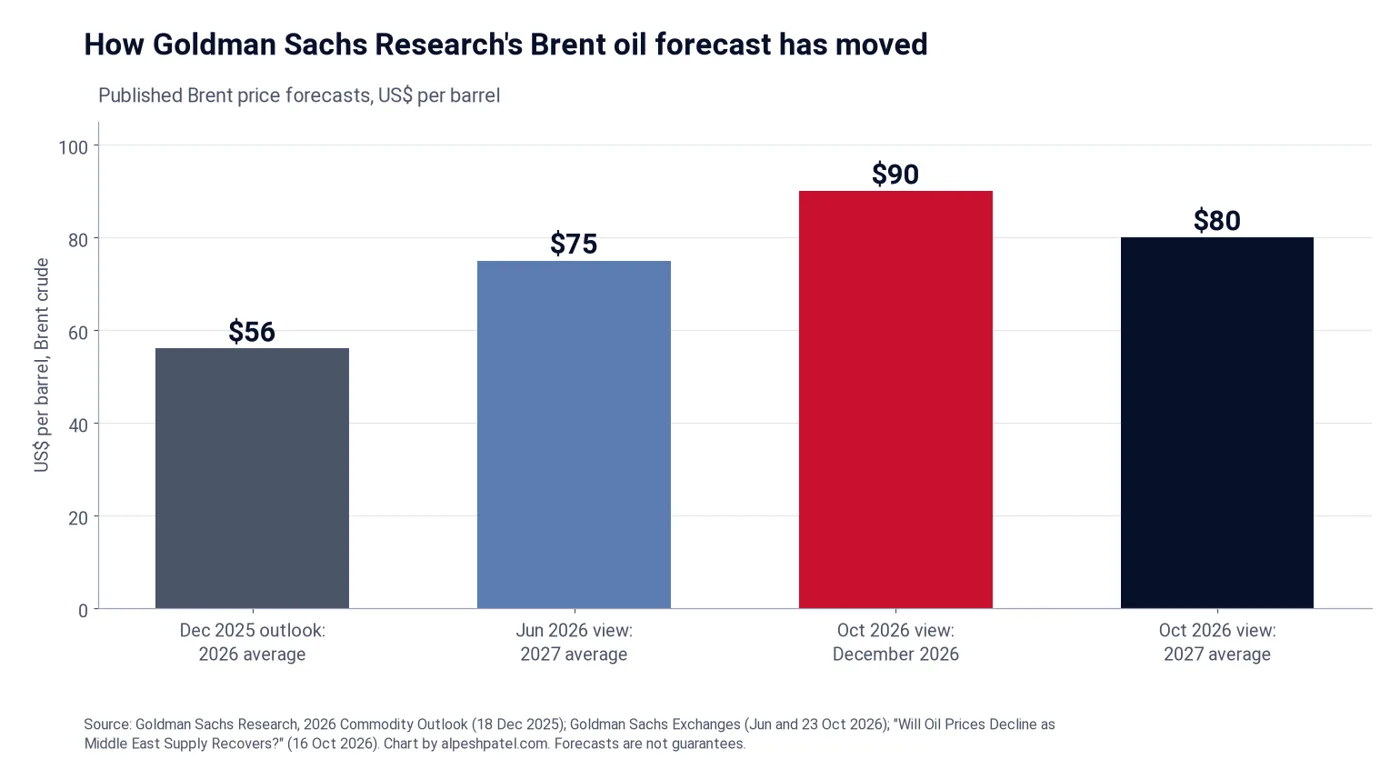
Look at the chart above before you trade on any oil forecast. In December 2025 the 2026 call was $56. In June 2026, Goldman said Brent would average $75 in 2027 (opens in a new tab). Four months later that became $80. The analysis was careful each time. The world simply changed faster than any model can.
Why it matters for UK investors: the FTSE All-Share has about 14% in energy (opens in a new tab), so the oil price matters more to a UK portfolio than many people realise. It also feeds inflation, and inflation feeds interest rates.
Two consumers, two stories: luxury and housing
At the top end, Goldman forecasts revenue growth for a basket of large listed luxury-goods makers of 6% in 2026 and 7% in 2027 (opens in a new tab). It blames recent weakness less on the economy than on the brands themselves: prices rose by an estimated 60% between mid-2019 and mid-2026 while innovation stalled. New creative directors may need "three to four collections" before shoppers notice, and Goldman calls the US, surprisingly, "an emerging market for luxury goods".
US housing is the opposite picture. The 30-year mortgage rate reached 7.32% on 22 October 2026 (opens in a new tab), and Goldman expects it to ease only to 6.4% in 2027. More than 95% of US mortgage borrowers pay less than today's market rate, and 65% pay at least two percentage points less, so very few want to move. Goldman forecasts 3.9 million existing-home sales in 2027, 26% below 2019, and home-price growth of just 0.8%.
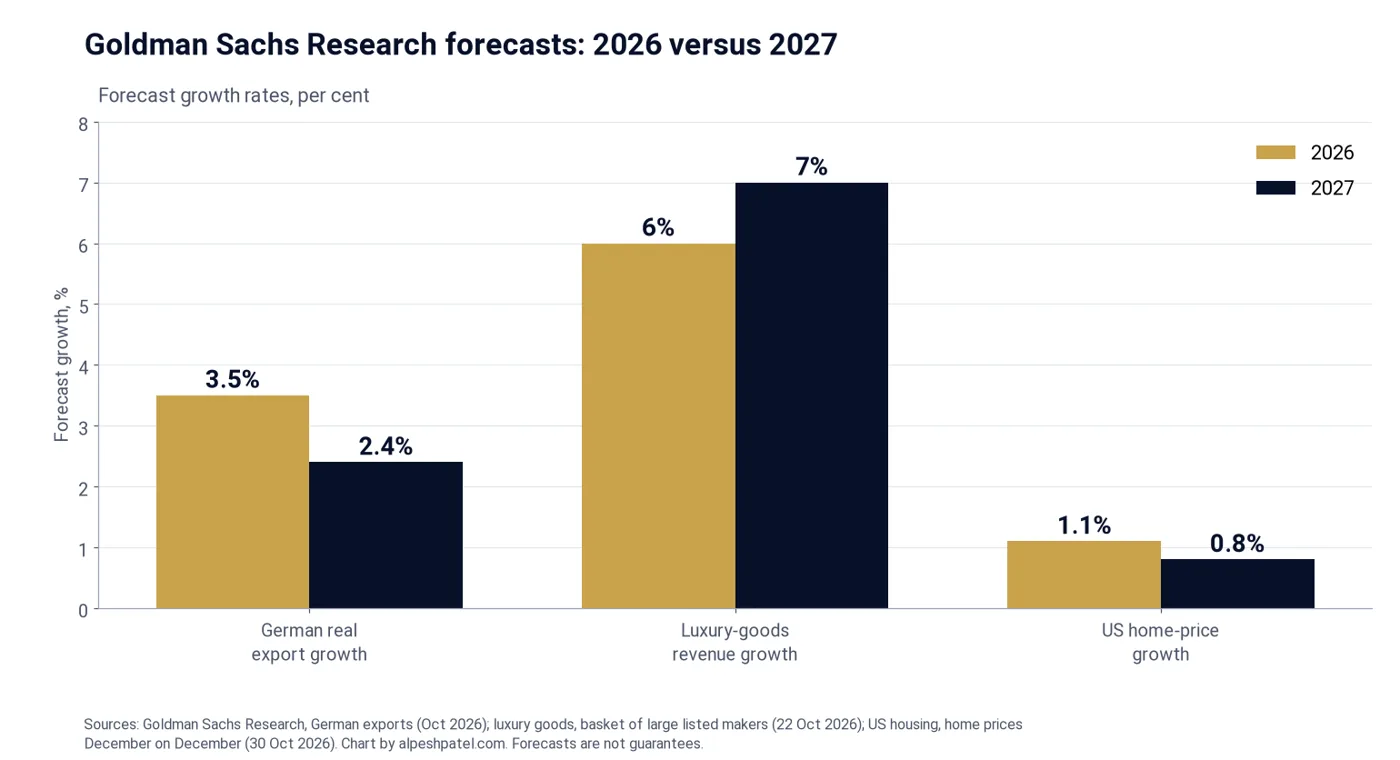
Why it matters: "the consumer" is not one thing. Wealthy shoppers and indebted homeowners are living through the same interest rates very differently, and companies selling to each will report very different results.
How to use bank research without being used by it
Here is where most investors go wrong. They read a confident report, buy the theme the next morning, and only later discover the forecast moved, as the oil chart shows it can. The problem is not the research. It is the missing process between reading and buying.
When I was a barrister, I learned to cross-examine my own case before the other side did. I still do it with every investment idea, using three columns on a single sheet of paper:
- Why I like it: the evidence, with the source. "Goldman forecasts a ninefold rise in optical networking spending" is a reason. "Everyone says AI networking is hot" is not.
- The challenges: what would make this wrong? For networking, it could be cheaper technology, a pause in data-centre spending, or a bond market that makes financing the build-out expensive.
- My replies: an honest answer to each challenge. If I cannot answer one, I either size the position smaller or do not buy.
Then come the two decisions that matter more than the idea itself: how much to put in, so that being wrong cannot hurt your retirement, and the price or condition at which you will sell, written down before you buy. A theme can be right and you can still lose money if you pay too much, own too much or never decide when to leave.
Frequently asked questions
What is Goldman Sachs Research?
It is the research division of Goldman Sachs, producing analysis on economies, markets and industries mainly for institutional clients. A selection is published free on the Goldman Sachs Insights (opens in a new tab) website, alongside reports from the Goldman Sachs Global Institute and the 10,000 Small Businesses programme.
What is Goldman Sachs's oil price forecast for 2027?
As of 16 October 2026, Goldman Sachs Research expects Brent crude to be about $90 a barrel in December 2026 and to average $80 in 2027, as a supply surplus builds. It says the risks are skewed to the upside because of possible escalation in the Middle East and low inventories.
Does Goldman Sachs think higher bond yields will cause a recession?
Not in its baseline. Goldman's Top of Mind report of 13 October 2026 expects higher rates to trim about 0.2 percentage points from US growth in 2027, rising to just over 0.5 points if rates stay at current levels. It flags housing, commercial property and the debt-funded AI build-out as the most sensitive areas.
Should I invest based on bank forecasts?
Use them as evidence, not instructions. Bank forecasts can change sharply: Goldman's 2026 Brent forecast was $56 in December 2025, yet by October 2026 it expected $90 by the end of the year. Test any theme against your own process, position size and exit rules before you act.
What to do next
- Map your hidden AI exposure. List the top ten holdings of every fund you own and note how many depend on AI spending, directly or through suppliers.
- Run the three columns on one theme. Pick AI networking, defence or energy and write down why you like it, what could go wrong and your honest replies. The free investment checklist gives you a structure.
- Stress-test before the market does it for you. Use the free Portfolio Odds tool (opens in a new tab) to see how your portfolio might behave if oil or bond yields surprise on the upside.
- Check how much of your return depends on oil and rates. UK investors in particular should know their energy weighting. My plain-English notes on the J.P. Morgan Guide to the Markets, November 2026 show the sector mix of UK and US shares side by side.
- Keep the numbers current. The weekly markets dashboard and market regime pages track the moves that matter, and my article on how to invest in AI with ETFs covers the two checks I would make before buying an AI fund.
Want a second pair of eyes on how your portfolio lines up against these themes? Book your free call with Alpesh's team (opens in a new tab). We will show you how to check your exposure to AI, oil and interest rates in what you already own. There is nothing to buy on the call.
About Alpesh Patel OBE
Alpesh Patel OBE is Founding Principal of Rootbridge Capital, an author and Dealmaker for the UK Government's Department for Business. He is a former Visiting Fellow in Business, Corpus Christi College, Oxford University, where he worked on technology to improve financial education. Watch his free investing education on YouTube (opens in a new tab).
Sources
- Goldman Sachs Research, German Exports Rebound amid Demand from the US, EU, and AI Buildout (opens in a new tab), October 2026.
- Goldman Sachs Research, German Economic Outlook: 1.1% Growth in 2026 (opens in a new tab).
- Goldman Sachs Research, Competition Among China's AI Models Is Intensifying as the Chip Sector Advances (opens in a new tab), 9 October 2026.
- Goldman Sachs Research, Optical Networking: The Next Mega Trend in AI Infrastructure (opens in a new tab), May 2026.
- Goldman Sachs Global Institute, The Security Supercycle: Investing in Innovation, Resilience, and Rearmament (opens in a new tab), October 2026.
- Goldman Sachs, How Small Business Owners Are Using AI to Help Propel Growth (opens in a new tab), October 2026.
- Goldman Sachs 10,000 Small Businesses, The AI Economy Is a Small Business Economy (opens in a new tab), October 2026.
- Goldman Sachs Research, Will Oil Prices Decline as Middle East Supply Recovers? (opens in a new tab), 16 October 2026.
- Goldman Sachs Exchanges, Why Oil Prices Are Surging Despite Recovering Supply (opens in a new tab), October 2026.
- Goldman Sachs Exchanges, How the US-Iran Deal Could Affect Oil Prices (opens in a new tab), June 2026.
- Goldman Sachs Research, 2026 Commodity Outlook: Ride the Power Race and Supply Waves (opens in a new tab), 18 December 2025.
- Goldman Sachs Global Investment Research, Higher Bond Yields: How Concerning? (opens in a new tab), Top of Mind Issue 152, 13 October 2026.
- Goldman Sachs Research, Why Luxury Goods Companies' Revenues Are Forecast to Climb (opens in a new tab), 22 October 2026.
- Goldman Sachs Research, The Outlook for US Housing in 2027 amid Rising Mortgage Rates (opens in a new tab), 30 October 2026.
- J.P. Morgan Asset Management, Guide to the Markets – UK (opens in a new tab), data as of 30 October 2026.
- Alpesh Patel OBE, Can You Survive a Market Downturn? Most Investors Can't (opens in a new tab), YouTube, 2 November 2026.
Charts on this page are drawn by alpeshpatel.com from figures published by Goldman Sachs. Alpesh Patel OBE and alpeshpatel.com are not affiliated with or endorsed by Goldman Sachs. Forecasts and views attributed to Goldman Sachs are theirs; the commentary is Alpesh Patel's own.
Important: This article is for education only and is not personal financial advice or a recommendation to buy or sell any investment. This article is general investment education only and is not regulated investment advice. The value of investments can go down as well as up, and you may get back less than you invest. Past performance is not a reliable indicator of future results.
Important: this article is education and information only. It is not financial advice or a personal recommendation, and it does not take your circumstances into account. The value of investments and pensions can fall as well as rise, and you may get back less than you put in. Past performance is not a reliable indicator of future results. Figures were correct when the article was written and may have changed. If you are unsure what is right for you, speak to a regulated financial adviser.