How to Invest £1 Million in Cash for £5,000 a Month Income, Without Rushing
Here is a fact that surprises most people sitting on a large cash balance. If you keep £1 million with one UK bank and that bank fails, the Financial Services Compensation Scheme (opens in a new tab) will pay you back up to £120,000. The other £880,000 is outside the standard protection. The cash that feels like the safe part of your wealth may be the part carrying a risk you never chose.
It is a situation my team hears about more and more. Someone with close to £1 million, much of it in cash. A need for about £5,000 a month to live on. And, after a week of sharp market swings, a real fear of making a rushed decision they would regret. Anyone wondering how to invest £1 million in cash for a monthly income will recognise every part of it.
My answer surprised them. The most expensive mistake here is not picking the wrong fund. It is the rushed fix: putting everything in on a Monday because markets bounced, or freezing for two years because they fell. What you need is an order of work that does not depend on any view of where markets go next.
Short answer: If you have close to £1 million in cash and need £5,000 a month, work in order. First, spread the cash so no banking licence holds more than the £120,000 FSCS limit. Second, ring-fence the first few years of income in cash. Only then invest the rest in stages, on dates you fix and write down in advance.
Sitting on a large cash balance and unsure where to start? Book your free call with Alpesh's team. We will walk through how self-directed investors put a lump sum to work with a written plan, step by step. There is nothing to buy on the call.
Why is the rushed fix the most expensive mistake?
A volatile week makes two opposite mistakes feel sensible. One is to invest everything at once so you "don't miss out". The other is to keep it all in cash until things "settle down". Both are decisions about the market's next move, and nobody knows what that is.
The cost of getting it wrong is lopsided. If you invest £1 million in one go and markets fall 20% the next month, you are looking at a £200,000 paper loss in your first weeks. Many people sell at that point, which turns a temporary fall into a permanent one. My piece on what 20% volatility really means explains why that reaction is so common.
Behaviour is where most of the damage is done. Morningstar's Mind the Gap study (opens in a new tab) found that the average dollar invested in US funds earned 8.7% a year over the ten years to 31 December 2025, against 9.9% a year for the funds themselves. That gap comes largely from people buying and selling at the wrong moments. A process you write down before you start is the cheapest protection against it.
So the three steps below come in a fixed order. None of them needs you to guess what markets do next.
Step 1: Is your cash protected above the FSCS limit?
Do this week. It carries no market risk at all.
From 1 December 2025, the FSCS protects deposits up to £120,000 per eligible person, per authorised firm. FSCS (opens in a new tab) The Bank of England (opens in a new tab) confirms the limit rose from £85,000 and that joint accounts are protected up to £120,000 for each holder, so £240,000 for two.
The catch is the word "firm". Several bank brands can sit under one banking licence. If they do, the FSCS (opens in a new tab) treats them as one bank, and the £120,000 limit covers all your accounts across those brands combined. Opening an account with a sister brand does not double your protection.
There is one exception worth knowing. Temporary high balances from life events such as selling a home or receiving an inheritance are protected up to £1.4 million for up to six months. FSCS (opens in a new tab) That is a breathing space, not a long-term home for the money.
A practical checklist:
- List every account with its balance and the banking group behind the brand.
- Check the licence. The FSCS website and each bank's own FSCS information sheet tell you which brands share one.
- Move anything above £120,000 per licence (or £240,000 for joint accounts) to a different licence.
- Consider NS&I for larger sums. NS&I (opens in a new tab) is backed by HM Treasury, which guarantees 100% of the money invested with it, not just the first £120,000.
Spreading cash this way changes nothing about your returns or your market exposure. It simply removes a risk that serves no purpose.
Step 2: How much should you ring-fence for income?
Before a single pound goes into the market, set aside the money for your first years of income. The aim is simple: your £5,000 a month should never depend on what markets did last week.
£5,000 a month is £60,000 a year. Two years of income is £120,000; three years is £180,000. Held in cash, or in fixed-term savings that mature as you need them, that money pays your bills whatever happens to share prices. Two years of income also happens to match one £120,000 FSCS limit, so the buffer can sit fully protected.
Why does this matter so much? Because of sequence risk. If you have to sell investments to fund your income in a falling year, you sell more units at lower prices and those units never recover for you. A cash buffer lets you leave the portfolio alone in bad years and refill the buffer in good ones. My comparison of six withdrawal strategies shows how much difference this makes.
Two points to check with a tax specialist. Whether £5,000 a month is before or after tax changes the sums, because withdrawals from pensions and interest above your allowances are taxed. And the state pension, when it starts, can reduce how much the portfolio has to provide.
How much does £5,000 a month need?
The answer depends on the withdrawal rate, the share of the portfolio you take out each year. Here is what £60,000 a year needs at different rates.
| Illustrative withdrawal rate | Portfolio needed for £60,000 a year | Gap against £1 million |
|---|---|---|
| 3% | £2,000,000 | Short by about £1,000,000 |
| 3.5% | £1,714,000 | Short by about £714,000 |
| 4% | £1,500,000 | Short by about £500,000 |
| 5% | £1,200,000 | Short by about £200,000 |
| 6% | £1,000,000 | Covered, but little margin |
Illustrative calculation: £60,000 divided by the withdrawal rate. Before tax and charges, ignores state pension and other income. Not a forecast.
The table is not meant to alarm. It shows that taking £60,000 a year from about £1 million means drawing roughly 6% in the early years. That can work if other income, such as a state pension or a part-time income, will reduce the draw later, or if you accept that the capital will be spent down over time. It does mean the plan has to be written, tested and reviewed, not improvised. The free Portfolio Odds (opens in a new tab) and Probability (opens in a new tab) tools let you test how a given mix and withdrawal rate might hold up under their assumptions.
Step 3: Should you invest a lump sum all at once or in stages?
Only now, with the cash protected and the income ring-fenced, does the question of investing the rest come up. And the evidence here is clearer than most people expect.
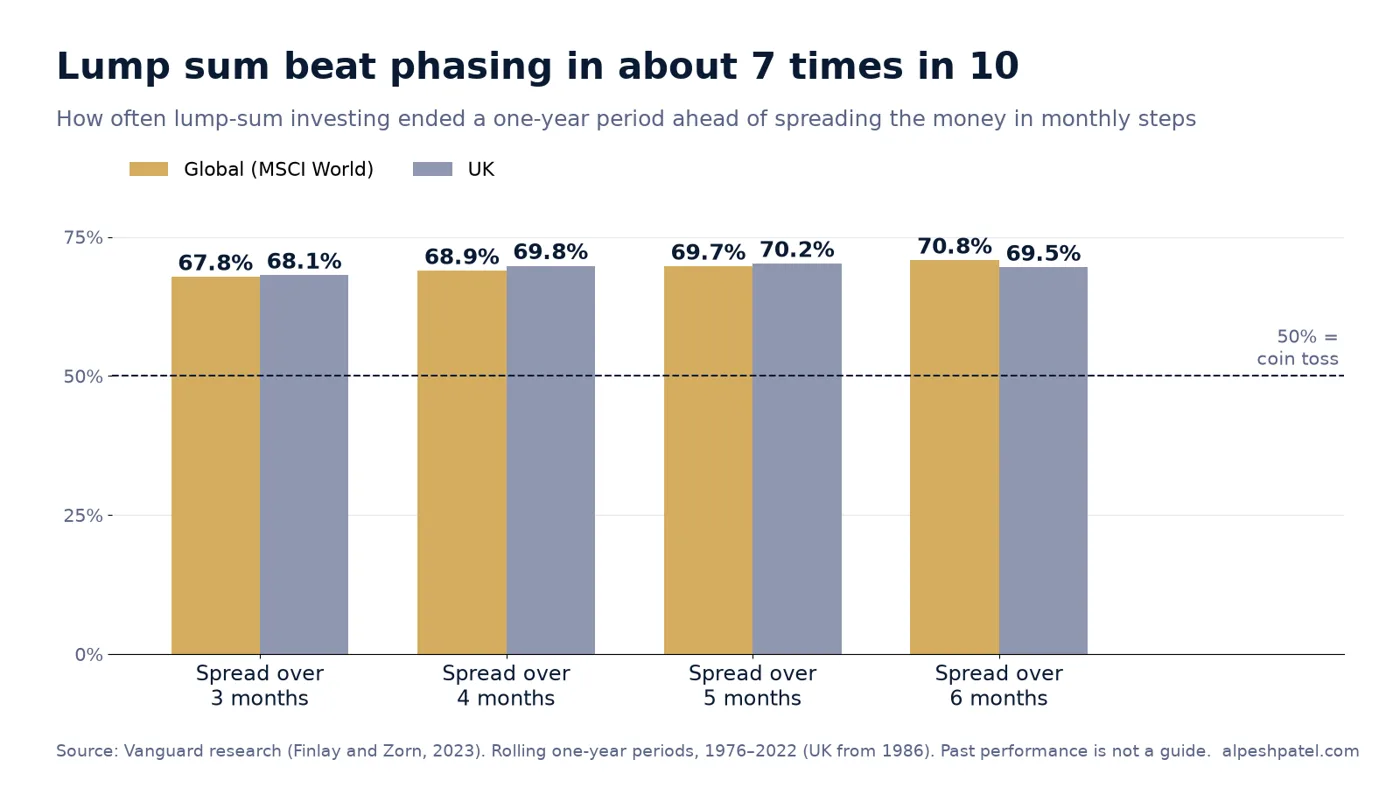
Vanguard's research (opens in a new tab) by Megan Finlay and Josef Zorn compared investing a lump sum straight away with spreading it in equal monthly amounts, over rolling one-year periods from 1976 to 2022. Investing at once came out ahead about two-thirds of the time.
| Spread over | Lump sum ahead, global (MSCI World) | Lump sum ahead, UK |
|---|---|---|
| Three months | 67.8% | 68.1% |
| Four months | 68.9% | 69.8% |
| Five months | 69.7% | 70.2% |
| Six months | 70.8% | 69.5% |
Source: Vanguard, Cost averaging: invest now or temporarily hold your cash? (opens in a new tab). Past performance is not a reliable guide to the future.
Source: Vanguard research (Finlay and Zorn, 2023), rolling one-year periods, 1976–2022; UK data from 1986.
The reason is simple. Markets have risen more often than they have fallen, so money waiting in cash usually misses some growth. The longer you take to invest, the bigger that cost tends to be.
So why do I still suggest stages for someone in this position? Because the same research shows the other side. In the worst 5% of outcomes, phasing in over three months left a 100% shares portfolio 3.6% better off than a lump sum. Vanguard (opens in a new tab) Vanguard's own conclusion is that the right choice depends on loss aversion and preferences, and that even nervous investors should keep the phasing period short.
That is the trade-off. A lump sum usually wins on return. Phasing wins on regret. For someone who has just lived through a volatile week and fears a rushed decision, a short, fixed schedule is often the plan they can actually stick to. And a plan you stick to beats a better plan you abandon.
What does a staged plan look like?
The key is that the dates are fixed in advance and written down, not decided by how the news feels that morning.
- Choose the period. Three to six months keeps the cost of waiting small, on Vanguard's figures.
- Split the amount into equal parts and pick the dates, for example the first working day of each month.
- Write it down, with what you will buy on each date and in what proportions.
- Do not change it because markets rose or fell. If markets drop between dates, the next instalment simply buys more cheaply.
My guide to investing a lump sum covers this in more detail, including how to decide the mix before the first purchase.
Why manage the money yourself?
With close to £1 million, the default route is to hand it to a wealth manager. That can suit some people. But fees on a sum this size are large: on £1 million, a 1% yearly charge is £10,000 a year, every year. My piece on what 1% a year really costs works through the long-term effect.
Running it yourself, with a written process, brings three things.
Control. You decide the mix, how much goes into any one holding and when you rebalance. Nobody sells for you in a panic, and nobody buys a product you do not understand.
Transparency. You see every holding and every charge in pounds. You know exactly where the £5,000 a month is coming from.
A portfolio built for you. Your income need, your other assets, your tax position and your tolerance for falls are specific to you. A portfolio built around them will look different from a model portfolio designed for an average client.
What you need is not genius. It is a written process: how you pick what to hold, how much you put in each, and the rules for when you sell or rebalance. The build a retirement income guide and the guide to protecting your portfolio in a crash set out the building blocks, and the free tools at alpeshpatel.com/tools help you test the numbers.
What to do next
- This week, map your cash. List each account, its balance and the banking licence behind it, and move anything above £120,000 per licence (£240,000 joint).
- Ring-fence two to three years of income. £120,000 to £180,000 for £5,000 a month, held where it is fully protected.
- Test the withdrawal rate. Check what £60,000 a year means for your total, with state pension and other income, in Portfolio Odds (opens in a new tab), and ask a tax specialist about the tax on each source of income.
- Write down your investing schedule. Fixed dates, fixed amounts, a fixed mix, and a rule that the schedule does not change with the headlines.
- Write your sell and rebalance rules before the first purchase, so the next volatile week finds you with a plan rather than a decision to make.
Want a written plan for turning a large cash balance into a monthly income? Book your free call with Alpesh's team. We will show you how self-directed investors pick investments, size positions and decide when to sell, so the money works without a rushed decision. There is nothing to buy on the call.
Frequently asked questions
Is my £1 million safe in a UK bank?
Only up to £120,000 per person, per banking licence, is protected by the FSCS if the bank fails. Brands that share a licence count as one bank. Spreading the money across licences, or using NS&I, which is backed by HM Treasury, removes most of that risk.
Can I live on £5,000 a month from £1 million?
£5,000 a month is £60,000 a year, which is about 6% of £1 million. That is a high starting withdrawal rate, so it usually works only if other income, such as a state pension, reduces the draw later, or if you accept spending some capital. It needs to be tested and reviewed every year.
Should I invest £1 million all at once?
Vanguard's research found that investing a lump sum at once beat spreading it over three to six months about two-thirds of the time. Phasing did better in the worst market outcomes. If the fear of a sudden fall would make you sell, a short, fixed schedule is often the better plan for you.
How much cash should I keep when I retire?
Many self-directed investors keep two to three years of income in cash, so they never have to sell investments in a falling market. For £5,000 a month that is £120,000 to £180,000. The right amount depends on your other income and how much volatility you can live with.
About Alpesh Patel OBE
Alpesh Patel OBE is Founding Principal of Rootbridge Capital, an author and Dealmaker for the UK Government's Department for Business. He is a former Visiting Fellow in Business, Corpus Christi College, Oxford University, where he worked on technology to improve financial education.
Sources
- FSCS, Deposit protection limit (opens in a new tab)
- Bank of England, What is the FSCS and what is the new deposit protection limit? (opens in a new tab)
- NS&I, How we protect your money (opens in a new tab)
- Vanguard, Cost averaging: invest now or temporarily hold your cash? (opens in a new tab)
- Vanguard UK Professional, The truth about cost averaging (opens in a new tab)
- Morningstar, Mind the Gap (opens in a new tab)
- Alpesh Patel OBE, How Far Will £1 Million REALLY Go in Retirement? (opens in a new tab) (YouTube)
Important: This article is for education only and is not personal financial advice or a recommendation to buy or sell any investment. This article is general investment education only and is not regulated investment advice. The value of investments can go down as well as up, and you may get back less than you invest. Past performance is not a reliable indicator of future results.
Important: this article is education and information only. It is not financial advice or a personal recommendation, and it does not take your circumstances into account. The value of investments and pensions can fall as well as rise, and you may get back less than you put in. Past performance is not a reliable indicator of future results. Figures were correct when the article was written and may have changed. If you are unsure what is right for you, speak to a regulated financial adviser.