Your Final Salary Pension Is Your Bond Allocation: What That Means for the Rest
On 5 November 2026, buying a guaranteed income of £5,641 a year, rising with inflation, cost a 65-year-old £100,000, according to Hargreaves Lansdown's best annuity rates (opens in a new tab). Turn that round, and a final salary pension of £20,000 a year with inflation increases is doing the work of roughly £350,000 of capital. Most people who have one never count it.
My team hears a version of the same worry often. Someone in their 50s has a defined benefit pension from a university or a school, plus a separate pot in a SIPP or ISA. They have been told to be "balanced", so the flexible pot is 60% shares and 40% bonds. And they have never asked what the guaranteed pension already does for them.
This post explains a simple idea: your final salary pension is your bond allocation. Once you see it that way, the question changes from "how much should I hold in bonds?" to "what job does the rest of my money need to do?"
Short answer: A final salary (defined benefit) pension pays a secure, usually inflation-linked income, so it behaves much like a large bond holding. Counting it often shows your total wealth is far more defensive than your pot suggests. That can mean the flexible pot can take more equity risk, while you keep the DB pension and never transfer it out lightly.
Have a final salary pension and a separate pot to run? Book your free call with Alpesh's team. We will walk through how self-directed investors look at their whole picture and write a process for picking, sizing and rebalancing the flexible part. There is nothing to buy on the call.
Why is a final salary pension like a bond?
A bond pays you a fixed stream of income for a set period. A gilt that pays £4 a year on £100 does not care what the stock market does. That reliability is why people hold bonds: to steady a portfolio and fund spending when shares fall.
A final salary pension does the same, but better in two ways. It pays for life rather than for a fixed term, and it usually rises with inflation. The USS (opens in a new tab) increases pensions in line with CPI up to 5%, then half of any excess, with a maximum of 10%. The Teachers' Pension Scheme (opens in a new tab) increases pensions in payment each April in line with CPI to the previous September.
In other words, a DB pension behaves like an inflation-linked bond you cannot sell. It is one of the most valuable defensive assets an ordinary investor can own.
What a final salary pension is not
The bond comparison has limits. You cannot sell it, borrow against it or rebalance it. Most of its value ends when you die, apart from any spouse's or dependant's pension. And the promise is only as strong as the scheme and employer behind it.
So the right way to think about it is as the "income floor" part of your bond allocation. It replaces the bonds you would otherwise buy to pay the bills. It does not replace cash you might need in a hurry.
How much is my final salary pension worth?
There is no single answer, but annuity prices give a sensible, current yardstick. An annuity is a guaranteed income bought from an insurer, so its price tells you what the market charges for an income like yours.
| Hargreaves Lansdown best rates, 5 Nov 2026 (yearly income per £100,000) | Age 55 | Age 60 | Age 65 | Age 70 |
|---|---|---|---|---|
| Single life, level, no guarantee | £7,057 | £7,414 | £8,209 | £8,996 |
| Single life, RPI-linked, 5-year guarantee | £4,485 | £4,921 | £5,641 | £6,446 |
Source: Hargreaves Lansdown best annuity rates (opens in a new tab), quotes generated 5 November 2026, average postcode, paid monthly in advance.
Divide the pension by the rate and you get an illustrative "cost to buy" figure.
| Illustrative DB pension from 65 | Cost to buy as a level annuity | Cost to buy as an RPI-linked annuity |
|---|---|---|
| £10,000 a year | about £122,000 | about £177,000 |
| £20,000 a year | about £244,000 | about £355,000 |
| £30,000 a year | about £365,000 | about £532,000 |
Illustrative, using the age-65 rates above. A DB pension linked to CPI with caps is not identical to an RPI-linked annuity, and spouse's benefits, lump sums and tax all change the picture. This is a way to think about size, not a valuation of any scheme.
The state pension works the same way. The full new State Pension is £241.30 a week (opens in a new tab), about £12,548 a year, and it too is a lifelong, inflation-protected income.
What does that mean for the rest of your money?
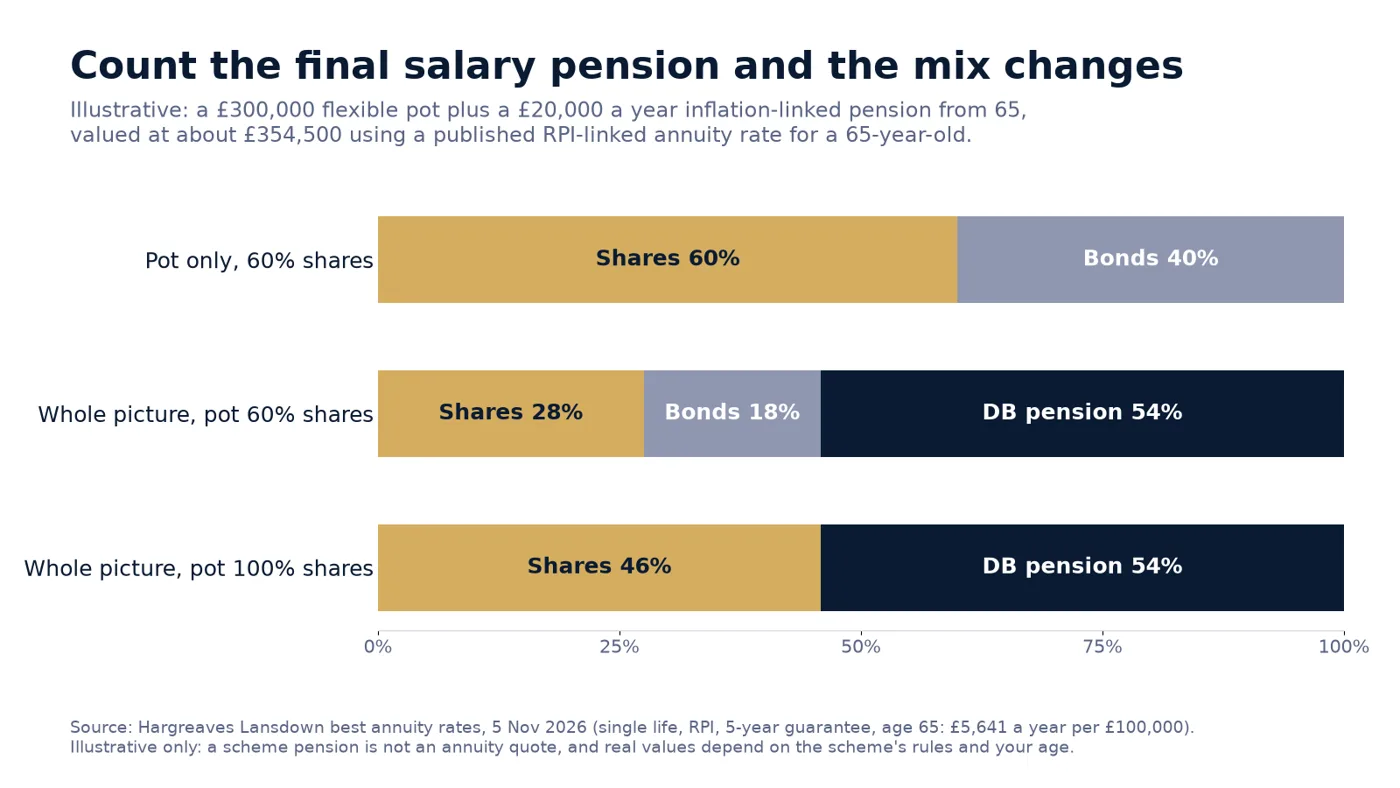
Here is where it gets interesting. Take an illustrative saver with a £300,000 flexible pot and a £20,000 a year inflation-linked DB pension from 65, valued at about £354,500 using the RPI-linked rate.
Source: Hargreaves Lansdown best annuity rates, 5 November 2026. Illustrative.
On its own, a 60/40 pot looks balanced. Count the DB pension, and the whole picture is only about 28% in shares. Even if the pot were 100% in shares, shares would be about 46% of the total, with the guaranteed pension making up the rest.
That is why, for many people with a decent DB pension, the flexible pot can usually take more equity risk than a "balanced" label suggests. The guaranteed income covers the essentials. The pot's job is growth, flexibility and whatever you want to leave behind.
"Usually" matters. Your own answer depends on how much of your spending the DB and state pensions cover, how you would feel watching the pot fall by a third, and when you will need to draw on it. That last point brings us to early retirement.
When can I take a USS or Teachers' pension without a reduction?
Each scheme has a normal pension age. Take the pension before it and the income is reduced, usually for life, because it will be paid for longer.
USS. The normal pension age is 66 for benefits built up since 6 October 2020, and it will rise in line with the State Pension age. Benefits built between 1 October 2011 and 5 October 2020 are usually reduced before 65, according to USS's factors page (opens in a new tab).
| Years before USS normal pension age | Share of pension you keep (factors from 1 Oct 2024) |
|---|---|
| 1 | 94.8% |
| 2 | 90.0% |
| 3 | 85.5% |
| 4 | 81.4% |
| 5 | 77.5% |
| 6 | 74.0% |
| 8 | 67.5% |
| 10 | 61.8% |
Source: USS, factors used by USS (opens in a new tab). Factors are reviewed after each valuation and can change.
Teachers' Pension Scheme. For career average benefits, the normal pension age is your State Pension age or 65, whichever is later. For final salary benefits it is 60 or 65, depending on when you joined, according to Teachers' Pensions (opens in a new tab). Early retirement is possible from 55, with benefits "actuarially adjusted" for life.
Both schemes say the minimum age rises from 55 to 57 on 6 April 2028 for some members. Teachers' Pensions says members with service before 4 November 2021 keep the right to retire early from 55, as its early retirement page (opens in a new tab) explains. Check your own position with your scheme in writing.
How do you bridge early retirement with a DB pension?
The reduction factors create a real choice. In the USS table, taking a pension six years early keeps 74% of it. Waiting keeps 100%. If you stop work before your normal pension age, someone has to pay the bills in between, and that someone is usually your flexible pot.
That changes the pot's job, at least for a while. The money that funds the bridge years needs to be there in cash terms when you need it, so it belongs in cash and short-dated, low-risk holdings. The money you will not touch until much later can still take equity risk, because the DB pension will arrive in full at normal pension age.
A simple way to write this down:
- Bridge pot. Spending for each year between stopping work and the DB pension starting, held in cash or short-dated holdings.
- Long-term pot. Everything else, invested for growth, because the DB and state pensions will cover the essentials later.
- Rule for bad years. If shares fall, spend from the bridge pot, and only refill it from the long-term pot after markets recover.
My post on retiring before 57 and funding the bridge years works through this in detail, including what changes in April 2028. You can model your own numbers with the free FIRE calculator (opens in a new tab) or the Pension Plan tool (opens in a new tab), and test the odds of different mixes with Portfolio Odds (opens in a new tab).
Should I transfer my final salary pension to a SIPP?
For most people, no, and this post is not an argument for doing so. The whole point is that the DB pension is valuable precisely because it is guaranteed. Transferring it swaps a secure income for investment risk you would then have to manage.
The regulator's position is clear. The FCA Handbook (COBS 19.1.6G) (opens in a new tab) says an adviser "should start by assuming that a transfer, conversion or opt-out will not be suitable", and should only consider it suitable if they can clearly demonstrate it is in your best interests.
If your safeguarded benefits are worth more than £30,000, you must take advice from an FCA-authorised adviser with pension transfer permission before the scheme will let a transfer go ahead. The FCA sets out its expectations of pension transfer advice (opens in a new tab), and MoneyHelper (opens in a new tab) warns that moving out of a DB scheme means losing the promise of a guaranteed income for life with automatic annual increases.
Before any decision about any pension, get the loss-of-benefit checks in writing: spouse's and dependants' pensions, inflation increases, the lump sum, ill-health terms and any protected pension age.
Scams target exactly this kind of pension. The Pensions Regulator (opens in a new tab) reports £17.7 million lost to pension fraud in 2023, an average of nearly £47,000 per victim, with fewer than one in five victims reporting it. Ignore cold calls, texts and emails offering free pension reviews or "guaranteed" returns.
How do self-directed investors use this idea?
The DB pension does not change how you pick investments. It changes how much risk the flexible pot can sensibly carry, and why. That is the case for running the pot yourself with a written process: you can build it around your whole picture, which a one-size-fits-all "balanced" fund cannot see.
- Pick: low-cost, diversified holdings for the long-term pot, and cash or short-dated holdings for the bridge.
- Size: decide the equity share for the whole picture first, then set the pot's mix to match. Cap any single holding.
- Sell and rebalance: write the rule in advance, such as once a year or when a holding drifts five percentage points.
My guides to which pot to draw first in retirement and building a retirement income show how the pieces fit together. If you want to compare the cost of running a SIPP, see the cheapest SIPP for drawdown.
What to do next
- Get your DB numbers. Ask your scheme for your current pension, lump sum, normal pension age and early retirement figures, in writing.
- Put a rough value on it. Use a current annuity rate as an illustrative yardstick, and add your state pension forecast.
- See your whole mix. Add the DB value to your pot and work out your real share in shares, bonds and guaranteed income.
- Split the pot by job. Ring-fence the bridge years in cash or short-dated holdings, and decide how much risk the rest can take.
- Write the rules. Set your pick, size and rebalance rules before markets test them.
Want to see your final salary pension and your pot as one plan? Book your free call with Alpesh's team. We will show you how self-directed investors build a written process for the part of their money they control. There is nothing to buy on the call.
Frequently asked questions
Is a defined benefit pension the same as owning bonds?
Not exactly, but it behaves similarly. It pays a secure income that does not depend on the stock market, usually with inflation increases. Unlike a bond, you cannot sell it or pass most of it on.
How do I value my final salary pension?
An illustrative approach is to divide the yearly pension by a current annuity rate. On 5 November 2026, an RPI-linked annuity for a 65-year-old paid £5,641 a year per £100,000, so £20,000 a year would cost about £355,000 to buy. Scheme transfer values are calculated differently.
Does having a DB pension mean I can take more risk elsewhere?
Often, yes, because the guaranteed income covers essential spending. But it depends on how much of your spending it covers, when you need to draw on your pot and how you would cope with a large fall. Money for the bridge years before the pension starts should stay low risk.
What is the normal pension age for USS and the Teachers' Pension Scheme?
USS's normal pension age is 66 for benefits built since October 2020, rising with the State Pension age. For the Teachers' career average scheme it is your State Pension age or 65, whichever is later; final salary benefits have a normal pension age of 60 or 65.
Should I transfer my final salary pension?
For most people, no. The FCA tells advisers to start by assuming a transfer will not be suitable, and if your safeguarded benefits are worth more than £30,000 you must take regulated advice before transferring.
About Alpesh Patel OBE
Alpesh Patel OBE is Founding Principal of Rootbridge Capital, an author and Dealmaker for the UK Government's Department for Business. He is a former Visiting Fellow in Business, Corpus Christi College, Oxford University, where he worked on technology to improve financial education.
Sources
- Hargreaves Lansdown, Best annuity rates (opens in a new tab)
- USS, Important information about USS and your pension (opens in a new tab)
- USS, Factors used by USS (opens in a new tab)
- Teachers' Pensions, When can you retire? (opens in a new tab)
- Teachers' Pensions, Early retirement (opens in a new tab)
- Teachers' Pensions, Tax, increases and deductions (opens in a new tab)
- GOV.UK, The new State Pension: what you'll get (opens in a new tab)
- FCA Handbook, COBS 19 Pensions supplementary provisions (opens in a new tab)
- Financial Conduct Authority, Advising on pension transfers: our expectations (opens in a new tab)
- MoneyHelper, Should I transfer or combine my pensions? (opens in a new tab)
- The Pensions Regulator, Working together to strengthen our defences against scams (opens in a new tab)
- Alpesh Patel OBE, How to Build a Resilient Retirement Portfolio in the Age of AI (opens in a new tab) (YouTube)
Important: This article is for education only and is not personal financial advice or a recommendation to buy or sell any investment. This article is general investment education only and is not regulated investment advice. The value of investments can go down as well as up, and you may get back less than you invest. Past performance is not a reliable indicator of future results.
Important: this article is education and information only. It is not financial advice or a personal recommendation, and it does not take your circumstances into account. The value of investments and pensions can fall as well as rise, and you may get back less than you put in. Past performance is not a reliable indicator of future results. Figures were correct when the article was written and may have changed. If you are unsure what is right for you, speak to a regulated financial adviser.