Retire Before 57? How to Fund the Bridge Years After the 2028 Pension Age Change
For most people, the earliest age you can take money from a personal or workplace pension is about to move. From 6 April 2028, the normal minimum pension age rises from 55 to 57. GOV.UK (opens in a new tab) If you plan to retire before 57, two years you may have pencilled in as "pension years" could become years with no pension at all.
My team hears this situation often. Someone with around £650,000 saved, planning to stop work in their mid-50s, with a portfolio built for growth. The question is always a version of the same one: how do I turn this into an income without being forced to sell when markets are down?
The answer comes in two parts. Build a cash reserve before you stop, so a bad year never forces a sale. And plan the "bridge years" between stopping work and the age your pension opens, because after April 2028 that bridge is longer, and it has to be built from ISAs and cash, not your pension.
Short answer: If you retire before 57, plan the bridge years first. Your pension usually stays locked until 57 from 6 April 2028, so the income until then must come from ISAs, cash and other savings. Before you stop work, build about two years' spending in cash, draw on it in bad years and refill it in good ones.
Planning to stop work in your mid-50s? Book your free call with Alpesh's team. We will walk through how self-directed investors plan the bridge years and turn a growth portfolio into an income. There is nothing to buy on the call.
What changes in April 2028?
The normal minimum pension age is the earliest age most people can take pension benefits without an unauthorised payments tax charge, unless they retire because of ill health. The Government's tax information note (opens in a new tab) confirms it rises from 55 to 57 with effect from 6 April 2028. HMRC's Pensions Tax Manual (opens in a new tab) says the same.
In practice, if you were born on or after 6 April 1973, you will not reach 55 before the change, so your earliest pension age will generally be 57. Members of the firefighters', police and armed forces public service schemes are exempt. GOV.UK (opens in a new tab)
What if you are 55 or 56 when the rule changes?
This is the awkward group. MoneyHelper (opens in a new tab) warns that if you are 55 or 56 on 6 April 2028, you might lose access to your pension until you turn 57, even if you have already taken money. The Government has consulted on transitional rules (opens in a new tab) so that some benefits already started before the change, such as drawdown or an annuity, can carry on being paid. These are draft rules, so ask your provider in writing how they will apply to you.
What is a protected pension age?
Some people keep the right to take benefits before 57. Broadly, the legislation protects members who, before 4 November 2021, had a right under their scheme's rules to take benefits at or before the existing minimum age. GOV.UK (opens in a new tab) The right has to be unqualified, for example not dependent on employer or trustee consent.
Protection applies scheme by scheme, and it can be lost on some transfers. So check before moving any old pension into a new SIPP: ask the scheme in writing whether you have a protected pension age and whether a transfer would keep it.
Retire before 57: why do the bridge years matter?
Think of retirement before 67 as three stages. From stopping work until your pension opens, you live on ISAs, cash and other savings. From your pension age to state pension age, the pension does most of the work. After that, the state pension takes some of the load.
The last stage is also moving. The State Pension age is rising from 66 to 67 between 2026 and 2028. GOV.UK State Pension age timetable (opens in a new tab) For anyone planning to stop in their mid-50s today, that means ten years between a pension age of 57 and a State Pension age of 67.
The first stage is the one people under-plan. Here is how long it lasts, and what it costs, depending on when you stop.
| Illustrative: stop work at | Bridge years to 57 (no pension) | Bridge money at £30,000 a year | Years from 57 to State Pension at 67 |
|---|---|---|---|
| 53 | 4 | £120,000 | 10 |
| 54 | 3 | £90,000 | 10 |
| 55 | 2 | £60,000 | 10 |
| 56 | 1 | £30,000 | 10 |
Illustrative calculation for someone whose minimum pension age is 57 and State Pension age is 67. £30,000 a year is an example spending figure, before tax, with no growth or inflation. Not a forecast.
This is why the split between accounts matters. Two people with the same £650,000 can have very different plans. If £550,000 sits in a pension and only £100,000 in ISAs and cash, stopping at 53 leaves almost nothing spare. If more sits in ISAs, the bridge is easy. My guide to retiring early in the UK covers the SIPP, ISA and general account stack in more detail.
How do you build the bridge before you stop work?
The bridge is built in your last working years, not on the day you stop.
Use your ISA allowance. You can save up to £20,000 a year in ISAs in the 2026 to 2027 tax year. GOV.UK (opens in a new tab) For a couple, that is £40,000 a year between you, and the money can be taken out at any age without tax.
Weigh pension against ISA contributions. Pension contributions get tax relief, which is valuable. But money paid into a pension in your early 50s may be locked away until 57. If your bridge is short, some of those contributions may be better going into an ISA. A tax specialist should confirm the right balance for you.
Know what is accessible. List every pot and tag it: available now (cash, ISAs, general investment account), available at 57 (most pensions), or available later (State Pension, any final salary scheme). Then check the "available now" total covers your bridge years plus your cash reserve.
Plan the tax-free cash. At 57 you can usually take up to 25% of a pension as a tax-free lump sum, with a maximum of £268,275 under the lump sum allowance. GOV.UK (opens in a new tab) That can refill your cash reserve when the bridge ends, but only if you know when it arrives.
The free FIRE calculator (opens in a new tab) and Pension Plan (opens in a new tab) tool let you test different stop ages and account splits.
What is sequence of returns risk?
A growth portfolio is built to rise over time, and it will fall along the way. While you are working, a fall is a buying opportunity. Once you are drawing an income, a fall early on can do lasting damage, because you sell more units at low prices to pay the bills.
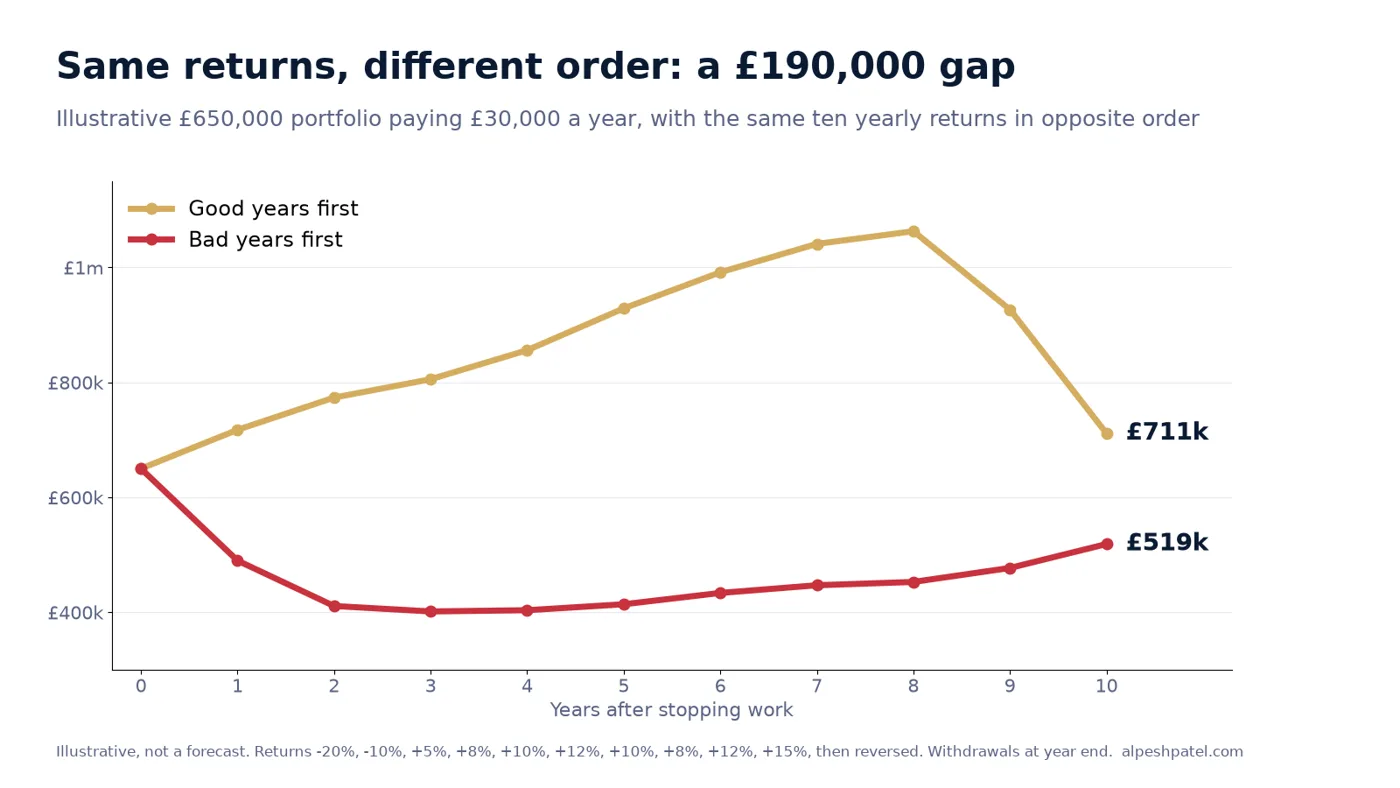
The order of returns matters as much as the average. In the illustrative example below, two portfolios start at £650,000, pay out £30,000 a year and earn exactly the same ten yearly returns, just in opposite order.
Source: illustrative calculation, not a forecast. Returns of -20%, -10%, +5%, +8%, +10%, +12%, +10%, +8%, +12% and +15%, then reversed; withdrawals taken at the end of each year.
With good years first, the portfolio ends at about £711,000. With bad years first, it ends at about £519,000. Same average, same withdrawals, about £190,000 apart. That is sequence risk, and it matters most in the years just after you stop work.
How does a two-year cash reserve help?
The reserve's job is simple: it means a bad year never forces a sale. You build about two years' spending in cash before you stop work. The rule is then written down:
- In a bad year, take your income from the cash reserve and leave the portfolio alone to recover.
- In a good year, take your income from the portfolio and top the reserve back up to two years.
- Define "bad" in advance, for example a year when the portfolio is below its previous high, so the decision is mechanical rather than emotional.
Be clear about what a reserve does and does not do. It does not raise your average return. Cash usually earns less than shares, so in long rising markets it can cost you a little. What it buys is the ability to stay invested through a fall without selling at the bottom, which is when most of the permanent damage is done.
My comparison of six withdrawal strategies shows how the cash buffer approach compares with fixed percentages and other rules. The guide to protecting your portfolio in a crash covers the investment side.
Does a growth portfolio need to change?
Often, partly. A portfolio built purely for growth is designed to be added to, not drawn from. For income, many self-directed investors keep the growth core but add the reserve, rebalance on fixed dates and set rules for which holdings to sell first when they need cash. The point is not to abandon growth. It is to make sure income does not depend on the market's mood that month.
Why run it yourself?
The bridge-years plan is personal. It depends on your exact stop date, how your money is split across pensions, ISAs and cash, any protected pension age, your tax position and how you feel about falls. A one-size model portfolio cannot see those details.
Running your own money, with a written process, gives you:
Control. You decide when to draw from cash and when from the portfolio, and nobody sells for you in a panic.
Transparency. Every holding, charge and withdrawal is visible in pounds. You always know how many bridge years you have left.
A plan bespoke to your risk profile. Your mix, your reserve size and your rebalancing rules are set for you, not for an average client.
You need a process: how you pick holdings, how much goes in each, and when you sell or rebalance. The build a retirement income and run your own SIPP guides set out the steps, and my piece on whether £600,000 is enough to retire at 60 covers the income numbers for a slightly later stop age.
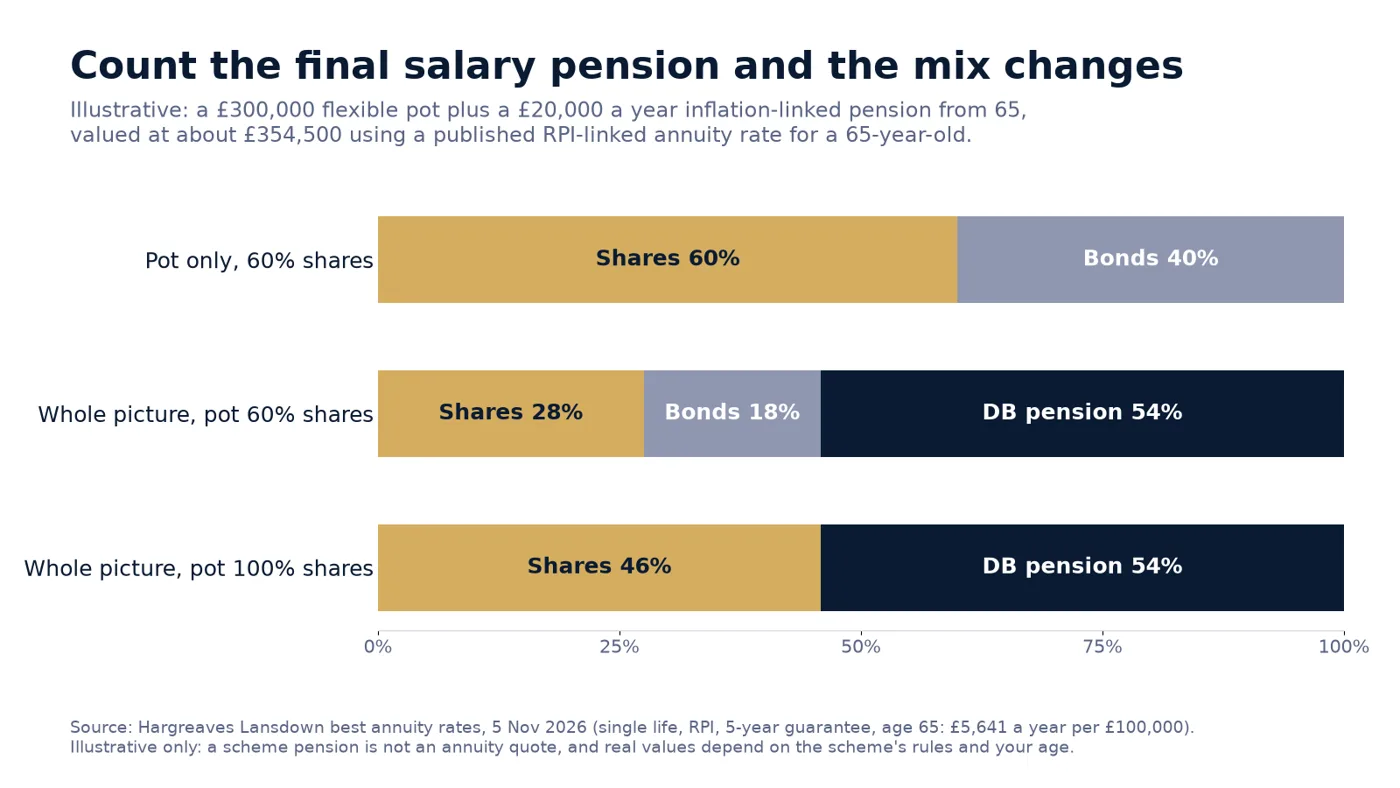
Related: Your final salary pension is your bond allocation.
What to do next
- Check your pension ages. Work out whether you reach 55 before 6 April 2028, and ask each scheme in writing whether you have a protected pension age and whether a transfer would keep it.
- Map your money by access date. Tag every pot as available now, at 57 or later, and total the "available now" column.
- Count your bridge years. Multiply the years from your stop date to 57 by your yearly spending, then add two years for the cash reserve.
- Fill the gap while you still earn. Use ISA allowances and ask a tax specialist how to balance pension and ISA contributions.
- Write your withdrawal rules down before your last pay day: what counts as a bad year, when you draw from cash and when you refill it.
Want a written plan for the years between work and your pension? Book your free call with Alpesh's team. We will show you how self-directed investors pick investments, size positions and decide when to sell, so your income never depends on a forced sale. There is nothing to buy on the call.
Frequently asked questions
Can I still retire at 55 after 2028?
You can stop work at any age, but most people will not be able to take money from a personal or workplace pension until 57 from 6 April 2028. The exceptions include those with a protected pension age, ill-health retirement and some uniformed services schemes. Until 57, income has to come from ISAs, cash and other savings.
What if I turn 55 before April 2028?
You can usually access your pension from 55 until the rule changes. MoneyHelper warns that if you are 55 or 56 on 6 April 2028 you might lose access until 57, and the Government has consulted on transitional rules for benefits already started. Ask your provider in writing how the rules will apply to you.
How much cash should I keep when I retire early?
Many self-directed investors hold about two years' spending in cash, plus whatever they need to cover the bridge years before their pension opens. The reserve lets you avoid selling investments in a falling market. The right amount depends on your other income and how much volatility you can live with.
Should I pay into my pension or an ISA if I want to retire before 57?
Both have a role. Pension contributions get tax relief but are usually locked until 57, while ISA money can be taken at any age. If your bridge years are not yet covered, a tax specialist can help you decide how to split new savings.
About Alpesh Patel OBE
Alpesh Patel OBE is Founding Principal of Rootbridge Capital, an author and Dealmaker for the UK Government's Department for Business. He is a former Visiting Fellow in Business, Corpus Christi College, Oxford University, where he worked on technology to improve financial education.
Sources
- GOV.UK, Increasing Normal Minimum Pension Age (opens in a new tab)
- HMRC, Pensions Tax Manual PTM062100: pension age (opens in a new tab)
- GOV.UK, Normal Minimum Pension Age transitional provisions regulations (opens in a new tab)
- MoneyHelper, When can I take money from my pension? (opens in a new tab)
- GOV.UK, State Pension age timetable (opens in a new tab)
- GOV.UK, Individual Savings Accounts (opens in a new tab)
- GOV.UK, Lump sum allowance (opens in a new tab)
- Alpesh Patel OBE, Will Your Savings Last If You Retire at 55? (opens in a new tab) (YouTube)
Important: This article is for education only and is not personal financial advice or a recommendation to buy or sell any investment. This article is general investment education only and is not regulated investment advice. The value of investments can go down as well as up, and you may get back less than you invest. Past performance is not a reliable indicator of future results.
Important: this article is education and information only. It is not financial advice or a personal recommendation, and it does not take your circumstances into account. The value of investments and pensions can fall as well as rise, and you may get back less than you put in. Past performance is not a reliable indicator of future results. Figures were correct when the article was written and may have changed. If you are unsure what is right for you, speak to a regulated financial adviser.