Rebuilding Your Savings After Illness or a Career Break: What to Do First
If serious illness stops you working, the legal minimum your employer has to pay is Statutory Sick Pay of up to £123.25 a week, for up to 28 weeks. GOV.UK (opens in a new tab) That is about £3,450 in total, roughly $4,550 or €4,150. For most households it covers a few weeks of bills, not a recovery.
People come back from a long illness, or from years caring for a parent or raising children, with the same feeling: the savings have shrunk, the pension stopped growing and there is no clear place to start.
Rebuilding your savings after illness or a career break is less about finding the perfect investment and more about doing things in the right order. Get the order right and each pound works harder, is better protected and is invested at a risk you can live with.
Short answer: Rebuild in this order. First, a cash buffer of three to six months' essential spending. Second, protect your income if you could not cope without it. Then use pension carry forward and tax relief, your £20,000 ISA allowance and voluntary National Insurance to fill State Pension gaps. Only then size investment risk to a fall you could sit through.
Coming back from illness or time out and want a plan you can trust? Book your free call with Alpesh's team. We will walk through how self-directed investors put a written process around saving, sizing and reviewing their investments. There is nothing to buy on the call.
Why the order matters more than the investment
After time out, there is a pull to make up for lost years fast by taking more risk. It is usually the wrong first move. A portfolio rebuilt without a cash buffer is one boiler repair or one relapse away from being sold at the worst moment.
The steps below run from "protects you now" to "grows your money later". Some, like pension carry forward, have deadlines that quietly pass each April.
| Step | What it does | Key 2026/27 figure |
|---|---|---|
| 1. Emergency cash | Stops a shock forcing you to sell investments | 3–6 months' essential outgoings (MoneyHelper (opens in a new tab)) |
| 2. Protect your income | Replaces part of your pay if you cannot work again | Policies typically pay 50%–65% of income (MoneyHelper (opens in a new tab)) |
| 3. Pension carry forward | Lets you catch up on missed pension saving | Unused allowance from the previous 3 tax years (GOV.UK (opens in a new tab)) |
| 4. Pension tax relief | Adds tax relief to every contribution | Up to 100% of earnings (GOV.UK (opens in a new tab)) |
| 5. ISA allowance | Tax-free growth you can reach at any age | £20,000 a year (GOV.UK (opens in a new tab)) |
| 6. State Pension gaps | Buys extra guaranteed income for life | Class 3: £18.40 a week (GOV.UK (opens in a new tab)) |
| 7. Size your risk | Keeps you invested through the next fall | Your own maximum tolerable loss |
These are UK rules. If you are taxed elsewhere, the order still works but the allowances differ, and a local tax specialist should confirm the details. Currency conversions in this article are approximate, using European Central Bank reference rates of about $1.32 and €1.20 to the pound in November 2026. ECB (opens in a new tab)
How much emergency cash do you need after a career break?
MoneyHelper's rule of thumb is three to six months' essential outgoings in an instant-access savings account. If your essentials cost £1,000 a month, that means aiming for £3,000 to £6,000. MoneyHelper (opens in a new tab)
After illness, I would lean towards the top of that range, because recovery is not always a straight line. On essentials of £2,000 a month, six months is £12,000, about $15,800 or €14,400.
You do not need the full buffer before doing anything else. Build one month first, then split new savings between the buffer and the next steps. This money is insurance, not an investment.
One rule change to note: from 6 April 2027, the yearly cash ISA limit for people under 65 falls to £12,000, within the overall £20,000 ISA allowance. Those aged 65 and over keep a £20,000 cash ISA limit. GOV.UK (opens in a new tab)
Should you protect your income before you invest?
If you have just been through an illness, you know what losing your income feels like. Income protection insurance pays a regular income if you cannot work because of illness or injury, until you return to work, retire or the policy ends. MoneyHelper (opens in a new tab)
MoneyHelper says policies typically pay 50% to 65% of your income after a waiting period, commonly 4, 13 or 26 weeks or a year; the longer the wait, the lower the premium. It is different from critical illness cover, which pays a one-off lump sum for specific conditions. MoneyHelper (opens in a new tab)
A recent illness can make cover harder to get, dearer or subject to exclusions, so read the terms carefully. You may not need it if your employer's sick pay lasts 12 months or more, or if your savings or a partner's income would cover you. MoneyHelper (opens in a new tab) Your emergency fund and your choice of waiting period work together: the bigger the buffer, the longer the wait you can choose.
This is an overview, not a product recommendation. Check what your employer already provides first.
Can you use pension carry forward after a career break?
The annual allowance for pension saving is £60,000 this tax year, and you might be able to carry over any allowance you did not use from the previous three tax years. GOV.UK (opens in a new tab) The allowance was £60,000 in each of 2023/24, 2024/25 and 2025/26. GOV.UK pension schemes rates (opens in a new tab)
There is a condition. HMRC's manual says you must have been a member of a registered pension scheme at some point in each earlier tax year you carry forward from. Membership includes being a deferred member, which means a frozen pension from an old job counts. HMRC Pensions Tax Manual (opens in a new tab) If you kept an old workplace pension during your time out, you probably met that test.
In an illustrative case, someone who paid nothing in for the past three tax years but stayed a member throughout could have up to £240,000 of available annual allowance in 2026/27: this year's £60,000 plus three unused years. That is about $317,000 or €288,000. The current year's allowance is used first, then unused allowance from the earliest year. HMRC Pensions Tax Manual (opens in a new tab)
The catch: carry forward raises how much you can pay in without an annual allowance charge, not how much tax relief you get on your own contributions.
How much pension tax relief can you get when you return to work?
You can get tax relief on your own pension contributions worth up to 100% of your annual earnings. GOV.UK (opens in a new tab) So if you return to work part-time on £25,000, that is roughly the most you can pay in personally with relief this year, however much allowance you are carrying forward.
If you have no earnings this year, you can still pay in up to £2,880 and your provider can claim 20% tax relief on it. GOV.UK (opens in a new tab) That is a useful way to keep a pension moving during a break.
Two limits catch people out. The allowance is tapered for very high earners, with threshold income over £200,000 and adjusted income over £260,000. And if you have already flexibly accessed a pension, a lower money purchase annual allowance applies. GOV.UK (opens in a new tab) If a lump sum, such as an insurance payout or inheritance, makes a large catch-up contribution possible, ask a tax specialist to confirm the numbers first.
Where does the ISA allowance fit?
You can put up to £20,000 a year into ISAs in 2026/27, about $26,400 or €24,000. GOV.UK (opens in a new tab) Growth and income inside an ISA are tax-free, and unlike a pension you can take the money out at any age.
That flexibility is why the ISA sits alongside the pension rather than after it. After illness, it is reassuring to know part of your long-term money is reachable before minimum pension age.
The allowance works tax year by tax year, from 6 April to 5 April, and GOV.UK describes no ISA equivalent of pension carry forward. GOV.UK how ISAs work (opens in a new tab) If you can save, even small regular amounts, use some of it each year.
Should you fill State Pension gaps with voluntary National Insurance?
A career break or long illness can leave gaps in your National Insurance record, and those gaps can reduce your State Pension. You usually need 35 qualifying years for the full new State Pension, currently £241.30 a week, and at least 10 qualifying years to get any. GOV.UK what you'll get (opens in a new tab) GOV.UK eligibility (opens in a new tab)
Check two things before you pay anything.
First, check for credits. People on Employment and Support Allowance, Carer's Allowance or Universal Credit get credits automatically. If you were on Statutory Sick Pay but earned too little for a qualifying year, or cared for someone at least 20 hours a week, you may need to apply. GOV.UK National Insurance credits (opens in a new tab)
Second, check your record and forecast. GOV.UK's service shows whether you have gaps, what filling them would cost and whether paying would actually increase your pension. GOV.UK voluntary National Insurance (opens in a new tab) For some people extra years add nothing.
If paying would help, Class 3 voluntary contributions cost £18.40 a week in 2026/27. GOV.UK rates (opens in a new tab) You can usually pay for the past six years, with a deadline of 5 April each year. For example, you have until 5 April 2032 to fill gaps for 2025/26. GOV.UK deadlines (opens in a new tab)
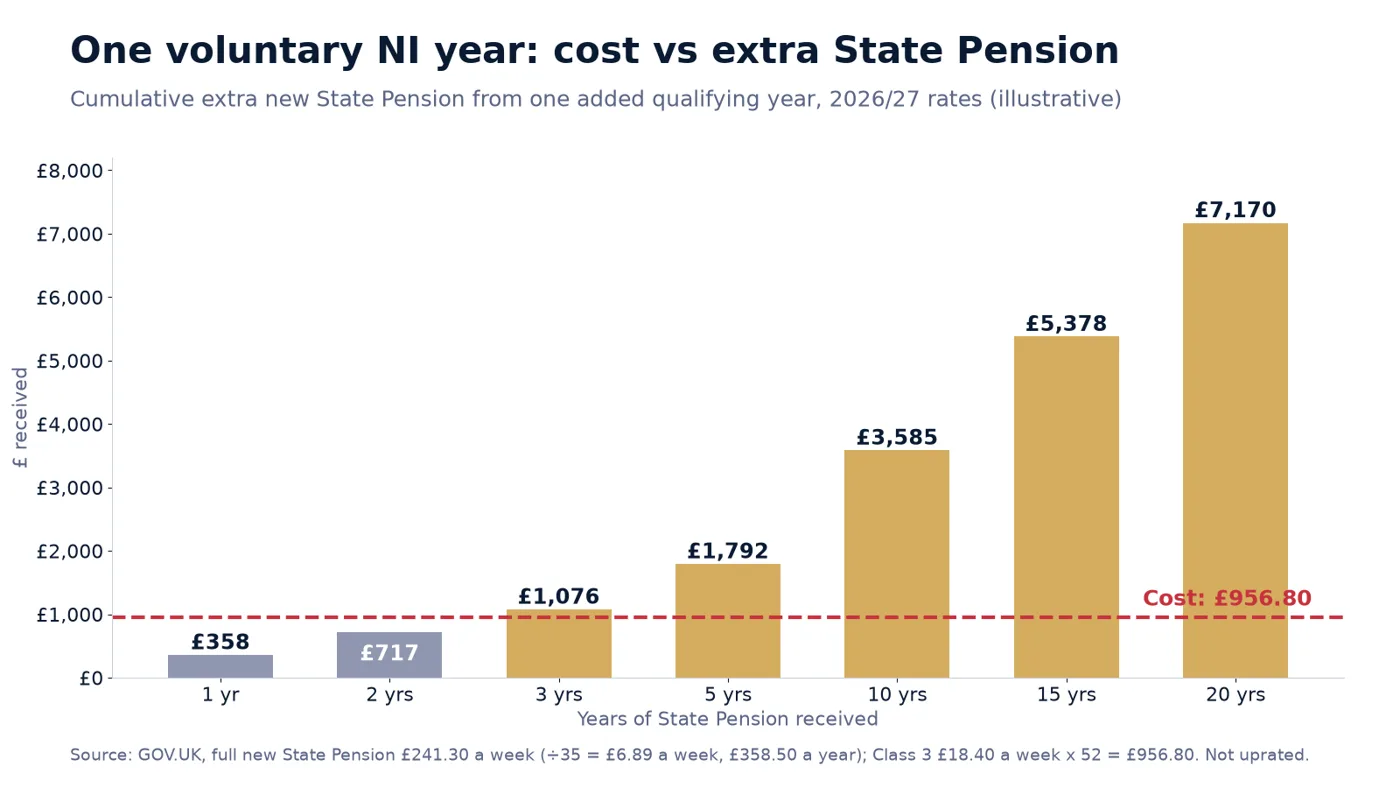
The numbers can be striking. In an illustrative case where one extra year adds 1/35 of the full rate, a full year of Class 3 costs £956.80 and adds about £6.89 a week, or £358.50 a year, for life. That pays for itself in under three years of receiving the State Pension. The full rate is also uprated: the government has proposed £250.70 a week for 2027/28. GOV.UK proposed rates (opens in a new tab)
Source: GOV.UK, full new State Pension £241.30 a week; Class 3 rate £18.40 a week, 2026/27. Illustrative; not uprated. Your own gain depends on your record, so check your forecast first.
If you lived or worked abroad during your break, other rules can apply, so have a specialist confirm before you pay.
How much investment risk should you take when you start again?
Only now does the question of what to invest in come in. The useful question is not "what will grow fastest?" but "how big a fall could I sit through without selling?"
Selling in a fall is how many investors lose money. Morningstar's Mind the Gap study found the average dollar invested in US funds earned 8.7% a year over the ten years to 31 December 2025, against 9.9% a year for the funds themselves, a gap caused largely by the timing of buying and selling. Morningstar (opens in a new tab)
A simple way to size it: decide the largest fall in pounds you could see and still hold, then divide it by a severe but plausible fall for shares. In an illustrative example, if you could tolerate seeing £15,000 drop on a £60,000 portfolio, a 25% fall, and you assume shares could fall 40% in a bad year, then shares should be no more than about 25 ÷ 40, or roughly 60%, of that portfolio. The rest sits in lower-risk assets.
After an illness, be honest about that number. A smaller share allocation you stick with will usually beat a bolder one you abandon, and you can raise it as confidence returns. My guide to protecting your portfolio in a crash and the article on what 20% volatility really means go further.
The free Portfolio Odds (opens in a new tab) tool lets you explore how likely a loss is for a given mix under its assumptions, and Probability (opens in a new tab) shows the range of outcomes over time.
Why a written plan helps most after time out
Everything above fits on one page: your cash target, your cover, monthly pension and ISA amounts, the National Insurance years you are filling and your maximum share allocation.
Then add the investing rules: what you hold and why, how much goes into any one holding, when you rebalance and what would make you sell. That is the case for managing your own money with a process: you have control, you can see every holding and every charge, and the portfolio is built around your own risk profile rather than a default fund designed for an average saver.
It is also kinder to yourself: you are not making big decisions from scratch every time markets wobble. You can see where you stand against typical figures in pension savings by age, and the build a retirement income guide shows how today's savings become tomorrow's income.
What to do next
- Write down your essential monthly spending and set a cash buffer target of three to six months. Start with one month.
- Check what income cover you already have through your employer before looking at income protection.
- Check your National Insurance record and State Pension forecast on GOV.UK, apply for any credits you are owed and only then consider voluntary contributions.
- Work out your pension carry forward by listing contributions for the past three tax years, and test contribution levels in the free Pension Plan (opens in a new tab) tool.
- Set your maximum tolerable fall in pounds and size your share allocation to it, then write your plan down. More free calculators are on the tools page.
Want a written plan for rebuilding your savings at a risk you can live with? Book your free call with Alpesh's team. We will show you how self-directed investors pick investments, size positions and decide when to sell or rebalance. There is nothing to buy on the call.
Frequently asked questions
What should I do first when rebuilding savings after illness?
Build an emergency cash buffer first, starting with one month of essential spending and working towards three to six. That stops a new shock forcing you to sell investments at a bad time.
Can I carry forward pension allowance from years I was not working?
Possibly. You can carry forward unused annual allowance from the previous three tax years if you were a member of a registered pension scheme at some point in each of those years, and a deferred member of an old scheme counts. Tax relief on your own contributions is still limited to 100% of this year's earnings.
Is it worth paying voluntary National Insurance after a career break?
Often, but check first. You may already have credits for years when you were ill or caring. Your GOV.UK record shows whether paying would increase your State Pension and what it would cost.
How much risk should I take when I start investing again?
Size it to the largest fall you could sit through without selling, divided by a severe fall for shares. Start lower if your health or circumstances are still uncertain.
About Alpesh Patel OBE
Alpesh Patel OBE is Founding Principal of Rootbridge Capital, an author and Dealmaker for the UK Government's Department for Business. He is a former Visiting Fellow in Business, Corpus Christi College, Oxford University, where he worked on technology to improve financial education.
Sources
- GOV.UK, Statutory Sick Pay (opens in a new tab)
- MoneyHelper, Emergency savings: how much is enough? (opens in a new tab)
- MoneyHelper, What is income protection insurance? (opens in a new tab)
- GOV.UK, Annual allowance (opens in a new tab)
- GOV.UK, Pension schemes rates and allowances (opens in a new tab)
- HMRC, PTM055100: Annual allowance: carry forward (opens in a new tab)
- GOV.UK, Pension tax relief (opens in a new tab)
- GOV.UK, Individual Savings Accounts (opens in a new tab)
- GOV.UK, How ISAs work (opens in a new tab)
- GOV.UK, Cash ISA limit reduction (opens in a new tab)
- GOV.UK, The new State Pension: what you'll get (opens in a new tab)
- GOV.UK, The new State Pension: eligibility (opens in a new tab)
- GOV.UK, Proposed benefit and pension rates 2027 to 2028 (opens in a new tab)
- GOV.UK, National Insurance credits: eligibility (opens in a new tab)
- GOV.UK, Voluntary National Insurance (opens in a new tab)
- GOV.UK, Voluntary National Insurance: rates (opens in a new tab)
- GOV.UK, Voluntary National Insurance: deadlines (opens in a new tab)
- European Central Bank, Euro foreign exchange reference rates (opens in a new tab)
- Morningstar, Mind the Gap (opens in a new tab)
- Alpesh Patel OBE, Starting to Invest at 50? Here's the Catch-Up Maths (opens in a new tab) (YouTube)
Important: This article is for education only and is not personal financial advice or a recommendation to buy or sell any investment. This article is general investment education only and is not regulated investment advice. The value of investments can go down as well as up, and you may get back less than you invest. Past performance is not a reliable indicator of future results.
Important: this article is education and information only. It is not financial advice or a personal recommendation, and it does not take your circumstances into account. The value of investments and pensions can fall as well as rise, and you may get back less than you put in. Past performance is not a reliable indicator of future results. Figures were correct when the article was written and may have changed. If you are unsure what is right for you, speak to a regulated financial adviser.