Business Owners: SIPP, SSAS or Employer Contributions, and Why Your Business Is Already Your Biggest Bet
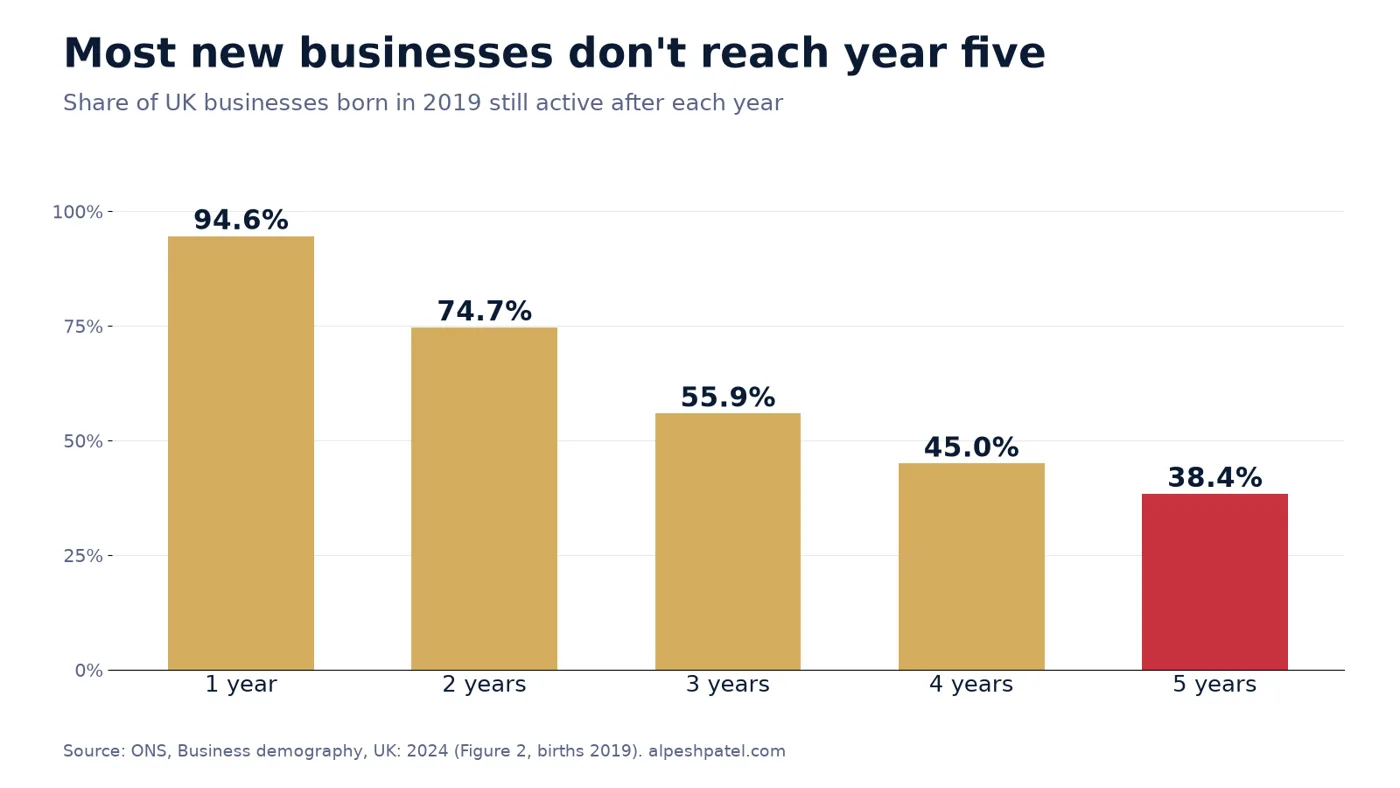
Only 38.4% of UK businesses born in 2019 were still active five years later, according to the Office for National Statistics (opens in a new tab). If you run a company that has made it well past that point, congratulations. You have beaten the odds. You have also, almost certainly, put most of your wealth into one place.
A situation my team hears often goes like this. A director in their fifties owns a profitable company. The company owns, or rents, the building it trades from. Their home is in the same town. And when they ask about a business owner pension, the question is usually framed as SIPP or SSAS, as if the wrapper were the big decision.
It isn't. The bigger decision is what goes inside. A pension is often the one pot of money a business owner has that does not depend on their own sector, their own town and their own customers. Used well, it is a hedge against the business. Used badly, it becomes a second bet on it.
Short answer: For most business owners, employer pension contributions from the company are the most tax-efficient route, because they can be an allowable business expense and count towards a £60,000 annual allowance. A SIPP or SSAS is just the wrapper. The real decision is whether the pension diversifies away from your business or doubles down on it.
Running a company and wondering what your pension should actually hold? Book your free call with Alpesh's team. We will walk through how self-directed investors pick, size and review investments inside a pension, so it works alongside your business rather than against it. There is nothing to buy on the call.
Why do employer pension contributions suit business owners?
If you own a limited company, you can pay yourself in salary, dividends or pension contributions. The company can make a pension contribution for you directly, as your employer.
HMRC's Business Income Manual says an employer's contribution to a registered pension scheme "will be an allowable expense unless there is a non-trade purpose for the payment" (HMRC BIM46035 (opens in a new tab)). For a director of a close company, HMRC says inspectors should accept the contribution is paid "wholly and exclusively" for the trade where the whole remuneration package is comparable with that paid to unconnected employees doing work of similar value.
That matters, because an allowable expense reduces the company's taxable profit. Corporation tax is 25% on profits over £250,000, and 19% for profits of £50,000 or less, with marginal relief in between (GOV.UK (opens in a new tab)). In an illustrative example, a £10,000 contribution that is fully allowable would cut the bill by £2,500 for a company paying the main rate and £1,900 for one paying the small profits rate.
There is also no set limit on the tax relief an employer can receive on its contributions, though relief is not automatic and very large one-off contributions may have to be spread over several years (HMRC PTM024200 (opens in a new tab); PTM043400 (opens in a new tab)). The contribution is not taxed on you as earnings (HMRC PTM024200 (opens in a new tab)).
On National Insurance, the government has confirmed that relief on traditional, non-salary-sacrifice employer pension contributions remains unchanged. What does change is salary sacrifice: from 6 April 2029, amounts sacrificed above £2,000 a year will attract employer and employee National Insurance (GOV.UK (opens in a new tab)). How you structure pay is a question for your accountant.
How much can the company pay into my pension?
The limit that bites is on you, not the company. The annual allowance is £60,000 this tax year, and it includes money paid in "by you or anyone else (for example, your employer)" (GOV.UK (opens in a new tab)). Unlike your own personal contributions, an employer contribution is not capped at 100% of your earnings, though it still has to pass the wholly and exclusively test.
You may be able to carry forward unused allowance from the previous three tax years (GOV.UK (opens in a new tab)). For a director who has paid in little while building the business, that can allow a much larger contribution in a strong year.
High earners need to check the taper. Your allowance falls by £1 for every £2 of adjusted income over £260,000, unless your threshold income is £200,000 or less, down to a minimum of £10,000 (GOV.UK (opens in a new tab)). Employer contributions are added in when working out adjusted income (GOV.UK (opens in a new tab)), so a large company contribution can itself trigger the taper. If you have already flexibly accessed a pension, a lower money purchase annual allowance may apply.
SIPP vs SSAS: what is the difference?
A SIPP is a personal pension run by a provider. A SSAS is an occupational pension scheme set up by your company, where the members are usually also the trustees. The Pensions Regulator defines these "relevant small schemes" as schemes with fewer than 12 members where, broadly, all members are trustees and decisions are taken unanimously (TPR (opens in a new tab)).
Both can hold shares, funds and commercial property. Neither can hold residential property or things like cars and furniture without tax charges (GOV.UK (opens in a new tab)). The main practical differences are below.
| Feature | SIPP | SSAS |
|---|---|---|
| Type of scheme | Personal pension, run by a provider | Occupational scheme set up by your company |
| Who makes decisions | You, within the provider's rules | Member trustees, usually unanimously (TPR (opens in a new tab)) |
| Members | Usually one per plan | Fewer than 12 (TPR (opens in a new tab)) |
| Loan to your company | Not allowed to you or a company you control (GOV.UK (opens in a new tab)) | Up to 50% of net scheme assets, secured, max five years, equal annual repayments (GOV.UK (opens in a new tab)) |
| Shares in your company | Restricted; check the rules with your provider | Under 5% of net assets per employer, under 20% in total (GOV.UK (opens in a new tab)) |
| Borrowing to invest | Up to 50% of net fund value (HMRC PTM124000 (opens in a new tab)) | Same 50% limit |
| Commercial property | Allowed, at a commercial rent if your company is the tenant (HMRC PTM121000 (opens in a new tab)) | Allowed, same rule |
| Example published fee | Low-cost SIPPs from 0.15% capped at £375 a year (Vanguard (opens in a new tab)) | £900 a year for the first member plus VAT at one provider (Westerby SSAS schedule (opens in a new tab)) |
The SSAS loan rules come straight from HMRC's guidance for trustees. The loan to the sponsoring employer cannot exceed 50% of the net value of scheme assets, must last no more than five years, must carry interest at least 1% above the average base lending rate of the leading high street banks, must be secured by a first charge and must be repaid in equal annual instalments (GOV.UK (opens in a new tab)). Breaking these rules creates an unauthorised payment and tax charges.
A SSAS also makes you a trustee, with legal duties. You become responsible for the proper running of the scheme, and can be personally liable for losses caused by a breach of trust (TPR trustee guidance (opens in a new tab)). If you want a deeper look at costs and returns inside a SSAS, see my SSAS pension review: fees, fund overlap and real returns.
Why is your business already your biggest bet?
Here is the part that rarely makes the brochure. The features that make a SSAS attractive, lending to your company and buying the premises it trades from, are the same features that tie your pension to the fate of your business.
Source: ONS, Business demography, UK: 2024 (opens in a new tab), Figure 2 (businesses born in 2019).
Think about a typical owner's balance sheet. The company is in one sector. Its premises are in one town. The owner's home is probably nearby. Their income, their dividends and the value of their shares all depend on the same customers and the same local economy. In a bad year, all of them can fall together.
Now add a pension that owns the company's building and has lent money to the company. If the business hits trouble, the tenant may stop paying rent, the loan may not be repaid on time and the building may be hard to re-let. HMRC itself notes, when explaining the 50% loan limit, that "it may also not be prudent to lend scheme funds to one company" (HMRC PTM123200 (opens in a new tab)).
That does not mean a loanback or a property purchase is always wrong. It can be a sensible, well-documented decision. It means you should make it knowing that you are adding to the biggest position you already hold.
What should a business owner's pension actually hold?
My view is simple. Your business is your concentrated, high-conviction bet. Your pension should be the opposite: diversified across countries, sectors and companies that have nothing to do with your trade.
That does not mean handing it to someone else and forgetting it. It means running it with a written process, in the same way you would run a business:
- What to own. A core of low-cost global funds, for example a global index fund with an ongoing charge of 0.23% (Vanguard (opens in a new tab)), plus individual shares chosen by clear rules if you want them.
- How much in each. A maximum position size, so no single holding can sink the plan, and a deliberate underweight in your own sector.
- When to sell or rebalance. Rules written before you need them, such as a yearly rebalance or a sell rule if a holding breaks your criteria.
Watch the overlap with what you already own. If you run a UK construction firm, a UK smaller companies fund full of builders and suppliers adds to your exposure rather than diluting it. The same thinking applies globally: a handful of very large US companies now dominate world indices, which I covered in S&P 500 concentration.
Behaviour matters as much as the funds. Morningstar found that over the ten years to 31 December 2025, the average US fund investor earned 8.7% a year, against 9.9% a year for the funds themselves, largely because of badly timed buying and selling (Morningstar (opens in a new tab)). A written process is the cheapest protection against that gap.
What changes for pensions and inheritance tax in 2027?
For many business owners, the pension has been the last pot they expected to spend, because it sat outside the estate. That is changing. The government will bring most unused pension funds and death benefits into scope of inheritance tax from 6 April 2027, with personal representatives liable for reporting and paying any tax due (GOV.UK (opens in a new tab)). Death-in-service benefits from registered schemes will be excluded.
This may change the order in which you draw on your company, your pension and your other savings. It may also change how much you want locked into an illiquid property inside the pension, if your executors could face a tax bill before it can be sold. This is an area for a tax specialist, and it interacts with business relief on your company shares.
Are SSAS loanbacks and property deals a scam risk?
Pension freedoms have attracted fraudsters, and schemes that allow unusual investments are a favourite target. The Pensions Regulator says £17.7 million was reported lost to pension fraud in 2023, an average of nearly £47,000 per victim, and fewer than one in five victims report it (TPR (opens in a new tab)).
Be wary of anyone who cold calls about setting up a SSAS, promises guaranteed returns, suggests a loan to a company you do not control or pushes overseas property or unregulated investments. HMRC applies a 40% unauthorised payments charge to payments that break the rules, with further charges on the scheme (HMRC PTM121000 (opens in a new tab)). If you are thinking of moving an existing pension into a new scheme, get in writing what you would give up, such as guaranteed annuity rates or protected tax-free cash. If the pension includes safeguarded benefits worth more than £30,000, such as a final salary scheme, you must take advice from an FCA-authorised adviser before transferring (FCA (opens in a new tab)).
What to do next
- Map your concentration. List your company, its premises, your home and your pension, and note which depend on the same sector or town. Our free tools can help you see the whole picture.
- Ask your accountant three questions. Is a company contribution allowable for you, how much unused allowance can you carry forward, and does the taper apply?
- Choose the wrapper last. If you only need low-cost investing, a SIPP may be enough; compare platforms in cheapest SIPP for drawdown 2026. If you need a loanback or shared ownership with other directors, price a SSAS properly and understand the trustee duties.
- Write your investment process. What you will own, how much in each, and when you will sell or rebalance. See run your own SIPP for the steps.
- Test the plan. Model your retirement income with the free Pension Plan tool (opens in a new tab) and the odds of reaching your target with Portfolio Odds (opens in a new tab).
Want your pension to balance your business risk rather than add to it? Book your free call with Alpesh's team. We will show you how self-directed investors pick investments, size positions and decide when to sell, so the money you take out of your company is managed with the same discipline you put into it. There is nothing to buy on the call.
Frequently asked questions
Are employer pension contributions a tax-deductible business expense?
They can be. HMRC treats an employer contribution to a registered pension scheme as an allowable expense unless there is a non-trade purpose, and for directors it looks at whether the whole pay package is reasonable for the work done. Your accountant should confirm this for your company.
Is a SIPP or a SSAS better for a company director?
It depends on what you need. A SIPP is usually simpler and cheaper for investing in funds and shares, while a SSAS adds options such as loans to the sponsoring company and joint ownership with other directors, at the cost of trustee duties and higher fees.
How much can my limited company pay into my pension?
Total contributions from you and your company count towards the £60,000 annual allowance, and you may be able to carry forward unused allowance from the previous three tax years. High earners may have a lower, tapered allowance, down to £10,000.
Can my SSAS lend money to my company?
Yes, within HMRC's rules: no more than 50% of the net value of the scheme's assets, secured by a first charge, for no more than five years, at a minimum interest rate and repaid in equal annual instalments. Break the rules and tax charges apply.
Will my pension be subject to inheritance tax?
From 6 April 2027, most unused pension funds and death benefits will come into scope of inheritance tax. A tax specialist can tell you how this affects your estate and the order in which you draw on your savings.
About Alpesh Patel OBE
Alpesh Patel OBE is Founding Principal of Rootbridge Capital, an author and Dealmaker for the UK Government's Department for Business. He is a former Visiting Fellow in Business, Corpus Christi College, Oxford University, where he worked on technology to improve financial education.
Sources
- Office for National Statistics, Business demography, UK: 2024 (opens in a new tab)
- HMRC, BIM46035: pension contributions, wholly and exclusively (opens in a new tab)
- GOV.UK, Corporation Tax rates and reliefs (opens in a new tab)
- HMRC, PTM024200: overview of pensions taxation, contributions (opens in a new tab)
- HMRC, PTM043400: spreading of employer tax relief (opens in a new tab)
- GOV.UK, Salary sacrifice reform for pension contributions (opens in a new tab)
- GOV.UK, Annual allowance (opens in a new tab)
- GOV.UK, Work out your tapered annual allowance (opens in a new tab)
- The Pensions Regulator, Occupational defined contribution landscape 2025 (opens in a new tab)
- GOV.UK, Tax on investments for pension trustees (opens in a new tab)
- HMRC, PTM124000: borrowing (opens in a new tab)
- HMRC, PTM123200: loans to sponsoring employers (opens in a new tab)
- HMRC, PTM121000: investments, essential principles (opens in a new tab)
- The Pensions Regulator, Trustee guidance (opens in a new tab)
- Vanguard, Personal Pension (opens in a new tab)
- Westerby, Schedule of SSAS fees (July 2026) (opens in a new tab)
- Vanguard, FTSE Global All Cap Index Fund (opens in a new tab)
- Morningstar, Mind the Gap 2026 (opens in a new tab)
- GOV.UK, Inheritance Tax: unused pension funds and death benefits (opens in a new tab)
- The Pensions Regulator, Working together to strengthen our defences against scams (opens in a new tab)
- Financial Conduct Authority, Advising on pension transfers: our expectations (opens in a new tab)
- Alpesh Patel OBE, Importance of Portfolio Diversification (opens in a new tab) (YouTube)
Important: This article is for education only and is not personal financial advice or a recommendation to buy or sell any investment. This article is general investment education only and is not regulated investment advice. The value of investments can go down as well as up, and you may get back less than you invest. Past performance is not a reliable indicator of future results.
Important: this article is education and information only. It is not financial advice or a personal recommendation, and it does not take your circumstances into account. The value of investments and pensions can fall as well as rise, and you may get back less than you put in. Past performance is not a reliable indicator of future results. Figures were correct when the article was written and may have changed. If you are unsure what is right for you, speak to a regulated financial adviser.