SSAS Pension Review: Fees, Fund Overlap and What 7% a Year Really Means
In the five years to 31 October 2026, a plain global index fund returned about 10% a year. The Vanguard FTSE Global All Cap Index Fund (opens in a new tab) made 10.0%, 19.3%, 24.6%, 4.0% and minus 5.0% in those five 12-month periods. Compounded, that is roughly 10.1% a year. Keep that number in mind when you start a SSAS pension review.
A situation my team sees often: a company director has built a small self-administered scheme (SSAS) worth around £600,000. Most of it sits in managed funds with a large insurer or platform. The company pays in about £75,000 a year, and the statements report a return of about 7%. The director already runs their own ISA, enjoys it and wants to know whether the same approach could work for the pension.
It can. The wrapper changes; the method does not. If anything, the method matters more inside the pension, because the pot is bigger, growth is free of tax and every year another large contribution has to be invested well.
Short answer: A SSAS pension review should start with three checks. Add up every platform, fund and adviser fee in pounds; on £600,000 each 1% a year costs £6,000. Look inside managed funds for the same shares held several times over. Then compare your return with a low-cost global tracker over the same years, after all fees.
Running your own ISA and wondering if your SSAS could work the same way? Book your free call with Alpesh's team. We will walk through how self-directed investors pick, size and review investments inside a pension. There is nothing to buy on the call.
What is a SSAS, and who runs it?
A SSAS is an occupational pension scheme set up by a company, usually for its directors and key staff. HMRC classes it as an occupational scheme, set up by a sponsoring employer to provide benefits for its employees (HMRC Pensions Tax Manual (opens in a new tab)). Unlike a personal pension or SIPP, the members are usually also the trustees.
That makes you more than a saver. The Pensions Regulator's trustee guidance (opens in a new tab) says trustees are responsible for the proper running of the scheme, from collecting contributions to investing the assets and paying benefits. They must act in the best interests of beneficiaries, impartially, responsibly and honestly, and can be personally liable for losses caused by a breach of trust. Some exemptions apply to schemes with fewer than 12 members, but the core duties remain.
Trustees must also keep proper records for at least six years, and be careful with "employer-related investments", such as shares in the company or property it uses (TPR (opens in a new tab)). Most SSASs appoint a professional scheme administrator to help with the paperwork. The decisions, though, sit with the trustees.
How are company contributions to a SSAS treated for tax?
For many directors, this is the reason to have a SSAS at all. HMRC says tax relief on an employer's contribution follows the normal rules for business expenses, and the contribution must be paid "wholly and exclusively for the purposes of the trade" to be deductible (HMRC Business Income Manual BIM46005 (opens in a new tab)).
For controlling directors, HMRC looks at the whole pay package. A contribution is allowable where the remuneration package is paid wholly and exclusively for the trade, and HMRC should accept this where the package is comparable with that paid to unconnected employees doing work of similar value (BIM46035 (opens in a new tab)). Relief is given in the accounting period the contribution is paid, subject to spreading rules for very large contributions (BIM46005 (opens in a new tab)).
Does the annual allowance apply to employer contributions?
Yes. The annual allowance covers the total paid into a defined contribution scheme in a tax year "by you or anyone else (for example, your employer)" (GOV.UK annual allowance (opens in a new tab)). The allowance is £60,000, you may be able to carry forward unused allowance from the previous three tax years, and it tapers if your threshold income is over £200,000 and adjusted income is over £260,000.
That matters for anyone paying in around £75,000 a year. Contributions above £60,000 only avoid an annual allowance tax charge if there is unused allowance to carry forward, and paying over the limit every year uses that up. Your accountant or a tax specialist should confirm the position each year before the company pays.
What does a SSAS really cost you each year?
Start with cost, because it is the one thing you control completely. A SSAS invested through an insurer's managed funds often has three or four layers of charges:
- the scheme administrator's fee for running the SSAS;
- the platform or insurer's charge on the investments;
- the ongoing charge of each fund;
- an ongoing adviser fee, if there is one.
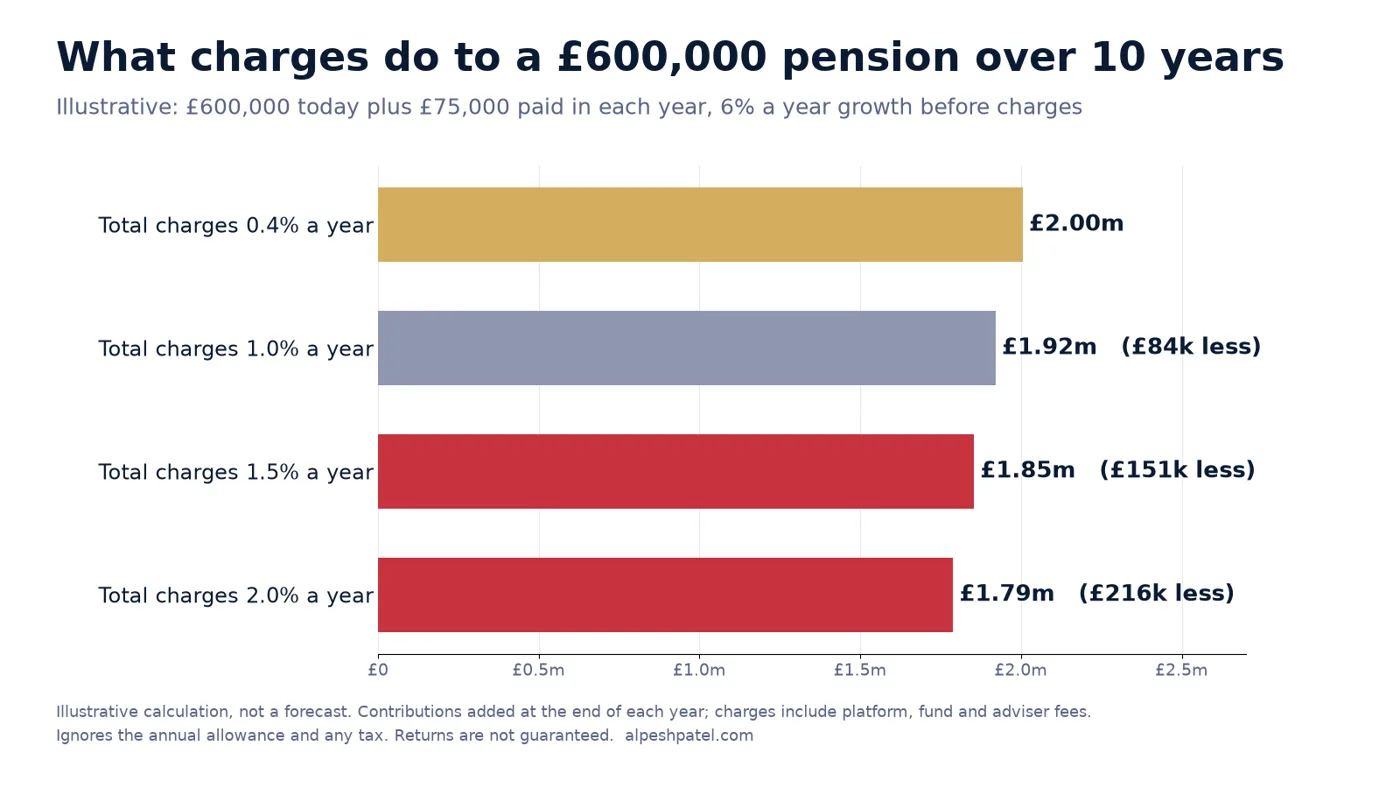
Write each one down in pounds, not percentages. On £600,000, every 1% a year is £6,000, every year, whether the fund has a good year or a bad one. Fees also come out of the £75,000 the company adds each year, so the bill grows as the pot grows.
Over time, the gap compounds. In the illustrative example below, the same pot with the same contributions and the same growth before charges ends ten years later about £151,000 smaller at 1.5% a year in total charges than at 0.4%.
Source: Alpesh B Patel OBE calculation. Illustrative only, not a forecast: £600,000 start, £75,000 added at the end of each year, 6% a year growth before charges. Ignores the annual allowance and tax.
For comparison, the Vanguard FTSE Global All Cap Index Fund (opens in a new tab) has an ongoing charge of 0.23%. That figure is an example of what a broad index fund can cost, not a recommendation. My piece on what 1% a year really costs goes further into how advice and fund fees add up.
Are your managed funds holding the same shares twice?
The second check is what you actually own. Managed and multi-asset funds often hold other funds, and many global funds have the same large companies near the top. Hold three or four of them and you can end up owning the same handful of names several times over, while paying several sets of charges to do it.
The fix is simple, if a little tedious. Download the latest factsheet for every fund in the scheme. List the top ten holdings of each, and add up how much of the whole SSAS sits in each company, sector and country. Many people are surprised by how concentrated a "diversified" set of funds turns out to be. My analysis of S&P 500 concentration and the Magnificent Seven shows why this matters now.
Then ask a plain question: what is each fund doing that the others are not? If you cannot answer it, that fund may be adding cost without adding anything else.
Is 7% a year a good return for a pension?
Seven per cent sounds respectable. The question is: 7% compared to what, and over what period?
A return only means something next to a benchmark measured over the same dates and after the same costs. The simplest benchmark for a growth-focused pension is a low-cost global tracker. Here is how one has done over the last five years.
| 12 months to 31 October | Vanguard FTSE Global All Cap Index Fund | A steady 7% a year (illustrative) |
|---|---|---|
| 2022 | −4.96% | 7.00% |
| 2023 | 4.03% | 7.00% |
| 2024 | 24.62% | 7.00% |
| 2025 | 19.26% | 7.00% |
| 2026 | 10.02% | 7.00% |
| Five years, compounded | about 61.7% (10.1% a year) | about 40.3% |
| £600,000 after five years | about £970,000 | about £842,000 |
Source: Vanguard fund performance (opens in a new tab), fund returns as published by Vanguard, before any platform or adviser fee. Compounded figures and £600,000 values are Alpesh B Patel OBE calculations, ignore contributions and are illustrative. Past performance is not a reliable indicator of future results.
Two cautions. First, a cautious or balanced fund holding bonds would be expected to lag an all-shares tracker in a strong five years for shares, so compare like with like for risk. The tracker also fell almost 5% in its weakest year here, and can fall much further in a crash. Second, check what your 7% means. Is it a yearly average, a compound annual rate, or simply the change in value including the company's contributions? Paying in £75,000 a year can make a pot look as if it is growing fast when the investments are doing much less.
Ask the provider for the money-weighted or time-weighted return after all charges, for one, three and five years, and set it next to a tracker over the same dates. Our free Portfolio Odds (opens in a new tab) tool shows how often a mix has lost money over different holding periods, under its assumptions.
Why does new money matter as much as the existing pot?
With £75,000 a year going in, the next five years of contributions add up to £375,000 before any growth. How and when that money is invested matters nearly as much as what you do with the £600,000.
Timing decisions are where investors tend to lose most. Morningstar's Mind the Gap 2026 (opens in a new tab) study found US fund investors earned 8.7% a year on their money over the ten years to 31 December 2025, against 9.9% a year for the funds themselves. The gap came from buying and selling at the wrong times.
A written rule removes most of that risk. For example: each contribution is invested within a set number of days, split according to your target mix, with no waiting for a "better time". Then rebalance on fixed dates rather than when the news is loudest.
How can you self-direct investments inside a SSAS?
If you already run your own ISA with a clear process, a SSAS gives you room to do the same with your pension. The usual options are:
Keep the administrator, change the investments. Many SSASs can open an investment or trading account in the trustees' names with a platform or stockbroker. You then choose the funds, trusts, ETFs or shares yourself, within the scheme rules. Check the account and dealing charges on the platform's own charges page.
Simplify the existing funds. Replace overlapping managed funds with fewer, cheaper holdings that each have a clear job, such as a global tracker as a core and a small number of chosen positions around it.
Delegate part, keep part. Some trustees keep a core with a manager and run a portion themselves until they are confident in their process.
Whichever you choose, the trustees remain responsible. Record each investment decision in trustee minutes, keep the statement of investment principles current where your scheme needs one, and ask your scheme administrator what the scheme rules and regulations allow. If you plan to move money between providers, ask both in writing about exit fees, and be wary of anyone who cold calls offering SSAS investments: Action Fraud figures cited by The Pensions Regulator (opens in a new tab) show £17.7 million reported lost to pension fraud in 2023, an average of nearly £47,000 per victim, and fewer than one in five scams are reported.
The case for doing it yourself is the same as in an ISA. You get control over what you own, transparency over every holding and every charge, and a portfolio built around your own risk profile and retirement date. The run your own SIPP guide sets out the practical habits, and most apply equally to a SSAS.
One date to note: from 6 April 2027, most unused pension funds and death benefits will be included in estates for Inheritance Tax (GOV.UK (opens in a new tab)). If the SSAS is part of your plans for the family, ask a tax specialist to review it.
Related: Business owners: SIPP, SSAS or employer contributions.
What to do next
- Add up every fee in pounds: administrator, platform, funds and adviser, as a yearly total on your current pot.
- List the top ten holdings of every fund and see how much of the SSAS sits in the same names.
- Get your real return: after all charges, for one, three and five years, excluding contributions, then compare it with a low-cost global tracker over the same dates.
- Check contributions against the annual allowance with your accountant before the company pays, including carry forward and any taper.
- Write your process down: target mix, how new money is invested, position sizes, rebalancing dates and sell rules. Our free Pension Plan (opens in a new tab) tool helps test contributions and growth rates.
Want to run your SSAS with the same discipline as your ISA? Book your free call with Alpesh's team. We will show you how self-directed investors decide what to hold, how much and when to sell, inside any wrapper. There is nothing to buy on the call.
Frequently asked questions
Can I manage my own SSAS investments?
Usually yes, because the members are normally the trustees and the trustees decide how the scheme invests. You remain bound by trustee duties and the scheme rules, so check with your scheme administrator what is permitted and keep written records of each decision.
Are company contributions to a SSAS tax-deductible?
They are normally allowable as a business expense if paid wholly and exclusively for the purposes of the trade. For controlling directors, HMRC looks at whether the whole pay package is reasonable for the work done.
Do employer contributions count towards the annual allowance?
Yes. The £60,000 annual allowance covers contributions from you and your employer, and you may be able to carry forward unused allowance from the previous three tax years.
Is 7% a good return for a SSAS?
It depends on the period, the risk taken and whether it is after all fees. Compare it with a low-cost global tracker over the same dates; one such fund returned about 10.1% a year over the five years to 31 October 2026.
How much do SSAS fees cost?
It varies by administrator, platform, funds and adviser. Add every layer in pounds: on £600,000, each 1% a year in total charges is £6,000 a year.
About Alpesh Patel OBE
Alpesh Patel OBE is Founding Principal of Rootbridge Capital, an author and Dealmaker for the UK Government's Department for Business. He is a former Visiting Fellow in Business, Corpus Christi College, Oxford University, where he worked on technology to improve financial education.
Sources
- Vanguard, FTSE Global All Cap Index Fund: performance (opens in a new tab)
- Vanguard, FTSE Global All Cap Index Fund: overview (opens in a new tab)
- HMRC, Pensions Tax Manual PTM022000: types of pension scheme (opens in a new tab)
- HMRC, Business Income Manual BIM46005: employer pension contributions (opens in a new tab)
- HMRC, Business Income Manual BIM46035: controlling directors (opens in a new tab)
- GOV.UK, Annual allowance (opens in a new tab)
- The Pensions Regulator, Trustee guidance (opens in a new tab)
- The Pensions Regulator, Working together to strengthen our defences against scams (opens in a new tab)
- Morningstar, Mind the Gap 2026 (opens in a new tab)
- GOV.UK, Inheritance Tax on unused pension funds and death benefits (opens in a new tab)
- Alpesh Patel OBE, I Reviewed a £480,000 Pension. Here's What Was Wrong. (opens in a new tab) (YouTube)
Important: This article is for education only and is not personal financial advice or a recommendation to buy or sell any investment. This article is general investment education only and is not regulated investment advice. The value of investments can go down as well as up, and you may get back less than you invest. Past performance is not a reliable indicator of future results.
Important: this article is education and information only. It is not financial advice or a personal recommendation, and it does not take your circumstances into account. The value of investments and pensions can fall as well as rise, and you may get back less than you put in. Past performance is not a reliable indicator of future results. Figures were correct when the article was written and may have changed. If you are unsure what is right for you, speak to a regulated financial adviser.