Retiring in 2027: A 12‑Month Checklist, Including the Gilt You Will Sell Before It Matures
A UK government gilt repays exactly £100 for every £100 nominal you hold, but only on the day it matures. The Debt Management Office puts it plainly: a gilt's title does not tell you "how much they would receive if they sold it (rather than waiting for repayment of the principal at maturity)". DMO (opens in a new tab) Sell a year or ten years early and you get whatever the market will pay.
That gap catches out a lot of people approaching retirement. Picture someone retiring next year with a seven-figure portfolio, a long-dated gilt bought as the "safe" part, and a plan to sell it in the first few years of retirement to fund income. The gilt is safe if held to maturity. The plan to sell it early is not the same thing.
If you are retiring in 2027, this checklist runs through the next 12 months in order: the dates, the tax traps, the April 2027 rule change, and the job every holding in your portfolio needs before the salary stops.
Short answer: If you are retiring in 2027, confirm your State Pension age, plan your 25% tax-free cash, prepare for emergency tax on your first withdrawal and update beneficiaries before pensions enter Inheritance Tax on 6 April 2027. Build a cash buffer, and give every holding, including any gilt you will sell early, a job, a size and a sell rule.
Retiring in 2027 and want a written plan for every holding? Book your free call with Alpesh's team. We will walk through how self-directed investors decide what each holding is for, how big it should be and when to sell. There is nothing to buy on the call.
Your 12-month retiring in 2027 checklist
Here is the whole year on one page. The sections below explain each item.
| When | What to do | Why |
|---|---|---|
| 12 months out | Check your State Pension age and forecast; fill NI gaps if worthwhile | The date and amount anchor everything else |
| 10–12 months out | List every pension, ISA and account; give each holding a job, size and sell rule | You cannot plan income from pots you cannot see |
| 9 months out | Decide how much tax-free cash to take and when | 25% is usually tax-free, capped at £268,275 |
| Before 6 April 2027 | Review pension beneficiaries and your will | Unused pensions enter the IHT estate from that date |
| 6 months out | Build the cash buffer; match any gilts to the dates you need cash | So no holding has to be sold at a bad price |
| 3 months out | Plan your first withdrawal and the emergency tax refund | The first payment is often over-taxed |
| Retirement month | Switch on income; diarise your first annual review | Rules only work if you check them |
Illustrative timetable. Your own order depends on your dates and pots.
When will you get your State Pension if you retire in 2027?
State Pension age is rising from 66 to 67 between 2026 and 2028. If you were born between 6 April 1960 and 5 March 1961, you reach it at 66 plus between one and 11 months, depending on your birth month. If you were born on or after 6 March 1961, it is 67. GOV.UK State Pension age timetable (opens in a new tab)
So someone born in December 1960 reaches State Pension age at 66 and nine months, in the autumn of 2027, not on their 66th birthday. Check your own date with the GOV.UK State Pension age tool (opens in a new tab). If you retire before then, your portfolio has to cover the gap.
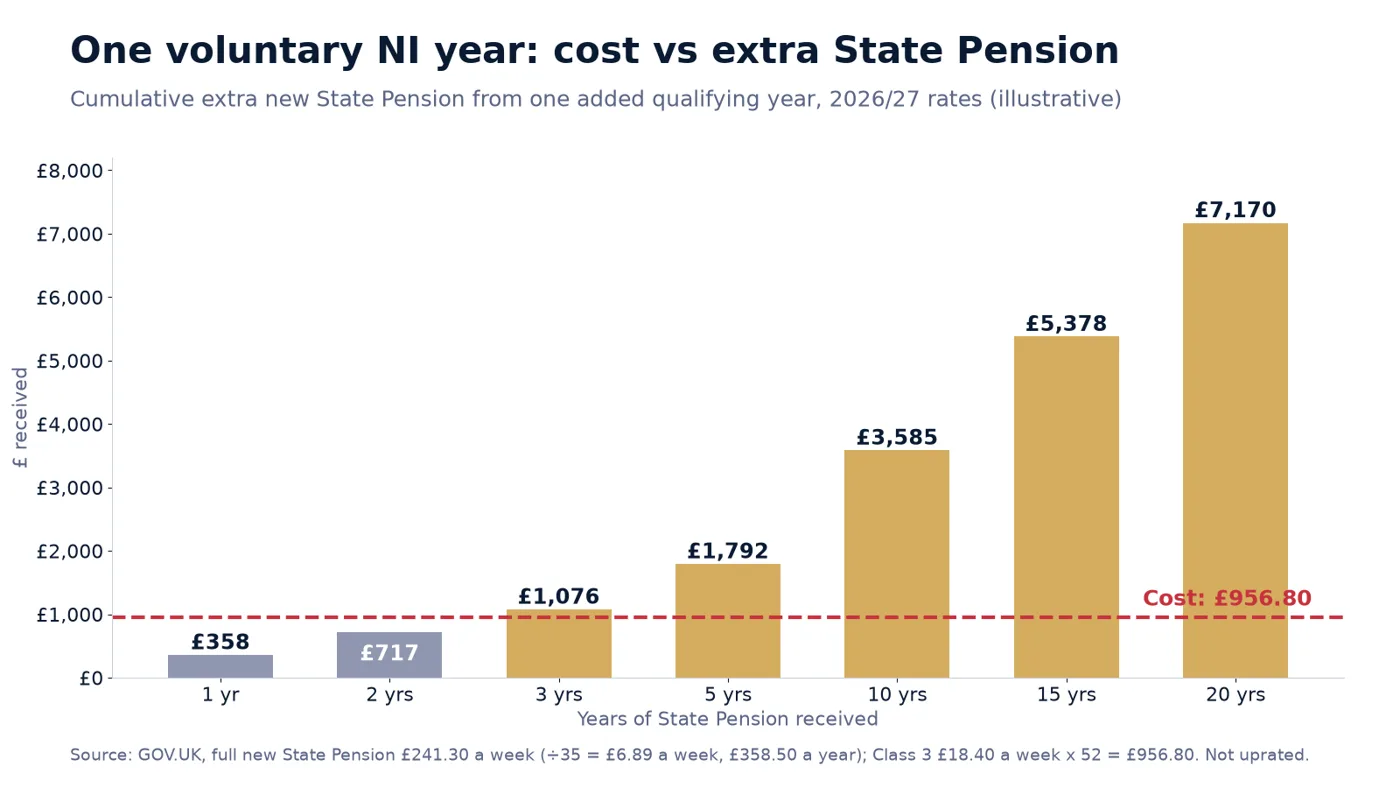
The full new State Pension is £241.30 a week in 2026/27. GOV.UK (opens in a new tab) The government has proposed £250.70 a week for 2027/28. GOV.UK proposed rates (opens in a new tab) Over 52 weeks that is about £13,036 a year, which is more than the usual £12,570 Personal Allowance. GOV.UK tax on pension (opens in a new tab) So if you get the full amount and the Personal Allowance stays at that level, most of your other pension income is likely to be taxed from the first pound.
Get a forecast now. If you have gaps, you can usually pay voluntary National Insurance for the past six years. GOV.UK (opens in a new tab)
How much tax-free cash can you take?
You can usually take up to 25% of each pension as a tax-free lump sum, up to a lifetime maximum of £268,275, known as the lump sum allowance. Above that, Income Tax applies. GOV.UK lump sum allowance (opens in a new tab)
The bigger decision is when. You do not have to take it all on day one. Taking tax-free cash in stages, alongside taxable income, can smooth your tax bill over several years. Taking it all at once can make sense if the cash has a clear job, such as clearing a mortgage.
Ask one more question before you take it: where will the money sit afterwards? Cash taken out of a pension and left in a bank account may lose ground to inflation. Cash with no plan is a decision deferred, not made.
Why does the first pension withdrawal get emergency tax?
This surprises almost everyone. When you first take a taxable flexible payment from a pension, the provider often has no up-to-date tax code for you. HMRC's own manual says that, unless you give the scheme a P45 from the current tax year, it "will use the emergency tax code on a month 1 basis against the first payment". HMRC PAYE Manual (opens in a new tab)
Month 1 means the payment is taxed as if you will receive the same amount every month of the year. A large one-off withdrawal can therefore be taxed at higher rates than you will actually owe.
You can claim the overpayment back during the tax year. The form depends on your situation: P55 if you have taken only part of your pot, and other forms such as P53Z or P50Z if you have emptied it. GOV.UK claim by post (opens in a new tab) HMRC Self Assessment Manual (opens in a new tab) Some people take a small first withdrawal so a proper tax code is issued before the larger ones.
Two more rules. Once you flexibly access a pension, the money purchase annual allowance of £10,000 applies to further contributions. GOV.UK pension schemes rates (opens in a new tab) If you plan to keep paying in, perhaps from part-time work, plan the order. And if you will draw before your State Pension starts, my guide to which pot to draw first in retirement goes through the sequence.
What changes for pensions and Inheritance Tax on 6 April 2027?
From 6 April 2027, most unused pension funds and death benefits will be included in the value of your estate for Inheritance Tax. Death in service benefits from registered schemes are excluded, and personal representatives will be responsible for reporting and paying any tax due. GOV.UK (opens in a new tab)
For anyone retiring in 2027, this lands in the middle of the planning year. It may change which pots you draw first, whether you leave the pension untouched and how you think about an annuity. My article on drawdown or annuity after the 2027 IHT change covers the trade-offs.
Before April, check your expression of wishes with every pension provider and make sure your will reflects your plans. The rules interact with spouse exemptions and other allowances, so a tax specialist should confirm your own position.
Is a gilt safe if you sell it before it matures?
This is the part of the plan people most often get wrong.
A conventional gilt pays a fixed coupon every six months and repays its nominal amount at maturity. Its yield moves as its price moves: when the price rises the yield falls, and when the price falls the yield rises. DMO (opens in a new tab) The DMO's own example: pay £90 for the 3¼% Treasury Gilt 2033 and hold it to maturity, and you make a £10 capital gain on top of the coupon, a yield to maturity of about 4.53%. Pay £110 and hold it, and you make a £10 capital loss. DMO (opens in a new tab)
Hold to maturity and you know what you will get. Sell early and you take whatever price the market offers that day. The longer the gilt has left to run, the more that price moves when interest rates change.
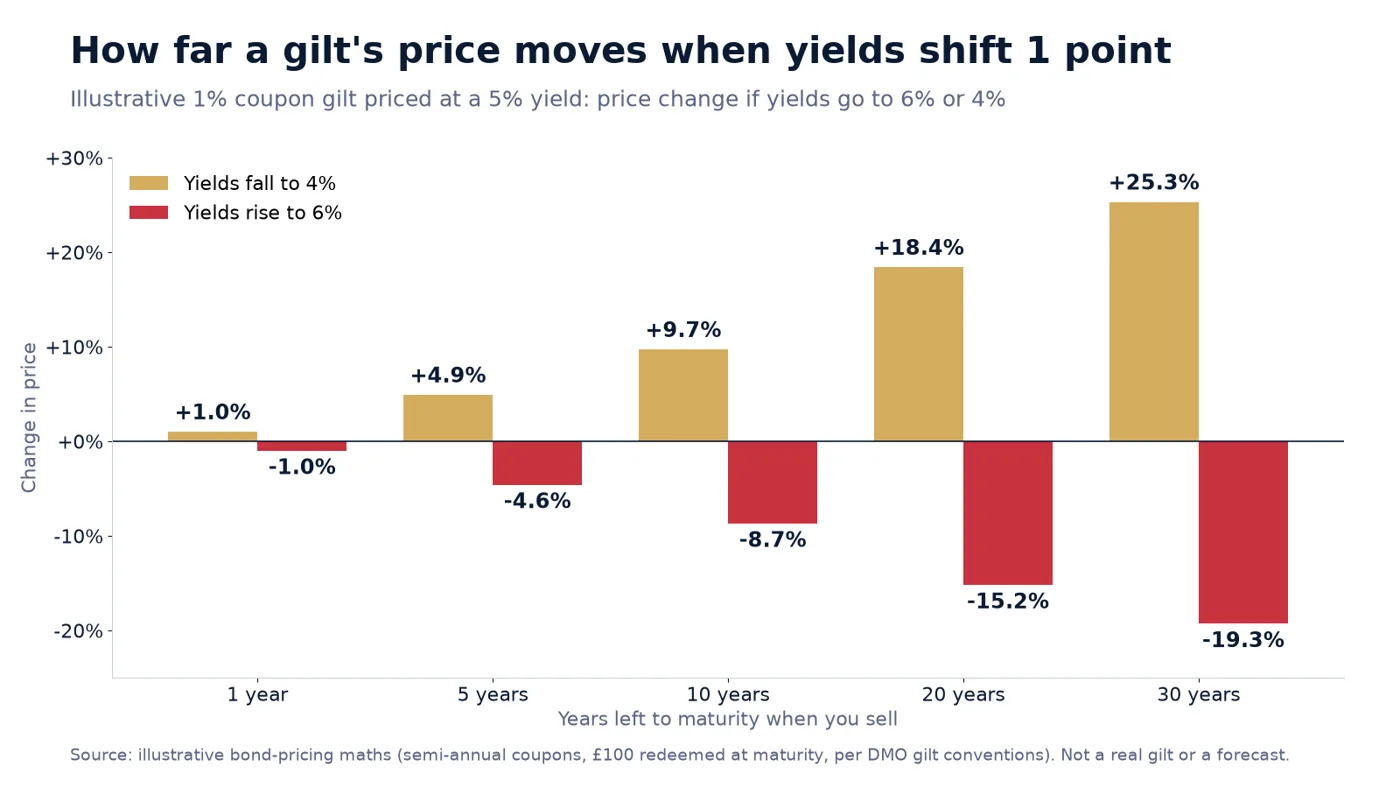
The chart shows the maths for an illustrative 1% coupon gilt priced at a 5% yield. If yields rise by one percentage point, a gilt with one year left falls about 1%. One with 20 years left falls about 15%, and one with 30 years left about 19%. If yields fall a point, the long gilts gain by more than they would have lost.
Source: illustrative bond-pricing calculation using semi-annual coupons and £100 repaid at maturity, following DMO gilt conventions (opens in a new tab). Not a real gilt and not a forecast.
So the question is not "is a gilt safe?" It is "will I hold this gilt to the date it repays?" If you will need the money in 2029, a gilt maturing in 2029 does that job. A gilt maturing in 2050 that you plan to sell in 2029 is a bet on where interest rates will be in 2029.
One tax point helps. Gains on UK government gilts are not subject to Capital Gains Tax. GOV.UK (opens in a new tab) Coupon income is a separate question, so check how it is taxed in your own accounts. For a fuller comparison, see my guide to gilts, corporate bonds and bond funds.
How big should your cash buffer be at retirement?
A cash buffer is the money that pays your income when markets are down, so you are not forced to sell shares, or a long gilt, at a poor price. One approach is to hold one to three years of planned withdrawals in cash or very short-dated holdings. That range is illustrative, not a rule.
In an illustrative example, if you plan to draw £40,000 a year and expect £13,000 from the State Pension once it starts, the portfolio needs to supply about £27,000 a year. Two years of that is £54,000. Before State Pension age, the buffer has to cover the full £40,000.
Gilts can form part of this if you line up their maturity dates with the years you need the money, sometimes called a ladder. That turns "safe if held to maturity" into "held to maturity by design". The build a retirement income guide shows how the buffer, the growth portfolio and the rules fit together.
Does every holding in your portfolio have a job, a size and a sell rule?
This is the heart of the checklist. Before your salary stops, go through every holding and write three things next to it.
| Holding (illustrative) | Job | Size | Sell rule |
|---|---|---|---|
| Cash and money market fund | Pays the next 1–3 years of income | 1–3 years of withdrawals | Spend it; refill from gains in good years |
| Gilt maturing when cash is needed | Funds a known future year | One year of withdrawals per rung | Hold to maturity; do not sell early |
| Long-dated gilt | Diversifier if shares fall | Capped, e.g. no more than a set % | Rebalance only when outside your band |
| Global share funds | Long-term growth and inflation protection | Your target share allocation | Rebalance when 5 points from target |
| Single shares | Higher conviction growth | Small, capped per holding | Pre-set loss limit or thesis broken |
Illustrative framework, not a recommendation of any investment or allocation.
If you cannot fill in all three columns for a holding, that is a warning sign. It usually means it was bought for a reason that no longer applies, or it is far bigger than you would choose today. My guide to position sizing explains how to cap any one holding.
This is also where managing your own money pays off. You have full control, you can see every holding and its cost, and the portfolio is shaped around your own risk profile and dates, not a default designed for someone else. The trade is that the rules are yours to write and keep.
What to do next
- Check your State Pension age and forecast on GOV.UK this month, and note the exact date it starts.
- List every holding across pensions, ISAs and other accounts, and write its job, size and sell rule. Flag any gilt you plan to sell before it matures.
- Review beneficiaries and your will before 6 April 2027, and ask a tax specialist how the Inheritance Tax change affects you.
- Plan your first withdrawal with the emergency tax refund in mind, and decide how and when to take tax-free cash.
- Test your income plan in the free Pension Plan (opens in a new tab) tool and the chance of a loss in Portfolio Odds (opens in a new tab). More calculators are on the tools page.
Want a written retirement process before your salary stops? Book your free call with Alpesh's team. We will show you how self-directed investors pick investments, size positions and set sell and rebalancing rules, so your plan is ready before you need it. There is nothing to buy on the call.
Frequently asked questions
What is the State Pension age if I retire in 2027?
It depends on your date of birth. People born between 6 April 1960 and 5 March 1961 reach State Pension age at 66 plus one to 11 months, and those born on or after 6 March 1961 reach it at 67. Check your exact date with the GOV.UK tool.
Will I pay emergency tax on my first pension withdrawal?
Often, yes. Without a current-year tax code, providers usually apply the emergency code on a month 1 basis to the first flexible payment. You can reclaim any overpayment in the same tax year using the right HMRC form.
Do gilts always pay back £100?
A conventional gilt repays £100 per £100 nominal on its maturity date. Before then, its price moves with interest rates, and long-dated gilts can move a lot, so selling early can mean getting back less than you paid.
How do pensions change for Inheritance Tax in April 2027?
From 6 April 2027, most unused pension funds and death benefits will count as part of your estate for Inheritance Tax. Death in service benefits are excluded. Personal representatives will report and pay any tax due.
About Alpesh Patel OBE
Alpesh Patel OBE is Founding Principal of Rootbridge Capital, an author and Dealmaker for the UK Government's Department for Business. He is a former Visiting Fellow in Business, Corpus Christi College, Oxford University, where he worked on technology to improve financial education.
Sources
- UK Debt Management Office, About gilts (opens in a new tab)
- GOV.UK, State Pension age timetable (opens in a new tab)
- GOV.UK, Check your State Pension age (opens in a new tab)
- GOV.UK, The new State Pension: what you'll get (opens in a new tab)
- GOV.UK, Proposed benefit and pension rates 2027 to 2028 (opens in a new tab)
- GOV.UK, Tax on pension income (opens in a new tab)
- GOV.UK, Voluntary National Insurance: deadlines (opens in a new tab)
- GOV.UK, Lump sum allowance (opens in a new tab)
- HMRC, PAYE76170: flexibly accessed pension payments (opens in a new tab)
- GOV.UK, Claim a tax refund on your pension by post (opens in a new tab)
- HMRC, SAM110270: in-year repayments, flexibly accessed pensions (opens in a new tab)
- GOV.UK, Pension schemes rates and allowances (opens in a new tab)
- GOV.UK, Inheritance Tax: unused pension funds and death benefits (opens in a new tab)
- GOV.UK, Capital Gains Tax: what you pay it on (opens in a new tab)
- Alpesh Patel OBE, Your Essential 5 Point Pension Checklist (opens in a new tab) (YouTube)
Important: This article is for education only and is not personal financial advice or a recommendation to buy or sell any investment. This article is general investment education only and is not regulated investment advice. The value of investments can go down as well as up, and you may get back less than you invest. Past performance is not a reliable indicator of future results.
Important: this article is education and information only. It is not financial advice or a personal recommendation, and it does not take your circumstances into account. The value of investments and pensions can fall as well as rise, and you may get back less than you put in. Past performance is not a reliable indicator of future results. Figures were correct when the article was written and may have changed. If you are unsure what is right for you, speak to a regulated financial adviser.