Drawdown or Annuity? Why the Answer Can Be Both After the 2027 IHT Change
For most of the last decade, the drawdown or annuity question had an easy answer for anyone who could afford to wait. Keep the pension invested, draw what you need and leave the rest to your family, because unused pension money usually sat outside your estate for Inheritance Tax.
That changes on 6 April 2027. From that date, most unused pension funds and death benefits will be brought into the value of your estate for Inheritance Tax. GOV.UK (opens in a new tab) At the same time, a healthy 65-year-old can buy £8,209 a year of guaranteed income for life with £100,000, according to Hargreaves Lansdown's best-buy table for 5 November 2026. Hargreaves Lansdown (opens in a new tab)
Put those two facts together and the old default looks less obvious. Someone approaching retirement with a pension of around half a million pounds no longer has to choose one side. The better question is how much income should be guaranteed, and how much should stay invested.
Short answer: You do not have to choose between drawdown or annuity. Many retirees blend them: the State Pension plus an annuity cover essential bills, and drawdown funds the rest with room to grow. With annuity rates near 8% at 65 and unused pensions entering Inheritance Tax from 6 April 2027, a partial annuity deserves a fresh look.
Working out how much of your retirement income should be guaranteed? Book your free call with Alpesh's team. We will show you how self-directed investors build a written income plan, from the floor to the invested part. There is nothing to buy on the call.
Drawdown or annuity: what is the real difference?
An annuity swaps a lump sum from your pension for an income paid for life, or for a fixed term. Once bought, a lifetime annuity cannot usually be undone. Its strength is certainty: the payments keep coming however long you live and whatever markets do.
Drawdown keeps your pension invested. You take income or lump sums when you choose, and whatever is left can pass on when you die. Its strength is flexibility and growth. Its weakness is that you carry two risks yourself: markets falling at the wrong time, and living longer than your money.
My earlier piece on living off your investments compares six ways to take income from an invested pot. This article is about the step before that: how much of your income you want guaranteed in the first place.
What are annuity rates in November 2026?
Annuity rates are set largely by gilt yields and life expectancy, and they have been strong. Hargreaves Lansdown's weekly best-buy table, using quotes from 5 November 2026 for £100,000, shows: Hargreaves Lansdown (opens in a new tab)
| Annuity type (£100,000, best rate) | Age 60 | Age 65 | Age 70 | Age 75 |
|---|---|---|---|---|
| Single life, level, no guarantee | £7,414 | £8,209 | £8,996 | £10,208 |
| Single life, level, 5-year guarantee | £7,386 | £8,145 | £8,881 | £9,948 |
| Single life, RPI-linked, 5-year guarantee | £4,921 | £5,641 | £6,446 | £7,648 |
| Single life, 3% escalation, 5-year guarantee | £5,336 | £6,093 | £6,913 | £8,094 |
| Joint life 50%, level, no guarantee | £7,081 | £7,624 | £8,331 | £9,143 |
Source: Hargreaves Lansdown best annuity rates (opens in a new tab), quotes generated 5 November 2026, average postcode, paid monthly in advance; joint-life quotes assume a spouse three years younger. Rates change often and your own quote depends on your health and options.
Two things stand out. Rates rise with age, so buying later buys more income per pound. And inflation protection is expensive: at 65, an RPI-linked annuity starts at about £5,641 against £8,209 for a level one. A level annuity keeps the same pound amount for life, so its buying power falls each year that prices rise.
How long does retirement income need to last?
Longer than many people plan for. The Office for National Statistics estimates that women aged 65 in the UK in 2024 can expect to live a further 22.7 years on average, and men a further 20.0 years, based on cohort life expectancy. ONS (opens in a new tab)
Those are averages, so many people live well beyond them, and for a couple the chance that at least one of them does is higher again. A drawdown plan that works to 85 can fail at 92. That is the longevity risk an annuity removes.
What is sequence risk, and why does it matter more in drawdown?
Sequence risk is the danger of poor returns early in retirement, while you are taking income. Losses in the first years hurt more than the same losses later, because you are selling investments at low prices to pay yourself and those units never recover.
In an illustrative example, take £500,000 in drawdown and withdraw £22,452 at the start of each year. If the portfolio falls 20% in year one and then grows 6% a year, it is worth about £372,000 after ten years. If the same 20% fall comes in year ten instead, it is worth about £439,000. Same returns, different order, a gap of about £67,000.
Now put only £350,000 in drawdown and take £10,138 a year, because an annuity is paying part of the bills. The same two orders leave about £336,000 and £366,000. The gap shrinks to about £30,000, because you are selling far less in the bad year. Lower withdrawals from the invested part are one of the most reliable defences against sequence risk. My guide to protecting your portfolio in a crash covers the others.
How does blending a guaranteed floor with drawdown work?
The idea is simple. Add up your essential spending: housing, food, bills, insurance. Cover that with guaranteed income, and invest the rest for growth, flexibility and what you hope to leave.
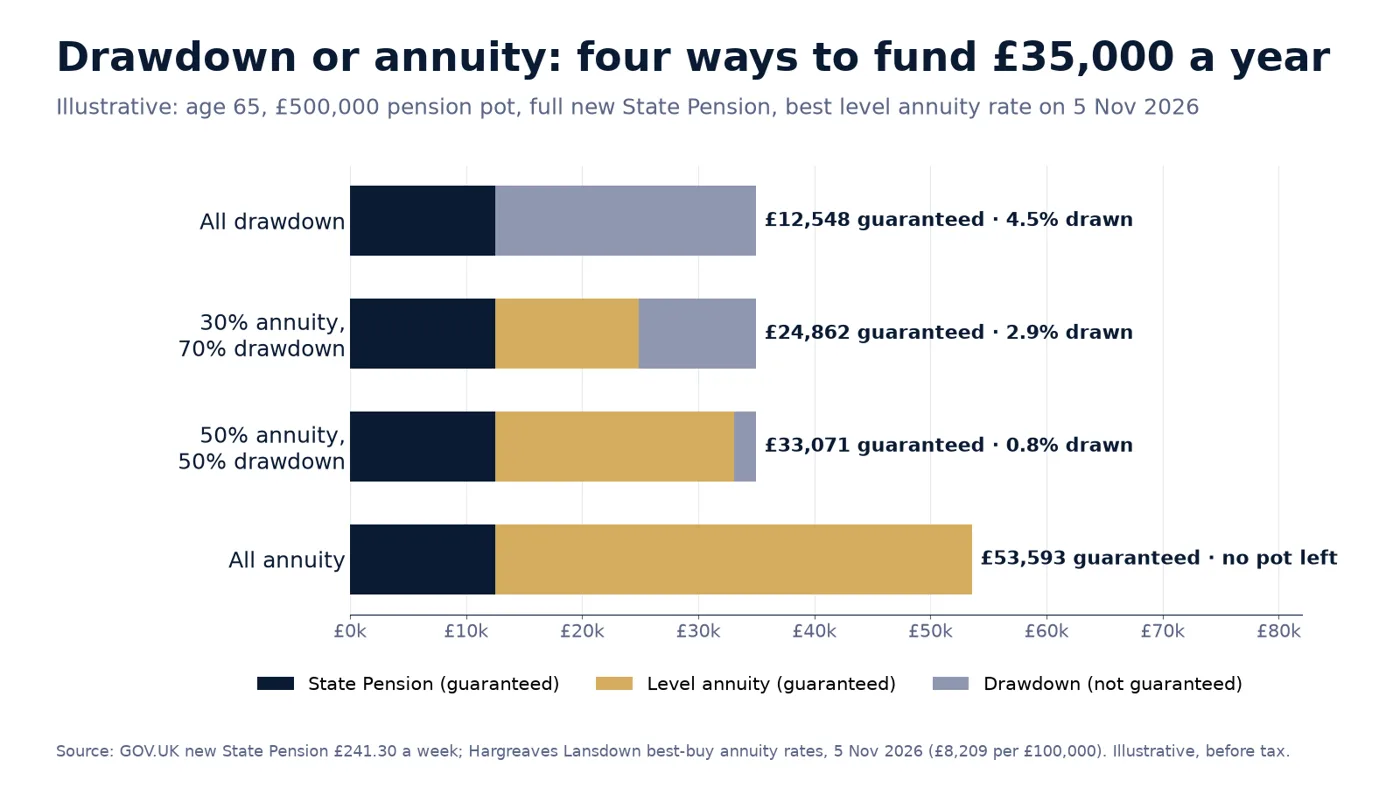
The State Pension is the first part of the floor. The full new State Pension is £241.30 a week, about £12,548 a year. GOV.UK (opens in a new tab) An annuity can top it up. Here is an illustrative example of someone aged 65 with a £500,000 pension who wants £35,000 a year before tax.
| Illustrative: £500,000 pot, age 65, £35,000 a year target | Guaranteed income | Needed from drawdown | Drawdown withdrawal rate | Invested pot left |
|---|---|---|---|---|
| All drawdown | £12,548 | £22,452 | 4.5% | £500,000 |
| 30% annuity (£150,000), 70% drawdown | £24,862 | £10,138 | 2.9% | £350,000 |
| 50% annuity (£250,000), 50% drawdown | £33,071 | £1,929 | 0.8% | £250,000 |
| All annuity (£500,000) | £53,593 | – | – | £0 |
Illustrative calculation using the full new State Pension from GOV.UK (opens in a new tab) and the best single-life level annuity rate at 65 with no guarantee, £8,209 per £100,000, from Hargreaves Lansdown (opens in a new tab) on 5 November 2026. Ignores tax-free cash, tax and inflation. Not a recommendation.
Source: GOV.UK new State Pension; Hargreaves Lansdown best-buy annuity rates, 5 November 2026. Illustrative, before tax.
The middle rows are where most of the interest lies. A 30% annuity covers much of the essentials and cuts the drawdown withdrawal rate from 4.5% to 2.9%. The invested £350,000 can then be run for growth, with far less pressure to sell in a falling market.
You also do not have to do it all at once. Some people buy an annuity in stages, for example at 65, 70 and 75, because rates rise with age and each purchase locks in part of the floor. You can test different splits with the free Pension Plan (opens in a new tab) tool and see the odds of a mix running short with Portfolio Odds (opens in a new tab).
How does the April 2027 Inheritance Tax change shift the balance?
Until now, a drawdown pot was one of the most tax-efficient things you could leave behind. Most unused pension funds sat outside your estate, so the usual advice was to spend other savings first and leave the pension untouched.
From 6 April 2027, for deaths on or after that date, most unused pension funds and pension death benefits will be included in your estate. GOV.UK technical note (opens in a new tab) Inheritance Tax is charged at 40% on the part of an estate above the £325,000 threshold, and the threshold can rise to £500,000 if you leave your home to children or grandchildren. Anything left to a spouse or civil partner is normally exempt. GOV.UK (opens in a new tab) Death in service benefits are excluded. GOV.UK (opens in a new tab)
The income tax rules on inherited pensions continue alongside this. If you die before 75, inherited drawdown and lump sums are usually free of income tax. If you die at 75 or over, death benefits are taxable at the recipient's own rate. GOV.UK technical note (opens in a new tab) So, after 75, money left in a pension could face Inheritance Tax and then income tax for whoever inherits it.
What happens to annuities under the new rules?
A lifetime annuity with no guarantee stops when you die, so there is nothing left to tax. A dependant's or nominee's annuity bought together with your own lifetime annuity, such as the survivor's part of a joint-life annuity, is an excluded benefit and stays outside Inheritance Tax. GOV.UK technical note (opens in a new tab) But annuity protection lump sums, paid when an annuity with value protection ends early, are listed as in scope. GOV.UK consultation (opens in a new tab)
None of this means you should buy an annuity to avoid tax. It means the case for leaving a large pension untouched for your heirs is weaker than it was. For some people, using part of the pension to secure an income floor, or simply drawing more of it during their lifetime, now looks more balanced. Whether that fits your estate is a question for a tax specialist. My article on which pot to draw first in retirement looks at the order of spending across pensions, ISAs and cash.
How is drawdown taxed?
Usually you can take up to 25% of your pension tax-free, subject to the lump sum allowance of £268,275 unless you have protection. GOV.UK (opens in a new tab) The rest, whether from drawdown or an annuity, is taxed as income. GOV.UK (opens in a new tab)
The State Pension uses most of the £12,570 personal allowance. GOV.UK (opens in a new tab) That means most annuity and drawdown income on top is taxed from the first pound, usually at the basic rate. Drawdown gives you more control over timing: you can take more in some years and less in others to manage which tax band you fall into. An annuity pays a fixed amount each year, so you have less room to adjust.
Why a written process matters for the invested part
A blend only works if the drawdown half is run with discipline. Without a plan, the invested part drifts into whatever funds were the default, and income decisions get made in a panic during a fall.
The case for running it yourself is control, transparency and a portfolio built around your own risk profile and income needs, not an average saver's. That works when you write down, before the first withdrawal, what you will hold, how much in each, how much income you take in good and bad years, when you rebalance and what would make you sell. The build a retirement income guide walks through this, and my comparison of the cheapest SIPP for drawdown shows how platform charges differ by pot size.
What to do next
- Add up your essential spending for a year and compare it with your State Pension. The gap is the floor you might want guaranteed.
- Get annuity quotes for your age, health and options, including level, rising and joint-life versions. Rates differ between providers and change often.
- Model two or three blends in Pension Plan (opens in a new tab), checking the drawdown withdrawal rate and how a crash in the first years would affect each.
- Review your estate plan for April 2027 with a tax specialist, including how your pension, home and other savings would be treated.
- Write down your drawdown process for the invested part: holdings, sizes, income rules, rebalancing and sell rules.
Want a written plan for the invested part of your retirement income? Book your free call with Alpesh's team. We will show you how self-directed investors pick investments, size positions and decide when to sell, so your income plan holds up in a falling market. There is nothing to buy on the call.
Frequently asked questions
Is it better to take drawdown or an annuity?
Neither is better for everyone. An annuity removes the risk of running out of money and of market falls, while drawdown keeps flexibility, growth and something to pass on. Many people use both: guaranteed income for essentials and drawdown for the rest.
What does £100,000 buy as an annuity at 65?
On Hargreaves Lansdown's best-buy table for 5 November 2026, £100,000 bought £8,209 a year for a healthy 65-year-old on a single-life, level annuity with no guarantee. An RPI-linked version started at £5,641 a year.
Will my pension be subject to Inheritance Tax from April 2027?
For deaths on or after 6 April 2027, most unused pension funds and death benefits will be included in your estate for Inheritance Tax. Death in service benefits and pensions left to a spouse or civil partner are exempt, and a tax specialist can confirm how it applies to you.
Can I buy an annuity with only part of my pension?
Yes. You can use part of your pension to buy an annuity and keep the rest in drawdown, and some people buy annuities in stages as they get older and rates rise.
Is an annuity included in my estate when I die?
A lifetime annuity with no guarantee ends when you die, so nothing is left to include. A survivor's annuity bought together with your own is excluded, but annuity protection lump sums are in scope from April 2027.
About Alpesh Patel OBE
Alpesh Patel OBE is Founding Principal of Rootbridge Capital, an author and Dealmaker for the UK Government's Department for Business. He is a former Visiting Fellow in Business, Corpus Christi College, Oxford University, where he worked on technology to improve financial education.
Sources
- GOV.UK, Inheritance Tax: unused pension funds and death benefits (opens in a new tab)
- GOV.UK, Technical note: Inheritance Tax on pensions (opens in a new tab)
- GOV.UK, Technical consultation: Inheritance Tax on pensions (opens in a new tab)
- GOV.UK, How Inheritance Tax works (opens in a new tab)
- GOV.UK, The new State Pension: what you'll get (opens in a new tab)
- GOV.UK, Lump sum allowance (opens in a new tab)
- GOV.UK, Tax when you get a pension (opens in a new tab)
- GOV.UK, Income Tax rates and Personal Allowances (opens in a new tab)
- Hargreaves Lansdown, Best annuity rates (opens in a new tab)
- Office for National Statistics, Past and projected period and cohort life tables: 2024-based (opens in a new tab)
- Alpesh Patel OBE, Will Your Pension Last? Test It With This Calculator (opens in a new tab) (YouTube)
Important: This article is for education only and is not personal financial advice or a recommendation to buy or sell any investment. This article is general investment education only and is not regulated investment advice. The value of investments can go down as well as up, and you may get back less than you invest. Past performance is not a reliable indicator of future results.
Important: this article is education and information only. It is not financial advice or a personal recommendation, and it does not take your circumstances into account. The value of investments and pensions can fall as well as rise, and you may get back less than you put in. Past performance is not a reliable indicator of future results. Figures were correct when the article was written and may have changed. If you are unsure what is right for you, speak to a regulated financial adviser.