Which Pot to Draw First in Retirement? Your Funds Are Fine. The Order Is the Real Decision
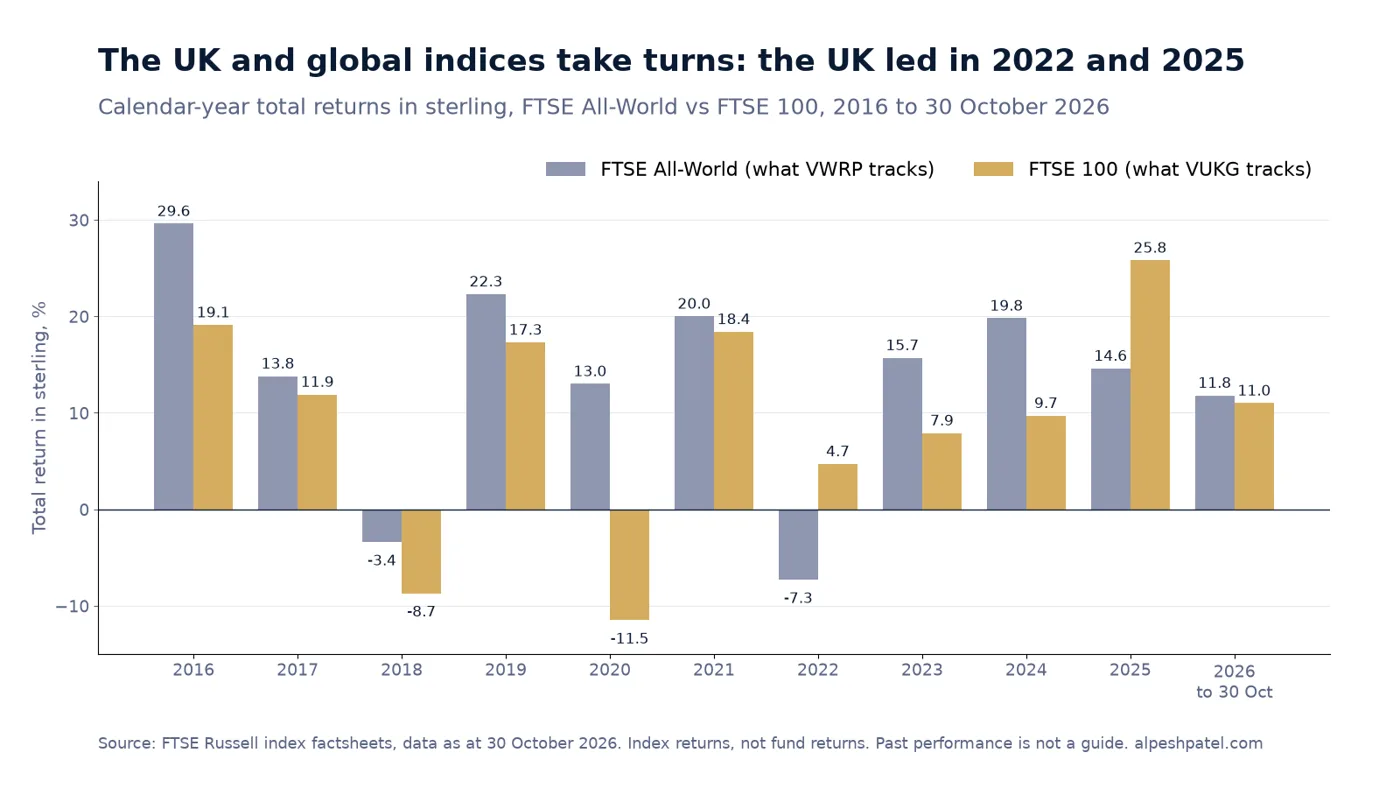
In 2025 the FTSE 100 returned 25.8% in sterling. The FTSE All-World, the index behind one of the most popular global funds in the UK, returned 14.6%, according to FTSE Russell's FTSE 100 factsheet (opens in a new tab) and its FTSE All-World comparison data (opens in a new tab). The "boring" home market beat the world by more than 11 percentage points.
I thought of that when a question about which pot to draw first reached my team recently. It came from someone who holds mainly two Vanguard funds, VWRP and VUKG, across a SIPP, an ISA, a general investment account and a rental property, with a total of around £700,000. They wanted to know whether their fund choices were poor, and how to approach drawdown.
The funds are not poor choices. The real questions are different: is the split between those two funds a rule or an accident, and which pot to draw first when the income starts? The second question matters more, and from April 2027 it matters more still.
Short answer: Low-cost global and UK index funds are reasonable building blocks. Give each a target weight and a band, for example rebalance when either drifts more than five percentage points. Then hold about two years of spending in cash and decide which pot to draw first, because tax and Inheritance Tax now depend on the order.
Holding a SIPP, an ISA and other investments and wondering how to turn them into an income? Book your free call with Alpesh's team. We will walk through how self-directed investors set a target mix, decide when to rebalance and plan the order they draw on each pot. There is nothing to buy on the call.
What are VWRP and VUKG?
VWRP is the Vanguard FTSE All-World UCITS ETF (USD) Accumulating (opens in a new tab), traded in pounds on the London Stock Exchange, with an ongoing charge of 0.14%. It tracks the FTSE All-World index, thousands of large and mid-sized companies across developed and emerging markets.
VUKG is the Vanguard FTSE 100 UCITS ETF (GBP) Accumulating (opens in a new tab), ISIN IE00BFMXYP42, with an ongoing charge of 0.09%. It tracks the 100 largest companies on the London market. "Accumulating" in both names means dividends are reinvested rather than paid out.
Both are cheap, broad and easy to trade. If you are paying 1% a year or more for a managed portfolio that looks much like these two funds, the cost of a 1% annual fee is worth a look. On fund choice alone, nothing here is broken.
Is a global fund plus a UK fund a sensible mix?
It can be, because the two funds lean in different directions. In the FTSE All-World, the United States makes up 62.7% of the index, and the top three holdings are Apple at 4.79%, Nvidia at 4.59% and Microsoft at 3.73%, according to FTSE Russell's All-World factsheet (opens in a new tab).
The FTSE 100 looks nothing like that. Its largest holdings at 31 October 2026 were Shell at 9.2%, HSBC at 8.5% and AstraZeneca at 8.2%, according to Vanguard's VUKG portfolio data (opens in a new tab). That is energy, banks and pharmaceuticals rather than American technology.
So the UK fund acts as a counterweight. Over the past year or so it has done exactly that. In 2025 the FTSE 100 returned 25.8% against 14.6% for the All-World, and over the 12 months to 30 October 2026 it returned 13.9% against 10.5%. This year to 30 October the two are roughly level, 11.0% for the FTSE 100 and 11.8% for the All-World, all in sterling, per FTSE Russell. If US technology concentration worries you, I covered it in should the Magnificent Seven worry you.
The chart shows the pattern. The global index led in most of the last ten years, sometimes by a lot, as in 2020 when it made 13.0% while the FTSE 100 lost 11.5%. But in 2022 and 2025 the UK did the leading. These are index returns, not fund returns, so the funds will differ slightly after costs.
Is your fund split a rule or an accident?
Here is the question I would ask first. If you hold, say, 70% in the global fund and 30% in the UK fund, did you choose that, or did it just happen?
For most people it just happened. You bought some of each years ago, added money when you remembered, and the market did the rest. Whichever fund ran faster quietly took over more of the portfolio.
That matters because the split is your real risk decision. A portfolio that has drifted from 60% global to 70% global is a different portfolio, with more in the US and more in a handful of technology companies, even though you never decided that.
The fix is simple. Write down a target for each fund and a band around it. A common rule is to rebalance when either holding drifts more than five percentage points from its target. If your target is 60% global and 40% UK, you act when global goes above 65% or below 55%, and otherwise you leave it alone.
How do rebalancing bands work in practice?
To make this concrete, here is an illustration using the index returns in the chart. It assumes a portfolio started at 60% FTSE All-World and 40% FTSE 100 at the beginning of 2016, checked once a year at year end, with no costs, tax or withdrawals.
| Year end | Global share, never rebalanced | Global share, 5-point band | Action with the band |
|---|---|---|---|
| 2016 | 62.0% | 62.0% | None |
| 2018 | 63.7% | 63.7% | None |
| 2019 | 64.7% | 64.7% | None, just inside the band |
| 2020 | 70.0% | 70.0%, reset to 60% | Rebalance: sell global, buy UK |
| 2022 | 67.7% | 57.4% | None |
| 2024 | 71.1% | 61.2% | None |
| 2025 | 69.1% | 58.9% | None |
Illustration only, based on FTSE Russell index total returns in sterling. Not a forecast or a recommendation.
Left alone, the "60/40" portfolio spent most of the decade at around 70/30. With the band, it was rebalanced once, at the end of 2020, and then stayed close to target for five years. The final value in this illustration was almost identical either way. The difference was risk: the banded portfolio held the mix its owner had actually chosen.
That is the point of a band. It is not a trick for higher returns. It stops the portfolio drifting into a shape you never chose, and it means you trade rarely, which keeps costs and tax down. If you want to see how often a given mix has lost money over different periods, the free Portfolio Odds (opens in a new tab) tool lets you test it under its assumptions.
Which pot to draw first in retirement?
This is the bigger job. With a SIPP, an ISA, a general investment account and a rental property, the same £30,000 of yearly spending can cost very different amounts of tax depending on which pot pays for it.
Each pot is taxed differently, so here is a summary, using GOV.UK figures for the 2026 to 2027 tax year.
| Pot | How withdrawals are taxed | Inheritance Tax |
|---|---|---|
| SIPP | Usually 25% tax-free, up to the £268,275 lump sum allowance; the rest taxed as income | Most unused pension funds come into the estate from 6 April 2027 |
| Stocks and shares ISA | No Income Tax or Capital Gains Tax | Part of your estate |
| General investment account | Gains over £3,000 taxed at 18% or 24%; dividends over £500 at 10.75%, 35.75% or 39.35% | Part of your estate |
| Rental property | Rent taxed as income; property rates of 24%, 44% and 49% announced from April 2027 | Part of your estate |
Sources: GOV.UK on lump sum allowance (opens in a new tab), ISAs (opens in a new tab), Capital Gains Tax (opens in a new tab), dividends (opens in a new tab) and Budget 2026 rates and allowances (opens in a new tab).
To make the order concrete, imagine a portfolio of around £700,000 split roughly into £300,000 in a SIPP, £150,000 in an ISA, £50,000 in a general account and £200,000 of equity in a rental property. These numbers are illustrative. The principles below apply whatever your own split is.
Start with two years of spending in cash
Before deciding the order, set aside roughly two years of planned spending in cash or near-cash. This is the buffer that means you never have to sell funds after a crash to pay the bills.
If markets fall 20% in your first year of retirement, you spend the cash and wait. When markets recover, you refill it. My earlier post on living off your investments explains why the order of returns in the early years matters so much. The cash buffer is the practical answer to that risk.
Where you hold the cash matters too. Interest outside an ISA is taxed, and the savings rates of income tax are set to rise to 24%, 44% and 49% from April 2027, according to the Budget 2026 rates and allowances (opens in a new tab).
Then decide which pot pays first
The old rule of thumb was simple: spend the general account first, then the ISA, and leave the pension until last, because a pension sat outside your estate for Inheritance Tax. That reasoning is changing. From 6 April 2027, most unused pension funds and death benefits will be brought into the value of your estate, according to GOV.UK (opens in a new tab).
So a different order may now make sense for many people. A typical way to think about it:
- Use your tax-free allowances every year. The first £12,570 of income is covered by the Personal Allowance, so drawing at least that much from the SIPP each year, if rent does not already use it, can mean paying no Income Tax on it, per the Budget 2026 rates and allowances (opens in a new tab).
- Draw the general account steadily. Selling enough each year to use the £3,000 Capital Gains Tax allowance stops gains building up. Many people move the proceeds into their ISA, within the £20,000 yearly limit.
- Keep the ISA flexible. Withdrawals are tax-free, so the ISA is useful for one-off costs, or for years when taking more from the pension would push you into a higher tax band.
- Treat the rental as income, not a cash machine. Rent arrives whatever you do and uses up your tax bands first. Selling the property is a single large decision with Capital Gains Tax at 18% or 24%, so plan it separately.
None of this is a fixed recipe. The right order depends on your other income, your age, your health, whether you are married and who you want to leave money to. A tax specialist should confirm it before you act.
How does the April 2027 change affect the drawdown order?
It changes the job the pension does. Until now, many people treated a SIPP as the last pot to touch and the best one to pass on. From April 2027, leaving a large pension untouched may simply mean a larger estate for Inheritance Tax.
Your ISA and general account already count in your estate, as GOV.UK confirms for ISAs (opens in a new tab). The rental property does too. With the pension joining them, there is no longer one pot that sits neatly outside the Inheritance Tax net.
That makes the order a balance between three things: the Income Tax you pay now, the Inheritance Tax your heirs may pay later, and keeping enough flexibility for the years you cannot predict. The free Pension Plan (opens in a new tab) tool lets you test how long a pot might last at different withdrawal rates, and the FIRE calculator (opens in a new tab) shows how different spending levels change the picture.
If you run your own SIPP, the run your own SIPP guide sets out what to check. For low-cost drawdown, see the cheapest SIPP for drawdown in 2026.
Should you change your funds before retiring?
Not necessarily. Two cheap, broad index funds are a reasonable core for the long-term part of a retirement portfolio. What changes at retirement is not the funds but the structure around them.
That structure is three decisions written down: the target split and band for your funds, the size of your cash buffer, and the order you draw on each pot. Once those exist, the funds have a job to do and you have a rule for each situation.
This is where running your own money pays off. You can see exactly what you own, what it costs and why, and you can build the plan around your own tax position rather than a model portfolio. For a step-by-step approach, the build a retirement income guide is a good place to start, and my post on using a global equity index fund for retirement income goes deeper on the core holding.
Related: Retiring in 2027: a 12-month checklist.
What to do next
- Write down your fund targets. Pick a target for each fund, for example 60% global and 40% UK, and a band of five percentage points either side.
- Check today's split. If either fund is outside its band, decide whether to rebalance, ideally inside the ISA or SIPP where switching does not trigger Capital Gains Tax.
- Size your cash buffer. Estimate two years of spending and decide where that cash will sit.
- Draft your draw order. List each pot, how it is taxed and the order you plan to use it, including your Personal Allowance and yearly Capital Gains Tax allowance.
- Take tax advice on the April 2027 change. A tax specialist should confirm the order, and what the Inheritance Tax change means for your estate.
Want a written plan for which pot to draw first and when to rebalance? Book your free call with Alpesh's team. We will show you how self-directed investors set targets, size positions and decide when to rebalance or sell, so your retirement income runs to a plan you control.
Frequently asked questions
Should I draw from my ISA or pension first?
There is no single answer. The old rule was to spend ISAs before pensions, but from April 2027 most unused pensions come into your estate for Inheritance Tax, so many people will draw some pension income each year, using their Personal Allowance and basic rate band. A tax specialist should confirm the right order for you.
How often should I rebalance my portfolio?
A band works better than a calendar for most people. Check once or twice a year, and rebalance only if a holding has drifted more than about five percentage points from its target. That keeps your risk where you chose it without trading too often.
Is VWRP enough on its own?
It is a broad, low-cost global fund, but about 62.7% of its index is in the United States. Some investors add a UK fund such as VUKG to balance that, as the FTSE 100 holds very different companies. Either way, set a target split and stick to it.
How much cash should I hold in retirement?
A common approach is around two years of planned spending in cash or near-cash. That buffer lets you avoid selling investments after a fall. Refill it when markets recover.
About Alpesh Patel OBE
Alpesh Patel OBE is Founding Principal of Rootbridge Capital, an author and Dealmaker for the UK Government's Department for Business. He is a former Visiting Fellow in Business, Corpus Christi College, Oxford University, where he worked on technology to improve financial education.
Sources
- FTSE Russell, FTSE 100 index factsheet, data as at 30 October 2026 (opens in a new tab)
- FTSE Russell, FTSE All-World comparison returns, data as at 30 October 2026 (opens in a new tab)
- FTSE Russell, FTSE All-World index factsheet (opens in a new tab)
- Vanguard, FTSE All-World UCITS ETF (USD) Accumulating (opens in a new tab)
- Vanguard, FTSE 100 UCITS ETF (GBP) Accumulating (opens in a new tab)
- Vanguard, FTSE 100 UCITS ETF portfolio data (opens in a new tab)
- GOV.UK, Budget 2026: rates and allowances (opens in a new tab)
- GOV.UK, Tax on your private pension: lump sum allowance (opens in a new tab)
- GOV.UK, Individual Savings Accounts: if you die (opens in a new tab)
- GOV.UK, Capital Gains Tax allowances (opens in a new tab)
- GOV.UK, Tax on dividends (opens in a new tab)
- GOV.UK, Inheritance Tax: unused pension funds and death benefits (opens in a new tab)
- Alpesh Patel OBE, Stock Investing: Outsized Returns and Rebalancing Strategies (opens in a new tab) (YouTube)
Important: This article is for education only and is not personal financial advice or a recommendation to buy or sell any investment. This article is general investment education only and is not regulated investment advice. The value of investments can go down as well as up, and you may get back less than you invest. Past performance is not a reliable indicator of future results.
Important: this article is education and information only. It is not financial advice or a personal recommendation, and it does not take your circumstances into account. The value of investments and pensions can fall as well as rise, and you may get back less than you put in. Past performance is not a reliable indicator of future results. Figures were correct when the article was written and may have changed. If you are unsure what is right for you, speak to a regulated financial adviser.