Position Sizing for High-Conviction Investing: How Much to Put in One Idea
Here is a fact that should make every confident stock picker pause. Of all the US common stocks that appeared in the main academic database of share prices since 1926, four out of every seven returned less over their listed lives than one-month Treasury bills. That is the headline finding of Professor Hendrik Bessembinder's study, published in the Journal of Financial Economics. Bessembinder, SSRN (opens in a new tab)
The same paper found that the best-performing 4% of listed companies explain the entire net gain of the US stock market since 1926. The rest, taken together, roughly matched Treasury bills. Bessembinder, SSRN (opens in a new tab) Most shares disappoint. A few carry everything.
Now picture someone with a seven-figure portfolio and a handful of ideas they believe in deeply. They have done the research. They want to put a quarter of the money into the best one. The research may be excellent. The question that decides how their retirement turns out is not whether the idea is good. It is how much of the pot goes into it. That is what position sizing for high-conviction investing is really about.
Short answer: High-conviction investing is about position sizing above all. The same idea at 3% of a pot is a strategy; at 25% it is a coin toss. Set a written maximum position size, know how much a 50% or 80% fall would cost the whole portfolio, and decide your trim rules before you buy.
Holding a few big ideas and not sure how much is too much? Book your free call with Alpesh's team. We will walk through how self-directed investors pick, size and decide when to sell, using a written process. There is nothing to buy on the call.
Why position sizing matters more than the idea
Most investors spend nearly all their effort on what to buy. They read reports, watch results calls and argue about valuations. Then they decide how much to buy in about ten seconds, usually based on how excited they feel.
That is backwards. A good idea sized badly can still wreck a portfolio. A mediocre idea sized sensibly rarely does. Size is the one decision that controls how much damage you take when you are wrong, and every investor is wrong regularly.
Bessembinder's work explains why. Individual share returns are positively skewed: a few huge winners, many disappointments. His paper says this helps explain why poorly diversified active strategies most often underperform market averages. Bessembinder, SSRN (opens in a new tab) If you put a large slice into one share, the odds are that it will be one of the many rather than one of the few. Conviction does not change the base rate. Size decides what the base rate costs you.
How much does one bad holding cost the whole portfolio?
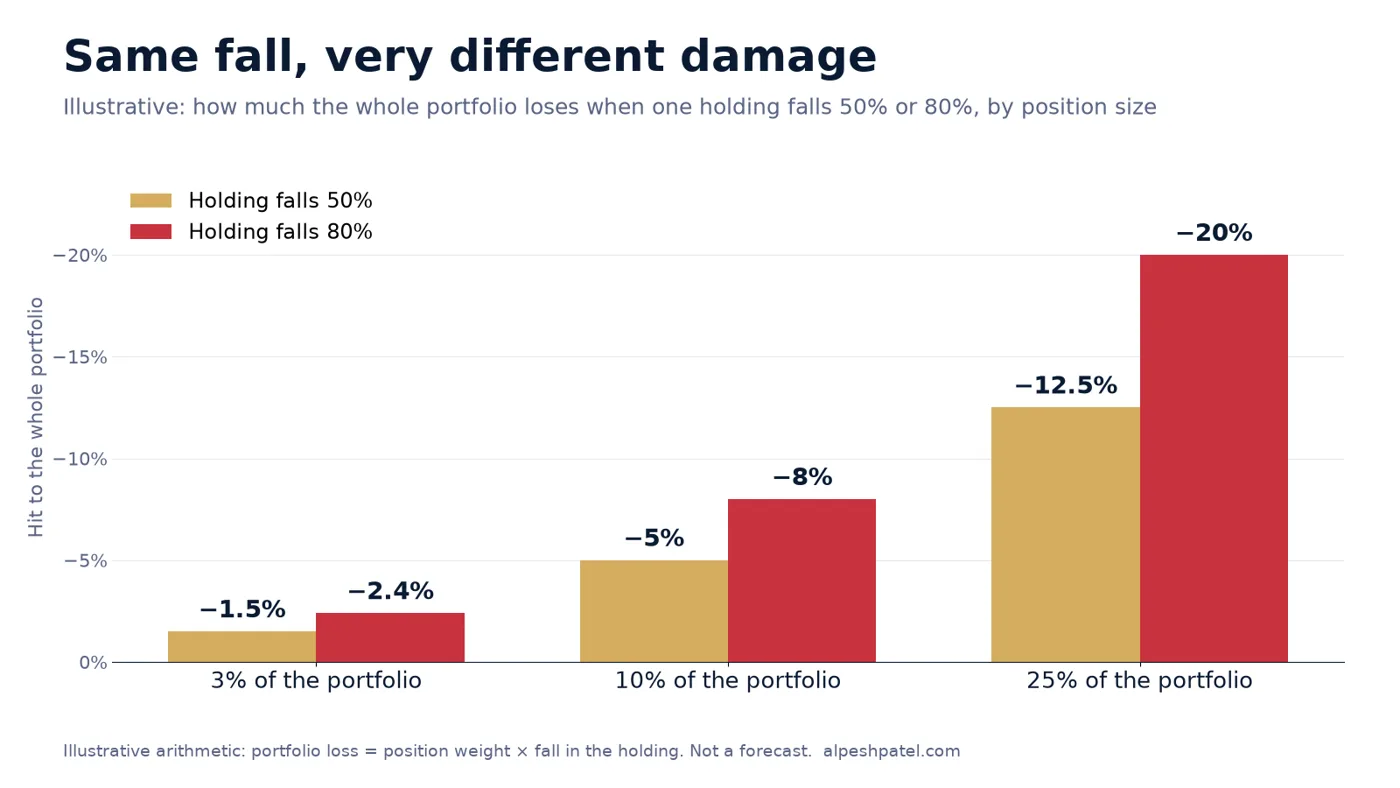
The arithmetic is simple. The hit to your portfolio is the position size multiplied by the fall in the holding. A 50% fall in a 3% position costs you 1.5% of the portfolio. The same fall in a 25% position costs you 12.5%.
| Illustrative: one holding falls | Position at 3% of portfolio | Position at 10% | Position at 25% |
|---|---|---|---|
| Fall of 50%: hit to portfolio | −1.5% | −5% | −12.5% |
| Fall of 50% on a £1 million portfolio | −£15,000 | −£50,000 | −£125,000 |
| Fall of 80%: hit to portfolio | −2.4% | −8% | −20% |
| Fall of 80% on a £1 million portfolio | −£24,000 | −£80,000 | −£200,000 |
| Gain the rest of the portfolio needs to recover an 80% fall | +2.5% | +8.7% | +25% |
Illustrative arithmetic, assuming everything else in the portfolio stays flat. Not a forecast.
Source: illustrative calculation, portfolio loss = position weight × fall in the holding.
At 3%, an 80% collapse is a bad week. You notice it, you learn from it and the rest of the portfolio carries on. At 25%, the same collapse takes a fifth of your wealth. For someone near retirement, that can mean working longer, spending less or changing the plan entirely.
Are falls of 50% or 80% realistic? For individual shares, yes, even among the biggest companies in the world. In my ten years of big tech stock data, Meta's largest fall from a closing high was 77% and Nvidia's was 66%, both within the last decade. My piece on what 20% volatility in a stock or fund really means shows how wide the normal range of outcomes is, before anything goes badly wrong.
The maths of recovery: why −50% needs +100%
Losses and gains are not symmetrical. If you lose 50%, you need a 100% gain just to get back to where you started. Lose 80% and you need 400%.
| Fall | Gain needed to get back to the start |
|---|---|
| −10% | +11.1% |
| −20% | +25% |
| −33% | +50% |
| −50% | +100% |
| −80% | +400% |
| −90% | +900% |
Arithmetic: gain needed = 1 ÷ (1 − fall) − 1.
This is the real reason big positions are dangerous. A large loss does not just cost money. It costs time, because the portfolio has to climb a steeper hill to recover. A 12.5% portfolio loss needs about a 14.3% gain to recover. A 20% portfolio loss needs 25%. At typical long-run stock market returns, that can take years.
Small positions keep losses in the shallow part of the table, where recovery is quick. That is what lets you keep investing in high-conviction ideas year after year without one mistake ending the game.
What is a sensible maximum position size?
There is no single right number. It depends on your pot, your age, how much income you need from the portfolio and how you would react to seeing a holding halve. But there should be a number, it should be written down and it should be set before you fall in love with an idea.
Here is an illustrative rule set of the kind many disciplined investors use. These are examples to show the structure, not a recommendation for you:
- Starting size: a new single share starts at, say, 2% to 3% of the portfolio, however strong the case looks.
- Maximum at cost: no single share above, say, 5% of the portfolio at the point you buy.
- Maximum by market value: if a winner grows above, say, 10% of the portfolio, it is trimmed back.
- Diversified funds treated differently: a broad global index fund can sensibly be a much larger share of a portfolio than any single company, because it already holds thousands of shares.
- Sector and theme limits: five technology shares at 5% each is still a 25% bet on one theme, so cap related holdings together.
The last point catches many people. Concentration can hide. If your "diversified" holdings all move with the same few US technology giants, you may be more concentrated than you think. My analysis of S&P 500 concentration and the Magnificent Seven shows how much of a typical index portfolio now rests on a small group of companies.
Does conviction justify a bigger position?
Conviction is a reason to own something. It is a weak reason to own a lot of it. Feeling certain and being right are different things, and the most painful losses in investing often come from the ideas people were surest about.
A better way to think about conviction is as a range, not a jump. Your best idea might be 4% rather than 2%. It should not be 25% rather than 2%. The difference between a modest overweight and a huge bet is exactly the difference between a strategy and a coin toss.
There is also a behavioural trap. A big position is hard to sell when the facts change, because selling means admitting a large mistake. Small positions keep you honest. You can change your mind cheaply. My regret test for deciding whether to sell your shares is built around that problem.
What does the Kelly criterion say about sizing?
The Kelly criterion is a formula from the 1950s, first developed for information theory and later used by gamblers and some investors. In simple terms, it says the right bet size depends on two things: your edge (how often you win and by how much) and the odds (how much you lose when you are wrong).
The useful idea for investors is the concept, not the formula. Kelly-style thinking says you should bet more only when your edge is large and reliable, and that betting more than the formula suggests reduces long-run growth while sharply raising the risk of ruin. Over-betting is worse than under-betting.
The problem in practice is that nobody knows their true edge on a single share. Estimates of win rates and pay-offs are guesses, and guesses tend to be optimistic. That is why investors who use Kelly ideas at all usually bet only a fraction of what the formula suggests. For most self-directed investors, the lesson is simpler: when in doubt, size smaller. Use this as a way of thinking, not a calculator.
If you want to see how probabilities and position sizes interact, the free Probability (opens in a new tab) tool and Portfolio Odds (opens in a new tab) let you explore the odds of a loss for a given mix under their assumptions.
When should you trim a winning position?
Trim rules matter as much as buy rules, because winners are how concentration usually creeps in. You buy at 3%. The share doubles while everything else is flat. Now it is around 6% of the portfolio. Double again and it is around 11%. Without a rule, you end up with a 25% position you never decided to take.
Three common approaches, each with trade-offs:
- Weight cap: trim back whenever a holding goes above a set percentage, such as 10%. Simple and automatic.
- Calendar rebalance: review once or twice a year and bring holdings back towards target weights. Fewer trades, more drift in between.
- Thesis check: if the reason you bought has changed, sell or cut regardless of weight. This is the rule people break most often.
Trimming a winner can feel like punishing success. It is not. Bessembinder's finding that a few shares carry the market is a reason to let winners run within limits, not without limits. A trim rule lets you keep a large share of a big winner while making sure that, if it turns, it cannot take the whole portfolio with it.
Remember tax and costs. In a general investment account, trimming may trigger Capital Gains Tax, so a tax specialist should confirm the position for your circumstances. Inside an ISA or SIPP, trimming has no tax consequence, which makes disciplined rebalancing easier. The protect your portfolio in a crash guide covers how rebalancing fits into a wider risk plan.
Why a written process beats gut feel
The case for managing your own money is control, transparency and a portfolio built around your own risk profile rather than an average client's. The cost of that control is that the sizing decisions are yours. Without a process, sizing becomes a mood.
A written process answers four questions before you buy anything:
- How do I pick? The criteria a share must pass, written down.
- How much do I buy? Starting size, maximum size and limits for related holdings.
- When do I sell or trim? Weight caps, thesis checks and review dates.
- How do I rebalance? How often, and what triggers an out-of-cycle review.
Write it on one page and keep it where you will see it when markets move. The pick stocks with a process guide walks through building one. None of this needs a professional background. It needs rules you set when you are calm and follow when you are not.
What to do next
- List your holdings by weight. Work out what percentage of the whole portfolio each share and fund is today, by market value.
- Run the stress test. For each single share, multiply its weight by 50% and by 80%. Ask whether you could live with that hit to the whole portfolio.
- Set your maximum position size in writing. One number for a new position, one for when a winner is trimmed, and one for related holdings together.
- Write your trim and sell rules. Weight caps, review dates and what would make you sell regardless of price.
- Test your mix. Use Portfolio Odds (opens in a new tab) and the other free tools to see how a more or less concentrated mix behaves under their assumptions.
Want a written process for sizing your best ideas? Book your free call with Alpesh's team. We will show you how self-directed investors pick, size and decide when to sell, so conviction comes with limits you can stick to. There is nothing to buy on the call.
Frequently asked questions
What is position sizing in investing?
Position sizing is deciding how much of your portfolio goes into each investment. It controls how much a single mistake can cost you. Two investors can own the same share with very different outcomes because one holds 3% and the other 25%.
What percentage of my portfolio should be in one stock?
There is no single correct figure, and it depends on your circumstances. Many disciplined investors start single shares at a few per cent and cap them well below 10%, while treating broad index funds differently. The key is to set your limit in writing before you buy.
Is a concentrated portfolio better for high-conviction investors?
A concentrated portfolio can outperform if the picks are right, but evidence suggests most individual shares underperform Treasury bills over their lives. Concentration raises the range of outcomes in both directions. Sizing rules let you express conviction without risking ruin.
Why does a 50% loss need a 100% gain to recover?
Because the gain is calculated on a smaller base. If £100 falls 50% to £50, it has to double to get back to £100. The deeper the loss, the steeper the climb.
Should I use the Kelly criterion to size my positions?
Use it as a concept rather than a calculator. It shows that over-betting damages long-run growth, but it needs an accurate estimate of your edge, which nobody has for a single share. Most people who use it bet a fraction of what it suggests.
About Alpesh Patel OBE
Alpesh Patel OBE is Founding Principal of Rootbridge Capital, an author and Dealmaker for the UK Government's Department for Business. He is a former Visiting Fellow in Business, Corpus Christi College, Oxford University, where he worked on technology to improve financial education.
Sources
- Hendrik Bessembinder, Do Stocks Outperform Treasury Bills? (opens in a new tab), Journal of Financial Economics (SSRN abstract)
- Alpesh Patel OBE, Your Portfolio Is More Fragile Than You Think (opens in a new tab) (YouTube)
- Illustrative calculations in the tables and chart are the author's own arithmetic.
Important: This article is for education only and is not personal financial advice or a recommendation to buy or sell any investment. This article is general investment education only and is not regulated investment advice. The value of investments can go down as well as up, and you may get back less than you invest. Past performance is not a reliable indicator of future results.
Important: this article is education and information only. It is not financial advice or a personal recommendation, and it does not take your circumstances into account. The value of investments and pensions can fall as well as rise, and you may get back less than you put in. Past performance is not a reliable indicator of future results. Figures were correct when the article was written and may have changed. If you are unsure what is right for you, speak to a regulated financial adviser.