How Much Time Does Managing Your Own Portfolio Really Take?
"I'd rather a manager just did it." It is one of the most common things people say when they think about managing their own portfolio. Picture someone in their fifties with a seven-figure pot, a demanding job and a family. Running their own investments sounds like a second job, so paying someone 1% a year feels like buying back their evenings.
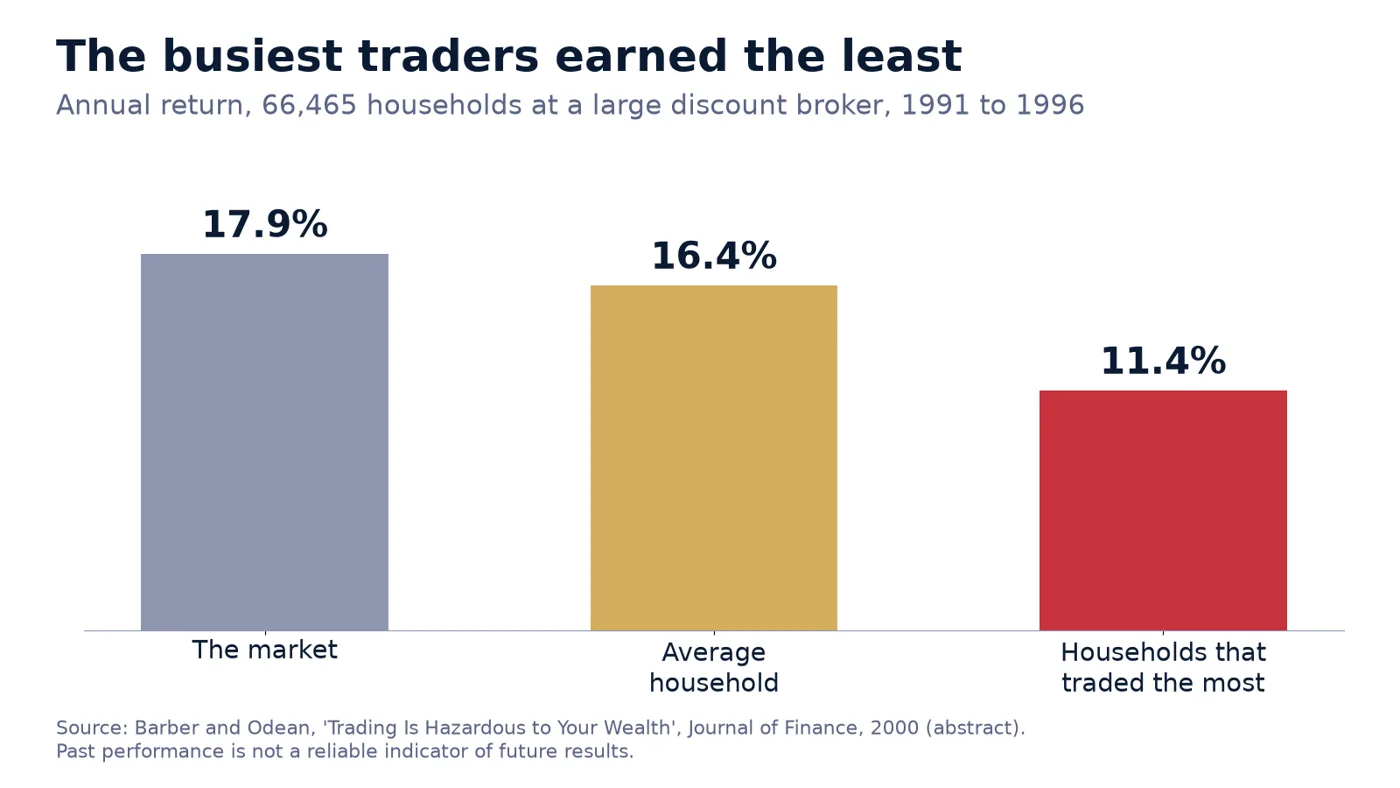
It is a fair worry, and it rests on one assumption: that doing it yourself takes a lot of time. The evidence suggests the opposite problem. In a landmark study of 66,465 households, the ones that traded most earned 11.4% a year while the market returned 17.9%. Barber and Odean, Journal of Finance (opens in a new tab) Spending more time on your portfolio, in the wrong way, cost them dearly.
So how much time does managing your own portfolio really take, done the right way? Less than most people fear. And when you put a pound figure on what a manager charges for that time, the answer often changes.
Short answer: A portfolio of 20 to 40 holdings with a written process and one rebalance a year can take roughly 35 to 40 hours a year once set up, under an hour a week (illustrative). On £500,000, a 1% manager fee is £5,000 a year. Much of the time people spend on investing is tinkering, which tends to hurt returns.
Wondering whether you could run your own portfolio without it taking over your life? Book your free call with Alpesh's team. We will walk through how self-directed investors pick, size and review their holdings on a simple timetable. There is nothing to buy on the call.
How much time does managing your own portfolio take?
It depends on what you hold and how you work. A portfolio of a few broad index funds needs very little. A portfolio of 20 to 40 individual shares and funds needs more, because each holding deserves a look when it reports results.
Here is an illustrative time budget for that second, more demanding case: around 30 holdings, run with a written process and rebalanced once a year.
| Task (illustrative, 30 holdings) | How often | Hours a year |
|---|---|---|
| Read results and updates for each holding (about 20 minutes each) | Twice a year | 20 |
| Portfolio check against your written rules | Quarterly, 2 hours each | 8 |
| Annual review and rebalance | Once a year | 5 |
| Admin: ISA and SIPP contributions, tax records, statements | Once a year | 3 |
| Total once set up | 36 |
Illustrative estimate, not a measured average. Your own figure will depend on how many holdings you have and whether they are funds or individual shares.
That is about 40 minutes a week averaged over the year, and it tends to bunch around results seasons and the annual review. The first year takes longer. Writing the plan, choosing a platform and building the portfolio might add another 20 to 30 hours, illustratively, as a one-off.
A simpler portfolio built mainly from funds could take a fraction of this. The point is not the exact number. It is that the work has a shape: a few fixed tasks on fixed dates, not a screen you watch every day.
What does a wealth manager cost in pounds?
Now put the other side in pounds. MoneyHelper, the government-backed guidance service, says ongoing advice typically costs 0.5% to 1% of the value of your investments a year, with initial advice often 1% to 3%. MoneyHelper (opens in a new tab) Fund and platform charges usually come on top.
Divide that fee by the illustrative 36 hours above and you get a rough price for each hour of work you are paying someone else to do.
| Portfolio | Ongoing fee at 0.5% to 1% a year | Per hour of your own time saved (36 hours) |
|---|---|---|
| £250,000 | £1,250 to £2,500 | £35 to £69 |
| £500,000 | £2,500 to £5,000 | £69 to £139 |
| £1,000,000 | £5,000 to £10,000 | £139 to £278 |
Fee range from MoneyHelper (opens in a new tab). Illustrative calculation using the 36-hour budget above. Excludes fund and platform charges, which you pay either way.
And the fee compounds. In my post on what 1% a year really costs your portfolio, an illustrative £500,000 growing at 5% a year before costs ends up about £231,087 smaller after 20 years with a 1% annual charge taken off. Per hour of work, that is an expensive way to buy back your evenings.
Doing it yourself is not free. You still pay a platform and the charges of the funds you hold. But those are costs you can see and compare, and for a large portfolio a flat or capped platform fee can be small. My guide to the cheapest SIPP for drawdown compares platform costs at different pot sizes.
A good adviser can be worth the fee: stopping a poor pension decision, sorting tax planning or keeping someone invested in a panic. The question is whether you are paying for that, or for someone to rebalance a portfolio once a year.
Does spending more time on your portfolio improve returns?
Usually not, if the time goes on trading. Barber and Odean studied 66,465 households with accounts at a large discount broker from 1991 to 1996. The average household turned over 75% of its portfolio a year and earned 16.4% a year, against 17.9% for the market. The households that traded most earned 11.4%. Barber and Odean (opens in a new tab) Their conclusion was blunt: "trading is hazardous to your wealth".
Source: Barber and Odean, "Trading Is Hazardous to Your Wealth", Journal of Finance, 2000 (full paper (opens in a new tab)). Past performance is not a reliable indicator of future results.
The authors put the poor results down to overconfidence. People who trade a lot tend to believe their information is better than it is, and the costs of all that activity add up.
Fund investors show the same pattern. Morningstar estimates the average dollar invested in US mutual funds and ETFs earned 8.7% a year over the 10 years to 31 December 2025, against 9.9% a year for the funds themselves. Morningstar (opens in a new tab) That gap of about 1.2 percentage points a year comes from the timing of investors' purchases and sales. In illustrative terms, on £500,000 a 1.2% gap is £6,000 a year, more than a 1% manager fee.
So the time question is really two questions. How much time does good portfolio management need? Not much. How much time do people spend on bad portfolio management? Often a lot, and it costs them.
Is it better to have a manager or do it yourself?
That depends on what you want from your money and whether you will follow a process. A manager makes sense if you genuinely do not want to make decisions, or you need regulated advice on a complex situation such as a pension transfer, a business sale or cross-border tax. In those cases a specialist should confirm the details.
For many investors, though, "I'd rather a manager just did it" really means "I don't know where to start". That is a solvable problem. Managing your own portfolio gives you three things that are hard to buy.
Control. You decide what you own, how much of each and when you sell. Nobody else's model portfolio, nobody else's business priorities.
Transparency. You see every holding and every charge in pounds. When the portfolio rises or falls, you know why.
A portfolio bespoke to you. You can build around your own risk profile, income needs and timeline, rather than a risk band designed for an average client.
The trade-off is real: the decisions are yours. That is only a good trade if you replace gut feel with a written process.
How do you manage your own portfolio in under an hour a week?
The time-efficient investor does fewer things, on a timetable, with rules written in advance. This is the outline I would use.
1. Write a one-page plan. Your goal, your target mix of shares, bonds and cash, and the maximum you will hold in any one fund or company. My guide to position sizing shows why the last rule matters so much.
2. Have rules for picking. Decide what a holding must show before it goes in, so you are not reacting to tips or headlines. The pick stocks with a process guide sets out the steps.
3. Have rules for selling. Write down in advance what would make you sell: the reason you bought has broken, a holding has grown too large, or something better clearly replaces it. My post on the regret test for selling shares walks through it.
4. Put the reviews in your diary. Quarterly checks and one annual rebalance. Between those dates, the default is to do nothing.
5. Use tools rather than spreadsheets built from scratch. The free tools include Portfolio Odds (opens in a new tab) for testing how a mix might behave and Pension Plan (opens in a new tab) for checking whether your contributions and growth assumptions reach your target.
Doing less, deliberately, is the skill. Most of the hours that hurt investors are the ones spent checking prices, reacting to news and trading in between those dates.
Is DIY investing worth it for a larger portfolio?
The larger the portfolio, the stronger the pound case. A percentage fee grows with your pot. The work does not: a £1 million portfolio of 30 holdings takes about the same time to review as a £250,000 one.
The case is weaker if you know you will tinker. If you check prices daily, trade on headlines or freeze in a fall, a manager's fee might buy you discipline you would not otherwise have. Be honest with yourself about which investor you are. Then fix the behaviour with written rules before you decide the answer is to hand over control. The run your own SIPP guide covers the practical side, and the review your adviser guide helps if you already pay someone and want to judge what you get.
What to do next
- Work out your fee in pounds. Add up adviser, platform and fund charges from your latest statements and convert them into a yearly pound figure.
- Estimate your own time budget. Count your holdings and use the table above to estimate the hours a year.
- Divide one by the other. That is roughly what you pay per hour of work, and a useful test of value.
- Write a one-page plan with your mix, position limits, pick and sell rules and review dates.
- Book your reviews in the diary and commit to doing nothing in between unless a written rule is triggered.
Want a simple, written process for running your own portfolio? Book your free call with Alpesh's team. We will show you how self-directed investors pick, size and sell on a timetable that fits around a busy life. There is nothing to buy on the call.
Frequently asked questions
How many hours a week does it take to manage your own investments?
For a portfolio of 20 to 40 holdings with a written process, an illustrative budget is about 36 hours a year once set up, or roughly 40 minutes a week averaged out. A portfolio built mainly from a few funds can take much less.
Is it worth paying a wealth manager 1%?
It can be, if you need advice on a complex situation or would otherwise make costly behavioural mistakes. MoneyHelper says ongoing advice typically costs 0.5% to 1% a year, so on £500,000 that is £2,500 to £5,000 a year before fund and platform charges. Ask what you get for that in pounds.
Does trading more often improve returns?
The evidence says it tends to do the opposite. In Barber and Odean's study, the households that traded most earned 11.4% a year against 17.9% for the market. Morningstar also finds fund investors' timing costs them about 1.2 percentage points a year.
How often should I rebalance my portfolio?
Many self-directed investors rebalance once a year, or when a holding drifts beyond a limit they have written down. Doing it on a fixed date keeps the work small and stops you reacting to every market move.
About Alpesh Patel OBE
Alpesh Patel OBE is Founding Principal of Rootbridge Capital, an author and Dealmaker for the UK Government's Department for Business. He is a former Visiting Fellow in Business, Corpus Christi College, Oxford University, where he worked on technology to improve financial education.
Sources
- Brad M. Barber and Terrance Odean, Trading Is Hazardous to Your Wealth: The Common Stock Investment Performance of Individual Investors (opens in a new tab), Journal of Finance, volume 55, 2000 (full paper (opens in a new tab))
- Morningstar, Mind the Gap (opens in a new tab) (10 years to 31 December 2025)
- MoneyHelper, Financial adviser fees (opens in a new tab)
- Alpesh Patel OBE, Wealth management fees UK: what 1% a year really costs your portfolio
- Alpesh Patel OBE, Stop Trading, Start Investing: Your Mindset Matters Most (opens in a new tab) (YouTube)
Important: This article is for education only and is not personal financial advice or a recommendation to buy or sell any investment. This article is general investment education only and is not regulated investment advice. The value of investments can go down as well as up, and you may get back less than you invest. Past performance is not a reliable indicator of future results.
Important: this article is education and information only. It is not financial advice or a personal recommendation, and it does not take your circumstances into account. The value of investments and pensions can fall as well as rise, and you may get back less than you put in. Past performance is not a reliable indicator of future results. Figures were correct when the article was written and may have changed. If you are unsure what is right for you, speak to a regulated financial adviser.