Should I Sell My Shares? The Nobel-Backed Regret Test for Uncertain Markets
Missing just the 10 best days in the market over the past two decades would have cut a portfolio in half (opens in a new tab), according to J.P. Morgan Asset Management. And the worst days, it notes, often sit very close to the best ones. So the investor who sells in a panic is often out of the market on exactly the days that matter.
Yet holding blindly is no better. In a study of 10,000 brokerage accounts, the shares investors kept went on to lag the shares they sold by 3.41 percentage points over the following year (opens in a new tab). Left to gut feel, people hold the wrong things and sell the wrong things.
When clients ask me "should I sell my shares?", what they are usually asking is "what will the market do next?" Nobody can tell you that reliably, and I have spent decades watching people try. So I give them a different question, one they can actually answer: which mistake would you find harder to live with?
Short answer: Don't try to predict the market. First ask whether the reason you bought has broken, and whether you need the money within five years. If neither applies, compare two futures: selling and then buying back higher, or holding while prices fall. Act to avoid the one you would regret more. If you can't tell, sell part, and write your rule down first.
Not sure whether to sell or hold? Book your free call with Alpesh's team (opens in a new tab). We will walk through your portfolio and show you a disciplined process for deciding what to hold, how much, and when to sell. There is nothing to buy on the call.
Why "should I sell my shares?" is the wrong first question
Every sell-or-hold decision has two possible mistakes built into it. You can't avoid both. You can only choose which one you are exposed to.
| If you… | …and the market falls | …and the market rises |
|---|---|---|
| Sell | Relief. But when do you get back in? | Regret of action. You missed the rise and may buy back higher. |
| Hold | Regret of inaction. You saw it coming and did nothing. | Relief. You stayed invested. |
Each row has one bad box. A forecast tries to guess which column you will end up in. That is the part no one can do consistently.
This framework does something different. It compares the two bad boxes and asks which one you would find harder to bear. That question has an answer, because it is about you, not about the market.
It is not a soft, "go with your feelings" idea. It rests on some of the best-known research in economics, including the work of three Nobel Prize winners.
What do Nobel Prize winners say about selling?
Daniel Kahneman: losses hurt more than gains please
Daniel Kahneman won the 2002 Nobel Prize in economics for integrating psychological research into economic science (opens in a new tab), especially judgement and decision-making under uncertainty. With Amos Tversky, he built prospect theory, which showed that people judge outcomes as gains or losses from a reference point and that "losses loom larger than gains" (opens in a new tab).
For an investor, that means a fall in a share you still hold tends to hurt more than missing an equal rise feels good. That asymmetry is exactly why the regret test asks you to weigh the two bad outcomes honestly, rather than pretend they feel the same.
Richard Thaler: we judge each decision too narrowly
Richard Thaler won the 2017 Nobel Prize for his contributions to behavioural economics (opens in a new tab). His work on mental accounting showed that people focus on the narrow effect of each individual decision rather than its effect on the whole. His work on the endowment effect showed we value things more highly simply because we own them.
Both matter when you are staring at one red line in your portfolio. Should you sell that share? The better question is what the sale does to your whole plan.
Thaler also described a "planner" and a "doer" inside each of us. The calm planner makes sensible long-term rules, and the anxious doer breaks them in the moment. That is why the last step of this framework is to write your rule down while you are still the planner.
Harry Markowitz: the father of portfolio theory minimised regret
Harry Markowitz shared the 1990 Nobel Prize for the mathematics of diversification. Asked how he invested his own first pension, he told Jason Zweig: "I visualized my grief if the stock market went way up and I wasn't in it, or if it went way down and I was completely in it. My intention was to minimize my future regret. So I split my contributions fifty-fifty between bonds and equities." (opens in a new tab)
Zweig adds an important caveat. Markowitz was describing his 1952 allocation, and he later said he no longer invested that way. So this is not a case for a 50/50 portfolio. It shows that even the man who invented portfolio theory treated future regret as a legitimate input to a real decision.
Regret theory: a sensible choice is the one whose worst regret is smallest
Economists have formalised this. The statistician Leonard Savage proposed minimax regret in 1951 (opens in a new tab): for each choice, find the worst gap between what you got and what the best choice would have given you, then pick the choice with the smallest worst gap. It needs no forecast at all.
In 1982, Graham Loomes and Robert Sugden published regret theory (opens in a new tab) in the Economic Journal, and David Bell published a parallel model (opens in a new tab) in Operations Research. Their point was that people don't just weigh outcomes. They compare them with what they would have got had they chosen differently, and anticipating that comparison is rational, not a flaw.
Later research by Marcel Zeelenberg and Rik Pieters adds a practical lesson: regret can come from acting or from not acting, and the more justifiable the decision, the less regret (opens in a new tab) you feel afterwards. A written reason makes a decision justifiable.
Is it worse to sell too early or to hold too long?
It depends on when you ask, and that is the most useful finding of all.
In a famous example, Kahneman and Tversky described two investors (opens in a new tab). Paul considered switching shares, didn't, and would have been $1,200 better off if he had. George did switch, and would have been $1,200 better off if he hadn't. The loss is identical, but most people say George, the one who acted, feels worse.
Thomas Gilovich and Victoria Medvec then found a twist. Actions produce more regret in the short term, while inactions produce more regret in the long run (opens in a new tab).
So selling stings sooner. But failing to act on a risk you could see coming tends to bite for longer. That is why I ask clients to run the regret test twice: how would I feel next month, and how would I feel in five years?
The evidence: gut-feel selling gets it backwards
In 1985, Hersh Shefrin and Meir Statman named the disposition effect (opens in a new tab): the tendency to sell winners too early and ride losers too long. Their explanation was regret avoidance. Selling a loser makes the mistake final, so people put it off.
Terrance Odean then tested it on trading records from 10,000 accounts (opens in a new tab) at a US discount broker between 1987 and 1993. The winners investors sold went on to beat the market. The losers they kept lagged it.
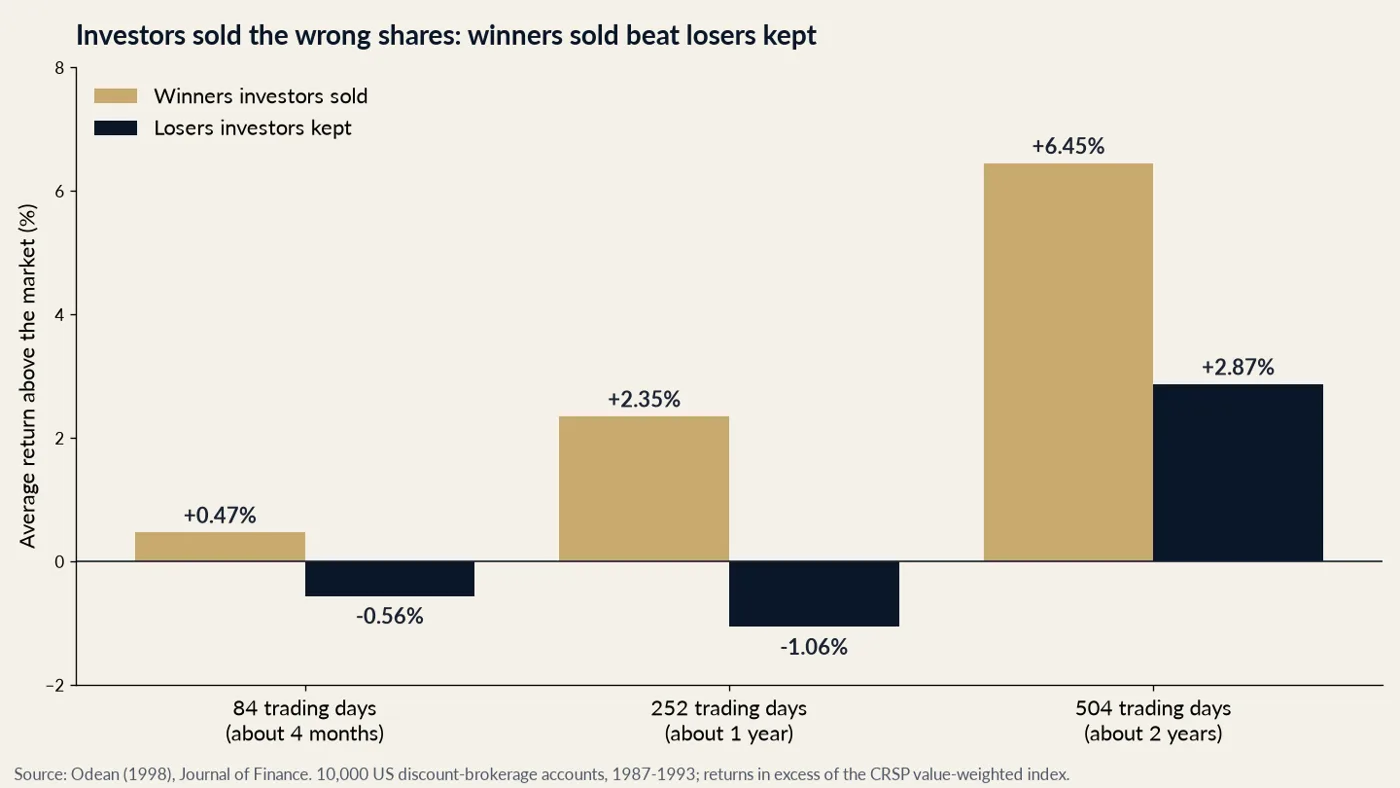
Over the following year (252 trading days), winners sold beat the market by 2.35%, while losers held lagged it by 1.06%: a gap of 3.41 percentage points. The lesson is not "never sell winners". It is that an untested gut feeling about selling is biased, and you need a process that puts the focus on the reason you own a share, not the price you paid.
The regret test: a three-question decision tree
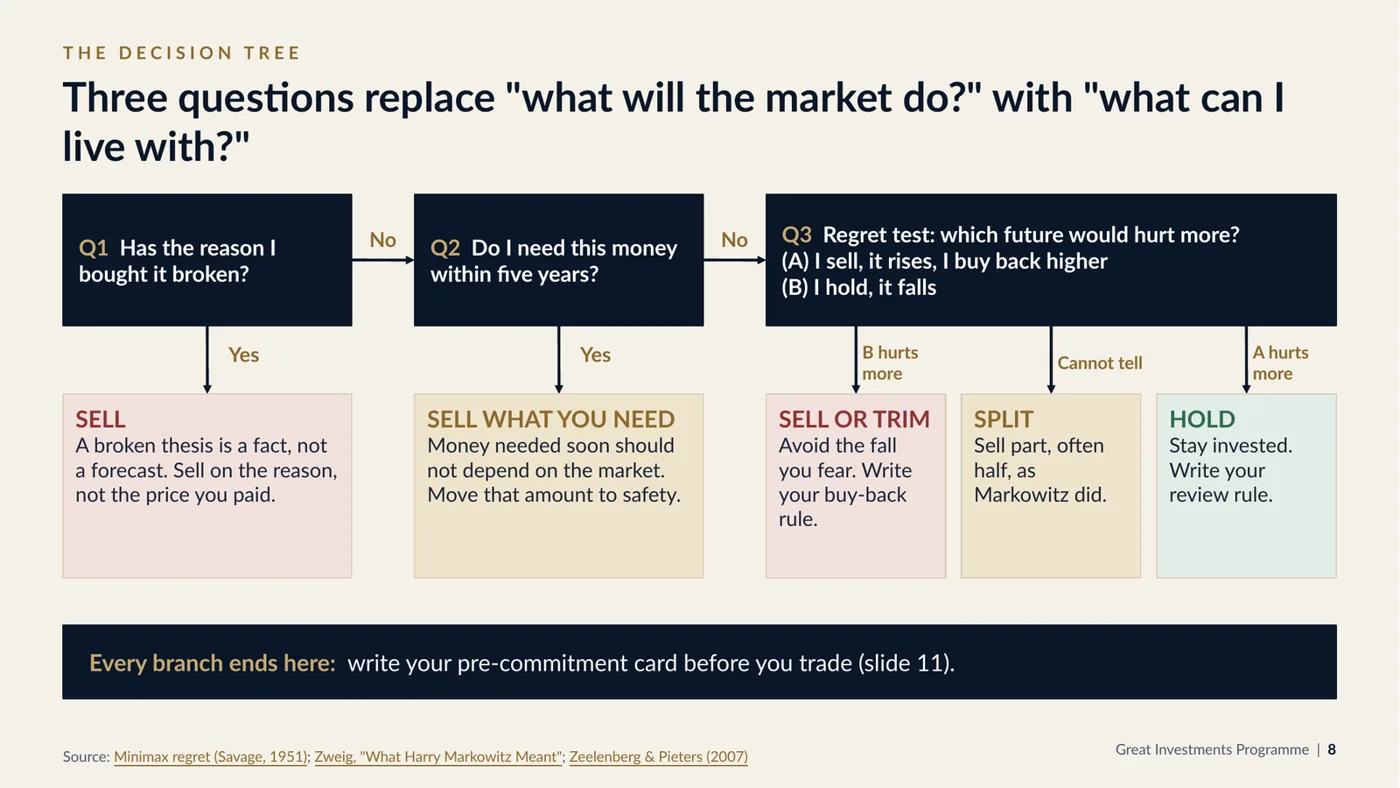
This is the framework I give my clients. It turns "what will the market do?" into "what can I live with?"
Question 1: Has the reason I bought it broken?
If the business has changed, the dividend has been cut or the reason you bought no longer holds, sell. That is a decision based on facts, not a forecast. Sell on the reason, not on the price you paid.
Question 2: Do I need this money within five years?
If you do, sell what you need and move it somewhere safe. Money you need soon should not depend on the market. Five years is my rule of thumb; adjust it to your own plan.
Question 3: Which future would hurt more?
Only now do you reach the genuinely uncertain case. Picture two futures, in pounds:
- Future A: you sell, the market rises, and you buy back at a higher price.
- Future B: you hold, and the market falls.
Then:
- If B would hurt more, sell or trim, and write down your buy-back rule.
- If A would hurt more, hold, and write down your review rule.
- If you honestly can't tell, sell part, often half, as Markowitz did.
Worked example: selling half on a £500,000 portfolio
Here is how minimax regret works in pounds. Imagine a £500,000 portfolio and a market that could fall 20%, stay flat or rise 20%. Regret is the gap between what you got and what the best choice would have given you with hindsight.
| Your choice | Market falls 20% | Market flat | Market rises 20% | Worst regret |
|---|---|---|---|---|
| Sell everything | £0 | £0 | £100,000 missed | £100,000 |
| Hold everything | £100,000 lost | £0 | £0 | £100,000 |
| Sell half | £50,000 | £0 | £50,000 | £50,000 |
Selling everything and holding everything carry the same £100,000 worst case, in opposite futures. Selling half halves it. That is the logic behind the Markowitz split.
Then make it personal. If a £100,000 fall would hurt you twice as much as missing a £100,000 rise, lean towards selling more than half. If missing out would haunt you, lean the other way. The figures are illustrative and ignore dealing costs, tax, cash interest and dividends.
Isn't selling half just a half-decision?
In my research paper Exit or Hold? A Decision Framework for Market Pullbacks, I warn that half-decisions do the most damage. That still stands. The damage comes from dithering: holding, then panicking, then selling near the low with no plan for either half.
A planned split is different. You decide the size in advance, and you write a rule for each half: when you would buy back the part you sold, and when you would review the part you kept. It is a deliberate position size, not a hedge against your own indecision.
Watch: my exit rules before panic selling
The buy-back trap: if you sell, the second decision is harder
Selling can reduce one regret but create another. After you sell, buying back at a higher price feels like admitting a mistake, so many investors wait, and the gap widens. Meanwhile the best and worst days tend to cluster together (opens in a new tab), so selling into a fall risks missing the rebound.
That is why every branch of the tree ends with a written rule. Write it while you are calm, before you trade, using a pre-commitment card like this:
- My decision: sell all / sell part (___%) / hold
- My reason: because ___
- If I sell: I will buy back if ___ or on date ___
- If I hold: I will review if the price falls to ___ or the reason changes
- The regret I accept: if I am wrong, the regret I am choosing to live with is ___
Count the costs too: dealing charges, spreads and, outside an ISA or SIPP, capital gains tax.
Download the full framework
I've published the full 14-slide framework, with the academic references, a worked example, the pre-commitment card and a blank worksheet, in the Research library: Sell or Hold? A Regret-Minimisation Decision Tree. You can also download the editable PowerPoint to fill in yourself.
What to do next
- Write down why you bought each holding. If you can't, that is your first answer to question 1.
- Separate money you need within five years. That part should not depend on the market.
- Run the regret test on your biggest position. Picture both futures in pounds, at one month and at five years.
- Fill in a pre-commitment card before you trade. Decide your buy-back or review rule now, not in the middle of a fall.
- Check the trend before reacting to the headlines. My free Market Regime dashboard shows the weekly picture, and my post on the November AI stocks sell-off shows the process applied to a real fall.
Make the decision once, with a process. Book your free call with Alpesh's team (opens in a new tab) to talk through your portfolio and build a disciplined process for buying, sizing and selling. There is nothing to buy on the call.
Frequently asked questions
Should I sell my shares when the market is falling?
Not just because it is falling. Check whether the reason you bought still holds and whether you need the money within five years. If neither applies, ask which you would regret more: selling and buying back higher, or holding through further falls. Act on that answer and write your rule down.
What is regret minimisation in investing?
It means choosing the option whose worst-case regret is smallest, rather than the one that depends on a correct forecast. The idea comes from Leonard Savage's minimax regret (1951) and regret theory (Loomes and Sugden, 1982). Harry Markowitz used it for his own first pension allocation.
Is it better to sell everything or sell half?
Neither is always better. On a £500,000 portfolio facing a 20% move either way, selling everything or holding everything each carries a £100,000 worst-case regret, while selling half carries £50,000. Selling half only works as a planned split with a written rule for each half.
Why do investors sell winners and hold losers?
It is called the disposition effect. Shefrin and Statman (1985) linked it to regret avoidance: selling a loser makes the mistake final. Odean (1998) found the winners investors sold beat the losers they kept by 3.41 percentage points over the following year.
About Alpesh Patel OBE
Alpesh Patel OBE is Founding Principal of Rootbridge Capital, an author and Dealmaker for the UK Government's Department for Business. He is a former Visiting Fellow in Business, Corpus Christi College, Oxford University, where he worked on technology to improve financial education. Watch his free investing education on YouTube (opens in a new tab).
Sources
- J.P. Morgan Asset Management, Navigating market volatility: a guide for retirement investors (opens in a new tab)
- Odean, T. (1998), Are Investors Reluctant to Realize Their Losses? (opens in a new tab), Journal of Finance, 53(5), 1775–1798
- Shefrin, H. and Statman, M. (1985), The Disposition to Sell Winners Too Early and Ride Losers Too Long (opens in a new tab), Journal of Finance, 40(3), 777–790
- The Royal Swedish Academy of Sciences, Prize in Economic Sciences 2002: press release (opens in a new tab)
- The Royal Swedish Academy of Sciences, Prize in Economic Sciences 2017: press release (opens in a new tab)
- Kahneman, D. and Tversky, A. (1979), Prospect Theory: An Analysis of Decision under Risk (opens in a new tab), Econometrica, 47(2), 263–292
- Kahneman, D. and Tversky, A. (1982), The Psychology of Preferences (opens in a new tab), Scientific American, 246(1), 160–173
- Zweig, J. (2017), What Harry Markowitz Meant (opens in a new tab) (original interview: Money, January 1998)
- Minimax regret (opens in a new tab), The New Palgrave Dictionary of Economics (Savage, 1951)
- Loomes, G. and Sugden, R. (1982), Regret Theory: An Alternative Theory of Rational Choice under Uncertainty (opens in a new tab), Economic Journal, 92(368), 805–824
- Bell, D. E. (1982), Regret in Decision Making under Uncertainty (opens in a new tab), Operations Research, 30(5), 961–981
- Gilovich, T. and Medvec, V. H. (1995), The Experience of Regret: What, When, and Why (opens in a new tab), Psychological Review, 102(2), 379–395
- Zeelenberg, M. and Pieters, R. (2007), A Theory of Regret Regulation 1.0 (opens in a new tab), Journal of Consumer Psychology, 17(1), 3–18
- Alpesh Patel OBE, Nasdaq Falling? My Exit Rules Before Panic Selling (opens in a new tab), YouTube, 11 October 2026
Important: This article is for education only and is not personal financial advice or a recommendation to buy or sell any investment. This article is general investment education only and is not regulated investment advice. The value of investments can go down as well as up, and you may get back less than you invest. Past performance is not a reliable indicator of future results.
Important: this article is education and information only. It is not financial advice or a personal recommendation, and it does not take your circumstances into account. The value of investments and pensions can fall as well as rise, and you may get back less than you put in. Past performance is not a reliable indicator of future results. Figures were correct when the article was written and may have changed. If you are unsure what is right for you, speak to a regulated financial adviser.