Moved Into Money Market Funds? When to Reinvest Your Pension, and How
Moving a pension into money market funds takes an afternoon. A few clicks on a platform, a sell order, a switch, and the numbers stop moving. For someone at or near retirement, that stillness can feel like relief.
The question that follows is much harder, and I hear a version of it often: "I moved everything into money market funds because I was frightened. I think I probably have enough to stop work. Now I don't know when, or how, to go back in." The decision to leave was quick. The decision to return has no obvious moment, so it never quite arrives.
That matters because cash is not standing still in real terms. Bank Rate is 4% after the Bank of England's November rise, and the Bank expects inflation to climb to about 5% by the middle of 2027 (Bank of England (opens in a new tab)). Consumer price inflation was already 3.6% in the year to October 2026 (ONS (opens in a new tab)). Money market funds feel safe. Over a long retirement, safe and sufficient are not the same thing.
Short answer: Don't wait until reinvesting feels safe, because it rarely does. Decide on paper now. First, keep enough years of spending in cash or money market funds that no market fall can touch your retirement income. Second, put the rest back in stages on dates you fix in advance, whatever the headlines. Then test whether "probably enough" really is enough.
Sitting in money market funds and not sure how to go back in? Book your free call with Alpesh's team. We will walk through how self-directed investors set a cash buffer, a re-entry plan and the rules for sticking to it. There is nothing to buy on the call.
Why moving to money market funds is the easy decision
A money market fund holds very short-term loans to governments, banks and large companies. Its yield tends to follow Bank Rate, less the fund's charges, and its price barely moves day to day. It is a sensible place for money you need soon. It is a fund, not a bank account, so read its factsheet for the charge and what it holds.
Selling out in a fright is easy because it answers one feeling: "make the falling stop". It does not answer the real question of retirement, which is "will this money pay me for 25 or 30 years?" That second question needs growth above inflation, and cash has a poor long-term record on that score.
Barclays' research, drawing on its Equity Gilt Study, found that its cash proxy lost 40.5% of its value in real terms over the 20 years from 2004 to 2024, even with interest included. UK equities gained 52.5% in real terms over the same period, while long-dated gilts fell 24.7% (Barclays (opens in a new tab)). Those are past figures and the next 20 years will be different. But they show what "doing nothing" can cost over a retirement-length horizon.
| Asset, 2004 to 2024 | Total real return (after inflation) |
|---|---|
| Cash proxy (building society savings) | −40.5% |
| Long-dated UK gilts | −24.7% |
| 60/40 UK equities and gilts (illustrative) | +21.6% |
| UK equities | +52.5% |
Source: Barclays, "The missed opportunity of not investing" (opens in a new tab), April 2026, using Equity Gilt Study data. Past performance is not a reliable indicator of future results.
When is the right time to reinvest after moving to cash?
There is no signal that rings a bell. Markets usually look most frightening near their lows and most comfortable after they have already risen. If your rule is "I'll go back in when it feels safe", you have chosen a rule that tends to buy late.
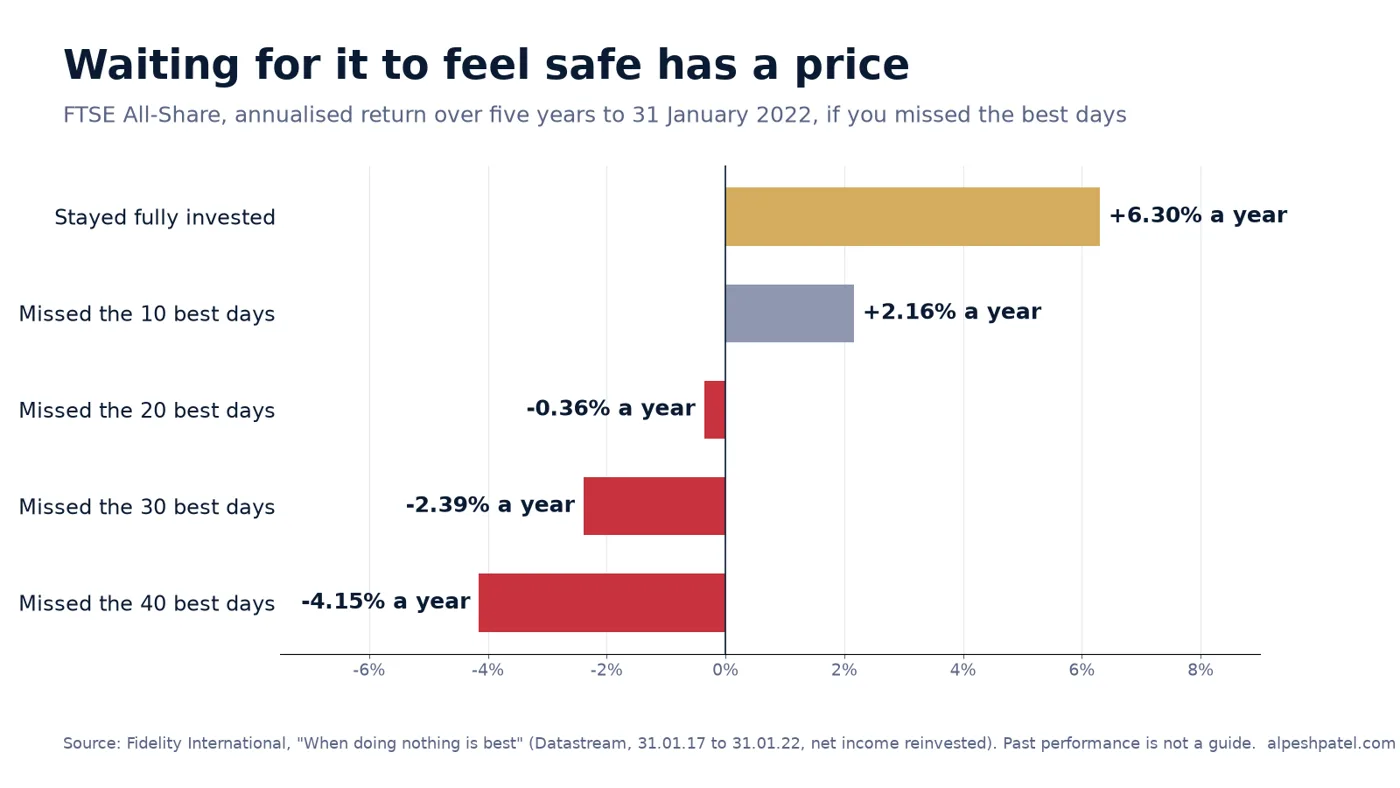
The cost of being out on the wrong days can be severe. Fidelity International looked at the FTSE All-Share over the five years to 31 January 2022. Staying fully invested returned 6.30% a year. Missing just the 10 best days cut that to 2.16% a year, and missing the 20 best days turned it negative, at −0.36% a year (Fidelity International (opens in a new tab)).
Source: Fidelity International, When doing nothing is best (opens in a new tab), Datastream data, 31 January 2017 to 31 January 2022.
The longer view tells the same story. Cazenove Capital, part of Schroders, found that £1,000 invested in the FTSE 250 at the start of 1986 and left alone could have grown to £43,595 by January 2021, or 11.4% a year. Missing the 30 best days over those 35 years would have left about £10,627, or 7% a year (Cazenove Capital (opens in a new tab)).
The awkward part is that the best days often come close to the worst ones, in the middle of the turmoil. That is exactly when someone in money market funds is least likely to act. I covered why fear rarely lines up with what markets do next in why the investors most afraid of a crash aren't moving markets.
The real decision: on what terms you go back in
So stop asking "when" and start asking "on what terms". Write the terms down now, while you are calm, and let the written rule make the decision later. It has two parts.
Part one: how many years of spending stay in cash?
Start with the money you will actually spend. Work out what you need each year from your investments, after the State Pension and any other guaranteed income. Then decide how many years of that spending you want held in cash or money market funds.
The point of this buffer is simple: no market fall should be able to touch your retirement income. If shares drop 30% next year, you keep paying yourself from the buffer and give the invested money time to recover. Many self-directed retirees choose somewhere between two and five years. The right number for you depends on how secure your other income is and how much a fall would worry you.
This is what makes the rest of the plan possible. Once the next few years of spending are ring-fenced, a bad headline is no longer a threat to your groceries. It becomes something you can watch rather than act on. My comparison of six withdrawal strategies for living off your investments shows how a buffer fits with different ways of drawing income.
Part two: the rest goes back in stages, on fixed dates
Everything beyond the buffer is long-term money. Decide how many stages you will use to reinvest it and put the dates in your diary now. For example, six equal amounts on the first working day of each month for six months. Or four amounts, one a quarter, over a year.
Then follow the dates whatever the news says. If markets fall between stages, the next purchase buys more cheaply. If they rise, you are already partly invested. Either way, you are no longer trying to call the bottom.
Putting everything back at once has tended to do better than staging when markets rise, simply because more money is invested for longer. But a plan you abandon halfway is worth nothing. For someone who left the market out of fear, staging on fixed dates is often the version they can actually follow through.
| Illustrative re-entry plan: £600,000 in money market funds, £30,000 a year needed from investments | Amount | When |
|---|---|---|
| Cash buffer: 3 years of spending | £90,000 | Stays in money market funds or cash |
| Stage 1 | £85,000 | 1st working day, month 1 |
| Stage 2 | £85,000 | 1st working day, month 2 |
| Stage 3 | £85,000 | 1st working day, month 3 |
| Stage 4 | £85,000 | 1st working day, month 4 |
| Stage 5 | £85,000 | 1st working day, month 5 |
| Stage 6 | £85,000 | 1st working day, month 6 |
Illustrative only. Not a recommendation of any amount, timetable or investment.
Write down what goes into each stage too: the mix of funds or shares, and how much any single holding is allowed to be. A re-entry plan without a target portfolio just moves the indecision from "when" to "what".
Do you really have enough to stop work?
"I probably have enough" is a feeling, not a plan. Your annual spending number turns it into a yes or a no.
Take the yearly amount you need from your investments. Divide it by your pot and you have your withdrawal rate. In the illustrative example above, £30,000 a year from £600,000 is 5% a year. That is a much more demanding rate than £30,000 from £1 million, which is 3%. The higher the rate, the more your plan depends on growth, and the less sense it makes to leave most of the money in cash.
Then stress-test it. The free Pension Plan (opens in a new tab) tool lets you test how long a pot lasts at different spending levels and returns. The FIRE calculator (opens in a new tab) shows whether your savings can support stopping work now or in a few years. Portfolio Odds (opens in a new tab) lets you explore how likely a loss is for a given mix under its assumptions. You will find all of them on the free tools page.
If the answer is yes, you can afford a calm, staged return to the market. If it is no, or only just, you have learned something far more useful than a market forecast: you may need to work a little longer, spend a little less or take a little more growth risk. Better to find that out now than at 75.
Why a written process beats a feeling
Moving to money market funds felt like taking control. In a way it was the opposite. The decision was made by fear, and the next decision is waiting on a feeling that may never come.
Running your own money properly means writing the rules first. What do you own and why? How large can any one holding be? When do you rebalance and when do you sell? How much stays in cash for income? Once those rules are on paper, a frightening week becomes a test of the plan, not a reason to tear it up.
That is the real advantage of managing your own portfolio. You have control and full transparency, and the portfolio can be built around your own risk profile and income needs rather than an average saver's. The trade-off is that the discipline is yours too. If you want a structured approach to market falls, the protect your portfolio in a crash guide and the build a retirement income guide are good places to start.
What to do next
- Write down your annual spending number. What you need each year from your investments, after the State Pension and any guaranteed income.
- Test whether you can stop work. Run that number through Pension Plan (opens in a new tab) and the FIRE calculator (opens in a new tab) to turn "probably enough" into yes or no.
- Decide your cash buffer. Choose how many years of spending stay in money market funds or cash, and leave it there.
- Fix your re-entry dates. Split the rest into stages, put the dates in your diary and write down the target mix for each stage.
- Write your sell and rebalance rules before the first stage goes in, so the next scare has a plan waiting for it.
Want a written plan for getting back into the market? Book your free call with Alpesh's team. We will show you how self-directed investors size a cash buffer, stage a return to the market and decide in advance when to rebalance or sell. There is nothing to buy on the call.
Frequently asked questions
Are money market funds safe for a pension?
They are among the lowest-risk funds, and their yields tend to track Bank Rate, which is 4% after the November 2026 rise. But they are investments, not bank deposits, and over long periods cash has struggled to keep up with inflation. They suit money you need in the next few years better than money you need in 20.
Should I reinvest my pension all at once or in stages?
Investing all at once has tended to do better when markets rise, because more money is working for longer. Staging on fixed dates reduces the regret of buying just before a fall and is easier to stick to. The best choice is the one you will actually follow through.
How much cash should I keep in retirement?
Many self-directed retirees hold between two and five years of the spending they need from their investments in cash or money market funds. The right amount depends on your other secure income, such as the State Pension, and how a market fall would affect you.
What if the market falls straight after I reinvest?
With a cash buffer in place, a fall does not touch your income, so you have time to wait for a recovery. Later stages of a staged plan would then buy at lower prices. That is why the buffer comes first.
About Alpesh Patel OBE
Alpesh Patel OBE is Founding Principal of Rootbridge Capital, an author and Dealmaker for the UK Government's Department for Business. He is a former Visiting Fellow in Business, Corpus Christi College, Oxford University, where he worked on technology to improve financial education.
Sources
- Bank of England, Interest rates and Bank Rate: our latest decision (opens in a new tab)
- Office for National Statistics, Consumer price inflation, UK: October 2026 (opens in a new tab)
- Barclays, The missed opportunity of not investing (opens in a new tab)
- Fidelity International, When doing nothing is best (opens in a new tab)
- Cazenove Capital, The £33k cost of trying to time the market (opens in a new tab)
- Alpesh Patel OBE, Once Retirees See This Data, They Stop Worrying About Investing (opens in a new tab) (YouTube)
Important: This article is for education only and is not personal financial advice or a recommendation to buy or sell any investment. This article is general investment education only and is not regulated investment advice. The value of investments can go down as well as up, and you may get back less than you invest. Past performance is not a reliable indicator of future results.
Important: this article is education and information only. It is not financial advice or a personal recommendation, and it does not take your circumstances into account. The value of investments and pensions can fall as well as rise, and you may get back less than you put in. Past performance is not a reliable indicator of future results. Figures were correct when the article was written and may have changed. If you are unsure what is right for you, speak to a regulated financial adviser.