Investing a Lump Sum at All-Time Highs: Is Waiting for a Dip Better?
Picture someone with a large sum sitting in cash. It might be a pension lump sum, the proceeds of a business or an inheritance. They want to invest it, but every time they look, the stock market is at another record. So they wait for the fall that will surely come. Months pass. The market keeps rising, and waiting starts to feel even safer.
It is one of the most common worries I hear: is investing a lump sum at all-time highs a mistake? Here is the surprising part. In the first nine months of 2026 the S&P 500 set 27 new all-time highs, and since 1950 it has closed at a record on about 7% of trading days, according to J.P. Morgan Asset Management's Guide to the Markets (opens in a new tab). Records are not rare events. They are what a rising market looks like.
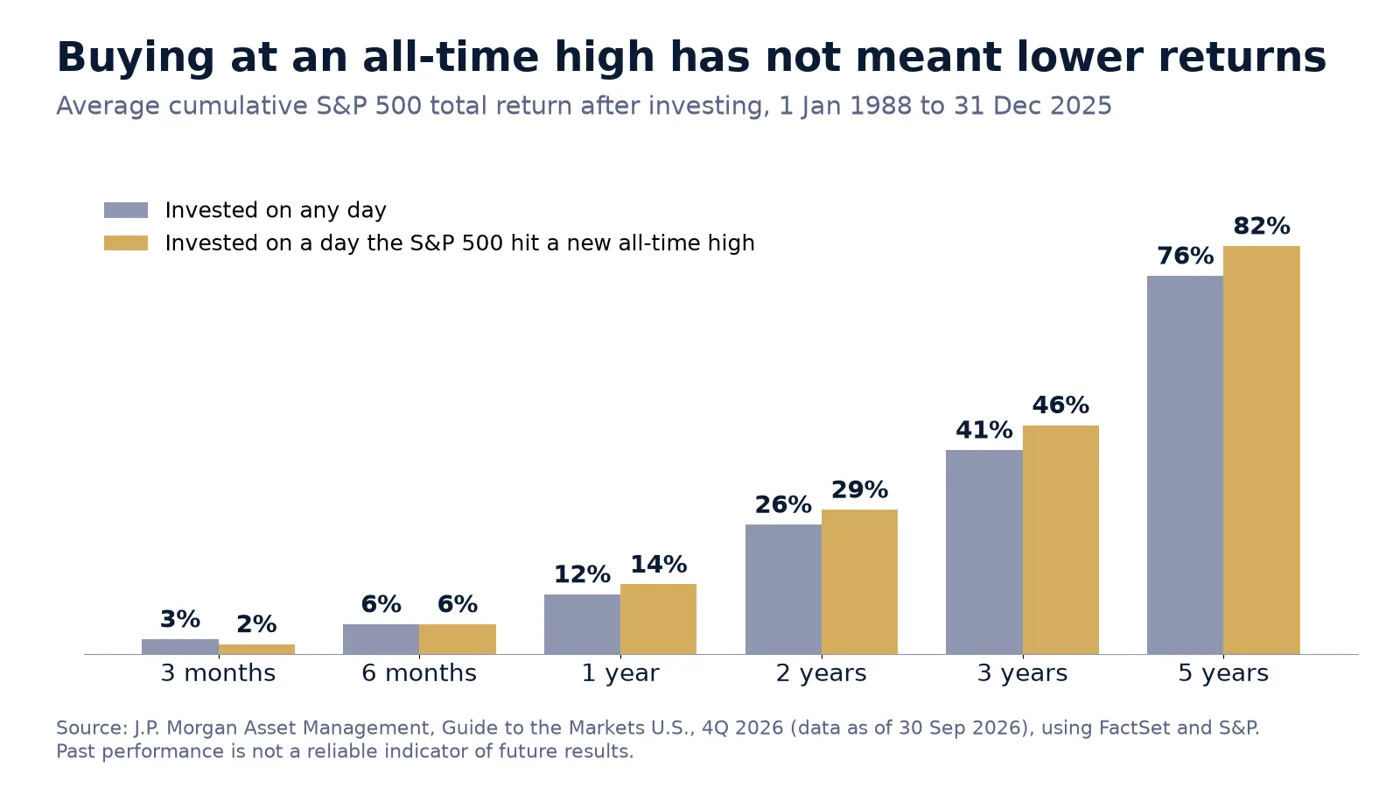
And the returns after those records have not been worse. From 1988 to 2025, money invested on a day the S&P 500 hit a new high was, on average, 82% higher five years later, against 76% for money invested on any day. That does not mean markets never fall. It means "the market is at a high" has not, on its own, been a reason to wait.
Short answer: Historically, investing a lump sum at an all-time high has produced returns similar to, or slightly better than, investing on an average day. Vanguard found a lump sum beat phasing in about two-thirds of the time. The real risk is a long flat spell, so decide in writing: invest now, or phase in on fixed dates.
Holding cash and waiting for a dip that has not come? Book your free call with Alpesh's team. We will walk through how self-directed investors set a written entry plan and decide what to buy, how much and when. There is nothing to buy on the call.
How often is the stock market at an all-time high?
More often than most people think. J.P. Morgan's data show the S&P 500 has closed at a record on about 7% of trading days since 1950, and 80% of all-time highs were followed by another within a week. J.P. Morgan Guide to the Markets (opens in a new tab) Highs tend to come in clusters.
There is a second statistic that matters even more for anyone waiting. Almost a third of those highs became what J.P. Morgan calls a market floor: a level from which the index never again fell more than 5%. J.P. Morgan Asset Management (opens in a new tab) An investor who waited for a 10% fall from one of those highs never got it.
That is the trap. Waiting for a dip feels prudent, but it is a forecast. You are betting that prices will be lower on the day you finally invest than they are today, and history shows that bet often loses.
Are returns lower after buying at an all-time high?
Not on the evidence. J.P. Morgan compared the average cumulative total return of the S&P 500 after investing on any day with the return after investing on a day the index set a new high, from 1 January 1988 to 31 December 2025.
| Holding period | Invested on any day | Invested at a new all-time high |
|---|---|---|
| 3 months | 3% | 2% |
| 6 months | 6% | 6% |
| 1 year | 12% | 14% |
| 2 years | 26% | 29% |
| 3 years | 41% | 46% |
| 5 years | 76% | 82% |
Source: J.P. Morgan Asset Management, Guide to the Markets U.S., 4Q 2026 (opens in a new tab), average cumulative S&P 500 total returns, data as of 30 September 2026.
Source: J.P. Morgan Asset Management, Guide to the Markets U.S., 4Q 2026. Past performance is not a reliable indicator of future results.
An earlier note from J.P. Morgan's wealth business made the same point a different way. Since the start of 1988, money invested in the S&P 500 on a random day, with dividends reinvested, was higher a year later 83% of the time, with an average one-year return of 11.7%. Money invested only on record-high days was higher a year later 88% of the time, with an average return of 14.6%. J.P. Morgan (opens in a new tab)
Why would that be? Partly because highs come in strong markets, and strong markets often have momentum. Mostly because shares rise over time, so over a full cycle most days end up being lower than some later day. A record today is often an ordinary price five years from now.
Is it better to invest a lump sum or phase it in?
This is the question underneath the worry, and Vanguard has studied it carefully. Megan Finlay and Josef Zorn compared investing a lump sum at once with spreading it over several months, on rolling one-year periods from 1976 to 2022, across several markets. Lump-sum investing beat cost averaging about two-thirds of the time. Vanguard Research (opens in a new tab)
The longer you spread the money, the more often the lump sum won. Using MSCI World data, a lump sum beat a three-month split 68% of the time, while cost averaging still beat staying in cash 69% of the time. Vanguard Research (opens in a new tab) In other words, phasing is a cost, but sitting in cash indefinitely has usually cost more.
J.P. Morgan ran a similar test for a balanced portfolio of 55% MSCI World shares and 45% bonds, comparing investing at once with phasing in over six or 12 months.
| Balanced portfolio, from 1975 | Median 1-year return | Worst 5% of 1-year returns | Median 3-year return |
|---|---|---|---|
| Invest at once | 11% | -8% | 11% |
| Phase in over 6 months | 9% | -6% | 10% |
| Phase in over 12 months | 6% | -2% | 9% |
Source: J.P. Morgan, "New Year Nerves: Why We're Still Optimistic" (opens in a new tab), January 2024. 55% MSCI World / 45% Bloomberg US Aggregate. Past performance is not a reliable indicator of future results.
That table is the honest trade-off in one picture. Investing at once gave the higher typical return. Phasing in gave a smaller typical return but a much softer worst case. Neither is wrong. What is wrong is having no rule at all and letting the news decide.
I covered the Vanguard figures for UK investors in more detail in how to invest £1 million held in cash.
What is the honest risk of investing at a high?
It would be dishonest to stop at averages. Averages hide the bad starting points, and there have been some very bad ones.
The S&P 500 hit an intraday high of 1,552.87 on 24 March 2000, at the peak of the dot-com bubble. It closed at a new record of 1,565.15 in October 2007, then fell to a closing low of 676.53 in March 2009. It did not close above that 2007 record until 28 March 2013, at 1,569.19. Reuters (opens in a new tab) Someone who invested at the 2000 high waited roughly 13 years for the price index to make lasting new ground, with dividends the only comfort.
The UK was worse. The FTSE 100 closed at 6,930.2 on 30 December 1999 and did not close above it until 24 February 2015, more than 15 years later. BBC News (opens in a new tab)
Set that against the long bull runs. US shares rose through most of the 1980s and 1990s into the 2000 peak. And from that March 2009 low of 676.53, the S&P 500 went on to set record after record, including 27 new highs in the first nine months of 2026. Reuters (opens in a new tab), J.P. Morgan (opens in a new tab)
So the real risk of investing at a high is not "the market falls 10% next month". It is a long, flat decade, usually after a period when prices ran well ahead of earnings. That risk is about valuation and concentration, not about the word "record". My piece on S&P 500 concentration and the Magnificent Seven looks at that side of today's market.
Why waiting for a dip usually fails
Waiting needs two correct decisions, not one. You have to get out of the way of the fall, and then you have to buy when the news is at its worst. Most people who wait for a dip find the second decision harder than the first. When the fall comes, it comes with frightening headlines, and the cash stays put.
Missing the rebound is expensive. I looked at what missing the best days does to returns in my post on money market funds and when to reinvest. The best days often arrive close to the worst ones, which is exactly when a nervous investor is still waiting.
There is also a quieter cost. Cash feels safe, but inflation erodes it, and every month in cash is a month the money is not doing the job you set aside for it. If the plan was always to invest, delay is not neutral.
If the worry is broader, such as whether to take money out of the market altogether, read should I move my pension to cash? first. That is a different decision with different risks.
How to invest a lump sum at all-time highs: a written entry plan
The answer is not to guess the next move. It is to decide how you will go in, write it down and stick to it. That is the process I would use.
1. Set aside what you need first. Money you will spend in the next two or three years should not be in shares at all, record high or not. Keep it in cash or short-term deposits.
2. Decide the mix before you decide the timing. How much in shares, how much in bonds or cash, and how much in any single fund or company. A sensible mix does most of the work of protecting you from a bad entry point. The protect your portfolio in a crash guide covers how to think about that.
3. Choose one of two entry methods. Either invest the whole sum now, because history favours it. Or phase in on fixed dates, for example equal amounts on the first working day of each month for three to six months. Both are reasonable. "When it feels right" is not a method.
4. Write the rules for a fall. If you phase in and the market drops 10% or 20% part-way through, do you keep to the schedule, or bring the remaining purchases forward? Decide that now, while you are calm.
5. Put the dates in your diary. A plan that lives in your head will be rewritten by the next headline.
Here is an illustrative example. Someone with around £400,000 to invest keeps £60,000 in cash for near-term spending. They put £170,000 into their chosen portfolio today and the remaining £170,000 in two equal amounts of £85,000 on the first working day of each of the next two months. Whatever the market does, they follow the dates. That split is illustrative, not a recommendation: the right mix depends on your own goals and risk.
You can test how a given mix might behave with the free Portfolio Odds (opens in a new tab) tool and the Probability (opens in a new tab) calculator, and the invest a lump sum guide walks through the steps.
Why run the plan yourself?
A lump sum is a moment of maximum choice, and that is where managing your own money pays off. You can see every holding and every charge. You decide how much goes into each position and when you would sell. You build the portfolio around your own risk profile, rather than a model built for an average client.
The trade-off is that the decisions are yours. That is fine if you have a process. You do not need to predict the market. You need a written plan for what you buy, how much and on what dates, and the discipline to follow it when the news is loud.
What to do next
- Separate the money. Put the next two to three years of spending in cash before you think about timing.
- Write your target mix. Shares, bonds and cash, and a maximum size for any one holding.
- Pick your entry method. All at once, or fixed amounts on fixed dates over three to six months.
- Write your rule for a fall during the phasing period, and put every purchase date in your diary.
- Test the plan with Portfolio Odds (opens in a new tab) and the other free tools before the first purchase.
Want a written entry plan for your lump sum? Book your free call with Alpesh's team. We will show you how self-directed investors decide what to buy, how much and when, so a record high becomes a scheduled decision rather than a reason to freeze. There is nothing to buy on the call.
Frequently asked questions
Is it a bad time to invest when the market is at an all-time high?
Not on the historical evidence. J.P. Morgan's data from 1988 to 2025 show average S&P 500 returns after a new high were similar to, or slightly better than, returns after investing on any day. The bigger risk is an expensive market going nowhere for years, which a sensible mix and a phased plan can help with.
Should I wait for a stock market correction before investing a lump sum?
Waiting is a forecast, and it often fails because almost a third of all-time highs were never followed by a fall of more than 5%. If a sudden drop would make you sell, phasing in on fixed dates is a better answer than waiting indefinitely.
Is lump sum investing better than pound cost averaging?
Vanguard's research found a lump sum beat cost averaging about two-thirds of the time from 1976 to 2022, because markets rise more often than they fall. Cost averaging did better in the worst outcomes, so it can suit someone who fears regret more than missing out.
How long should I phase in a lump sum?
There is no single right answer, but long schedules carry a cost. Vanguard found the longer the phasing period, the more often a lump sum won. Many people choose three to six months on fixed dates so the money is fully invested without relying on a forecast.
About Alpesh Patel OBE
Alpesh Patel OBE is Founding Principal of Rootbridge Capital, an author and Dealmaker for the UK Government's Department for Business. He is a former Visiting Fellow in Business, Corpus Christi College, Oxford University, where he worked on technology to improve financial education.
Sources
- J.P. Morgan Asset Management, Guide to the Markets U.S., 4Q 2026 (opens in a new tab) ("Investing at all-time highs", data as of 30 September 2026)
- J.P. Morgan Asset Management, U.S. Equities: How to invest in a market near all-time highs? (opens in a new tab)
- J.P. Morgan, Is it worth considering investing at all-time highs? (opens in a new tab)
- J.P. Morgan, New Year Nerves: Why We're Still Optimistic (opens in a new tab) (January 2024)
- Vanguard Research, Finlay and Zorn, Cost averaging: Invest now or temporarily hold your cash? (opens in a new tab) (February 2023)
- Reuters, Key dates and milestones in the S&P 500's history (opens in a new tab)
- BBC News, FTSE 100 closes at record level (opens in a new tab) (24 February 2015)
- Alpesh Patel OBE, Why The Stock Market Refuses To Crash: All-Time Highs Explained (opens in a new tab) (YouTube)
Important: This article is for education only and is not personal financial advice or a recommendation to buy or sell any investment. This article is general investment education only and is not regulated investment advice. The value of investments can go down as well as up, and you may get back less than you invest. Past performance is not a reliable indicator of future results.
Important: this article is education and information only. It is not financial advice or a personal recommendation, and it does not take your circumstances into account. The value of investments and pensions can fall as well as rise, and you may get back less than you put in. Past performance is not a reliable indicator of future results. Figures were correct when the article was written and may have changed. If you are unsure what is right for you, speak to a regulated financial adviser.