Nvidia, Anthropic and Market Falls: Build an Investing Plan

Based on my webinar of 19 November 2026. Market commentary reflects that webinar, not live prices or forecasts.
When markets become unsettled, the questions arrive quickly. Should I sell Nvidia? Am I missing an opportunity in Anthropic? Would UK or European shares feel more comfortable?
There is a question to answer before any of those: what is your process for making a decision when you cannot know what happens next?
In this webinar, I used Nvidia, Anthropic and the wider markets to explore that problem. The useful lesson is not a price target. It is how to connect the companies you own, the risks you take and the decisions you can live with.
Watch the webinar
Watch on YouTube (opens in a new tab).
Start with the risk you can actually carry
Predicting a crash and preparing for a fall are different activities. You can spend hours collecting arguments for and against a crash without getting any closer to a decision that fits your circumstances.
As I put it in the webinar:
You've got to try and avoid crystal ball gazing and try and make it bespoke to your own risk capacity.
Risk capacity includes the financial consequences of a fall: whether you will need the money, how concentrated your holdings are and whether a loss would disrupt your plans. Alongside that sits your emotional tolerance. A portfolio you cannot bear to hold through a difficult period may be a poor fit, however persuasive the investment story sounds.
The webinar explored regret from both directions. Buying can bring the pain of a subsequent fall. Waiting can bring the frustration of watching a price rise without you. Neither feeling tells you, by itself, which decision is right.
Before acting, write down which risk you are accepting and why. That gives you something more useful to revisit than the mood of the market on the day.
Nvidia: separate the business from the share price
Nvidia was a case study in the difference between a company's business performance and the price investors are willing to pay for it.
Profits matter. So does the multiple placed on those profits. That multiple can expand or contract as expectations, sentiment and willingness to take risk change. A valuation calculation is therefore an input to a decision, rather than a timetable for when the market will agree with you.
My framework considers value, growth, income and cash flow. It asks what supports the business, rather than treating a familiar company name or an exciting theme as enough.
Quality does not remove the possibility of a sharp fall or a long period of little progress. Holding a company for the long term also does not mean adding to it whenever its price drops.
In the session, I distinguished holding an existing position from committing more money while the trend was still falling steeply. Those are separate decisions. Each needs a reason, a position size and a clear understanding of what further weakness would mean for the portfolio.
Anthropic: enthusiasm is not a substitute for evidence
The discussion around Anthropic raised a different issue: how to approach an exciting business when the information you normally rely on is limited.
It is possible to be interested in a company's long-term potential without deciding to own it immediately. In the webinar, I explained my reluctance to participate in initial public offerings when I do not have the listed-company data I use in my process.
The broader lesson is to identify the evidence you require before the excitement starts. That might include a reporting history, a clearer understanding of profitability or enough information to assess valuation consistently.
Waiting has an opportunity cost. Buying with incomplete information has risks too. A written process makes that trade-off explicit instead of allowing urgency to make the decision.
UK and Europe: look beyond the market label
The webinar also looked at UK and European markets. But moving between regions does not remove the need to understand what you own.
A country name or a sector label cannot, on its own, tell you how volatile a holding is or how it will behave alongside the rest of your portfolio.
One distinction from the session is worth keeping:
Volatility is a mathematical number.
Rather than assuming that a technology company must be too volatile, or that an apparently defensive business must be comfortable to hold, look at the evidence. Then ask whether the measured risk fits your circumstances.
Diversification needs more than a list of holdings
An attendee asked how many different company shares a portfolio should contain. The more important follow-up was how those holdings behave together.
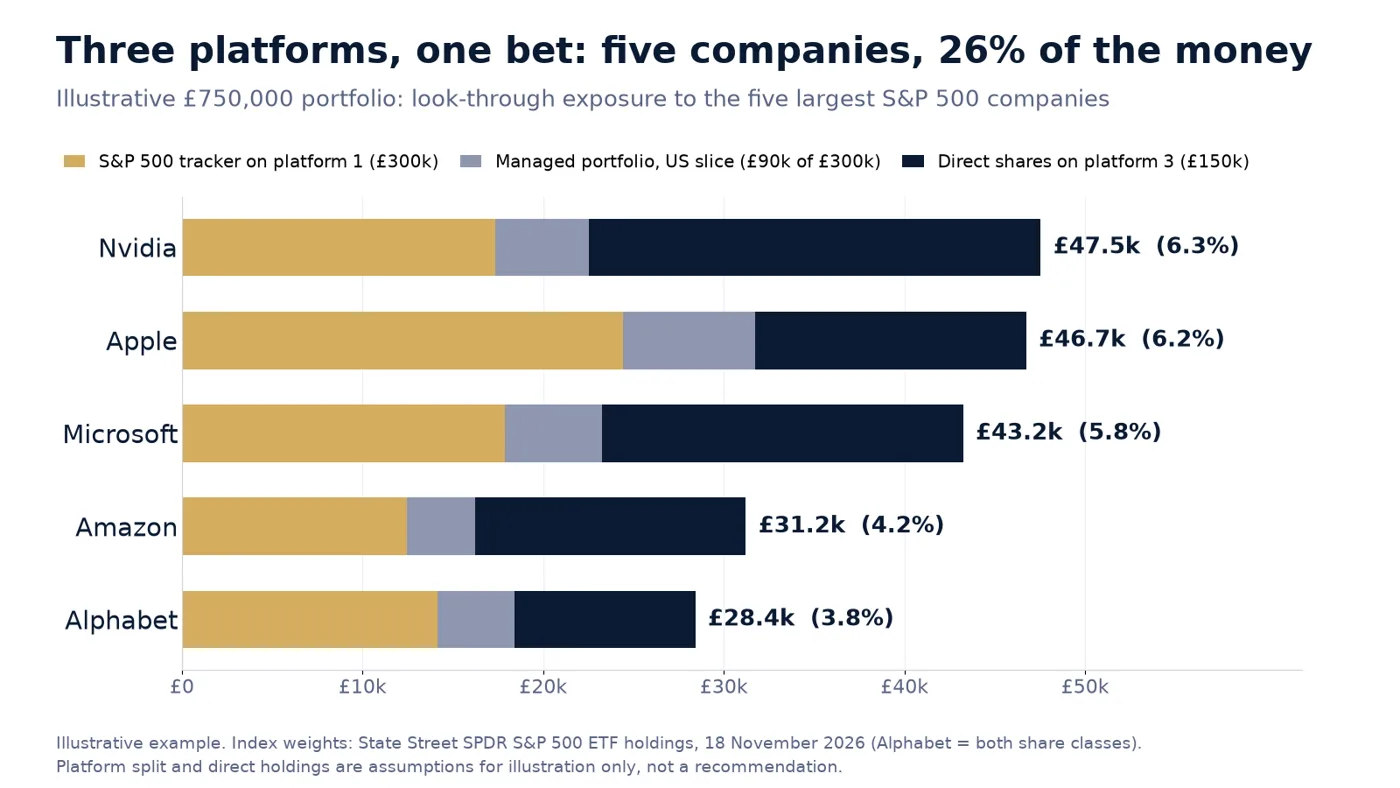
Several holdings can leave you exposed to the same underlying risks. Equally, different sector labels do not guarantee that investments will move independently during a difficult market.
In the webinar, I discussed examining correlations and looking at how a proposed combination behaved in a stressed period. Historical behaviour cannot settle what happens next, but it can expose weaknesses that a list of company names conceals.
The practical question is whether you could remain comfortable with the combined portfolio if conditions became difficult again.
A short checklist before your next decision
Before buying, selling or adding to a holding, ask:
- What is my investment case? Write it in terms of the business and its valuation, not the latest price move.
- What could undermine that case? Decide which evidence would make you reconsider.
- How much risk does this add? Consider the position alongside your other holdings and your need for access to the money.
- Am I investing or trying to time a short-term move? Be honest about the behaviour your decision requires.
- What is my plan if I am wrong? Consider both a further fall and a rise after you decide to wait.
The aim is a process you can understand and apply consistently, including when headlines become uncomfortable.
Want to explore a more structured investing process?
If you are a self-directed investor and would like to learn more about the Great Investments Programme's education and approach, book a call with the team at www.alpeshpatel.com/call.
Important: this article is education and information only. It is not financial advice or a personal recommendation, and it does not take your circumstances into account. The value of investments and pensions can fall as well as rise, and you may get back less than you put in. Past performance is not a reliable indicator of future results. Figures were correct when the article was written and may have changed. If you are unsure what is right for you, speak to a regulated financial adviser.