Bond-Heavy Pension, 10% Ambitions: How to Rebuild Growth From Gilts and Fixed Interest
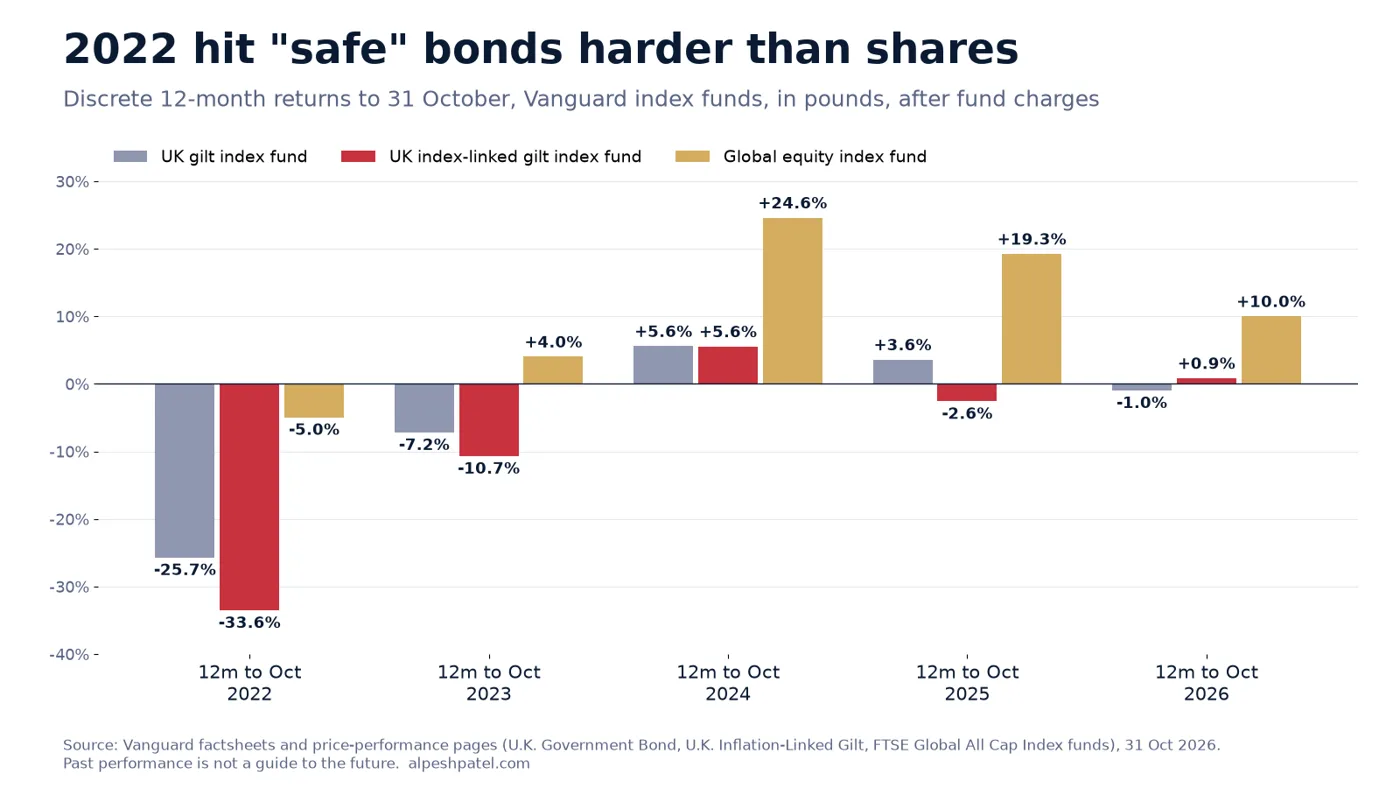
In the 12 months to 31 October 2022, a plain UK government bond index fund lost 25.72% of its value, according to Vanguard's own performance figures (opens in a new tab). Its index-linked cousin, the one many people hold precisely because it is meant to protect them from inflation, lost 33.55% over the same year, per the Vanguard U.K. Inflation-Linked Gilt Index Fund factsheet (opens in a new tab). A global share index fund lost 4.96%.
That is the backdrop to a situation my team hears about more often than you might think. Someone in their late fifties or sixties has a sizeable pension, sometimes well into six figures, sitting mostly in fixed interest and gilt funds. It was set up to be "safe". It has gone nowhere for years. And they would now like it to earn something like 10% a year to fund the retirement they want.
A bond-heavy pension and a 10% target do not fit together. That is not a criticism of either. It means one of them has to change, and if it is the portfolio, the change needs a written plan rather than a leap.
Short answer: A bond-heavy pension is unlikely to deliver 10% a year. Over 126 years, developed-market bonds returned about 4.4% a year and shares about 8.5%. Rebuilding growth means moving towards shares gradually, with written rules for how much, how fast and when to rebalance, while keeping a few years of withdrawals in safer assets.
Is your pension mostly in bonds and gilts, but your plans need growth? Book your free call with Alpesh's team. We will walk through how self-directed investors set a target mix, phase into it and decide when to rebalance. There is nothing to buy on the call.
What return can a bond-heavy pension realistically make?
The best long-run evidence is the UBS Global Investment Returns Yearbook, compiled by Elroy Dimson, Paul Marsh and Mike Staunton. Its 2026 summary edition (opens in a new tab) shows that from 1900 to 2025, developed-market shares returned 8.5% a year and developed-market bonds 4.4% a year, in US dollars.
The US figures make the gap plainer still. US shares returned 9.8% a year, US bonds 4.6% and Treasury bills 3.4%. After inflation, that is 6.6% a year for shares against 1.6% for bonds, according to the same UBS summary (opens in a new tab).
Today's starting yields matter too. As at 31 October 2026, Vanguard's U.K. Government Bond Index Fund showed an effective yield to maturity of 5.2% and an average duration of 7.5 years, on Vanguard's fund page (opens in a new tab). The yield is a reasonable guide to what a gilt fund might earn over the next several years if yields stay roughly where they are. It is a long way from 10%.
So a pension that is, say, 80% or 90% in bonds is likely to earn something in the mid-single digits over time, before charges. That can be fine for some goals. It is not built for a double-digit one.
What happened to gilts and bonds in 2022?
Bond prices move the opposite way to interest rates. When rates rose quickly in 2022, the prices of existing bonds fell to match. The longer a bond fund's duration, the more it falls for each rise in yields.
That is why index-linked gilts did worse than conventional ones. The Vanguard U.K. Inflation-Linked Gilt Index Fund has an average duration of 12.7 years, against 7.5 years for the conventional gilt fund, per the index-linked factsheet (opens in a new tab) and Vanguard's gilt fund page (opens in a new tab).
Source: Vanguard factsheets and price-performance pages, 31 October 2026. Past performance is not a guide to the future.
| 12 months to 31 October | UK gilt index fund | UK index-linked gilt index fund | Global equity index fund |
|---|---|---|---|
| 2022 | -25.72% | -33.55% | -4.96% |
| 2023 | -7.20% | -10.70% | +4.03% |
| 2024 | +5.59% | +5.55% | +24.62% |
| 2025 | +3.61% | -2.59% | +19.26% |
| 2026 | -0.99% | +0.86% | +10.02% |
| Five years, a year | -5.7%* | -9.26% | +10.08% |
Sources: Vanguard U.K. Government Bond Index Fund (opens in a new tab); Vanguard U.K. Inflation-Linked Gilt Index Fund factsheet (opens in a new tab); Vanguard FTSE Global All Cap Index Fund factsheet (opens in a new tab), all to 31 October 2026, after fund charges. *Calculated from the five discrete years shown. Funds named as examples of each asset class, not recommendations.
Five years on, someone fully in index-linked gilts would still be well over a third down in cash terms. Someone in a global share index fund would be up by more than 60%. Past performance is not a guide to the future, and the next five years could look very different. But it shows why a bond-heavy pension can feel stuck.
Are index-linked gilts still a safe haven?
They protect against inflation if you hold an individual linker to maturity, because both the coupons and the final repayment rise with inflation. A fund of linkers never matures, though. It is exposed to changes in real yields every day, and with a duration of over 12 years those changes are large.
That makes a linker fund useful for some jobs, such as matching a long-dated inflation-linked spending need, and poor for others, such as money you may need to draw in the next few years. My earlier post on gilts, corporate bonds and bond funds covers the differences in more detail.
What mix of shares and bonds do you need for a target return?
Here is an illustrative way to think about it, using the long-run UBS developed-market averages of 8.5% a year for shares and 4.4% for bonds. A simple weighted average gives a rough long-run expectation for each mix. It ignores charges, inflation, currency and the order of returns, so treat it as a sense check rather than a forecast.
| Illustrative mix (shares / bonds) | Rough long-run return | Gap to 10% |
|---|---|---|
| 20 / 80 | 5.2% a year | 4.8 points |
| 40 / 60 | 6.0% a year | 4.0 points |
| 60 / 40 | 6.9% a year | 3.1 points |
| 80 / 20 | 7.7% a year | 2.3 points |
| 100 / 0 | 8.5% a year | 1.5 points |
Illustrative. Weighted averages of the UBS Global Investment Returns Yearbook 2026 developed-market figures (shares 8.5% a year, bonds 4.4% a year, 1900–2025, in US dollars). Not a forecast.
The uncomfortable message is in the last row. Even a portfolio entirely in shares has historically averaged less than 10% a year across developed markets. Reaching 10% consistently means either taking concentrated risk, adding money, or accepting a lower target. I go through what higher targets demand in Is 20% a year realistic?, and the same logic applies at 10%.
The other side of the trade is the size of the falls. The UBS researchers note that since 1900, shares and bonds have each lost more than 70% in real terms on several occasions, while a 60:40 blend has never fallen more than 50%, per the 2026 summary (opens in a new tab). Moving from 20% to 80% in shares raises the expected return. It also raises the size of the worst year you need to be able to sit through.
You can test your own mix in the free Portfolio Odds (opens in a new tab) tool, which shows how often a given mix has lost money over different holding periods under its assumptions, and the Probability (opens in a new tab) tool for the odds of hitting a target.
How do you move a pension from bonds to shares safely?
Not all at once, and not on a feeling. The risk in moving from a bond-heavy pension into shares is not just a market fall. It is a market fall in the first few months, followed by the urge to reverse the decision at the worst moment.
That behaviour gap is measurable. Morningstar's Mind the Gap 2026 study (opens in a new tab) found US fund investors earned 8.7% a year over the ten years to 31 December 2025, against 9.9% a year for the funds themselves, largely because of the timing of their buying and selling. Written rules are how you close that gap.
Here is an illustrative set of phasing rules of the kind a self-directed investor might write down before starting:
- Set the target mix first. For example, move from 15% to 60% in shares over 12 months. The target comes from your income needs and the worst fall you can live with, not from last year's returns.
- Move a fixed amount on a fixed date. For example, one twelfth of the planned switch on the first working day of each month, whatever the news.
- Allow one exception, written in advance. For example, if global shares fall 10% or more from their high, bring forward the next two tranches. Never delay a tranche because markets have risen.
- Keep the near-term money where it is. Leave two to three years of planned withdrawals in short-dated gilts or cash, so a fall in shares never forces a sale.
- Rebalance on a calendar and a band. Once a year, or when shares drift more than five percentage points from target, sell what has grown and buy what has fallen.
The numbers in that list are examples, not recommendations. The point is that each rule answers a question in advance: how much, when, and what happens if markets fall. If you would like to compare this with investing a lump sum in one go, my post on investing a lump sum at all-time highs looks at the evidence both ways, and the protect your portfolio in a crash guide covers position limits.
Is a cautious multi-asset fund an easier answer?
It can look like one, but check what is inside. Many cautious funds hold under a third in shares and charge well over 1% a year, which is exactly the low-growth, high-cost combination that keeps a pension stuck. I unpack that trade-off in Cautious fund, high fees, low equity. And if your bond allocation sits in one product, my Scottish Widows Diversified Bond Fund review shows why it is worth knowing its duration and track record.
Can you take withdrawals sustainably while you rebuild?
This is where the return you earn and the income you take meet. A higher return helps, but the withdrawal rate does more of the work than most people expect.
| Illustrative: £500,000 pot, withdrawals rising 2.5% a year | 4% start (£20,000) | 5% start (£25,000) |
|---|---|---|
| Steady 3% a year return | about 28 years | about 22 years |
| Steady 4.5% a year return | about 36 years | about 27 years |
| Steady 6% a year return | 60+ years | about 36 years |
| Steady 7% a year return | 60+ years | about 54 years |
Illustrative calculation, withdrawals taken at the end of each year. Real returns are not steady: a large fall early in retirement shortens these figures, which is why near-term money is kept out of shares. Not a forecast.
Two things stand out. First, moving from a bond-like 3% to a balanced 6% roughly doubles how long a 4% withdrawal lasts in this example. Second, the order of returns matters as much as the average. A 30% fall in year one does far more damage than the same fall in year 20, because you are selling assets to fund income while prices are low.
That is why a rebuild plan for someone already drawing income keeps the next few years of withdrawals in safer assets and moves the rest towards growth. My comparison of six withdrawal strategies sets out the main rules people use, and the build a retirement income guide brings them together. You can test your own numbers in the free Pension Plan (opens in a new tab) tool.
Why manage the rebuild yourself?
A bond-heavy pension is often the result of a decision made years ago, by a default fund or an adviser, for reasons that may no longer apply. Nobody revisited it when circumstances changed. That is the case for taking control: you see every holding, you know why it is there, and the mix is set around your own risk tolerance and income needs.
Doing it yourself does not mean doing it by instinct. It means a written process for picking investments, sizing positions and deciding when to rebalance or sell, so you stick to the plan in the bad months as well as the good ones. Lower costs are a bonus: a self-run pension in a low-cost SIPP can cost far less than 1% a year in total.
If you hold a final salary pension as well, it may already be doing the job of your bond allocation, which changes what the rest of your money needs to do. I cover that in Your final salary pension is your bond allocation.
What to do next
- List what you hold. For each pension, note the fund names, the share of shares versus bonds, the duration of any bond funds and the total yearly charge.
- Write down the return you need. Work back from your income target and timeline in Pension Plan (opens in a new tab), rather than starting from 10%.
- Choose a target mix you can hold through a bad year. Check the worst historical falls for that mix in Portfolio Odds (opens in a new tab).
- Write your phasing and rebalancing rules before you move anything: tranche size, dates, the one exception, and how much stays in near-term money.
- Review once a year, against the written plan, not against the headlines.
Want a written plan to rebuild growth in a bond-heavy pension? Book your free call with Alpesh's team. We will show you how self-directed investors pick investments, size positions and decide when to sell and rebalance, so the change happens to a plan rather than to the news.
Frequently asked questions
Can a bond-heavy pension earn 10% a year?
It is unlikely over the long run. From 1900 to 2025, developed-market bonds returned about 4.4% a year and shares about 8.5%, according to the UBS Global Investment Returns Yearbook. A target near 10% needs a high share allocation and still may not be met.
Why did gilts fall so much in 2022?
Interest rates rose quickly, and existing bond prices fell to match. Funds with long durations fell most: a UK gilt index fund lost 25.72% and an index-linked gilt index fund lost 33.55% in the 12 months to October 2022, per Vanguard.
Should I move all my bonds into shares at once?
Many investors prefer to phase in over months, using a fixed schedule written in advance, to reduce the risk of moving everything just before a fall. Whatever you choose, keep money you will need in the next few years out of shares.
Are index-linked gilts a good inflation hedge?
An individual index-linked gilt held to maturity protects against UK inflation. A fund of linkers does not mature, so its price moves with real yields and can fall sharply, as it did in 2022.
How much can I safely withdraw from my pension?
It depends on your returns, how long the money must last and the order of returns. In an illustrative example, a 4% withdrawal from £500,000 rising 2.5% a year lasted about 28 years at a steady 3% return and over 60 years at 6%.
About Alpesh Patel OBE
Alpesh Patel OBE is Founding Principal of Rootbridge Capital, an author and Dealmaker for the UK Government's Department for Business. He is a former Visiting Fellow in Business, Corpus Christi College, Oxford University, where he worked on technology to improve financial education.
Sources
- UBS, Global Investment Returns Yearbook 2026: public summary edition (opens in a new tab)
- Vanguard, U.K. Government Bond Index Fund: price and performance (opens in a new tab)
- Vanguard, U.K. Government Bond Index Fund: portfolio data (opens in a new tab)
- Vanguard, U.K. Inflation-Linked Gilt Index Fund factsheet (opens in a new tab)
- Vanguard, FTSE Global All Cap Index Fund factsheet (opens in a new tab)
- Morningstar, Mind the Gap (opens in a new tab)
- Alpesh Patel OBE, Equity Fixed Income Choice Not Working (opens in a new tab) (YouTube)
Important: This article is for education only and is not personal financial advice or a recommendation to buy or sell any investment. This article is general investment education only and is not regulated investment advice. The value of investments can go down as well as up, and you may get back less than you invest. Past performance is not a reliable indicator of future results.
Important: this article is education and information only. It is not financial advice or a personal recommendation, and it does not take your circumstances into account. The value of investments and pensions can fall as well as rise, and you may get back less than you put in. Past performance is not a reliable indicator of future results. Figures were correct when the article was written and may have changed. If you are unsure what is right for you, speak to a regulated financial adviser.