Cautious Fund, High Fees, Low Equity: Is It the Job You Want Done?
Here is a situation I see often. Someone holds a "moderately cautious" multi-manager fund in their pension or ISA. It charges about 1.3% a year. Fewer than a third of its assets are in shares, and a large slice of the holdings shows up as "unclassified" on their platform. Then they ask why their money has grown so slowly.
The answer is not that anyone has done a bad job. A cautious fund with high fees and low equity is doing exactly what it was built to do: protect capital and produce steady, modest returns. The problem is that you may be paying an active, multi-manager price for a portfolio that is mostly bonds and cash, while wanting growth it was never designed to deliver.
That is a mismatch between the fund's mandate and your objective. It is not a criticism of the fund house. The real question is simple: is this the job you want done?
Short answer: A cautious multi-manager fund charging around 1.3% a year with under a third in shares will usually grow slowly, because that is its mandate. If you want caution, low-cost multi-asset funds charge far less for a similar mix. If you want growth, the mix itself needs to change. Fees and mandate should both match your goal.
Not sure whether your fund's mandate matches what you want from your money? Book your free call with Alpesh's team. We will show you how self-directed investors check a fund's real mix, its full cost and whether it fits their goal. There is nothing to buy on the call.
What does a moderately cautious fund actually hold?
Mostly bonds, cash and other lower-risk assets, with a minority in shares. That is the point of the label. Cautious funds aim to smooth the ride, so they accept lower long-term growth in return for smaller falls.
Look at a well-known example. In its annual report for the year to 31 May 2026, 7IM said the objective of its Moderately Cautious Fund (opens in a new tab) is to provide "a return by way of income with some capital growth", and that it invests at least 80% in other funds. The manager also wrote that the fund's strategic allocation was underweight equity. That is a clear, honest description of a cautious mandate.
Funds like this are not trying to beat the stock market. They are trying to give a gentler ride than it. If you bought one expecting equity-like growth, the disappointment is built in from day one. My guide to cautious, balanced and adventurous pension funds explains what each risk label usually means in practice.
How much does a cautious multi-manager fund cost?
More than many investors realise, because a fund of funds has two layers of charges: the manager's own fee and the costs of the funds it buys. The ongoing charges figure (OCF) adds both together.
For the 7IM Moderately Cautious Fund C class, the annual report (opens in a new tab) shows an OCF of 1.24% at 31 May 2026, made up of a 0.90% management fee, 0.09% of other expenses and 0.25% for the underlying funds. It was 1.31% a year earlier and 1.35% the year before that. A platform listing showed 1.28% for the C accumulation shares (Hargreaves Lansdown (opens in a new tab)). Different share classes and dates give slightly different figures, so always check the latest factsheet or KIID for your own class.
Compare that with a low-cost multi-asset index fund. Vanguard LifeStrategy 20% Equity (opens in a new tab) and Vanguard LifeStrategy 40% Equity (opens in a new tab) both have an OCF of 0.20%. Vanguard's costs and charges document (opens in a new tab) also lists transaction costs of 0.06% and 0.05% respectively.
These are not identical products. A multi-manager fund offers active choices, alternatives and a team adjusting the mix. An index fund offers a fixed mix at a low price. But on £500,000 the yearly difference between roughly 1.3% and 0.2% is around £5,500, before platform fees, every year.
What does that difference cost over 10 and 20 years?
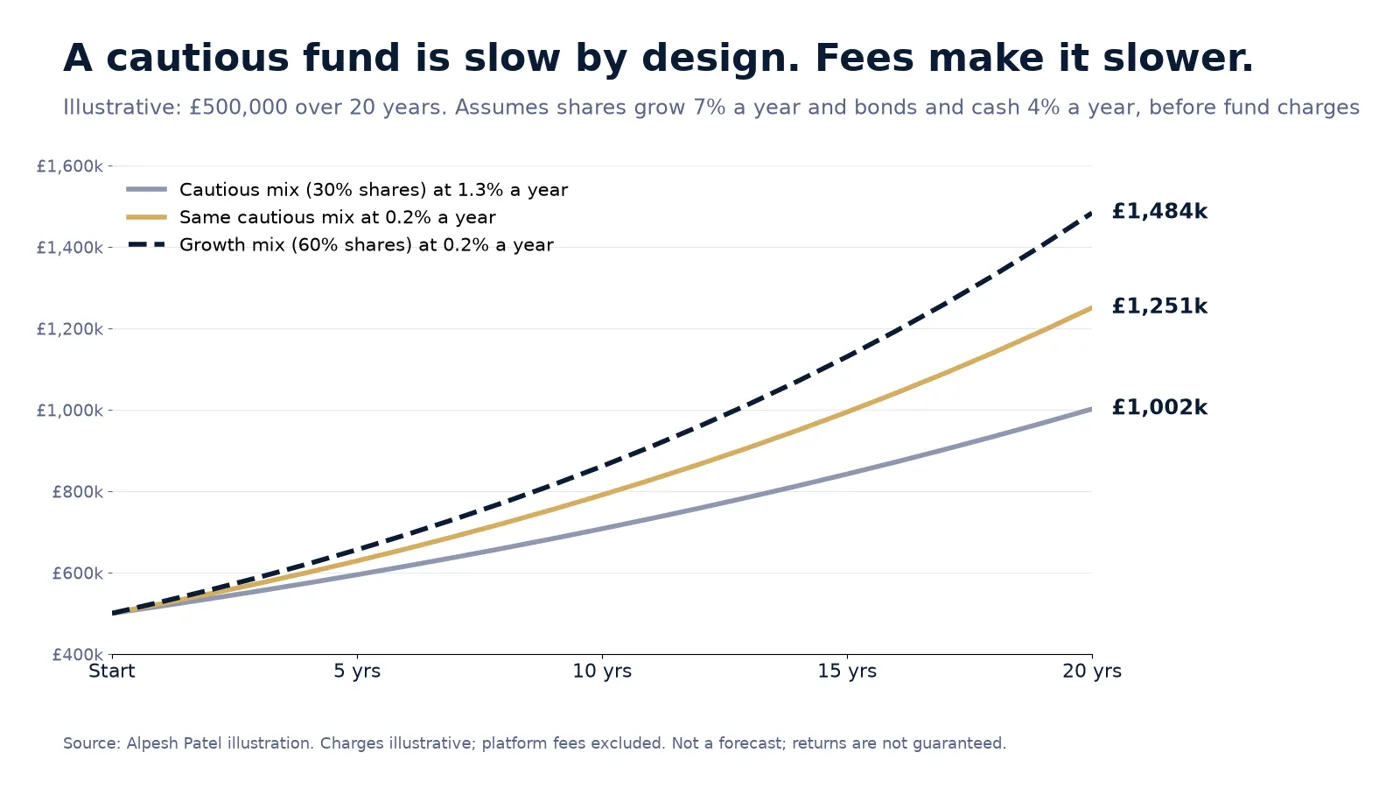
The table and chart below are an illustration, not a forecast. They assume shares grow 7% a year and bonds and cash 4% a year before fund charges. They ignore platform fees, tax and the ups and downs real markets bring.
Source: Alpesh Patel illustration. Assumed growth of 7% a year for shares and 4% a year for bonds and cash, before charges. Charges illustrative; platform fees excluded. Not a forecast.
| Illustrative scenario on £500,000 | Fund charge | After 10 years | After 20 years |
|---|---|---|---|
| Cautious mix, 30% shares | 1.3% a year | £708,000 | £1,002,000 |
| Same cautious mix | 0.2% a year | £791,000 | £1,251,000 |
| Growth mix, 60% shares | 0.2% a year | £861,000 | £1,484,000 |
Illustrative. Assumes 7% a year for shares, 4% a year for bonds and cash, before charges. The 0.2% charge is in line with the published OCF of Vanguard LifeStrategy funds (opens in a new tab). Platform fees excluded. Rounded to the nearest £1,000.
Two separate things are going on. It helps to keep them apart, because they call for different fixes.
The fee gap. Same mix, different price. On these assumptions the higher charge costs about £83,000 over 10 years and about £249,000 over 20 years. In the first year alone, 1.3% on £500,000 is about £6,500, against about £1,000 at 0.2%.
The mandate gap. Even at 0.2%, a cautious mix grows more slowly than a growth mix, because it holds fewer shares. That is not a fault. It is the price of a smoother ride. Whether that price is worth paying depends on your goal, your time horizon and how you would feel in a bad year.
If you want to see what a percentage fee really costs at your own figures, my post on what 1% a year really costs your portfolio goes through it step by step.
Has a moderately cautious fund lagged its benchmark?
Sometimes, and it is worth checking honestly rather than assuming. The 7IM fund's C accumulation shares returned 11.50% over one year, 21.50% over three years and 11.10% over five years to 31 May 2026, according to its annual report (opens in a new tab). The same report shows the fund behind its benchmark by 2.2, 8.1 and 8.5 percentage points over those periods.
For context, Vanguard LifeStrategy 40% Equity returned 10.42% in the 12 months to 31 October 2025 and 3.76% in the 12 months to 31 October 2026, after a fall of 13.15% in the year to October 2022, according to Vanguard (opens in a new tab). The periods and mixes differ, so this is not a like-for-like race. It does show that low-cost cautious funds also have bad years: bonds fell hard in 2022.
The fairer lesson is this. A cautious fund will lag shares in a rising market. That is by design. What you want to know is whether the extra cost of active management is earning its keep against a cheaper fund with a similar mix. The disappointing funds page helps you run that check on your own holdings.
Why do unclassified holdings matter?
Because you cannot manage what you cannot see. If a large part of your fund shows as "non-classified" on your platform, you cannot easily tell how much is really in shares, bonds, cash or alternatives, or which countries you are exposed to.
On one platform's breakdown of the 7IM fund, dated 30 September 2026, 21.42% of the sector split and 23.15% of the country split appeared as non-classified, with a further block labelled "managed funds" (Hargreaves Lansdown (opens in a new tab)). To be fair to fund houses, this is often a data problem rather than a hidden one. Funds of funds, alternatives and derivatives do not always map neatly onto a platform's categories.
But the effect on you is the same. If a third of your portfolio is a grey box, you cannot judge your true equity level, your overlap with other holdings or how the fund might behave in a crash. Ask the provider for a full look-through of asset classes. If they cannot give you one in plain English, that tells you something too.
Is a cautious fund the job you want done?
Start with the goal, not the fund. Write down in one line what this money is for, when you need it and what fall you could live with in a bad year without selling.
- If the job is to protect capital you need soon, a cautious mix may be exactly right. The question then is mainly cost: are you paying active prices for something a low-cost multi-asset fund could do?
- If the job is long-term growth, a cautious fund is the wrong tool at any price. It will grow slowly by design, and no amount of patience changes the mandate.
- If you are not sure, the gap between those two answers is the thing to resolve first. My guide to bonds, gilts and bond funds explains what the bond side of a cautious fund actually does.
Why managing your own money changes the picture
When you run your own pension or ISA, you choose the mix to fit your goal, and you see every holding. There is no grey box. You can keep a cautious core if you want one, at a lower cost, and add growth where it suits you.
That freedom only helps with a written process. Decide what you hold and why, how much each part of the portfolio may be, and when you will rebalance or sell. The free pension plan tool (opens in a new tab) and the FIRE calculator (opens in a new tab) help you see whether your current growth rate gets you where you need to go. The cut fees and charges and review your adviser guides cover the rest.
Related: Bond-heavy pension: rebuilding growth.
What to do next
- Write the job down. One line: what the money is for, when you need it and what fall you could tolerate.
- Find your full cost. Check the OCF on the latest factsheet or KIID for your share class, then add your platform fee.
- Get a look-through. Ask for the true split between shares, bonds, cash and alternatives, including anything shown as unclassified.
- Compare like with like. Put your fund next to a low-cost multi-asset fund with a similar equity level, over the same periods.
- Decide on mandate, then cost. If the mix is wrong for your goal, change the mix. If the mix is right, ask whether you are paying too much for it.
Want to see what your money could do with the right mix at the right cost? Book your free call with Alpesh's team. We will walk you through how self-directed investors match their portfolio to their goal and keep charges under control. There is nothing to buy on the call.
Frequently asked questions
Why is my cautious fund growing so slowly?
Most likely because it holds mostly bonds and cash, which is its mandate. High charges then take a bigger share of the modest returns those assets produce. Check both the equity level and the full cost.
Is 1.3% a year a high charge for a multi-asset fund?
It is high compared with low-cost multi-asset index funds, such as Vanguard LifeStrategy at an OCF of 0.20%. Multi-manager funds offer active choices and alternatives for the higher price, so the question is whether that extra is earning its keep for you.
What does "unclassified" mean in a fund breakdown?
It usually means the platform's data provider could not map some holdings, such as other funds, alternatives or derivatives, to a standard category. It is often a data issue, but it still means you cannot see your full exposure without a look-through from the provider.
Should I switch from a cautious fund to a growth fund?
Only if your goal, time horizon and tolerance for falls call for it. This article is not a recommendation. A growth fund can fall much further in a bad year, so decide the job first and choose the fund second.
About Alpesh Patel OBE
Alpesh Patel OBE is Founding Principal of Rootbridge Capital, an author and Dealmaker for the UK Government's Department for Business. He is a former Visiting Fellow in Business, Corpus Christi College, Oxford University, where he worked on technology to improve financial education.
Sources
- 7IM, 7IM Investment Funds annual report and financial statements, year to 31 May 2026 (opens in a new tab)
- Hargreaves Lansdown, 7IM Moderately Cautious Class C Accumulation fund page (opens in a new tab)
- Vanguard, LifeStrategy 20% Equity Fund overview (opens in a new tab)
- Vanguard, LifeStrategy 40% Equity Fund overview (opens in a new tab)
- Vanguard, Full fund costs and charges (opens in a new tab)
- Alpesh Patel OBE, Vanguard 100 Equity Fund, Hidden Fees and Alternatives (opens in a new tab) (YouTube)
Important: This article is for education only and is not personal financial advice or a recommendation to buy or sell any investment. This article is general investment education only and is not regulated investment advice. The value of investments can go down as well as up, and you may get back less than you invest. Past performance is not a reliable indicator of future results.
Important: this article is education and information only. It is not financial advice or a personal recommendation, and it does not take your circumstances into account. The value of investments and pensions can fall as well as rise, and you may get back less than you put in. Past performance is not a reliable indicator of future results. Figures were correct when the article was written and may have changed. If you are unsure what is right for you, speak to a regulated financial adviser.