Aviva My Future Focus and Lifestyle Funds: The Glidepath Problem Nobody Checks
Buried in Aviva's own governance report is a warning most members never read. "It's very important that you check the nominated retirement date Aviva holds for you," the Independent Governance Committee writes. "If your planned retirement age isn't accurate, it could unfavorably affect your investment outcomes" (Aviva IGC report 2025 (opens in a new tab)).
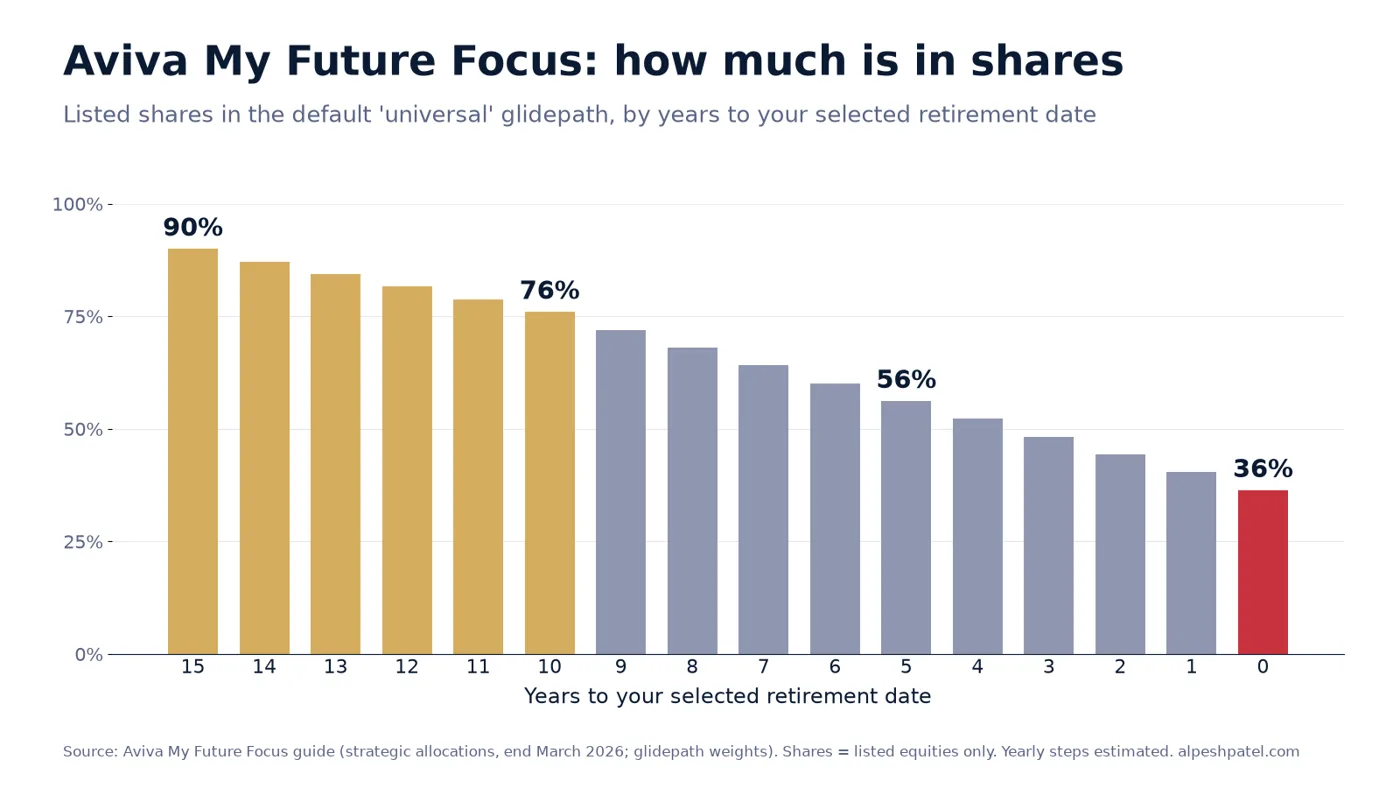
Why does one date matter so much? Because Aviva My Future Focus, the default for many Aviva workplace pensions, moves your money on a timetable set by that date. On Aviva's own strategic allocations, the default shifts from about 90% in listed shares 15 years out to about 36% on the day you said you would retire (Aviva My Future Focus guide (opens in a new tab)).
That suits someone who will cash in at that date. It may not suit someone who will keep working, or draw an income for 25 years. This is the glidepath problem: a sensible design pointed at a date that may be wrong for you.
Short answer: Aviva My Future Focus holds you in its Long Term Growth fund until 15 years before your selected retirement date, moves you into My Future Focus Growth by year ten, then into the lower-risk Consolidation fund by the date itself. Check that date and the option you are in; both decide how much of your pension is in shares.
Not sure your Aviva default fits how you will actually retire? Book your free call with Alpesh's team. We will walk through the written process self-directed investors use to choose, size and review their investments. There is nothing to buy on the call.
My earlier Aviva pension review asked whether an old Aviva pot is working hard enough overall. This post zooms in on one thing: the lifestyle glidepath, and how to test whether it suits you.
How does Aviva My Future Focus de-risk your pension?
The default "universal" strategy combines three multi-asset funds. Aviva says the member's journey "starts in My Future Focus Long Term Growth and from 15 years before retirement customers are gradually moved into the My Future Focus Growth Fund. Starting 10 years before retirement, they slowly migrate to My Future Focus Consolidation" (Aviva My Future Focus guide (opens in a new tab)).
Aviva's member guide says the moves "take place monthly and are at no extra cost", though your annual management charge may change as you move between funds (Aviva member guide (opens in a new tab)). Some scheme versions switch quarterly instead, so check your own scheme guide (Aviva scheme guide (opens in a new tab)).
The three stages hold very different mixes. Adding up the listed share holdings in Aviva's strategic allocations at the end of March 2026:
| Stage | Fund | When | Listed shares | Bonds and cash |
|---|---|---|---|---|
| Growth | My Future Focus Long Term Growth | More than 15 years out | 90.0% | 0% |
| De-risking | My Future Focus Growth | Fully in by 10 years out | 76.0% | 15.0% |
| Consolidation | My Future Focus Consolidation | Fully in at your selected date | 36.4% | 59.7% |
Source: Aviva My Future Focus guide (opens in a new tab), strategic asset allocations as at end March 2026. Listed shares are US, European, emerging market, Japanese, UK and Pacific ex Japan equities. The rest is property, private debt and infrastructure.
Source: Aviva My Future Focus guide, strategic allocations at end March 2026 and glidepath weights. The yearly steps between Aviva's published points are my estimate, assuming even annual moves.
Are you on an older version?
Aviva has changed this design. It extended the My Future Focus de-risking glidepath from 10 to 15 years by adding the Long Term Growth fund (Aviva implementation statement (opens in a new tab)). The older "Pre-2024" version started in My Future Focus Growth and moved to Consolidation from ten years out (Aviva My Future Focus Pre-2024 guide (opens in a new tab)).
There is also a separate My Future range, which the IGC said would move to the same design in the fourth quarter of 2025 (Aviva IGC report 2025 (opens in a new tab)). Your annual statement or online account shows the exact fund names you hold.
What is the glidepath problem?
A glidepath answers one question: how much risk should someone carry as a fixed date approaches? It cannot know what you will do on that date.
Aviva is open about this. It offers three alternatives to the universal strategy: Target Drawdown, Target Annuity and Target Cash Lump Sum. The universal option "has been designed for members who haven't yet decided how they want to use their pension savings" (Aviva My Future Focus guide (opens in a new tab)). The end points are very different.
| My Future Focus option | Fund you end in | What it holds at the end |
|---|---|---|
| Universal (default) | Consolidation | About 36% listed shares, 60% bonds and cash |
| Target Drawdown | Drawdown | About 51% listed shares, 42% bonds and cash |
| Target Annuity | Annuity | 70% sterling corporate bonds, 30% gilts |
| Target Cash Lump Sum | Cash Lump Sum | Short-dated gilts and corporate bonds, 20% cash |
Source: Aviva My Future Focus guide (opens in a new tab), strategic allocations as at end March 2026.
Now picture someone who plans to retire at 60 but keep the pot invested and draw from it into their nineties. That money may need to last 30 years. If they are in the universal option, they reach 60 with roughly a third in shares. If their date is set at 60 but they actually work on to 67, they de-risk seven years early. On the chart above, a correct date would leave them about 68% in shares at 60, not 36%.
Neither is "right" in general. But only one was chosen on purpose.
How have the My Future Focus funds performed?
Aviva's IGC publishes the returns. To the end of 2024, they show clearly what the de-risking stage costs in a strong market.
| Fund or comparator, to end 2024 | 1 year | 3 years, a year | 5 years, a year |
|---|---|---|---|
| My Future Focus Long Term Growth | 17.3% | 6.5% | not shown (newer fund) |
| My Future Focus Growth | 14.1% | 5.2% | 6.2% |
| My Future Focus Consolidation | 7.9% | 2.2% | 2.0% |
| ABI Mixed Investment 40–85% Shares | 8.1% | 1.6% | 3.9% |
| Consumer Price Index | 2.6% | 5.2% | 4.7% |
Source: Aviva Independent Governance Committee report 2025 (opens in a new tab), page 20. Past performance is not a reliable indicator of future results.
Look at the Consolidation line. Over the five years to the end of 2024, it returned 2.0% a year while inflation ran at 4.7% a year. Money in the final stage of the glidepath lost buying power over that period, which included the 2022 bond sell-off. That is the price of stability, and it will not be repeated in every five years.
The IGC also says the Growth fund's 2024 return of 14.24% "compares well against many other pension providers", while noting the three- and five-year figures were "more mixed" (Aviva IGC report 2025 (opens in a new tab)).
What does My Future Focus Growth cost and return now?
Aviva's February 2026 factsheet shows My Future Focus Growth returning 9.73% over one year, 36.21% over three years and 43.76% over five years to 31 January 2026. That five-year figure is about 7.5% a year. The figures are calculated with a total charge of 0.60% taken out, which Aviva says "may or may not be the same as your policy" (Aviva My Future Focus Growth factsheet (opens in a new tab)).
The same factsheet gives its benchmark as 75% MSCI ACWI, 15% Bloomberg Global Aggregate Bond (sterling hedged) and 10% SONIA plus 2.75%. Its calendar-year returns from 2021 to 2025 were 10.65%, −7.39%, 9.14%, 13.55% and 12.50%.
Workplace charges vary by employer. The IGC notes the charge cap for auto-enrolment default funds is 0.75% a year, and that charges on newer policies are "often significantly below" it (Aviva IGC report 2025 (opens in a new tab)). Your statement shows your own figure.
The five-year test: your pot against the default growth fund
Here is a quick test you can run in ten minutes.
- Find your fund names. Your statement or online account lists them. If you see "Consolidation", you are already in the final stage.
- Find your five-year return. Use the fund's factsheet from the Aviva fund centre (opens in a new tab), not your pot value, which includes contributions.
- Compare it with My Future Focus Growth. On the factsheet above, that was 43.76% over five years to 31 January 2026, after a 0.60% charge.
- Ask why there is a gap. Is it because you chose to take less risk, or because a date you never revisited moved you early?
The gap compounds. On an illustrative £250,000, five years at the Growth fund's 6.2% a year to the end of 2024 grows to about £337,700. At Consolidation's 2.0% a year, it grows to about £276,000. That £61,700 difference is the cost of being in the lower-risk fund through those five years, using past returns that may not repeat.
If the lower-risk fund is right for your plan, that is a fair price for stability. If it is the result of a wrong date, it is a cost you did not choose.
Should I change my selected retirement date?
Only if it is wrong. The date drives the timetable, so make it match when you will actually start drawing the money, not the earliest age you could.
If you will take everything as cash at a fixed date, the Target Cash Lump Sum option is built for that. If you will buy an annuity, the Target Annuity option prepares for it. If you will stay invested and draw an income, Target Drawdown ends with more in shares than the universal default. Aviva says members can switch into any of these options as they approach their selected date (Aviva My Future Focus guide (opens in a new tab)). Aviva's guide to the earlier versions adds that you can choose your own growth-stage funds within a lifestyle programme, or leave the programme to choose your own investments (Aviva guide to My Future and My Future Focus (Pre-2024) (opens in a new tab)).
Changes cost little to make. When Aviva moved members onto the new glidepath, it said dealing costs on the switches were "expected to be in the region of 0.05%-0.10%", reflected in unit prices (Aviva FAQs (opens in a new tab)).
What does running it yourself look like?
A glidepath de-risks your whole pot on one date. A written plan can do something more precise: hold enough in lower-risk assets to cover the next few years of withdrawals, and keep the rest invested for growth. That is the idea behind the strategies in my guide to living off your investments.
Running it yourself gives you control over that mix, transparency over every holding and charge, and a portfolio built around your own risk profile and spending dates. The price is that you must make the decisions: what to hold, how much in each, and when to rebalance or sell. Write those rules down before you change anything.
Test the numbers first. The free Pension Plan (opens in a new tab) tool shows whether your pot is on track, Portfolio Odds (opens in a new tab) explores the chance of a loss for a given mix, and the build a retirement income guide covers withdrawals. My review of cautious, balanced and adventurous pension funds shows how risk labels translate into returns.
Before you move money out of Aviva
If you are still working, your employer pays into the workplace scheme, so changing funds or your date inside it may be all you need. If you do transfer, ask Aviva in writing whether you would lose any guarantees, protected tax-free cash or other benefits. Safeguarded benefits worth more than £30,000 need FCA-authorised advice before transfer (FCA (opens in a new tab)).
Watch for scams. Action Fraud figures cited by The Pensions Regulator show £17.7 million reported lost to pension fraud in 2023, an average of nearly £47,000 per victim, and the FCA estimates fewer than one in five scams are reported (The Pensions Regulator (opens in a new tab)). Ignore cold calls and promises of guaranteed returns.
What to do next
- Check your selected retirement date. Log in or call Aviva and confirm the date it holds. Change it if it is wrong.
- Check which option you are in. Universal, Drawdown, Annuity or Cash, and whether it matches how you will take the money.
- Run the five-year test. Compare your fund's five-year return with My Future Focus Growth, and explain any gap.
- Put numbers on your plan. Use Pension Plan (opens in a new tab) and Portfolio Odds (opens in a new tab) to test the mix your spending needs.
- Write your rules before you change anything. What you hold, in what sizes and when you rebalance.
Want a glidepath built around your own plan? Book your free call with Alpesh's team. We will show you how self-directed investors set their mix, size positions and decide when to rebalance or sell. There is nothing to buy on the call.
Frequently asked questions
How does Aviva My Future Focus work?
You start in the Long Term Growth fund. From 15 years before your selected retirement date you move gradually into My Future Focus Growth, and from ten years out into Consolidation, which you fully hold at the date itself. The moves happen automatically.
Is Aviva My Future Focus Growth a good fund?
It returned 43.76% over the five years to 31 January 2026 on Aviva's factsheet, after a 0.60% charge, with about three quarters in shares. Whether it is right depends on your timeline and risk tolerance. Past performance is not a reliable indicator of future results.
Can I change my retirement date with Aviva?
Yes. Aviva's own governance committee urges members to check the date it holds and tell Aviva if it is wrong, because the lifestyle switches are based on it. Log in to your account or contact Aviva.
Should I switch to the My Future Focus Target Drawdown option?
It is designed for people who will stay invested and draw an income, and ends with about half in listed shares rather than about a third. Whether that suits you depends on your income needs and other assets.
Is lifestyling bad?
Not in itself. It reduces the risk of a large fall just before you take your money. The problem comes when the date or the end point does not match how you will actually retire.
About Alpesh Patel OBE
Alpesh Patel OBE is Founding Principal of Rootbridge Capital, an author and Dealmaker for the UK Government's Department for Business. He is a former Visiting Fellow in Business, Corpus Christi College, Oxford University, where he worked on technology to improve financial education.
Sources
- Aviva, My Future Focus guide for advisers, trustees and employers (opens in a new tab) (strategic allocations as at end March 2026)
- Aviva, My Future Focus member guide (opens in a new tab)
- Aviva, Scheme investment guide (quarterly switching) (opens in a new tab)
- Aviva, My Future Focus (Pre-2024) guide (opens in a new tab)
- Aviva, Implementation statement (opens in a new tab)
- Aviva, A guide to the My Future (Pre-2025) and My Future Focus (Pre-2024) investment programmes (opens in a new tab)
- Aviva, Changes to your investment approach: FAQs (opens in a new tab)
- Aviva, Independent Governance Committee report 2025 (opens in a new tab)
- Aviva, My Future Focus Growth factsheet, February 2026 (opens in a new tab)
- Aviva, Fund centre (opens in a new tab)
- Financial Conduct Authority, Advising on pension transfers: our expectations (opens in a new tab)
- The Pensions Regulator, Working together to strengthen our defences against scams (opens in a new tab)
- Alpesh Patel OBE, Is Your Aviva Pension Actually Safe? (opens in a new tab) (YouTube)
Important: This article is for education only and is not personal financial advice or a recommendation to buy or sell any investment. This article is general investment education only and is not regulated investment advice. The value of investments can go down as well as up, and you may get back less than you invest. Past performance is not a reliable indicator of future results.
Important: this article is education and information only. It is not financial advice or a personal recommendation, and it does not take your circumstances into account. The value of investments and pensions can fall as well as rise, and you may get back less than you put in. Past performance is not a reliable indicator of future results. Figures were correct when the article was written and may have changed. If you are unsure what is right for you, speak to a regulated financial adviser.