Standard Life Pension Review 2026: Is Your Old Pot Keeping Up?
The Standard Life Managed Pension Fund was launched on 17 March 1980 and held £17.7 billion at the end of September 2026, according to its Q3 2026 factsheet (opens in a new tab). It is one of the oldest and largest pension funds in the country. Millions of people have had money in it, or in something like it, at some point in their working lives.
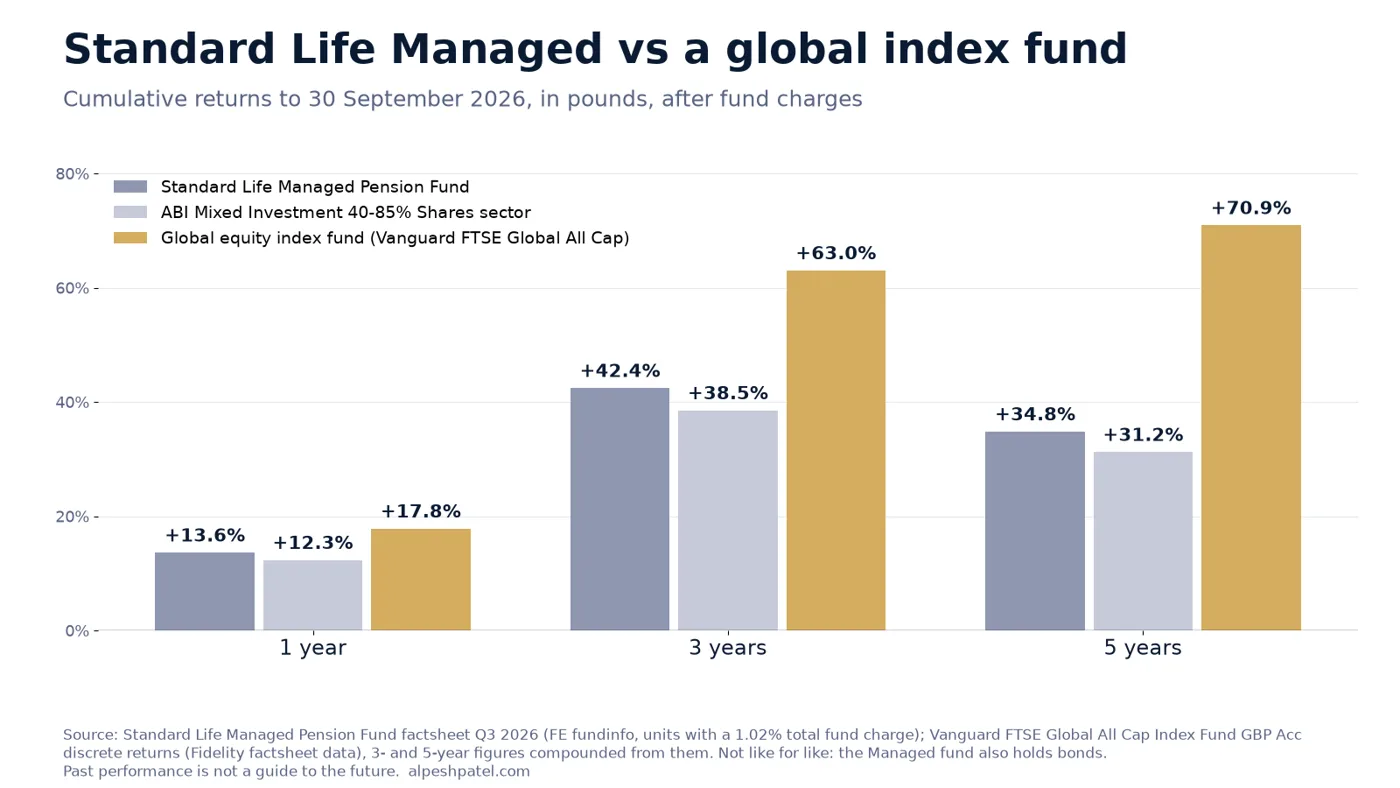
Over the five years to 30 September 2026, it returned 34.8%. Over the same five years, a plain global share index fund returned about 70.9%, compounding its yearly returns as published by Fidelity (opens in a new tab). The two funds are not like for like, and I explain why below. But the gap is large enough to be worth a look.
A situation my team hears often goes like this. Someone in their fifties has an old Standard Life pension from a previous employer, sometimes two or three. They have not looked at it properly in years. They are not sure which fund it is in, what it costs or whether it is keeping up. This Standard Life pension review is a way to answer those three questions for yourself.
Short answer: Standard Life's flagship funds have done broadly in line with, or slightly better than, their mixed-asset sectors, but well behind a global share index over three and five years. Factsheet charges are around 1% a year on standard units. Check your own fund, charges and any guarantees in writing before deciding whether to stay or move.
Not sure whether your old Standard Life pension is keeping up? Book your free call with Alpesh's team. We will walk through how self-directed investors review a pension fund, compare it with a simple benchmark and decide what to do next. There is nothing to buy on the call.
Which Standard Life fund is my pension in?
It depends on when and how the pension was set up. Older personal pensions and workplace plans were often invested in the Standard Life Managed Pension Fund or a fund chosen by an adviser. Many workplace members were in default lifestyle options called Active Plus or Passive Plus.
In 2022, Standard Life moved its largest defaults, Active Plus and Passive Plus, onto its Sustainable Multi Asset strategies for around 9,000 workplace schemes, according to Standard Life's announcement (opens in a new tab). Today, its primary default for workplace pensions is the Sustainable Multi Asset Universal Strategic Lifestyle Profile, per Standard Life's employer pages (opens in a new tab).
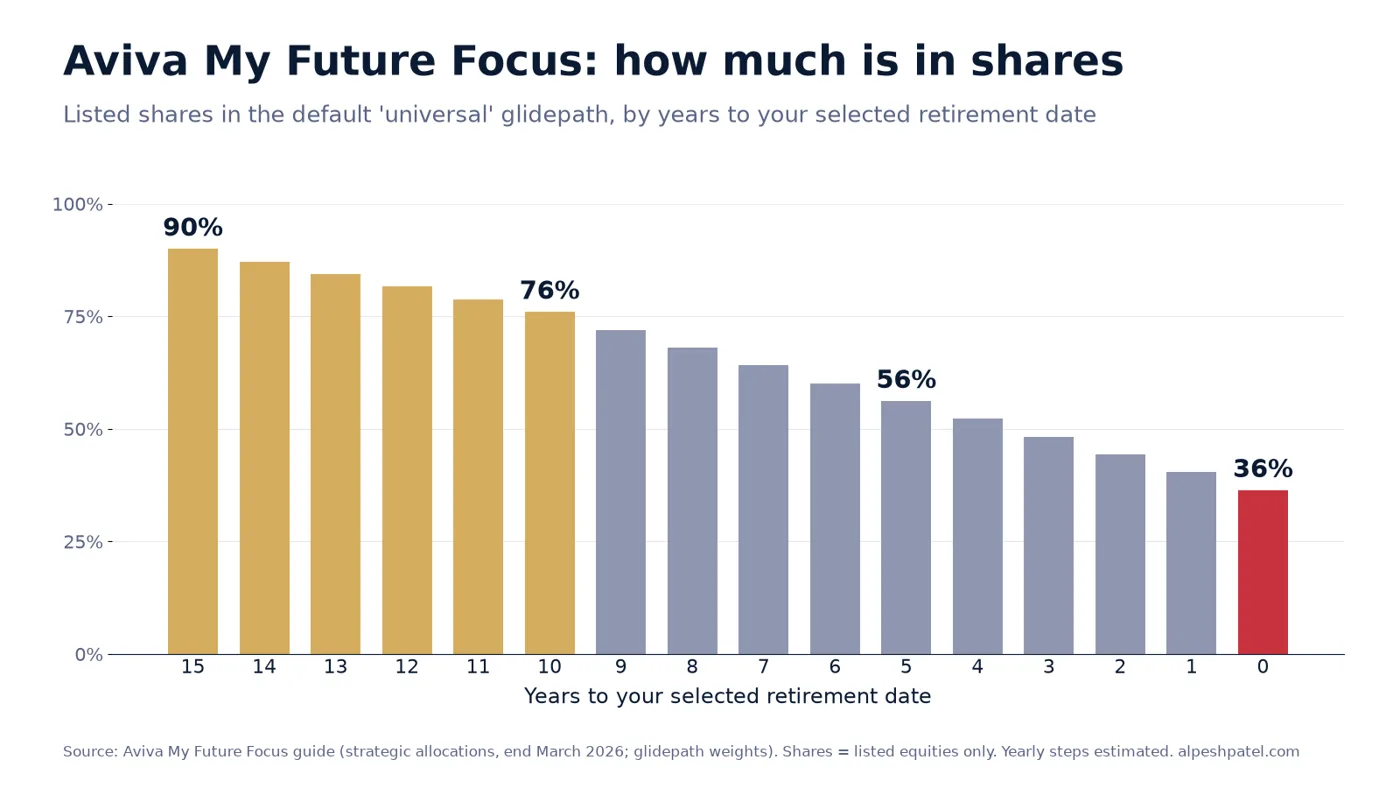
A lifestyle profile is not a single fund. It holds you in a growth fund until you are around 15 years from your selected retirement age, then gradually moves you into lower-risk funds, as Standard Life describes it (opens in a new tab). If you are in your fifties, part of your pot may already have been moved out of growth.
To see exactly where your money is, log in to Standard Life's online servicing or app, or look at the top of your last statement for the plan number, as Standard Life's pensions help page (opens in a new tab) explains. If you have lost track of a pension entirely, the government's Pension Tracing Service (opens in a new tab) can find the provider's contact details.
How has the Standard Life Managed Pension Fund performed?
The Managed Pension Fund is a multi-asset fund of funds. At 30 September 2026, it held about 71% in shares, 21.1% in global fixed interest and the rest in money market, property and alternatives, according to its factsheet (opens in a new tab). UK shares were the largest single block at 23.7%.
| 12 months to 30 September | Standard Life Managed Pension Fund | ABI Mixed Investment 40-85% Shares sector | Global equity index fund |
|---|---|---|---|
| 2022 | -9.0% | -10.1% | -4.65% |
| 2023 | +4.0% | +5.4% | +9.96% |
| 2024 | +13.9% | +12.8% | +18.95% |
| 2025 | +10.0% | +9.3% | +16.30% |
| 2026 | +13.6% | +12.3% | +17.81% |
| 5 years cumulative | +34.8% | +31.2% | +70.9%* |
Sources: Standard Life Managed Pension Fund factsheet, Q3 2026 (opens in a new tab) (FE fundinfo, bid to bid, units with a 1.02% total fund charge); global equity index fund is the Vanguard FTSE Global All Cap Index Fund GBP Acc, discrete returns from Fidelity (opens in a new tab), after its 0.23% ongoing charge but before any platform fee. *Calculated by compounding the five yearly returns. Named as an example of a broad index fund, not a recommendation.
Source: Standard Life Managed Pension Fund factsheet Q3 2026; Vanguard FTSE Global All Cap Index Fund discrete returns via Fidelity. Past performance is not a guide to the future.
On a fair reading, the Managed fund has done its job against its own peer group. It beat the sector average over one, three and five years. The factsheet does not publish a ten-year figure, so I have left that out rather than estimate it.
Against a global share index, it has lagged by a wide margin. Part of that is by design: around a fifth of the fund is in bonds, which had a very poor 2022, and it holds much more in UK shares than a global index does. Part of it is cost. The factsheet figures are based on units with a total fund charge of 1.02% a year, against 0.23% for the index fund.
The question for you is not whether the Managed fund is a bad fund. It is whether a mix with a fifth in bonds, a UK tilt and a charge of around 1% is still the right mix for your money and your timeline.
What about the Standard Life default fund?
The growth engine of the current default is the Sustainable Multi Asset Growth Pension Fund. Standard Life says the strategy's growth fund returned 55.7% gross over its first five years from launch in December 2020, beating its benchmark of inflation plus 3.5%, in a Standard Life press release (opens in a new tab). Note that "gross" means before charges.
One share class, the Sustainable Multi Asset Growth (Series 3) Pension Fund, shows yearly returns of +6.7%, +16.4%, +11.8% and +14.9% for the four years to 30 September 2026, and 49.4% over three years, per its factsheet (opens in a new tab). Those figures are based on units with a total fund charge of 1.00%. Workplace members often pay a lower negotiated charge, so check your own.
That is a stronger record than the Managed fund over three years, though still behind the 63.0% from the global index fund over the same period. The growth fund is mostly in shares, with about 41% in a North American equity fund, plus smaller amounts in property and credit.
Two changes are coming. Standard Life plans to add an initial allocation of around 3% to private assets within the Sustainable Multi Asset default from December 2026, according to Standard Life (opens in a new tab). It has also launched an alternative default, Future Opportunities, which targets around 25% in private markets over five to ten years, per Standard Life's Future Opportunities page (opens in a new tab). If your employer moves you, read what changes for charges, liquidity and how often prices are set.
What do Standard Life pension charges cost?
The factsheet figures for both funds above use units with a total fund charge of around 1% a year. Your own plan may differ. Older plans can carry policy charges on top, and workplace plans often have discounts. Standard Life says you can see your total charges and any discounts by logging in online or through its app, on its pensions help page (opens in a new tab).
Here is why the charge matters. In an illustrative example, £200,000 growing at 6% a year before charges for ten years would reach about £325,000 after a 1.02% yearly charge. With 0.4% a year in total charges it would reach about £345,000. That is a gap of roughly £20,000 from charges alone, before any difference in what the money is invested in.
My post on what 1% a year really costs works through the long-run effect in more detail.
Should I transfer my Standard Life pension?
Not until you have checked what you might give up. Old pensions, including some Standard Life plans, can carry features that are worth more than any saving on charges. Ask Standard Life, in writing, about each of these:
- Guaranteed annuity rates (GARs). Some older plans promise an annuity rate set years ago, often higher than today's market rates. MoneyHelper (opens in a new tab) suggests looking for words such as "retirement annuity contract", "section 226 policy", "with-profits" and "guarantee" in your paperwork.
- Protected tax-free cash. Most people can take up to 25% tax-free, within the lump sum allowance of £268,275, but some schemes have a protected right to more, which may be lost on transfer, per MoneyHelper's guide to special features (opens in a new tab).
- With-profits terms. If part of your pot is in a with-profits fund, ask about bonuses and any market value adjustment that would apply if you left before a guaranteed date. Ask how any adjustment is treated under the exit-charge rules below.
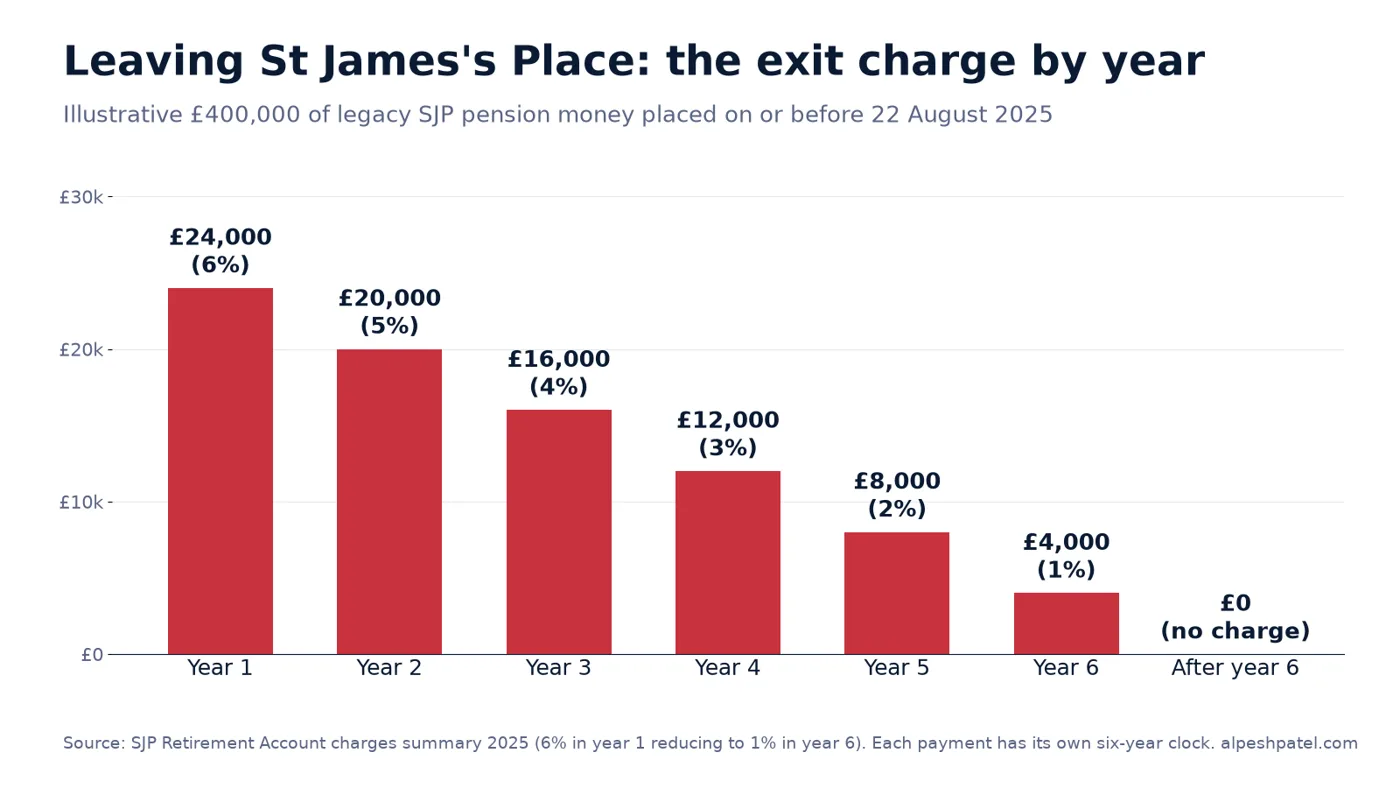
- Exit fees. If you are 55 or over, early exit charges on existing personal pensions are capped at 1% of the value, and newer contracts cannot charge them at all, under FCA rules from 31 March 2017 (opens in a new tab).
- Protected pension age and death benefits. Some plans let you access money earlier or pay more on death. Ask.
If your plan has safeguarded benefits, such as a guaranteed annuity rate, worth more than £30,000, you must take regulated financial advice before the transfer can go ahead, as MoneyHelper (opens in a new tab) and the FCA (opens in a new tab) explain. That rule is there to protect you.
If the checks come back clean, moving can be straightforward. My guides to whether to combine your pensions and bringing frozen pensions into one SIPP cover the steps, and the combine old pensions guide brings them together.
How do I avoid pension scams when moving?
Pension fraud is real and under-reported. The Pensions Regulator says £17.7 million was lost to pension fraud in 2023, with an average loss of nearly £47,000, and that fewer than one in five cases are reported, per The Pensions Regulator (opens in a new tab).
Do not move a pension because of a cold call, text or email, as MoneyHelper warns (opens in a new tab). Be wary of "free pension reviews" from firms you do not know, promises of guaranteed high returns and pressure to act quickly. Check any firm on the FCA Register and only transfer to a provider or platform you have chosen yourself.
Why take control of an old pension?
An old pension left in a default or a managed fund is a decision someone else made, often a long time ago. Taking control means you see every holding, you know why it is there and you set the mix around your own risk profile and retirement date.
Doing it yourself works best with a written process: how you pick investments, how much you put in each, when you rebalance and when you sell. That process matters more than any single fund choice. Running your own SIPP on a low-cost platform can also cut costs; my comparison of the cheapest SIPP for drawdown has the numbers.
You can test how different returns and charges change your outcome with the free Pension Plan (opens in a new tab) tool, and see how often a given mix has lost money over different periods in Portfolio Odds (opens in a new tab). More free calculators are on the tools page.
What to do next
- Find every Standard Life plan. Log in online or use the app, note the plan number, fund names and current value, and use the Pension Tracing Service for any you have lost.
- Get the factsheet for each fund. Compare the 1-, 3- and 5-year returns with a simple global index fund and with the fund's own sector.
- Write down your total yearly charge in pounds, including any policy charges or discounts shown in your account.
- Ask Standard Life in writing about guaranteed annuity rates, protected tax-free cash, with-profits terms, exit fees and death benefits.
- Decide with a written plan, not a hunch: stay, switch funds within Standard Life, or move, and set the mix, sizes and review dates either way.
Want a clear process for reviewing and running your old pensions yourself? Book your free call with Alpesh's team. We will show you how self-directed investors pick investments, size positions and decide when to sell, so every pound has a job. There is nothing to buy on the call.
Frequently asked questions
Is the Standard Life Managed Pension Fund a good fund?
It has beaten its mixed-asset sector average over one, three and five years to September 2026, per its factsheet. It has lagged a global share index fund by a wide margin, partly because it holds bonds and a large UK share allocation, and partly because of its charge of around 1% a year on standard units.
What is the Standard Life default pension fund?
For workplace pensions, Standard Life's primary default is the Sustainable Multi Asset Universal Strategic Lifestyle Profile. It invests in a growth fund until you are around 15 years from retirement, then gradually moves you into lower-risk funds.
How do I find out what my Standard Life pension charges are?
Log in to Standard Life's online servicing or app, where you can view your total charges and any discounts. Your annual statement also shows them. Ask Standard Life directly if any policy charges are not clear.
Can I transfer my Standard Life pension to a SIPP?
Usually, yes. Check first in writing for guaranteed annuity rates, protected tax-free cash, with-profits terms and exit fees. If safeguarded benefits are worth more than £30,000, regulated advice is required before the transfer can proceed.
Does Standard Life charge an exit fee?
Many plans have no exit fee. Where an older personal pension has one and you are 55 or over, FCA rules cap it at 1% of the value. With-profits funds may apply a separate market value adjustment, so ask.
About Alpesh Patel OBE
Alpesh Patel OBE is Founding Principal of Rootbridge Capital, an author and Dealmaker for the UK Government's Department for Business. He is a former Visiting Fellow in Business, Corpus Christi College, Oxford University, where he worked on technology to improve financial education.
Sources
- Standard Life, Managed Pension Fund factsheet, Q3 2026 (opens in a new tab)
- Standard Life, Sustainable Multi Asset Growth (Series 3) Pension Fund factsheet (opens in a new tab)
- Standard Life, Sustainable Multi Asset strategy celebrates five years (opens in a new tab)
- Standard Life, Embedding Sustainable Multi Asset strategies for Active Plus and Passive Plus (opens in a new tab)
- Standard Life, Compare our pensions (opens in a new tab)
- Standard Life, Off-the-shelf investment options (opens in a new tab)
- Standard Life, Introducing private assets to Sustainable Multi Asset (opens in a new tab)
- Standard Life, Future Opportunities (opens in a new tab)
- Standard Life, Pensions help and FAQs (opens in a new tab)
- Fidelity, Vanguard FTSE Global All Cap Index Fund GBP Acc performance (opens in a new tab)
- GOV.UK, Find pension contact details (Pension Tracing Service) (opens in a new tab)
- Financial Conduct Authority, PS16/24: Capping early exit pension charges (opens in a new tab)
- Financial Conduct Authority, Advising on pension transfers: our expectations (opens in a new tab)
- MoneyHelper, Guaranteed annuity rates explained (opens in a new tab)
- MoneyHelper, Pension scheme special features (opens in a new tab)
- MoneyHelper, Transfer or combine defined contribution pensions (opens in a new tab)
- The Pensions Regulator, Working together to strengthen our defences against scams (opens in a new tab)
- Alpesh Patel OBE, The SHOCKING Truth About Standard Life Pension Returns! (opens in a new tab) (YouTube)
Important: This article is for education only and is not personal financial advice or a recommendation to buy or sell any investment. This article is general investment education only and is not regulated investment advice. The value of investments can go down as well as up, and you may get back less than you invest. Past performance is not a reliable indicator of future results.
Important: this article is education and information only. It is not financial advice or a personal recommendation, and it does not take your circumstances into account. The value of investments and pensions can fall as well as rise, and you may get back less than you put in. Past performance is not a reliable indicator of future results. Figures were correct when the article was written and may have changed. If you are unsure what is right for you, speak to a regulated financial adviser.