Frozen Pensions Charging 2%? How to Consolidate Into One SIPP and Take Control
A man on a call with my team last week had spent 30 years in commercial roles. Along the way he had collected a string of frozen pensions from old employers, about £450,000 in total, not counting a final salary scheme. He thought the charges on those pots ran between 1.5% and 2% a year. That was what prompted the call.
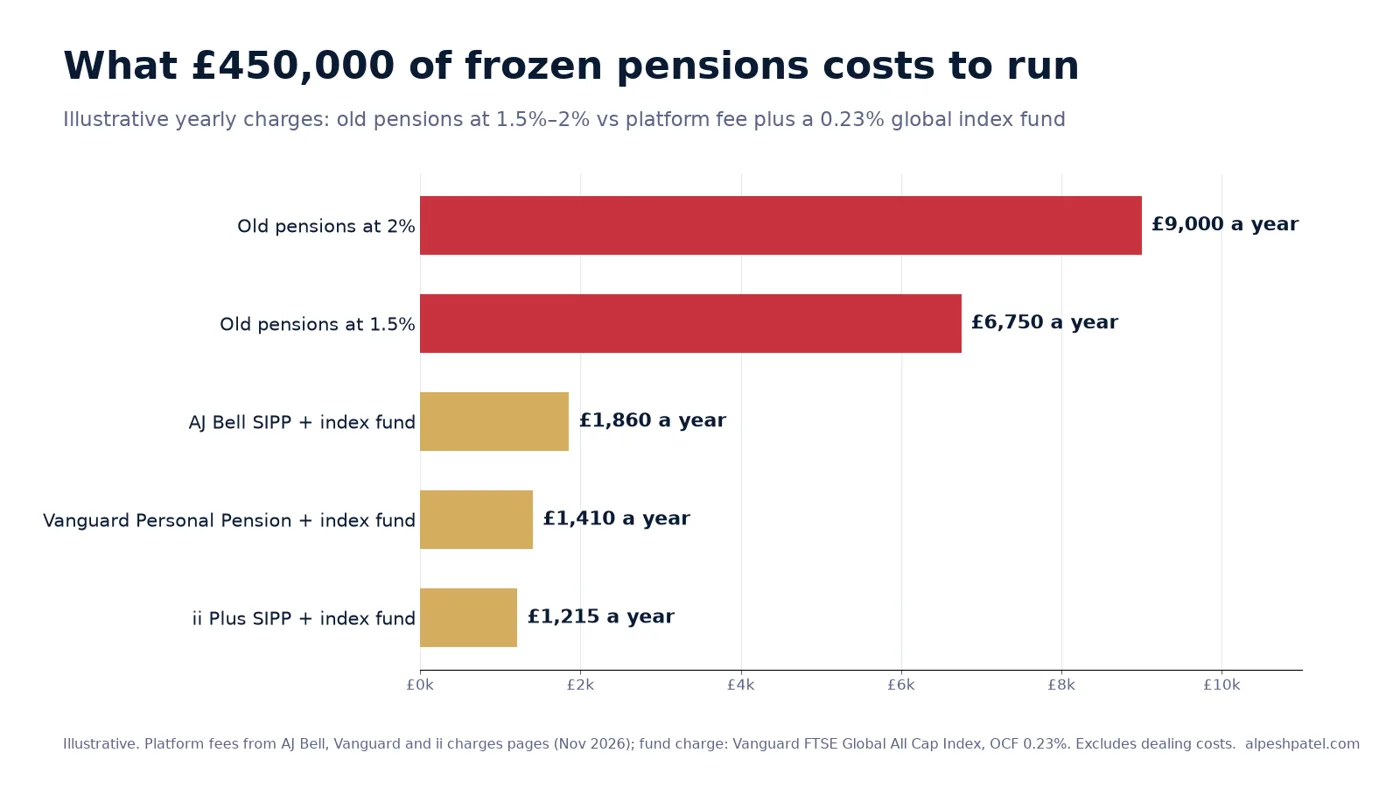
Do the sum and it is hard to ignore. On £450,000, a 1.5% charge is £6,750 a year. At 2% it is £9,000. That is a decent family holiday, a new car every few years or a chunk of a grandchild's university fees, paid every year to managers he no longer thinks about.
His plan was simple. Keep his current employer's scheme open, move the frozen pensions into one self-managed SIPP, grow the pot to between £750,000 and £800,000 in five years and then live off the returns without eating into the capital. It is a good plan. It also asks more of him than lower fees alone.
Short answer: Consolidating frozen pensions into one SIPP can cut yearly charges on £450,000 from £6,750–£9,000 to roughly £1,200–£1,900 in an illustrative low-cost set-up. The bigger prize is control: one pot, every holding visible, built around your own risk and income needs. Check each old pension for guarantees and exit fees in writing first.
Thinking of bringing your frozen pensions together and running them yourself? Book your free call with Alpesh's team. We will walk through how self-directed investors choose, size and review their investments. There is nothing to buy on the call.
What do frozen pensions really cost you?
A frozen pension is one you no longer pay into, usually from a previous job. The money stays invested, often in the scheme's default fund, and the charges keep coming out whether you look at it or not.
Charges of 1.5% to 2% a year usually mean more than one layer: a fund charge, an administration or product charge and sometimes an adviser fee left over from years ago. Your annual statements, or a call to each provider, will show the total.
Over time the drag compounds. In an illustrative example, £450,000 growing at 6% a year before charges would reach about £547,000 after five years with 2% a year taken off. With 0.4% taken off it would reach about £591,000. That is a gap of roughly £43,000 in five years, from charges alone.
How much cheaper is a self-invested personal pension?
A SIPP is a pension you run yourself on a platform. You pay the platform a fee and you pay the charges of whatever funds or shares you hold.
| Illustrative yearly cost on £450,000 | Platform fee | Fund charge (0.23%) | Total |
|---|---|---|---|
| Frozen pensions at 2% | – | – | £9,000 |
| Frozen pensions at 1.5% | – | – | £6,750 |
| AJ Bell SIPP | £825 | £1,035 | £1,860 |
| Vanguard Personal Pension | £375 | £1,035 | £1,410 |
| interactive investor Plus SIPP | £180 | £1,035 | £1,215 |
Sources: AJ Bell SIPP charges (opens in a new tab) (0.25% on the first £250,000 of funds, 0.10% on the next £250,000, £1.50 a fund deal); Vanguard Personal Pension (opens in a new tab) (0.15% a year, capped at £375); interactive investor SIPP (opens in a new tab) (Plus plan £14.99 a month, trading fees extra). Fund charge uses the 0.23% ongoing charge of the Vanguard FTSE Global All Cap Index Fund (opens in a new tab) as an example of a broad index fund, not a recommendation. Illustrative; excludes dealing costs.
Source: platform charges pages above, November 2026. Illustrative.
On these figures, the saving could be £5,000 to £7,800 a year. The platform that is cheapest for you depends on your pot size, how often you trade and whether you hold funds, shares or exchange-traded funds. My comparison of the cheapest SIPP for drawdown works through the numbers for different pot sizes.
Can I use AI to research the cheapest SIPP platform?
Yes, and it is a sensible starting point. ChatGPT, Perplexity and similar tools can summarise platform charges quickly and help you compare them for your own pot size. Then check every figure on the platform's own charges page, because fees change and AI tools sometimes quote old or wrong prices. Also note that some well-known names are fund managers rather than SIPP platforms: you buy their funds through a platform. My guide to using ChatGPT for investing has prompts that help.
Can you grow £450,000 to £800,000 in five years?
It depends far more on contributions than most people expect. Without adding any money, growing £450,000 to £750,000 in five years needs about 10.8% a year. Reaching £800,000 needs about 12.2% a year. Those are high returns to rely on, and a portfolio aiming for them will carry a lot of risk.
Add regular contributions and the picture changes.
| Illustrative: gross contributions each year | Return needed to reach £750,000 in 5 years | Return needed to reach £800,000 in 5 years |
|---|---|---|
| None | 10.8% a year | 12.2% a year |
| £20,000 | 7.1% a year | 8.6% a year |
| £40,000 | 3.5% a year | 5.2% a year |
| £60,000 | 0.0% a year | 1.7% a year |
Illustrative calculation from a £450,000 starting pot, contributions added at the end of each year. Not a forecast.
That is why paying more into your pension while you are still working can matter so much. The annual allowance is £60,000 this tax year, and you may be able to carry forward unused allowance from the previous three tax years. GOV.UK annual allowance (opens in a new tab) Tax relief is limited to contributions worth up to 100% of your annual earnings. GOV.UK pension tax relief (opens in a new tab)
Two limits catch people out. The allowance is tapered if your threshold income is over £200,000 and your adjusted income is over £260,000. And if you have already flexibly accessed a pension, for example by taking cash from drawdown, a lower money purchase annual allowance may apply. GOV.UK annual allowance (opens in a new tab) Keep your current employer's scheme open if your employer pays into it. Those contributions are part of the plan.
Use the free Pension Plan (opens in a new tab) tool to test different contribution levels and growth rates, and Portfolio Odds (opens in a new tab) to explore how likely a loss is for a given mix under its assumptions.
Can you live off the returns without touching the capital?
On paper, yes. On an illustrative £775,000 pot, taking 3% a year is £23,250 and 4% is £31,000. But markets do not pay a steady 3% or 4%. Some years the portfolio falls, and taking income in a falling year means selling at low prices or cutting what you take.
A self-directed plan for living off returns usually separates money for the next two or three years of income from money invested for long-term growth. It sets a rule for how much to take in good years and bad. And it is written down before the first withdrawal, not worked out during a crash. The build a retirement income guide walks through this step by step.
There is one more reason to plan carefully if you intend to leave the capital untouched. From 6 April 2027, most unused pension funds and death benefits will be brought into the value of your estate for Inheritance Tax. GOV.UK (opens in a new tab) If passing money on is part of your thinking, that changes the sums.
Why do it yourself rather than pay a manager?
Cutting charges is the obvious gain. The less obvious gains matter as much.
Control. With five frozen pensions, five different managers are making five different decisions, none of them looking at the whole picture. In one SIPP you decide the mix, how much sits in any one fund or share and when to rebalance.
Transparency. You see every holding and every charge in pounds. You know why the pot rose or fell last year.
A portfolio built for you. A default fund is designed for an average saver. A self-run portfolio can be built around your own risk profile, your target, your contributions and the date you plan to start taking income.
The trade-off is that the decisions are yours. That is a good trade if you have a process and the discipline to follow it. You do not need to be a professional. You need a written plan for what you buy, how much and when you would sell. The run your own SIPP guide covers the practical steps, and those skills can be learned.
What should you check before consolidating frozen pensions?
Leave the final salary scheme alone until you have advice. If you have safeguarded benefits, such as a final salary pension, worth more than £30,000, the law requires you to take advice from an FCA-authorised adviser before transferring them. FCA (opens in a new tab) A guaranteed income for life is very hard to replace.
Check each frozen pension in writing for valuable extras. Ask each provider whether you would lose anything by transferring: guaranteed annuity rates, protected tax-free cash above 25%, a protected pension age below the normal minimum, with-profits bonuses or terminal bonuses, special death benefits and exit fees. Some older policies carry guarantees that are worth more than any fee saving. My guide, Should I combine my pensions? 7 checks before you move, covers each one.
Move in stages if it helps. You do not have to transfer everything at once. Start with the pots that have the highest charges and no guarantees.
Watch for scams. Action Fraud figures cited by The Pensions Regulator show £17.7 million was reported lost to pension fraud in 2023, an average of nearly £47,000 per person, and the FCA estimates fewer than one in five scams are reported. The Pensions Regulator (opens in a new tab) Be wary of cold calls, offers of "free pension reviews" from firms you do not know, promises of guaranteed high returns and pressure to act fast. Check any firm on the FCA Register and only transfer to a platform you have chosen yourself.
What to do next
- List every frozen pension. Provider, value, fund and total yearly charge in pounds, from each latest statement.
- Ask each provider in writing about guarantees, protected benefits, bonuses and exit fees before you move anything.
- Compare two or three SIPP platforms for your pot size, using AI to start and each platform's own charges page to confirm.
- Run your target through the numbers. Test contributions and returns in Pension Plan (opens in a new tab), and check your annual allowance and carry forward.
- Write your process down before the money arrives: your mix, position sizes, rebalancing dates, sell rules and how you will take income.
Want a written process for running your own consolidated pension? Book your free call with Alpesh's team. We will show you how self-directed investors pick investments, size positions and decide when to sell, so lower fees come with a plan you can stick to.
Frequently asked questions
Should I consolidate my frozen pensions into a SIPP?
It can make sense if your old pensions charge more than a low-cost SIPP and carry no valuable guarantees. One pot is also easier to manage and see. Check each pension in writing for guarantees, protected benefits and exit fees before you transfer.
How much can I save by moving frozen pensions to a SIPP?
On £450,000, charges of 1.5% to 2% cost £6,750 to £9,000 a year. An illustrative low-cost SIPP holding a broad index fund might cost around £1,200 to £1,900 a year, depending on the platform and what you hold.
Can I keep my current workplace pension open while I consolidate old ones?
Yes. Transferring frozen pensions does not affect the scheme you are paying into now, and keeping it open means you keep your employer's contributions.
How much can I pay into my pension each year?
The annual allowance is £60,000 this tax year, and you may be able to carry forward unused allowance from the previous three tax years. Tax relief is limited to 100% of your annual earnings, and lower limits can apply to high earners or if you have already flexibly accessed a pension.
Do I need advice to transfer a final salary pension?
Yes, if your safeguarded benefits are worth more than £30,000, you must take advice from an FCA-authorised adviser before the scheme will let the transfer go ahead.
About Alpesh Patel OBE
Alpesh Patel OBE is Founding Principal of Rootbridge Capital, an author and Dealmaker for the UK Government's Department for Business. He is a former Visiting Fellow in Business, Corpus Christi College, Oxford University, where he worked on technology to improve financial education.
Sources
- AJ Bell, SIPP charges and rates (opens in a new tab)
- Vanguard, Personal Pension (opens in a new tab)
- Vanguard, FTSE Global All Cap Index Fund (opens in a new tab)
- interactive investor, Personal Pension (SIPP) (opens in a new tab)
- GOV.UK, Annual allowance (opens in a new tab)
- GOV.UK, Pension tax relief (opens in a new tab)
- GOV.UK, Inheritance Tax: unused pension funds and death benefits (opens in a new tab)
- Financial Conduct Authority, Advising on pension transfers: our expectations (opens in a new tab)
- The Pensions Regulator, Working together to strengthen our defences against scams (opens in a new tab)
- Alpesh Patel OBE, Your Pension Fees Are Costing You Half a Million Pounds (opens in a new tab) (YouTube)
Important: This article is for education only and is not personal financial advice or a recommendation to buy or sell any investment. This article is general investment education only and is not regulated investment advice. The value of investments can go down as well as up, and you may get back less than you invest. Past performance is not a reliable indicator of future results.
Important: this article is education and information only. It is not financial advice or a personal recommendation, and it does not take your circumstances into account. The value of investments and pensions can fall as well as rise, and you may get back less than you put in. Past performance is not a reliable indicator of future results. Figures were correct when the article was written and may have changed. If you are unsure what is right for you, speak to a regulated financial adviser.