Leaving St James's Place: Exit Charges, Timing and Where Your Pension Goes Next
In July 2025, St. James's Place announced that its early withdrawal charge "will no longer apply for new investments" (St. James's Place (opens in a new tab)). Many clients heard that as "the exit fee has gone". It has not, for money already invested.
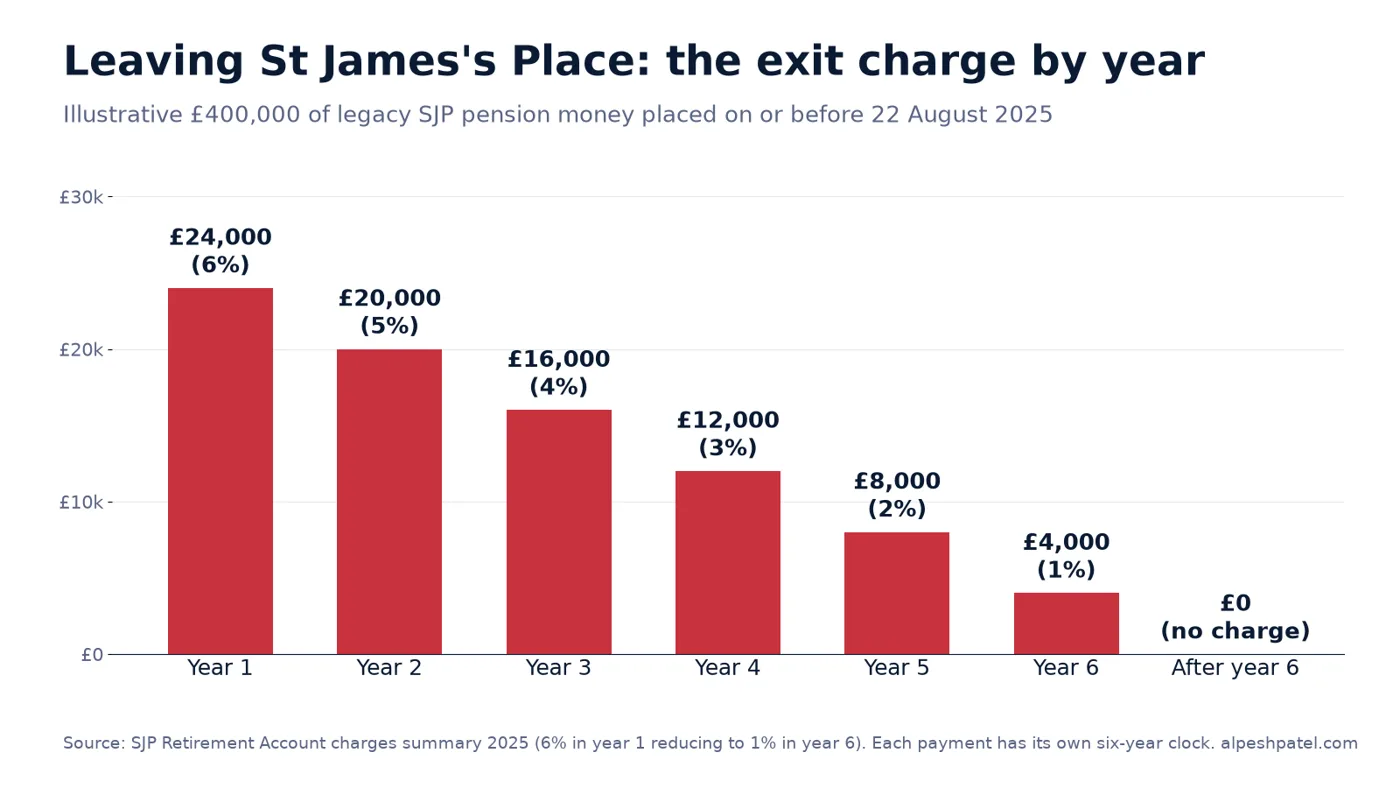
SJP's own charges summary says that for Retirement Account business placed on or before 22 August 2025, the old integrated charges stay in place while an investment is subject to the early withdrawal charge, on a scale from 6% in year one down to 1% in year six (SJP Retirement Account charges summary 2025 (opens in a new tab)). Money paid in during summer 2025 can still carry a charge into 2031.
So if you are thinking about leaving St James's Place, the useful question is not "is there an exit charge?" It is "how much, on which payments, and does waiting cost me more than paying it?"
Short answer: Leaving St James's Place is usually straightforward: you open the new pension and it requests the transfer. Pension money placed with SJP on or before 22 August 2025 can carry an early withdrawal charge of 6% falling to 1% over six years. If your yearly charges would fall by more than one percentage point, waiting often costs more than the charge saves.
Weighing up whether to stay with SJP or run your own pension? Book your free call with Alpesh's team. We will walk through the written process self-directed investors use to choose, size and review their investments. There is nothing to buy on the call.
My St James's Place pension review and Polaris 4 review asked whether SJP is worth it. This is the practical exit guide.
How much is the St James's Place exit charge?
It depends on when each payment went in. For legacy pension money, SJP describes the charge as applying "only on withdrawals made in the first six years on a reducing scale (6% in year 1 reducing to 1% in year 6)" (SJP Retirement Account charges summary 2025 (opens in a new tab)). SJP's pension charges summary adds that it applies "in the first six years of any investment" (SJP pension charges summary (opens in a new tab)).
"Any investment" matters. Every top-up or transfer in has its own six-year clock. A pension built up over several years can have some money free of charge and other money still in year two.
The charge exists because SJP's legacy pension terms took 4.5% for initial advice and 1.5% as an initial product charge, recovered over time. SJP says the combined effect equals a 1.5% annual charge plus a charge on "any amount withdrawn over the first six years" (SJP pension charges (opens in a new tab)).
A transfer counts. In one published complaint decision, the Financial Ombudsman Service noted the client had agreed to pay the charge "in the event that she made an early withdrawal (such as by transferring her pension)" (Financial Ombudsman Service (opens in a new tab)).
Source: SJP Retirement Account charges summary 2025 (opens in a new tab). The £400,000 pot is illustrative and assumes all of it sits in the same year.
What changed in August 2025, and does it apply to me?
New money is treated differently. From 23 August 2025, SJP applied unbundled charges to new Retirement Account investments: an advice charge of 0.80% a year and a product charge of 0.35% on the first £500,000, falling in tiers to 0.25% above £3 million (SJP Retirement Account charges summary 2025 (opens in a new tab)). New investments pay an initial advice charge of 3% on the first £250,000, 2% on the next £250,000 and 1% above £500,000 instead (St. James's Place (opens in a new tab)).
Older money keeps the old deal until its six years are up. While a legacy investment is still subject to the early withdrawal charge, SJP says its integrated charge is equivalent to an annual management charge of 1.41%, plus the fund charges. Once the charge period ends, that money moves to the unbundled charges (SJP Retirement Account charges summary 2025 (opens in a new tab)).
So most long-standing clients hold a mix. Ask SJP in writing for every payment, its date and today's charge.
What does it cost to stay?
The fund charge comes on top of the advice and product charges. SJP's 2025 figures for its three most commonly held pension funds, Polaris 2, 3 and 4, and its cheaper index-based range are below.
| SJP pension fund (2025) | Fund charge a year | Transaction costs |
|---|---|---|
| Polaris 1 | 0.45% | 0.16% |
| Polaris 2 | 0.48% | 0.18% |
| Polaris 3 | 0.52% | 0.20% |
| Polaris 4 | 0.55% | 0.21% |
| Polaris Multi Index 1 to 4 | 0.20% | 0.02%–0.03% |
Source: SJP Retirement Account charges summary 2025 (opens in a new tab), figures for 1 January to 31 December 2025.
SJP's own example puts Polaris 3 at a total ongoing charge of 1.67% a year inside a pension once advice, product and fund charges are added together (SJP charges explained (opens in a new tab)). For legacy money still under the integrated charge, 1.41% plus Polaris 3's 0.52% comes to 1.93% a year.
Here is what that looks like on an illustrative £400,000 pension, set against two self-invested personal pensions (SIPPs) holding a global index fund.
| Illustrative £400,000 pension | Total charge a year | In pounds |
|---|---|---|
| SJP legacy money in Polaris 3 (1.41% + 0.52%) | 1.93% | £7,720 |
| SJP unbundled charges in Polaris 3 | 1.67% | £6,680 |
| AJ Bell SIPP + Vanguard FTSE Global All Cap (0.23%) | about 0.42% | £1,695 |
| Vanguard Personal Pension + the same fund | about 0.32% | £1,295 |
Sources: SJP figures as above; AJ Bell SIPP charges (opens in a new tab) (0.25% on the first £250,000, 0.10% on the next £250,000, plus £1.50 a fund deal); Vanguard Personal Pension (opens in a new tab) (0.15% capped at £375); Vanguard FTSE Global All Cap Index (opens in a new tab) (OCF 0.23%). Illustrative; excludes dealing and transaction costs. The SJP figures include ongoing advice; the SIPP figures do not.
That last line is the honest caveat. In a SIPP you are the adviser, which is only a saving if you bring a process. My guide to what a 1% fee really costs shows how the gap compounds.
Should I wait for the exit charge to run off?
Each year you wait, the charge on a payment falls by one percentage point. Each year you stay, you pay the gap between SJP's charges and wherever you would move. In the illustrative table above, that gap is about 1.5 percentage points a year for legacy money.
Take the illustrative £400,000 in year four. Leaving now costs £12,000 (3%). Waiting a year cuts that to £8,000, a saving of £4,000. But the extra year of charges costs about £6,025 (£7,720 less £1,695). Waiting loses roughly £2,000, before any difference in returns.
A simple rule follows. If your yearly charges would fall by more than one percentage point, waiting usually costs more than it saves. If the gap is smaller, for example because you would move to another adviser on similar fees, waiting can make sense.
Two more options to raise with SJP before you decide. First, ask whether you can transfer only the payments already free of the charge and leave the rest until they clear. Second, ask whether switching to a cheaper fund such as Polaris Multi Index, at 0.20% rather than 0.52%, is possible without triggering any charge while you wait. I have not seen SJP's answer to either in its published documents, so get it in writing.
How do I transfer my pension out of St James's Place?
You start at the receiving end. You open the new pension, give it your SJP plan details and the new provider requests the transfer. AJ Bell, for example, says that once it has your details, "we'll contact your current pension provider(s) to get the transfer started" (AJ Bell (opens in a new tab)). MoneyHelper says a transfer often takes between two and six weeks, though a provider has up to six months (MoneyHelper (opens in a new tab)).
You do not have to go through your SJP adviser. If you are not receiving ongoing advice, SJP has a dedicated team for withdrawals and changes on 0800 027 1031 (SJP (opens in a new tab)).
Cash or in specie?
An in-specie transfer moves your funds as they are. A cash transfer sells them, moves the money and you reinvest it. SJP's pension funds are its own funds, so ask the receiving platform whether it can hold them at all. In practice, expect a cash transfer.
Cash transfers are usually faster. AJ Bell's guide is two to four weeks for cash and six to eight weeks for funds (AJ Bell (opens in a new tab)). The cost is time out of the market. SJP itself warns, in the context of ISA transfers, that "you will be out of the market until the transfer is complete" (SJP (opens in a new tab)). On an illustrative £400,000, a 3% market move while you wait is £12,000 either way.
Decide in advance what you will buy and in what proportions, so the money is reinvested the day it lands.
What could I lose by transferring?
The exit charge is the obvious cost. The hidden ones are benefits that do not travel. MoneyHelper lists exit fees, guaranteed annuity rates, with-profits bonuses and a protected pension age among the things to check (MoneyHelper (opens in a new tab)).
Protected tax-free cash. If your SJP pension holds money originally transferred from an older scheme that allowed more than 25% tax-free, check whether that protection survived. HMRC says scheme-specific lump sum protection "is lost unless the transfer is a block transfer" (HMRC PTM063150 (opens in a new tab)).
Protected pension age. Some older schemes allowed benefits before the normal minimum age. HMRC says that protection is lost on transfer "unless the transfer is a block transfer" (HMRC PTM062210 (opens in a new tab)).
Guarantees and safeguarded benefits. Final-salary rights and guaranteed annuity rates count as safeguarded benefits. If they are worth more than £30,000, you must take advice from an FCA-authorised adviser before transferring them (FCA (opens in a new tab)). A standard SJP Retirement Account is not usually safeguarded, but confirm it for every plan.
The SJP guarantee. SJP guarantees the suitability of advice its partners give on group products. It says that if you are not receiving ongoing advice, the guarantee "will not apply to decisions you make yourself" (SJP (opens in a new tab)).
Ask for every answer in writing, from SJP itself rather than your adviser.
How do I avoid a pension scam when I leave?
People leaving a big-name firm are a target, because they have already decided to move. Action Fraud figures cited by The Pensions Regulator show £17.7 million reported lost to pension fraud in 2023, an average of nearly £47,000 per victim. The FCA estimates fewer than one in five scams are reported (The Pensions Regulator (opens in a new tab)).
Be wary of cold calls, "free pension reviews" from firms you do not know, offers to "beat" your exit charge, guaranteed returns and pressure to act this week. Check any firm on the FCA Register. If SJP is worried about the scheme you are moving to, it can stop or delay the transfer until you have had a free MoneyHelper safeguarding appointment (MoneyHelper (opens in a new tab)).
Where does the money go next?
Another adviser. If you value advice but not SJP's model, an independent adviser can use the whole market. Use the review your adviser guide to compare what you would pay and get.
A ready-made fund in a low-cost pension. One global or multi-asset fund, rebalanced for you, inside a cheap wrapper. Simple and cheap, but no plan for your own spending dates.
Your own portfolio in a SIPP. The most control and transparency: every holding and charge visible, built around your own risk profile and income needs. My cheapest SIPP for drawdown comparison and the run your own SIPP guide cover the practical side.
That only pays if you write down your process first: what you will pick, how much goes in each holding and when you rebalance or sell. Test your plan with the free Pension Plan (opens in a new tab) tool and the odds of a loss for different mixes with Portfolio Odds (opens in a new tab).
What to do next
- Ask SJP for a payment-by-payment schedule. Every investment date, its current exit charge and the date it falls to zero, in writing.
- Price staying against going. Use the tables above with your own pot size to see whether waiting saves or costs you money.
- Check for benefits you could lose. Protected tax-free cash, protected pension age, guarantees, and whether any plan is safeguarded.
- Choose your destination and write your process. Decide what you will hold and in what sizes before the cash arrives.
- Start the transfer from the new provider. Then track it and reinvest to plan the day it lands.
Want a written process before you move a penny? Book your free call with Alpesh's team. We will show you how self-directed investors choose a mix, size positions and decide when to sell, so the control you gain is matched by a plan you can stick to. There is nothing to buy on the call.
Frequently asked questions
Does St James's Place still charge exit fees?
Not on new investments made under its new charges from August 2025. Pension and bond money placed on or before 22 August 2025 can still carry an early withdrawal charge of 6% in year one, falling to 1% in year six, then nothing. Check the date of each payment.
Can I transfer my SJP pension to a SIPP?
Usually yes. You open the SIPP and the new provider requests the transfer from SJP. Because SJP's funds are its own, expect your holdings to be sold and moved as cash.
Do I have to pay SJP's ongoing advice charge if I stop seeing my adviser?
SJP says clients not receiving ongoing advice continue to pay the fund and product charges. Ask SJP in writing whether your advice charge stops, and how that works for legacy money still under the integrated charge.
Is it better to wait until my SJP exit charge has gone?
Not always. The charge falls by one percentage point a year, so if moving would cut your yearly charges by more than that, waiting usually costs more than it saves. If the charge gap is smaller, waiting can make sense.
Do I need financial advice to leave St James's Place?
The law requires advice only for safeguarded benefits worth more than £30,000, such as final-salary rights or guaranteed annuity rates. A standard SJP pension is not usually safeguarded, but confirm it in writing before you transfer.
About Alpesh Patel OBE
Alpesh Patel OBE is Founding Principal of Rootbridge Capital, an author and Dealmaker for the UK Government's Department for Business. He is a former Visiting Fellow in Business, Corpus Christi College, Oxford University, where he worked on technology to improve financial education.
Sources
- St. James's Place, Confirms implementation date of its simple, comparable charging structure (opens in a new tab) (15 July 2025)
- St. James's Place, Retirement Account charges summary 2025 (opens in a new tab)
- St. James's Place, Pension charges summary (opens in a new tab)
- St. James's Place, Pension charges (opens in a new tab)
- St. James's Place Partnership, Our charges explained (opens in a new tab)
- St. James's Place, What is ongoing advice? (opens in a new tab)
- St. James's Place, Stocks and Shares ISA (opens in a new tab)
- Financial Ombudsman Service, Decision DRN-5899838 (opens in a new tab)
- AJ Bell, SIPP charges (opens in a new tab), Pension transfers (opens in a new tab) and Consolidating pensions (opens in a new tab)
- Vanguard, Personal Pension (opens in a new tab) and FTSE Global All Cap Index Fund (opens in a new tab)
- MoneyHelper, Should I transfer or combine my pensions? (opens in a new tab), Transfer or combine defined contribution pensions (opens in a new tab) and What to do if your pension transfer is stopped or delayed (opens in a new tab)
- HMRC, PTM063150: scheme-specific lump sum protection on transfers (opens in a new tab) and PTM062210: protected pension age (opens in a new tab)
- Financial Conduct Authority, Advising on pension transfers: our expectations (opens in a new tab)
- The Pensions Regulator, Working together to strengthen our defences against scams (opens in a new tab)
- Alpesh Patel OBE, Your Pension Is Broken—Here's Why: St James's Place (opens in a new tab) (YouTube)
Important: This article is for education only and is not personal financial advice or a recommendation to buy or sell any investment. This article is general investment education only and is not regulated investment advice. The value of investments can go down as well as up, and you may get back less than you invest. Past performance is not a reliable indicator of future results.
Important: this article is education and information only. It is not financial advice or a personal recommendation, and it does not take your circumstances into account. The value of investments and pensions can fall as well as rise, and you may get back less than you put in. Past performance is not a reliable indicator of future results. Figures were correct when the article was written and may have changed. If you are unsure what is right for you, speak to a regulated financial adviser.