Scottish Widows Diversified Bond Fund Review: When ‘Balanced’ Means One Product
In the 12 months to the end of October 2022, a plain UK government bond index fund lost 25.72% of its value, according to Vanguard's own performance figures (opens in a new tab). That was the "safe" part of millions of pensions. Nobody defaulted. Interest rates simply rose fast, and bond prices fell to match.
So when someone tells my team their pension is "balanced", the first question we ask is: balanced how? A situation we see often runs like this. A saver in their late 50s holds a global share fund for growth, and every pound of the cautious side sits in one product: the Scottish Widows Diversified Bond fund. Two funds, one decision maker for the defensive half, and no view on what that half actually owns.
This Scottish Widows Diversified Bond fund review looks at what the fund is, what it costs, what it holds and, just as important, what its short record cannot tell you. Then it asks the bigger question: should one product be your whole bond allocation?
Short answer: The Scottish Widows Diversified Bond CS8 fund is cheap, at a 0.10% yearly fund charge, and broadly diversified across government and corporate bonds. But it only launched in February 2025, so it has no record through the 2022 bond crash. Holding your whole defensive allocation in it concentrates manager, strategy and rate risk in one place.
Not sure what the "safe" half of your pension really holds? Book your free call with Alpesh's team. We will walk through how self-directed investors look under the bonnet of a fund, size each holding and decide when to rebalance. There is nothing to buy on the call.
What is the Scottish Widows Diversified Bond fund?
The fund's objective, from the Scottish Widows Diversified Bond CS8 factsheet (opens in a new tab), is "to provide long-term capital growth through exposure to a diversified portfolio of government and corporate bonds". It is a pension fund that invests through other funds, a mix of index-tracking and actively managed, with ESG tilts on the corporate bond side.
The rules give the managers a lot of room. Between 20% and 80% can be in investment grade government bonds, up to 70% in corporate bonds, and up to 20% in high yield bonds, inflation-linked bonds and cash. Non-sterling bonds may be hedged back to sterling, and derivatives may be used.
The benchmark is half the Bloomberg Global Aggregate Corporates index and half the Bloomberg Global Aggregate index, both hedged to sterling. In plain English, it is a global bond fund with a tilt towards company debt.
Key facts at a glance
| Scottish Widows Diversified Bond CS8 | Figure |
|---|---|
| Launch date | 28 February 2025 |
| Yearly fund charge | 0.100% |
| Sector | ABI Global Fixed Interest |
| FE fundinfo risk score | 28 |
| 1-year return to 30 Sep 2026 | -0.19% (benchmark -0.85%) |
| 3-, 5- and 10-year returns | None: the fund is too new |
Sources: Scottish Widows factsheet, September 2026 (opens in a new tab); risk score and sector from Trustnet (opens in a new tab). Other charges specific to your plan may apply on top of the fund charge.
Credit where it is due. A 0.10% fund charge is low, and over its first full year the fund slightly beat its benchmark. This is not a high-fee, closet-tracker story. The issues are different, and subtler.
What does the fund actually hold?
As at 30 September 2026, the factsheet shows six underlying holdings. Most of the money sits in three Scottish Widows funds.
| Underlying holding | Share of fund |
|---|---|
| Scottish Widows Global Government Bond Fund | 37.50% |
| Scottish Widows Global ESG Tilted Corporate Bond Fund | 29.97% |
| Scottish Widows Sterling ESG Tilted Corporate Bond Fund | 19.97% |
| iShares Emerging Markets Government Bond | 6.91% |
| iShares Emerging Markets Local Currency Bond | 4.92% |
| Schroders Sterling Liquidity Fund | 0.54% |
Source: Scottish Widows Diversified Bond CS8 factsheet (opens in a new tab), holdings as at 30/09/2026.
By asset type, the same factsheet shows 85.57% in global fixed interest, 10.61% in UK fixed interest, 2.29% in UK gilts and 1.46% in money market funds. Three things stand out.
- Very little in gilts. Barely 2% sits directly in UK government bonds. If you spend in pounds, that is a choice worth knowing about.
- Around 12% in emerging market debt, part of it in local currencies. That adds return potential and also a different kind of risk to the "safe" half.
- About half in company debt. Corporate bonds tend to fall alongside shares in a recession, which is when you most want your defensive assets to hold up.
A Scottish Widows adviser update for the second quarter of 2026 (opens in a new tab) adds that Aberdeen manages the underlying corporate bond funds and applies the ESG tilt.
Where is the duration figure?
Duration tells you roughly how much a bond fund falls when interest rates rise. The Scottish Widows factsheet does not publish it. For comparison, Vanguard's Global Bond Index Fund (opens in a new tab) shows an average duration of 6.0 years and a yield to maturity of 4.7% as at 31 October 2026.
As an illustrative rule of thumb, a duration of 6 years means a fund could fall by about 6% if yields rose by one percentage point. If you hold a bond fund, ask your provider for its duration in writing. It is the single most useful number for knowing what "cautious" means in a bad year.
How has the Scottish Widows Diversified Bond fund performed?
This is where the review has to be honest about what is missing. The CS8 share class launched on 28 February 2025. The factsheet shows a 1-year return of -0.19% to 30 September 2026 and dashes for every longer period. There is no 3-, 5- or 10-year record and no 2022.
Trustnet's figures to 9 November 2026 show the fund up 0.3% over one year, against -0.6% for its pension sector. That is a decent start. But 20 months of data, in a calm-ish period for bonds, says almost nothing about how it will behave in a crisis.
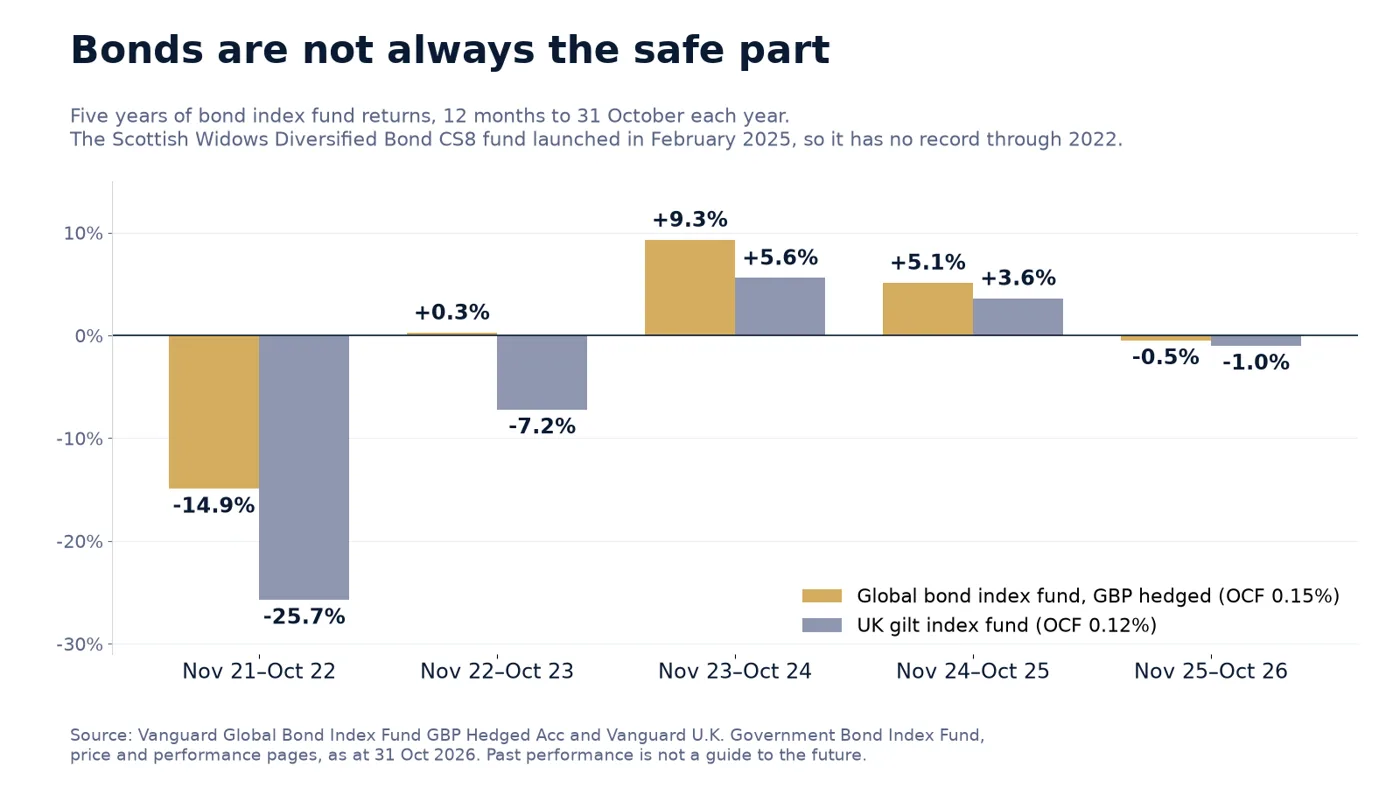
So the better guide is how this kind of fund behaved over the full cycle. Here are the long-run comparators.
| 12 months to 31 October | Global bond index fund, GBP hedged | UK gilt index fund | PN Global Fixed Interest sector* |
|---|---|---|---|
| 2022 | -14.91% | -25.72% | -13.9% |
| 2023 | 0.27% | -7.20% | -0.7% |
| 2024 | 9.30% | 5.59% | 5.1% |
| 2025 | 5.13% | 3.61% | 5.6% |
| 2026 | -0.47% | -0.99% | -0.6% |
| Ongoing charge | 0.15% | 0.12% | – |
Sources: Vanguard Global Bond Index Fund GBP Hedged Acc (opens in a new tab) and Vanguard U.K. Government Bond Index Fund (opens in a new tab), discrete 12-month returns to 31 October 2026. *Sector figures from Trustnet (opens in a new tab) are for 12-month periods to 9 November, so they are not exactly comparable. Funds named as examples, not recommendations.
Source: Vanguard fund price and performance pages, as at 31 October 2026.
Compounded, those yearly figures leave the global bond index fund about 2.4% down over the five years, and the gilt fund about 25% down. Trustnet puts the five-year sector return at -5.5%. Over five years, the "safe" half of a balanced pension did not just fail to grow. It shrank.
Is it risky to hold your whole bond allocation in one fund?
A single bond fund can own thousands of bonds and still be a concentrated decision. The concentration is not in the bonds. It is in the people and the rules behind them.
One manager, one view. The factsheet says the fund's allocations "are based on Scottish Widows' medium to long-term investment outlook". With a 20% to 80% range for government bonds, that outlook can move a lot of your money. If it is wrong, all of your defensive money is wrong together.
One strategy for rates. If the fund's duration is similar to the global index, a sharp rise in yields hits all of your cautious money at once. A mix of shorter-dated bonds, gilts held to maturity and cash would behave differently in the same shock.
Hidden doubling up. Scottish Widows' multi-asset pension funds use the same building blocks. The Pension Portfolio A CS8 factsheet (opens in a new tab) shows 16.36% in the same Global Government Bond Fund, 12.79% in the same Global ESG Tilted Corporate Bond Fund and 8.66% in the same Sterling corporate bond fund. Hold both, and your "diversified" pension may own the same three bond funds twice.
No inflation protection to speak of. Inflation-linked bonds sit in the same 20% bucket as high yield and cash. In 2022, inflation was the problem. A defensive allocation with little inflation linkage leaves that risk uncovered.
None of this makes the fund bad. It makes it one tool. My earlier review of the Scottish Widows CS8 Pension Portfolios looked at fees, bond drag and lifestyling across the risk-rated range. This post is narrower: what happens when one bond product is asked to be the whole safety net.
How does it compare with a low-cost global bond index fund?
On cost, the Scottish Widows fund wins. Its 0.10% yearly charge is below the 0.15% ongoing charge of Vanguard's Global Bond Index Fund (opens in a new tab) and the 0.12% of Vanguard's UK gilt index fund (opens in a new tab). Inside a workplace scheme, you may also pay no separate platform fee.
On transparency, the index fund wins. Vanguard publishes the benchmark, the number of bonds (15,161 as at 31 October 2026), duration and yield. You know what you own and how it will roughly behave. The Scottish Widows factsheet tells you the holdings and asset split, but not the duration or yield.
On track record, neither tells you much about the future, but only one has lived through 2022. The real choice is not Scottish Widows or Vanguard. It is whether you want a manager deciding your defensive mix, or a written rule that you control.
How do self-directed investors build the defensive side?
Here is how I think about it when I run my own money. The defensive part of a portfolio has one job: to be there, in cash terms, when shares are down and you need to spend.
That points to a written process with three parts.
- Pick by job, not by label. Money you need in the next two years belongs in cash or very short-dated instruments. Money for years three to seven might sit in gilts or a short-dated bond fund. Only longer-term money needs to take bond market risk.
- Size each piece. Decide the percentage for each part and write it down. No single fund or manager should hold all of your defensive money.
- Set the rebalance rule. For example, rebalance once a year or when any part drifts more than five percentage points. Write it before markets move, not after.
You can test how different mixes affect your chances of hitting your goal with the free Portfolio Odds tool (opens in a new tab), or model your retirement income with the Pension Plan calculator (opens in a new tab). Our guide to protecting your portfolio in a crash explains the cash buffer idea in more detail, and bonds explained: gilts vs corporate bonds vs bond funds covers the basics.
Should you move your pension out of the fund?
That is a personal decision, and switching funds within your Scottish Widows plan is different from transferring the whole pension away. If you are thinking about a transfer to a SIPP, check these points in writing first.
- Guarantees. Ask whether the plan has a guaranteed annuity rate or any guaranteed growth. MoneyHelper (opens in a new tab) warns these are unlikely to be offered elsewhere.
- Protected tax-free cash. Some older plans allow more than 25% tax-free. You could lose that on transfer.
- Protected pension age. Some plans let you draw before the normal minimum age, which rises to 57 from April 2028 (see retiring before 57).
- Employer contributions. If your employer pays into this scheme, leaving may mean losing that money.
- Exit fees and any loyalty or with-profits bonus.
If your pension includes safeguarded benefits, such as a guaranteed annuity rate or a final salary element, worth more than £30,000, you must take regulated advice before transferring. The FCA explains its expectations of pension transfer advice here (opens in a new tab).
And be alert to scams. The Pensions Regulator (opens in a new tab) reports that £17.7 million was lost to pension fraud in 2023, an average of nearly £47,000 per victim, and that fewer than one in five victims report it. Never act on a cold call, text or email about your pension.
What to do next
- Find out what you hold. Log in to your Scottish Widows account and note every fund and its percentage. Download each factsheet.
- Look through the labels. Add up how much of your pension sits in the same underlying bond funds, across the Diversified Bond fund and any Pension Portfolio fund.
- Ask for the missing numbers. Request the fund's duration and yield in writing.
- Write your defensive plan. Split cautious money by when you will need it, cap any one fund or manager, and set a rebalance rule.
- Check before any transfer. Get guarantees, protected cash and exit fees confirmed in writing.
Want a written plan for the defensive half of your pension? Book your free call with Alpesh's team. We will show you how self-directed investors pick, size and rebalance their holdings with a clear process. There is nothing to buy on the call.
Frequently asked questions
Is the Scottish Widows Diversified Bond fund a good fund?
It is low cost, at a 0.10% yearly fund charge, and broadly diversified across government and corporate bonds. But it launched in February 2025, so it has no long-term record and no history through the 2022 bond crash. Judge it as one part of a plan, not the whole safety net.
What are the charges on the Scottish Widows Diversified Bond CS8 fund?
The factsheet shows a yearly fund charge of 0.100%, deducted within the unit price. Other charges specific to your plan may apply, so check your annual statement for the total.
Why did bond funds fall so much in 2022?
Interest rates rose quickly, and existing bonds paying lower rates fell in price to compete. In the 12 months to October 2022, Vanguard's UK gilt index fund lost 25.72% and its global bond index fund lost 14.91%. Longer-dated bonds fell the most.
Are bonds still worth holding in a pension?
They can be, because yields are much higher than before 2022, with Vanguard's global bond index fund showing a 4.7% yield to maturity at the end of October 2026. The key is matching each bond holding to when you need the money, and knowing its duration.
Can I move my pension out of Scottish Widows?
Usually, yes. First check in writing for guarantees, protected tax-free cash, a protected pension age, employer contributions and exit fees. If safeguarded benefits are worth more than £30,000, regulated advice is required.
About Alpesh Patel OBE
Alpesh Patel OBE is Founding Principal of Rootbridge Capital, an author and Dealmaker for the UK Government's Department for Business. He is a former Visiting Fellow in Business, Corpus Christi College, Oxford University, where he worked on technology to improve financial education.
Sources
- Scottish Widows, Diversified Bond CS8 factsheet, September 2026 (opens in a new tab)
- Trustnet, Scottish Widows Diversified Bond CS8 Pn Acc GBP (opens in a new tab)
- Scottish Widows, Pension Portfolio A CS8 factsheet (opens in a new tab)
- Scottish Widows, Pension Portfolio and Retirement Portfolio Funds performance update, Q2 2026 (opens in a new tab)
- Vanguard, Global Bond Index Fund GBP Hedged Acc (opens in a new tab)
- Vanguard, Global Bond Index Fund price and performance (opens in a new tab)
- Vanguard, Global Bond Index Fund portfolio data (professional site) (opens in a new tab)
- Vanguard, U.K. Government Bond Index Fund price and performance (opens in a new tab)
- MoneyHelper, Pension scheme special features (opens in a new tab)
- Financial Conduct Authority, Advising on pension transfers: our expectations (opens in a new tab)
- The Pensions Regulator, Working together to strengthen our defences against scams (opens in a new tab)
- Alpesh Patel OBE, Your Pension's Biggest Problem - Scottish Widows CS8 Breakdown (opens in a new tab) (YouTube)
Important: This article is for education only and is not personal financial advice or a recommendation to buy or sell any investment. This article is general investment education only and is not regulated investment advice. The value of investments can go down as well as up, and you may get back less than you invest. Past performance is not a reliable indicator of future results.
Important: this article is education and information only. It is not financial advice or a personal recommendation, and it does not take your circumstances into account. The value of investments and pensions can fall as well as rise, and you may get back less than you put in. Past performance is not a reliable indicator of future results. Figures were correct when the article was written and may have changed. If you are unsure what is right for you, speak to a regulated financial adviser.