Scottish Mortgage and JPMorgan American Before Retirement: Is Your Risk Doubled?
Picture someone a few years from retirement with well over £1 million saved. Two of the biggest holdings are household names among UK investors: Scottish Mortgage and JPMorgan American. Both are large, long-established investment trusts with low charges. Both have done well recently. It feels like a portfolio built on quality.
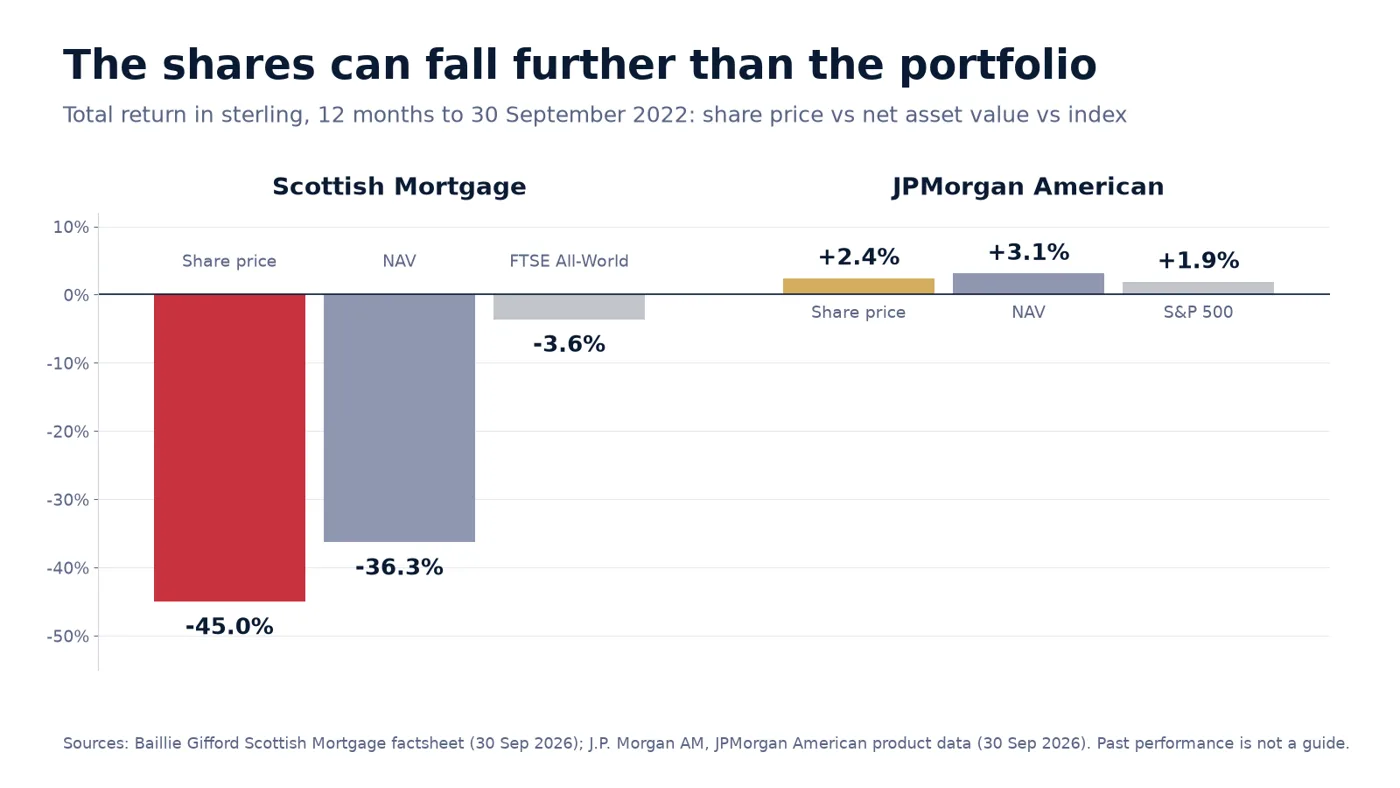
Here is the surprising part. In the 12 months to 30 September 2022, Scottish Mortgage's portfolio fell 36.3%, but its shares fell 45.0%, while the FTSE All-World Index fell only 3.6% (Baillie Gifford factsheet (opens in a new tab)). The shares dropped further than everything the trust owned, because the gap between the share price and the value of the portfolio widened at the worst moment.
And today, the two trusts share some of the same big US technology names. Nvidia is the largest holding in JPMorgan American and the third-largest in Scottish Mortgage. So the question is not whether these are good trusts. They may well be. The question is how much of your retirement depends on them together, and whether you could live with both falling hard in the same year, just before you stop work.
Short answer: Scottish Mortgage and JPMorgan American can both be well-run trusts, but holding them together before retirement may double your exposure to the same large US tech names. Discounts and gearing can make trust shares fall further than their portfolios. Decide what share of your money they make up, and give each a job, a size and a trim rule.
Holding big investment trusts as you approach retirement? Book your free call with Alpesh's team. We will walk through how self-directed investors size their biggest holdings and set rules for when to trim. There is nothing to buy on the call.
Why an investment trust's share price doesn't match its NAV
An investment trust is a company listed on the stock exchange whose business is owning other investments. It has two prices. One is the net asset value (NAV), the value of everything it owns less any borrowing. The other is the share price, which is set by buyers and sellers on the day.
When the share price is below the NAV, the trust trades at a discount. The Association of Investment Companies (AIC) puts the risk plainly: if the discount widens because the share price and the NAV are both falling, but the share price is falling faster, you lose more than the fall in the NAV (AIC (opens in a new tab)).
Many trusts can also borrow to invest, which is called gearing. It lifts returns when markets rise and deepens losses when they fall. As the AIC says, the more an investment trust borrows, the more risky it is (AIC (opens in a new tab)). Gearing and a widening discount can work together in a sharp fall. That is when someone close to retirement can least afford it.
What happened to Scottish Mortgage in 2022?
Scottish Mortgage shows how far this can go. At 31 March 2022 its shares traded at a 0.5% discount to NAV. By 30 September 2022 the discount was 10.6%. Over those six months, the NAV fell 14.9% but the share price fell 23.5% (Scottish Mortgage interim report, September 2022 (opens in a new tab)).
The trust was also geared at the time. The same report shows borrowings at book value of about £2.2 billion against shareholders' funds of about £12.0 billion (Scottish Mortgage interim report (opens in a new tab)). Borrowed money magnified the fall in the portfolio, and the widening discount then magnified the fall in the shares.
JPMorgan American had a very different 2022. In the 12 months to 30 September 2022 its NAV rose 3.08% and its share price rose 2.39%, slightly ahead of the S&P 500's 1.86% in sterling (J.P. Morgan Asset Management (opens in a new tab)). That is worth saying clearly. The point is not that both fell last time. It is that they now overlap more than many holders realise, so the next fall may not spare one of them.
Source: Baillie Gifford Scottish Mortgage factsheet (opens in a new tab), 30 September 2026; J.P. Morgan Asset Management (opens in a new tab), 30 September 2026. Total returns in sterling. Past performance is not a reliable indicator of future results.
Scottish Mortgage and JPMorgan American today: the numbers
Both trusts are cheap to own and both currently trade at a discount. Here is how they compare on the latest published figures.
| Scottish Mortgage | JPMorgan American | |
|---|---|---|
| Discount to NAV (AIC, latest close) | 9.09% | 3.14% |
| Gearing (AIC) | 3% | 6% |
| Ongoing charge (AIC) | 0.33% | 0.34% |
| Largest holding | SpaceX, 15.0% | Nvidia, 8.9% |
| Nvidia | 6.2% (3rd largest) | 8.9% (largest) |
| Amazon | 2.7% | 4.2% |
| Top ten holdings combined | 52.2% of total assets | Nvidia, Alphabet, Apple, Microsoft and Amazon alone are 29.3% |
| Can borrow up to | – | 20% (range 5% net cash to 20% geared) |
Sources: AIC company data for Scottish Mortgage (opens in a new tab) and JPMorgan American (opens in a new tab), checked 18 November 2026; Baillie Gifford factsheet (opens in a new tab) holdings at 30 September 2026; J.P. Morgan Asset Management (opens in a new tab) holdings at 30 September 2026. Figures change daily.
Scottish Mortgage's top ten also include TSMC (6.5%) and ASML (2.8%), two of the companies that make or equip the making of the chips behind the AI boom. JPMorgan American's top ten include Broadcom (2.6%) and Advanced Micro Devices (2.5%), and 35.2% of the trust is in information technology (J.P. Morgan Asset Management (opens in a new tab)). JPMorgan American's half-year report even lists a small 0.5% holding in SpaceX, Scottish Mortgage's largest position (JPMorgan American half-year report, June 2026 (opens in a new tab)).
Are two investment trusts more diversified than one?
Not necessarily. Two trusts with different managers, different styles and different benchmarks can still lean on the same handful of companies and the same theme.
Take an illustrative investor with equal amounts in each. On the 30 September 2026 holdings, about 7.6% of that combined money would be in Nvidia alone, the average of 6.2% and 8.9%. Add Amazon and the chip companies across both, and a meaningful slice of the two trusts depends on the same story: continued spending on AI and the share prices of a few very large technology companies.
That risk is doubled, not spread. If those companies fall together, both trusts fall together. And with Scottish Mortgage, the discount can add a second leg down on top. My post on S&P 500 concentration and the Magnificent Seven explains why so much of the US market now rests on so few names, and the Mag6 Watch tracks how far those stocks have fallen in the past.
Could you live with both falling hard in the same year?
This is the question that matters near retirement. A big fall at 45 is a setback with time to recover. The same fall the year before you stop work can change when you retire, or how much you can spend.
So test it. Assume both trusts' shares fell 45% in the same year, the size of Scottish Mortgage's share price fall in the 12 months to September 2022. That is a harsh assumption, not a forecast; JPMorgan American did not fall like that last time. Then look at what it would do to the whole portfolio at different combined weights.
| Illustrative: £1.2 million portfolio, both trusts' shares fall 45% | Combined holding in the two trusts | Loss in pounds | Fall in whole portfolio |
|---|---|---|---|
| Two trusts are 20% of the portfolio | £240,000 | £108,000 | 9.0% |
| Two trusts are 30% of the portfolio | £360,000 | £162,000 | 13.5% |
| Two trusts are 40% of the portfolio | £480,000 | £216,000 | 18.0% |
| Two trusts are 50% of the portfolio | £600,000 | £270,000 | 22.5% |
Illustrative only, assuming the rest of the portfolio is unchanged. Not a forecast or a recommendation.
Then ask the questions only you can answer. If the portfolio fell by that much in the year before you retired, would you still retire on time? Would you have enough outside these trusts, in cash or lower-risk assets, to pay yourself for two or three years without selling at the bottom? Would you hold on, or sell in a panic?
The free Portfolio Odds (opens in a new tab) tool lets you explore how likely a loss is for a given mix under its assumptions. The Pension Plan (opens in a new tab) tool shows how a fall early in retirement changes how long the money lasts.
Every holding needs a job, a size and a trim rule
The fix is not to sell good trusts. It is to decide in advance what each holding is for and how big it is allowed to get. A self-directed investor can do this better than most fund managers can do it for them, because they can see the whole portfolio at once.
A job. Write one line for each holding. For example: "Scottish Mortgage is my high-growth, high-risk holding for money I won't need for 15 years." Or: "JPMorgan American is my core US large-company holding." If two holdings do the same job, ask whether you need both at their current sizes.
A size. Set a maximum for each holding and for any group that shares the same risk. An illustrative rule might be no more than 10% in any single trust, and no more than 20% in holdings that all depend on US technology. The right numbers depend on your own risk profile and how soon you need the money.
A trim rule. Decide what happens when a holding grows past its limit. For example: "At my annual review, if any holding is above its maximum, I trim it back and move the money to where the portfolio is underweight." Strong performance is exactly what makes holdings grow too big, so this rule matters most after good years.
This is what managing your own money with a process looks like: control over what you own, full transparency over the risks, and a portfolio sized to your own retirement rather than a fund manager's benchmark. The protect your portfolio in a crash guide covers sizing and rebalancing, and the build a retirement income guide shows how to separate money you will spend soon from money that can ride out a fall. If you hold these trusts in a pension or ISA, trimming inside the wrapper does not trigger tax, but in a general account it may, so check with a tax specialist first.
What to do next
- Add up the two trusts together. Work out what share of your whole portfolio Scottish Mortgage and JPMorgan American make up between them.
- Look through to the top holdings. Check each trust's latest factsheet and note where the same companies or themes appear in both.
- Run the stress test. Apply a 45% fall to the combined holding and see what it does to your plans for the year before and after you retire.
- Give each holding a job, a size and a trim rule, and write them down before markets test them.
- Check your income buffer. Make sure the next two or three years of spending would not depend on selling either trust after a fall.
Want a second pair of eyes on how your biggest holdings are sized? Book your free call with Alpesh's team. We will show you how self-directed investors set position sizes, look through to overlapping holdings and decide in advance when to trim. There is nothing to buy on the call.
Frequently asked questions
Why did Scottish Mortgage shares fall more than its NAV?
Because the discount widened while the portfolio was falling. In the six months to 30 September 2022 the discount moved from 0.5% to 10.6%, so the share price fell 23.5% while the NAV fell 14.9%. Gearing also magnified the fall in the portfolio itself.
Is it risky to hold Scottish Mortgage and JPMorgan American together?
It depends on how much of your portfolio they make up together. Both currently hold large positions in Nvidia and Amazon and lean on US technology, so a fall in those companies could hit both at once. Sizing the pair together, not just each one on its own, is the key check.
What does gearing mean in an investment trust?
Gearing is borrowing to invest more. It increases gains when the portfolio rises and increases losses when it falls. JPMorgan American can operate between 5% net cash and 20% geared in normal markets, and the AIC shows its gearing at 6%.
What is a sensible maximum for one investment trust in a retirement portfolio?
There is no single right figure, because it depends on your risk profile, the trust and when you need the money. Many self-directed investors set a cap per holding and a separate cap for holdings that share the same risk, then trim back at a regular review.
About Alpesh Patel OBE
Alpesh Patel OBE is Founding Principal of Rootbridge Capital, an author and Dealmaker for the UK Government's Department for Business. He is a former Visiting Fellow in Business, Corpus Christi College, Oxford University, where he worked on technology to improve financial education.
Sources
- Baillie Gifford, Scottish Mortgage Investment Trust factsheet (opens in a new tab), data at 30 September 2026
- Baillie Gifford, Scottish Mortgage interim financial report, 30 September 2022 (opens in a new tab)
- J.P. Morgan Asset Management, JPMorgan American Investment Trust plc (opens in a new tab)
- J.P. Morgan Asset Management, JPMorgan American half year report to 30 June 2026 (opens in a new tab)
- The AIC, Scottish Mortgage company data (opens in a new tab)
- The AIC, JPMorgan American company data (opens in a new tab)
- The AIC, What are investment trusts? (opens in a new tab)
- Alpesh Patel OBE, Why Even the Biggest Tech Stocks Can Crash 50% (opens in a new tab) (YouTube)
Important: This article is for education only and is not personal financial advice or a recommendation to buy or sell any investment. This article is general investment education only and is not regulated investment advice. The value of investments can go down as well as up, and you may get back less than you invest. Past performance is not a reliable indicator of future results.
Important: this article is education and information only. It is not financial advice or a personal recommendation, and it does not take your circumstances into account. The value of investments and pensions can fall as well as rise, and you may get back less than you put in. Past performance is not a reliable indicator of future results. Figures were correct when the article was written and may have changed. If you are unsure what is right for you, speak to a regulated financial adviser.