Commercial Property in a SIPP: Fees, Rent and What to Check Before You Buy
Your pension cannot own a buy-to-let flat. It can own the warehouse, shop or office your business trades from. HMRC's own manual puts it plainly: a sponsoring employer or member "could rent a property owned by the pension scheme but would have to pay the commercial rent due on the property" (HMRC PTM121000 (opens in a new tab)).
That is why commercial property in a SIPP appeals to so many business owners. The rent your company already pays goes into your own pension rather than to a landlord. The company may be able to deduct the rent as a business expense, and inside a registered pension most investment income is exempt from income tax and gains are exempt from capital gains tax (HMRC PTM031100 (opens in a new tab)).
But the running costs are real, the rules are strict and the biggest risk often shows up years later, at retirement, when you need cash and your pension owns one building. Here is what three published fee schedules actually charge, what HMRC requires and what to check before you buy.
Short answer: A SIPP can hold UK commercial property, but not residential property. If your company is the tenant, it must pay a market rent. Published schedules from three specialist providers show yearly administration and property fees of about £1,075 to £2,160 before VAT, plus legal, valuation and insurance costs. Plan how you will raise cash at retirement.
Thinking about buying your business premises through your pension? Book your free call with Alpesh's team. We will walk through how self-directed investors build the rest of the pension around a property, with a written process for what to own and when to rebalance. There is nothing to buy on the call.
Can a SIPP own commercial property?
Yes. HMRC's tax charges target "taxable property", which means residential property and tangible moveable property such as cars, vans and office furniture (GOV.UK (opens in a new tab)). Shops, offices, warehouses, factories and similar commercial premises fall outside that definition.
Residential property is where people get caught. If a self-invested pension buys a dwelling, the member faces a 40% unauthorised payments charge and the scheme administrator a separate scheme sanction charge (HMRC PTM125300 (opens in a new tab)). There are narrow exceptions, such as a flat above a shop occupied by an unconnected person in connection with the shop's business (HMRC PTM125200 (opens in a new tab)). Mixed-use buildings need specialist advice before you commit.
Not every SIPP allows property. Many low-cost platform SIPPs only hold funds, shares and cash. Property usually needs a "full" SIPP from a specialist provider, and that is where the fees change.
What does commercial property in a SIPP cost?
I looked at three current published fee schedules from specialist SIPP providers. These are the fees for running the SIPP and the property, before VAT, legal fees, surveys, valuations and insurance.
| Published fee (before VAT) | Westerby Full SIPP | Talbot and Muir SIPP | Morgan Lloyd Outlook SIPP |
|---|---|---|---|
| Set-up | £350 | Nil online | £475 |
| Property purchase | £1,040 | £800 | £950 |
| Yearly SIPP administration | £900 | £1,075 (externally managed) or £1,250 (self-managed), including one property | £1,210 advised, £1,660 non-advised |
| Yearly property fee | £600 (single tenant) | Included above | £500 |
| Sale of property | £650 | £350 | £570 |
| VAT on fees | 20% on all fees | VAT where applicable | All fees subject to VAT |
| Schedule date | July 2026 | June 2026 | February 2026 |
Sources: Westerby Full SIPP schedule (opens in a new tab), Talbot and Muir schedule of fees (opens in a new tab), Morgan Lloyd menu of charges (opens in a new tab).
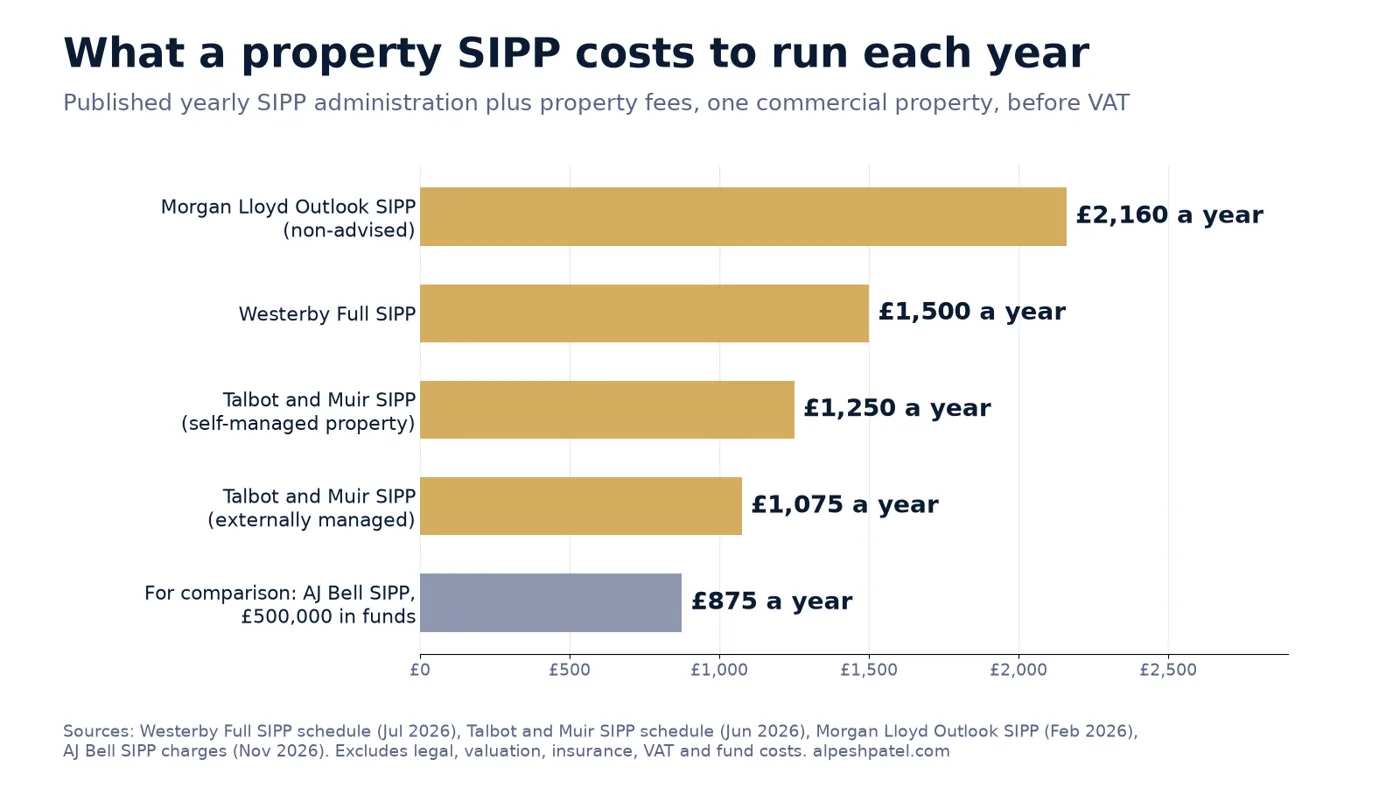
Add the yearly lines together and the running cost of one property ranges from about £1,075 to £2,160 a year before VAT. For comparison, a mainstream platform SIPP holding £500,000 in funds at AJ Bell would cost £875 a year in custody charges, at 0.25% on the first £250,000 and 0.10% on the next £250,000 (AJ Bell (opens in a new tab)). That SIPP cannot hold property, which is the point: you pay more for the flexibility.
Source: provider fee schedules linked above (July 2026, June 2026, February 2026) and AJ Bell SIPP charges (opens in a new tab). Excludes legal, valuation, insurance, VAT and fund costs.
Watch the extras. Westerby lists a £320 borrowing fee, £350 for lease renewals and new leases, and £300 to register for VAT plus £400 a year for VAT returns. Talbot and Muir charges £400 for pension fund borrowing and from £225 for an environmental screening report. Small lines add up over a 20-year holding.
What rent must my company pay?
If your company, or anyone connected with you, rents the property from your SIPP, the rent must be the commercial rent. HMRC says failure to pay it "would lead to an unauthorised payment tax charge on an amount equivalent to the shortfall" (HMRC PTM121000 (opens in a new tab)).
The same arm's length rule applies when you buy. If the SIPP buys a building from you or your company, the price must be what an unconnected buyer would pay. Paying too much, or selling for too little later, creates an unauthorised payment on the difference (HMRC PTM121000 (opens in a new tab)). HMRC can ask its valuers whether a price or a rent reflects open market value (HMRC Capital Gains and other taxes manual (opens in a new tab)).
In practice that means an independent RICS valuation before purchase, a proper written lease, and rent reviews that are actually carried out. If the business struggles, you cannot simply let the rent slide. Your SIPP trustee will expect it to be collected.
What about stamp duty and VAT?
In England and Northern Ireland, a SIPP buying commercial property pays Stamp Duty Land Tax like any other buyer; Scotland and Wales have their own taxes (GOV.UK (opens in a new tab)). The non-residential rates are 0% up to £150,000, 2% on the next £100,000 and 5% above £250,000 (GOV.UK (opens in a new tab)). On an illustrative £400,000 building, that is £9,500.
VAT is the other trap. Sales and lettings of commercial property are normally exempt from VAT, but a seller or landlord can "opt to tax", after which supplies are standard-rated and VAT incurred can normally be recovered (HMRC VAT Notice 742A (opens in a new tab)). If the building you want has been opted to tax, your SIPP may need to register for VAT, charge VAT on the rent and file returns. Where a let building is sold as a transfer of a going concern, VAT may not be charged at all. A tax specialist should confirm the position before exchange.
Can my SIPP borrow to buy the property?
Yes, within limits. A registered pension scheme can borrow up to 50% of the net value of the fund immediately before the borrowing, and the property being bought does not count towards that value (HMRC PTM124000 (opens in a new tab)). Borrow more and the excess faces a 40% scheme sanction charge.
In an illustrative example, a SIPP worth £300,000 could borrow up to £150,000. Borrowing increases both the gain and the loss. It also means some of the rent goes on interest, and the lender may want repayment at an awkward moment.
What happens to a property SIPP at retirement?
This is the risk that gets the least attention at purchase and causes the most trouble later. A building is one large, illiquid asset. You cannot sell 4% of it to pay this year's income.
You can usually take up to 25% of a pension as a tax-free lump sum, up to a maximum of £268,275 (GOV.UK (opens in a new tab)). If most of your SIPP is a single building, finding that cash may mean selling it, borrowing against it or waiting until rent has built up. Drawdown income has the same problem. If the tenant leaves, the income stops while the fees, insurance and void costs continue.
There is also the question of who you sell to. If your own company is the tenant and you are selling the business at the same time, the building, the lease and the business sale all have to line up. Commercial property can take months to sell, and the price on the day is the price you get.
Then there is inheritance tax. From 6 April 2027, most unused pension funds and death benefits come into scope of inheritance tax, with personal representatives responsible for paying it (GOV.UK (opens in a new tab)). An illiquid building could leave executors needing cash before the property can be sold. Ask a tax specialist how this applies to you.
How should you invest the rental income?
Here is where the property decision meets the rest of your plan. Every rent payment lands in the SIPP's bank account. Left there, it earns whatever the provider's account pays. Westerby's schedule, for example, explains that it receives interest of at least 1.85% on balances in the nominated SIPP bank account, which helps fund its costs (Westerby (opens in a new tab)).
The building is already a concentrated bet on one tenant, one town and often your own business. So the rent should go somewhere different: a diversified portfolio across countries and sectors. A low-cost global index fund, for example, has an ongoing charge of 0.23% (Vanguard (opens in a new tab)). Check what your full SIPP charges to hold funds or a dealing account alongside the property.
Run it with a written process, not on instinct:
- Pick. Decide what you will own, for example a global core plus a small number of individual shares chosen by clear rules.
- Size. Set maximum position sizes, and decide what share of the whole pension the building should be.
- Sell and rebalance. Write down when you will rebalance and what would make you sell, before you need to.
Over time, a growing pool of liquid investments also solves the retirement problem. It can fund your tax-free cash and drawdown while the building stays let. My guide to living off your investments compares six ways to draw that income.
What should you check before transferring an old pension?
Many people fund a property SIPP by transferring older pensions in. Before you do, get in writing what each scheme would charge to leave, and what you would give up, such as guaranteed annuity rates, protected tax-free cash or a guaranteed growth rate.
Exit charges at some large firms can still apply. St. James's Place, for example, simplified its charges in August 2025 so that the early withdrawal charge no longer applies to new investments (St. James's Place (opens in a new tab)). For Retirement Account money placed on or before 22 August 2025, early withdrawal charges remain on a reducing scale from 6% in year one to 1% in year six (St. James's Place (opens in a new tab)). I reviewed the firm's costs in more detail in St. James's Place pension review 2026.
If a pension includes safeguarded benefits worth more than £30,000, such as a final salary scheme, you must take advice from an FCA-authorised adviser before it can be transferred (FCA (opens in a new tab)).
Be alert to scams. The Pensions Regulator says £17.7 million was reported lost to pension fraud in 2023, an average of nearly £47,000 per victim, and fewer than one in five victims report it (TPR (opens in a new tab)). Walk away from cold calls, guaranteed returns, overseas property, storage units or hotel rooms sold as "commercial property", and anyone who rushes you.
What to do next
- Check the property qualifies. Confirm it is commercial, not residential or mixed-use, and get an independent valuation and a market rent opinion.
- Price the whole cost. Add set-up, purchase, yearly and sale fees from at least three providers, plus VAT, legal, survey, insurance and SDLT. Compare platforms for the rest of your pension in cheapest SIPP for drawdown 2026.
- Plan your retirement cash. Work out where your tax-free lump sum and income will come from if the building is still let. The free Pension Plan tool (opens in a new tab) can help.
- Write your process for the rent. What you will own, how much in each and when you will rebalance. See run your own SIPP and build a retirement income.
- Get the tax checked. Ask your accountant or a tax specialist about VAT, SDLT, the rent your company deducts and inheritance tax from 2027.
Want a clear plan for the rest of your pension around a property? Book your free call with Alpesh's team. We will show you how self-directed investors pick investments, size positions and decide when to sell, so the rent your business pays builds a diversified portfolio rather than sitting in cash. There is nothing to buy on the call.
Frequently asked questions
Can I buy my business premises with my SIPP?
Yes, if the premises are commercial and the SIPP provider allows property. The price must be at market value, your company must pay a commercial rent under a proper lease, and the provider will usually require a valuation and legal work before it agrees.
Can a SIPP buy residential property?
Not without heavy tax charges. Residential property is taxable property for self-invested pensions, which leads to a 40% unauthorised payments charge on the member and a scheme sanction charge on the administrator, with only narrow exceptions.
How much does it cost to hold commercial property in a SIPP?
Published schedules from three specialist providers show yearly administration and property fees of about £1,075 to £2,160 before VAT. Purchase fees run from £800 to £1,040, before legal, survey, valuation and insurance costs.
Can my SIPP get a mortgage to buy property?
Yes. A pension can borrow up to 50% of its net value immediately before the borrowing, not counting the property being bought. Borrowing above that limit triggers a 40% tax charge on the excess.
What happens to the property when I retire?
The SIPP can keep the property and pay you income from the rent and other investments, or sell it. Because a building cannot be sold in small pieces, plan early where your tax-free cash and income will come from.
About Alpesh Patel OBE
Alpesh Patel OBE is Founding Principal of Rootbridge Capital, an author and Dealmaker for the UK Government's Department for Business. He is a former Visiting Fellow in Business, Corpus Christi College, Oxford University, where he worked on technology to improve financial education.
Sources
- HMRC, PTM121000: investments, essential principles (opens in a new tab)
- GOV.UK, Tax on investments for pension trustees (opens in a new tab)
- HMRC, PTM031100: registration, tax reliefs (opens in a new tab)
- HMRC, PTM125300: taxable property, direct holdings (opens in a new tab)
- HMRC, PTM125200: taxable property, residential property (opens in a new tab)
- Westerby, Schedule of Full SIPP fees (July 2026) (opens in a new tab)
- Talbot and Muir, SIPP schedule of fees and services (June 2026) (opens in a new tab)
- Morgan Lloyd, Outlook SIPP menu of charges (February 2026) (opens in a new tab)
- AJ Bell, SIPP charges and rates (opens in a new tab)
- HMRC, Capital Gains and other taxes manual, section 9 (opens in a new tab)
- GOV.UK, Stamp Duty Land Tax (opens in a new tab)
- GOV.UK, SDLT rates for non-residential and mixed land and property (opens in a new tab)
- HMRC, Opting to tax land and buildings (VAT Notice 742A) (opens in a new tab)
- HMRC, PTM124000: borrowing (opens in a new tab)
- GOV.UK, Tax when you get a pension: what's tax-free (opens in a new tab)
- GOV.UK, Inheritance Tax: unused pension funds and death benefits (opens in a new tab)
- Vanguard, FTSE Global All Cap Index Fund (opens in a new tab)
- St. James's Place, Confirms implementation date of its simple, comparable charging structure (opens in a new tab)
- St. James's Place, Retirement Account charges summary 2025 (opens in a new tab)
- Financial Conduct Authority, Advising on pension transfers: our expectations (opens in a new tab)
- The Pensions Regulator, Working together to strengthen our defences against scams (opens in a new tab)
- Alpesh Patel OBE, This "Boring" Retirement Portfolio Will Beat 98% of Pension Funds in 2027 (opens in a new tab) (YouTube)
Important: This article is for education only and is not personal financial advice or a recommendation to buy or sell any investment. This article is general investment education only and is not regulated investment advice. The value of investments can go down as well as up, and you may get back less than you invest. Past performance is not a reliable indicator of future results.
Important: this article is education and information only. It is not financial advice or a personal recommendation, and it does not take your circumstances into account. The value of investments and pensions can fall as well as rise, and you may get back less than you put in. Past performance is not a reliable indicator of future results. Figures were correct when the article was written and may have changed. If you are unsure what is right for you, speak to a regulated financial adviser.