Friends Provident and RL360 Offshore Bonds: Is It the Market or the Fees?
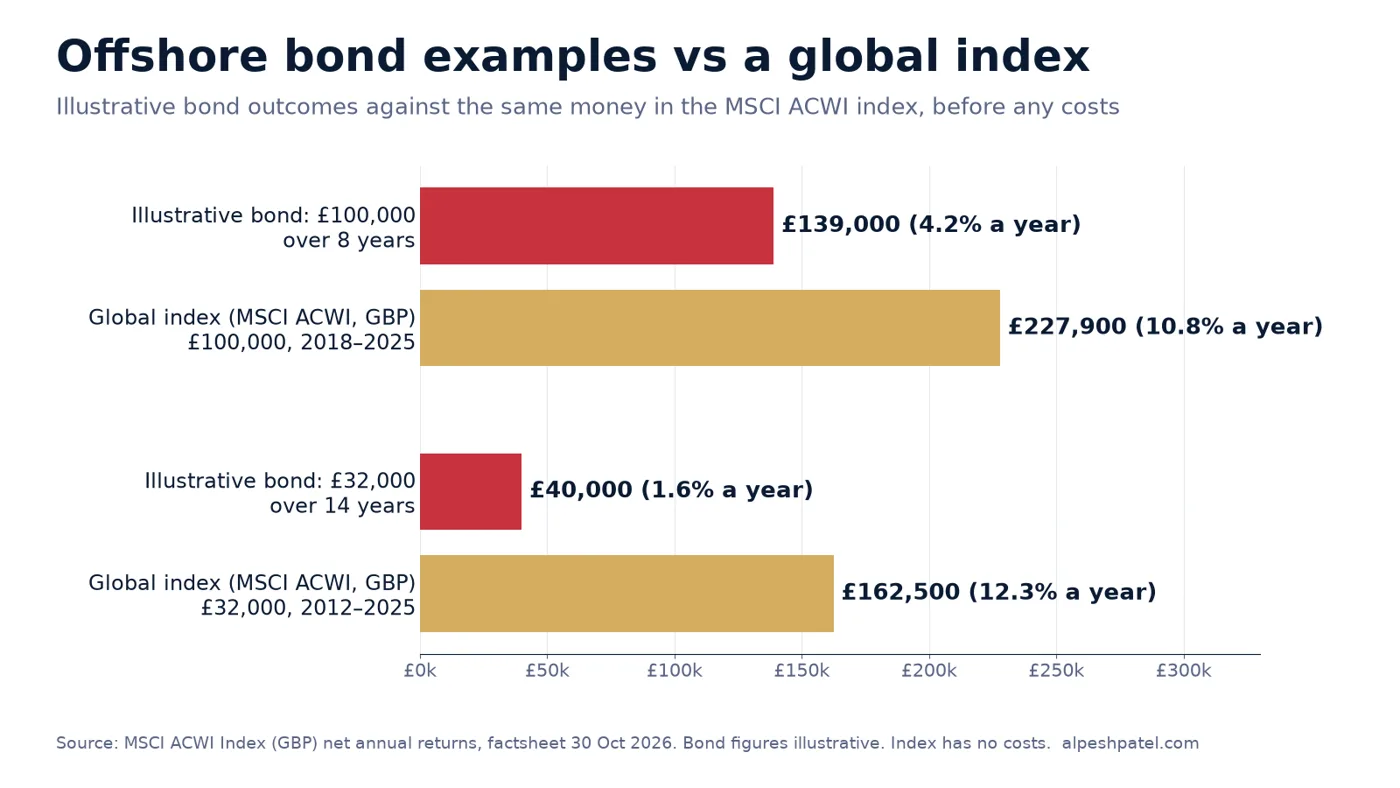
Picture an expat who has worked in London and Dubai. Over the years an adviser or two has sold them a Friends Provident International bond, an RL360 plan, a workplace pension here and a sharesave scheme there. This offshore bond review starts with a sum they can check from their own statements: £100,000 that has grown to about £139,000 over eight years.
That sounds respectable until you work out the rate. It is about 4.2% a year. Over the eight calendar years 2018 to 2025, the MSCI ACWI global index returned about 10.8% a year in sterling, turning £100,000 into roughly £228,000 before costs. MSCI (opens in a new tab) Same world, same markets, very different result.
A second illustrative example is starker. £32,000 that has become £40,000 over fourteen years has grown at about 1.6% a year. The same index, over 2012 to 2025, would have turned £32,000 into about £162,000. These are not market outcomes. They are product and fee outcomes.
Short answer: Friends Provident International and RL360 portfolio bonds are wrappers with layered charges: establishment or initial charges, ongoing administration charges, fund charges and often adviser fees, plus exit penalties in the early years. When a bond has grown 1.6% to 4.2% a year while a global index made 10% to 12%, look at costs first, then decide with all your accounts in one view.
Holding an offshore bond and not sure what it is really costing you? Book your free call with Alpesh's team. We will show you how self-directed investors look at every account as one portfolio, with a written process for what to hold and when to change it. There is nothing to buy on the call.
What is an offshore investment bond?
An offshore investment bond, sometimes called a portfolio bond, is a life insurance or capital redemption policy issued from a jurisdiction such as the Isle of Man. You invest a lump sum and the insurer holds funds or other assets inside the policy for you.
They are widely sold to expats in Dubai and elsewhere because the wrapper can travel with you, can be split into many small policies for later withdrawals and can be held in different currencies. Friends Provident International's Reserve, for example, offers eight currencies Friends Provident International (opens in a new tab) and a minimum investment of £50,000. Friends Provident International (opens in a new tab) RL360's Oracle starts at £20,000 and offers seven currencies. RL360 (opens in a new tab)
None of that is a problem in itself. The question is what you pay for the wrapper, and whether the funds inside are doing better than a simple, low-cost alternative after those charges.
Why do the illustrative examples lag the market so badly?
Here are the two illustrative examples next to the MSCI ACWI index in sterling, which covers large and mid-sized companies across developed and emerging markets.
| Illustrative example | Start | End | Implied growth a year | MSCI ACWI (GBP) over a comparable period | Index value of the same start |
|---|---|---|---|---|---|
| Bond A, 8 years | £100,000 | £139,000 | 4.2% | 10.8% a year (2018–2025) | about £227,900 |
| Bond B, 14 years | £32,000 | £40,000 | 1.6% | 12.3% a year (2012–2025) | about £162,500 |
Index figures are compounded from the calendar-year net returns in the MSCI ACWI Index (GBP) factsheet (opens in a new tab) (data to 30 October 2026). The index carries no costs, and a real index fund would trail it slightly. Bond figures are illustrative. Past performance is not a guide to the future.
Source: MSCI ACWI Index (GBP) factsheet, 30 October 2026. Bond figures illustrative.
To be fair to the bonds, not every holder wants 100% in shares. A cautious mix of bonds and cash would have earned less than a global equity index over these years, so part of any gap can be a risk choice. But a gap of six to ten percentage points a year, year after year, is far too large to be explained by asset mix alone. The usual suspects are charges, expensive funds chosen to pay trail commission, and portfolios that were set up once and never reviewed.
What do Friends Provident International and RL360 actually charge?
Both providers publish their charging structures. The exact terms on your policy are in your policy schedule and illustration, so check those, but the published figures show the shape.
Friends Provident International Reserve. On the establishment charge structure, you pay a charge based on the amount you invest, either on day one or spread over five, eight or ten years. For premiums from £50,000 that is 8.5% on day one, or 1.90% a year for five years, 1.25% a year for eight years or 1.00% a year for ten years. On top, there is a fixed administration charge of £139.50 a quarter for the life of the policy, plus £42 per fund deal. Friends Provident International charging structures (opens in a new tab)
There is also an annual policy charge structure: 0.35% a year on premiums from £100,000, falling to 0.15% from £1.5 million, taken on the higher of the policy value or the total premium. It comes with an initial charge of 7% up front or 1.506% a year for five years. Friends Provident International charging structures (opens in a new tab)
RL360 Oracle. RL360 publishes an establishment charge of between 0% and 7.5% of your payment, taken over the first five years, and an administration charge of 0.60% to 1.20% a year for the life of the plan, based on the higher of the plan value or the payment made. There are no dealing or custody charges inside Oracle. RL360 Oracle product guide (opens in a new tab) RL360's own summary sheet gives a standard example of 1.5% a year establishment charge for five years and 1.2% a year administration charge. RL360, Why choose Oracle (opens in a new tab)
Two details matter more than the headline rates. First, establishment charges are based on what you paid in, not what the bond is worth, so they do not fall if markets do. Second, fund charges and any adviser fee sit on top of all of this.
What could that cost on £100,000 a year?
| Illustrative yearly cost on £100,000 in the early years | Wrapper charges | Fund charges (illustrative 1%) | Total |
|---|---|---|---|
| FPI Reserve, 8-year establishment option | £1,250 + £558 admin | £1,000 | £2,808 |
| FPI Reserve, 10-year establishment option | £1,000 + £558 admin | £1,000 | £2,558 |
| RL360 Oracle, 1.5% establishment + 1.2% admin | £2,700 | £1,000 | £3,700 |
| RL360 Oracle, lowest published (0% + 0.6%) | £600 | £1,000 | £1,600 |
| Global index fund only (0.23% OCF) | – | £230 | £230 + platform fee |
Sources: FPI charging structures (opens in a new tab); RL360 Oracle product guide (opens in a new tab); Vanguard FTSE Global All Cap Index Fund (opens in a new tab) (OCF 0.23%), shown as an example of a broad index fund, not a recommendation. The 1% fund charge is illustrative. Excludes dealing costs and adviser fees.
On these illustrative figures, the wrapper and fund layers can take 2.5% to 3.7% a year in the early years. Take that off a balanced portfolio's return and you start to see how £100,000 becomes £139,000 rather than something much larger. My piece on what 1% a year really costs your portfolio shows how this compounds over decades.
Can I get out of an offshore bond early?
Usually, yes, but it can cost you. Both providers recover outstanding establishment charges if you leave early.
At Friends Provident International, if you cash in during an establishment charge period, an early cash-in charge equal to the outstanding establishment charges applies. It does not apply if you chose the day-one option. Friends Provident International charging structures (opens in a new tab) In an illustrative example, on £100,000 with the ten-year option at 1% a year, cashing in after three years would leave seven years of charges, about £7,000, to pay.
At RL360, if you exit Oracle before the end of the first five years, any outstanding establishment charge is taken as an early exit charge, so you could get back less than you paid in. RL360 Oracle product guide (opens in a new tab)
That does not mean you should stay put. It means you should get the exact surrender value and the exit charge in writing, compare it with what the current charges will cost you over the remaining period, and only then decide. Sometimes waiting until the penalty period ends is the cheaper choice. Sometimes paying it now is. Often a partial step, such as switching the funds inside the bond to cheaper ones, is worth looking at too.
Why does nobody look at all your accounts together?
This is the bigger problem, and it is the one most expats never hear about. Each account was sold separately, so each is judged separately. The bond is in one statement, the old UK workplace pension in another, the Dubai end-of-service savings somewhere else and the sharesave in your employer's portal.
Put them together and you often find the same companies again and again. In the MSCI ACWI index, US companies make up 64.63% of the index and the ten largest holdings, led by Apple, Nvidia and Microsoft, account for 24.26%. MSCI (opens in a new tab) Most global and US funds, whatever the label, hold the same megacaps. Five accounts with five global funds can mean one large, concentrated bet on a handful of US technology shares. My article on too many funds tracking the same index shows how to spot this, and S&P 500 concentration covers what that concentration means.
Workplace sharesave adds another layer. A Save As You Earn scheme lets you save up to £500 a month for three or five years to buy your employer's shares at a fixed price. GOV.UK (opens in a new tab) It can be a good deal. But it is single-stock risk tied to the same company that pays your salary. If that company has a bad year, your job and your savings can suffer together.
What is the answer for expats with accounts in several countries?
It is not another product. It is three things.
One consolidated view. List every account in every country: provider, value, currency, funds held, total yearly cost in pounds and any exit penalty. Then look through the funds to the actual companies and countries. Until you can see the whole as one portfolio, you cannot manage risk or cost.
A written selection and review process. Decide in writing what you will hold, how much in any one fund, share or region, how often you will review it and what would make you sell. That process is what turns a pile of accounts sold over twenty years into one plan built around your own risk profile. The invest a lump sum and cut fees and charges guides walk through the steps.
A broker account you control. Where it makes sense, and once exit penalties and tax have been checked, hold your long-term investments in an account in your own name, where you see every holding and every charge and can act without an intermediary. That is the case for managing your own money: control, transparency and a portfolio that fits you rather than a commission table.
You can test how a different mix might behave with the free Portfolio Odds (opens in a new tab) tool, and the other free tools are on the tools page.
What should I check before moving out of an offshore bond?
Exit penalties in writing. Ask the provider for the current surrender value, any early cash-in or exit charge and the date the establishment period ends. Ask your adviser, in writing, what ongoing fees and trail commission they receive from the bond.
Tax, with a specialist. Offshore bonds have their own tax rules, and gains are taxed differently depending on where you live when you take money out. HMRC's helpsheet on gains on foreign life insurance policies (opens in a new tab) shows how UK residents report them. If you have lived in more than one country, or plan to return to the UK, a cross-border tax specialist should confirm the position before you surrender or withdraw anything.
Pensions are different. If any of your accounts are pensions with guarantees or safeguarded benefits, such as a final salary scheme worth more than £30,000, the law requires advice from an FCA-authorised adviser before a transfer. FCA (opens in a new tab)
Watch for scams. Action Fraud figures cited by The Pensions Regulator show £17.7 million was reported lost to pension fraud in 2023, an average of nearly £47,000 per person, and fewer than one in five scams are thought to be reported. The Pensions Regulator (opens in a new tab) Expats are a common target. Be wary of cold calls, "free reviews" from firms you do not know, promises of guaranteed returns and pressure to move quickly. Check any UK firm on the FCA's ScamSmart (opens in a new tab) pages.
What to do next
- Work out the implied rate of every bond. Take the amount paid in, today's value and the number of years, and calculate the growth a year. Compare it with a global index over the same period.
- Request the charges and exit terms in writing from Friends Provident International, RL360 or your other providers, including adviser fees.
- Build one consolidated view of every account in every country, and look through the funds to the companies you actually own.
- Write down your process: what you will hold, how much in each, when you will review and what would make you sell.
- Speak to a cross-border tax specialist before you surrender or switch anything.
Want to see all your accounts as one portfolio, with a process you control? Book your free call with Alpesh's team. We will show you how self-directed investors pick investments, size positions and decide when to sell. There is nothing to buy on the call.
Frequently asked questions
Are Friends Provident International and RL360 bonds a bad investment?
The wrappers are not good or bad in themselves. What matters is the total cost, the funds held inside and whether the result beats a simple low-cost alternative after charges. If your bond has grown at a few per cent a year while global markets made far more, find out why.
How do I work out what my offshore bond has really returned?
Divide today's value by what you paid in, then raise it to the power of one divided by the number of years and subtract one. For example, £139,000 from £100,000 over eight years is about 4.2% a year. Withdrawals and top-ups make it more complex, so ask the provider for a full transaction history.
Will I pay a penalty to leave an offshore bond?
Possibly. Friends Provident International and RL360 both recover outstanding establishment charges if you leave during the establishment period. Ask for the exact figure in writing before deciding.
Should expats hold everything in one account?
Not necessarily one account, but one view. You should see every holding across every country together, so you can spot overlap, concentration and cost. Where you hold the money also depends on tax and residency, which a specialist should confirm.
About Alpesh Patel OBE
Alpesh Patel OBE is Founding Principal of Rootbridge Capital, an author and Dealmaker for the UK Government's Department for Business. He is a former Visiting Fellow in Business, Corpus Christi College, Oxford University, where he worked on technology to improve financial education.
Sources
- MSCI, MSCI ACWI Index (GBP) factsheet (opens in a new tab)
- Friends Provident International, Reserve charging structures (opens in a new tab)
- Friends Provident International, Reserve (opens in a new tab)
- RL360, Oracle product guide (capital redemption) (opens in a new tab)
- RL360, Why choose Oracle (opens in a new tab)
- Vanguard, FTSE Global All Cap Index Fund (opens in a new tab)
- GOV.UK, Save As You Earn (SAYE) (opens in a new tab)
- HMRC, Gains on foreign life insurance policies (HS321) (opens in a new tab)
- Financial Conduct Authority, Advising on pension transfers: our expectations (opens in a new tab)
- Financial Conduct Authority, ScamSmart (opens in a new tab)
- The Pensions Regulator, Working together to strengthen our defences against scams (opens in a new tab)
- Alpesh Patel OBE, Hidden Pension Fees: Print This Before Investing (Simple Steps!) (opens in a new tab) (YouTube)
Important: This article is for education only and is not personal financial advice or a recommendation to buy or sell any investment. This article is general investment education only and is not regulated investment advice. The value of investments can go down as well as up, and you may get back less than you invest. Past performance is not a reliable indicator of future results.
Important: this article is education and information only. It is not financial advice or a personal recommendation, and it does not take your circumstances into account. The value of investments and pensions can fall as well as rise, and you may get back less than you put in. Past performance is not a reliable indicator of future results. Figures were correct when the article was written and may have changed. If you are unsure what is right for you, speak to a regulated financial adviser.