True Potential Fees: The Three Layers of Cost and How to Get the Total in Pounds
Type £120,000 into True Potential's own fee calculator and tick "yes" for ongoing advice. The answer it gives is a total annual ongoing cost of £1,968, or £164 a month. That is 0.50% for advice, 0.40% for the platform and a typical 0.74% investment charge: 1.64% a year in all. True Potential (opens in a new tab)
Many True Potential clients never see that figure laid out in one place. Their statements show a value, a portfolio name and perhaps a performance line. The charges sit in different documents, and one of the biggest is taken inside the funds, so it never appears as a deduction at all.
Picture someone in their fifties with a pension and an ISA at True Potential, set up through an adviser years ago. The pot has grown. They have a nagging sense that it should have grown more. Their question is simple: what am I actually paying, in pounds, every year? This guide breaks True Potential fees into their three layers and shows how to get that number in writing.
Short answer: True Potential fees come in three layers: a tiered platform charge (0.40% on the first £150,000, falling above that), the portfolio's ongoing charge (0.78% on the Balanced Portfolio) and, if you have one, an adviser fee (0.50% on True Potential's Central Advice Service). Ask in writing for your total cost in pounds for the last 12 months.
Not sure what your pension really costs you each year? Book your free call with Alpesh's team. We will walk through how self-directed investors read their charges, compare them with their returns and run a low-cost portfolio with a written process. There is nothing to buy on the call.
What are the three layers of True Potential fees?
Most platform-based pensions and ISAs charge in layers. True Potential's own fees page lists three: an ongoing advice fee, an ongoing platform fee and an ongoing investment charge. True Potential (opens in a new tab) Underneath those sit transaction costs inside the funds, and there can be one-off charges too.
Layer 1: the platform charge
This is what you pay to hold your investments on the True Potential platform. From 1 October 2026 it is tiered: 0.40% a year on the first £150,000 of invested assets, 0.30% on the next £350,000, 0.20% on the next £4.5 million and nothing above £5 million. True Potential Personal Pension terms (opens in a new tab) Before that it was a flat 0.40%. Money Marketing (opens in a new tab)
The tiers apply in slices, like income tax, and your accounts and any joint account group are added together to work out your rate. The charge is taken monthly in arrears. True Potential Personal Pension terms (opens in a new tab)
Layer 2: the portfolio or fund charge
This is the ongoing charge figure, or OCF, of the True Potential portfolio you hold. The True Potential Balanced Portfolio factsheet shows an OCF of 0.78% at 31 July 2026. True Potential Balanced Portfolio factsheet (opens in a new tab) The fees page quotes a "typical" investment charge of 0.74%, and notes that the exact cost depends on your portfolio. True Potential (opens in a new tab)
This layer is easy to miss. True Potential says these charges are taken within your investments and are not charged as a separate fee you see deducted. True Potential (opens in a new tab) It also says discretionary management of the portfolios is included at no extra cost, so the OCF is the management layer. True Potential (opens in a new tab)
Layer 3: the adviser fee
If you were set up through an adviser, you probably pay an ongoing advice fee. On True Potential's Central Advice Service that is 0.50% a year, and Wealth Management Partner fees may vary. True Potential (opens in a new tab) There may also have been a one-off initial advice fee of up to 4% when you invested: up to £2,000 on £50,000. True Potential (opens in a new tab)
Underneath: transaction costs
The cost of buying and selling inside the funds is reported separately. In one sample True Potential pension illustration, dated May 2021, transaction costs were 0.02% (£5.79 on £25,000), alongside ongoing fund costs of 0.79%, a 0.50% adviser charge and a 0.40% platform charge, for total aggregated costs of 1.72% or £429.45 a year. True Potential sample illustration (opens in a new tab) Your own figures will differ, which is why you need your own statement.
How much do True Potential fees cost in pounds?
Here are the published components applied to four illustrative pot sizes. The platform charge uses the tiered rates, the portfolio charge uses the Balanced Portfolio's 0.78% OCF and the advice fee uses the Central Advice Service's 0.50%.
| Illustrative pot | Platform charge | Portfolio OCF (0.78%) | Ongoing advice (0.50%) | Total a year | As a % |
|---|---|---|---|---|---|
| £100,000 | £400 | £780 | £500 | £1,680 | 1.68% |
| £250,000 | £900 | £1,950 | £1,250 | £4,100 | 1.64% |
| £500,000 | £1,650 | £3,900 | £2,500 | £8,050 | 1.61% |
| £1,000,000 | £2,650 | £7,800 | £5,000 | £15,450 | 1.55% |
Sources: True Potential fees (opens in a new tab), Personal Pension terms (opens in a new tab), Balanced Portfolio factsheet (opens in a new tab). Illustrative; excludes transaction costs and any initial advice fee. Partner adviser fees may differ.
Without ongoing advice, the same pots would cost about 1.18% at £100,000 and 1.05% at £1 million on these figures. With advice, the total stays above 1.5% even at £1 million, because only the platform layer is tiered.
How does that compare with a low-cost index approach?
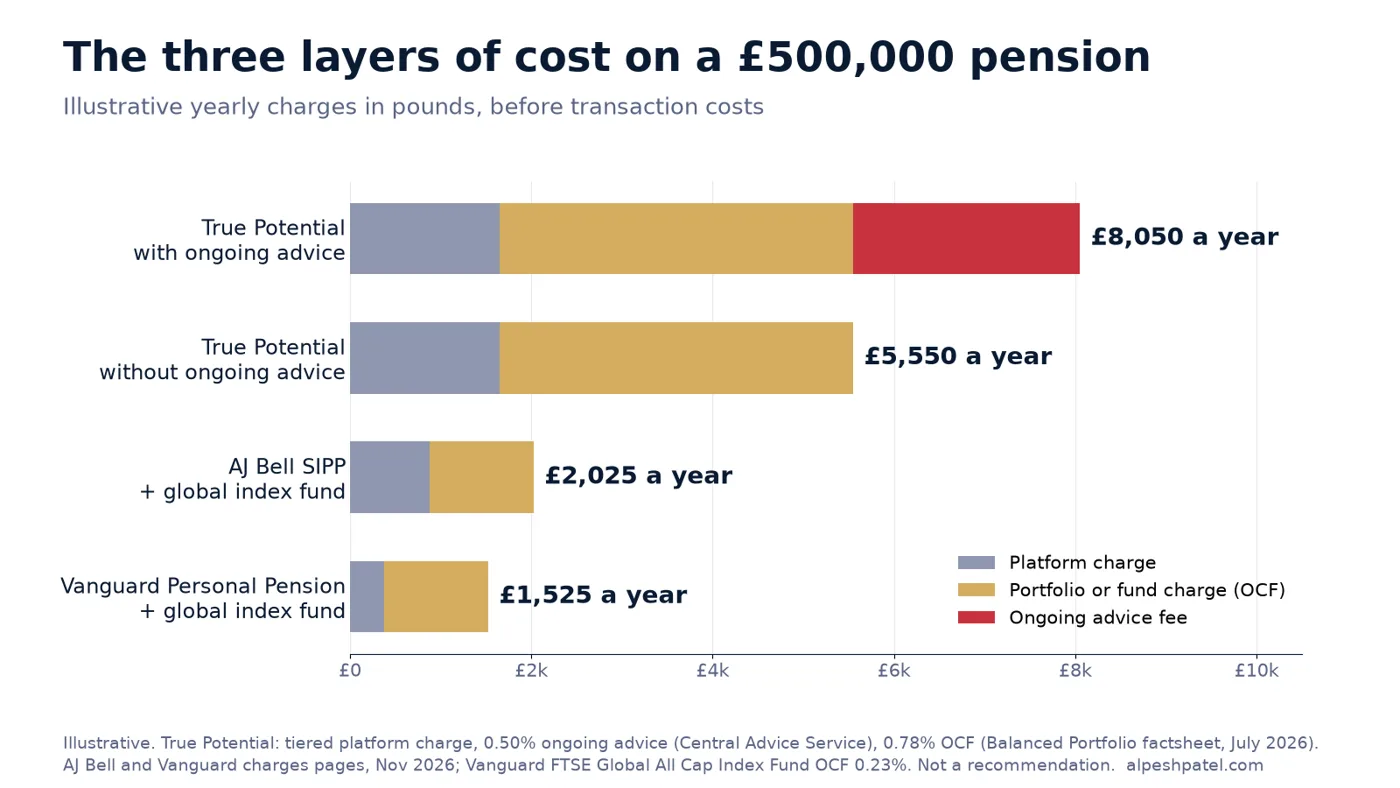
A straightforward alternative is a low-cost pension platform holding a broad global index fund. The Vanguard Personal Pension charges 0.15% a year, capped at £375. Vanguard (opens in a new tab) The AJ Bell SIPP charges 0.25% on the first £250,000 of funds, 0.10% on the next £250,000 and nothing above £500,000. AJ Bell (opens in a new tab) The Vanguard FTSE Global All Cap Index Fund has an OCF of 0.23%. Vanguard (opens in a new tab)
Source: True Potential fees page, Personal Pension terms and Balanced Portfolio factsheet; AJ Bell and Vanguard charges pages, November 2026. Illustrative; excludes dealing and transaction costs.
| Illustrative pot | True Potential with advice | Vanguard Personal Pension + global index fund | AJ Bell SIPP + global index fund |
|---|---|---|---|
| £250,000 | £4,100 (1.64%) | £950 (0.38%) | £1,200 (0.48%) |
| £500,000 | £8,050 (1.61%) | £1,525 (0.31%) | £2,025 (0.41%) |
| £1,000,000 | £15,450 (1.55%) | £2,675 (0.27%) | £3,175 (0.32%) |
The fund is used as an example of a broad index fund, not a recommendation. AJ Bell charges £1.50 a fund deal. AJ Bell (opens in a new tab)
Over time the gap compounds. In an illustrative example, £500,000 growing at 6% a year before charges would reach about £768,000 after ten years with 1.61% a year taken off. With 0.31% taken off it would reach about £870,000. That is a difference of roughly £100,000 from charges alone, before you ask whether the higher-cost route earned a higher return. My piece on what 1% a year really costs your portfolio works through the same compounding in more detail.
The comparison is not like for like. The True Potential figure includes advice and active portfolio management. The index route includes neither: you make the decisions. That is the real question. Is the advice and management worth the difference to you, and can you show it in your returns?
How do I find out the total I paid True Potential last year?
Ask for it in writing. Under FCA rules for investment firms, where a firm provides an ongoing service it must disclose on a personalised and annual basis the actually incurred costs and charges of the service and of the investments. FCA Handbook, COBS 6.1ZA (opens in a new tab) These are often called ex-post costs and charges statements, after the MiFID II rule they come from.
The same rules say the costs must be added together, with the total expressed as a cash amount and as a percentage, and accompanied by an illustration of the cumulative effect of costs on your return. FCA Handbook, COBS 6.1ZA (opens in a new tab) The exact rules that apply depend on the type of account, but any provider should be able to give you the figures.
A simple request might read:
Please send me, in writing, the total costs and charges I paid on each of my accounts for the last 12 months, in pounds and as a percentage. Please break this down into platform charges, ongoing adviser charges, portfolio or fund ongoing charges, transaction costs and any one-off charges, and include the cumulative effect of these costs on my return.
Send it to True Potential and, if you have one, your adviser. Keep a copy.
Is True Potential worth the fees? Compare cost with return
Once you have the total in pounds, put it next to your return in pounds for the same 12 months. Then do the same over three and five years if you can. £8,000 a year can look small as a percentage and large in pounds.
Check what the published performance figures include. The Balanced Portfolio factsheet states that performance is calculated on a total return basis and is net of the portfolio OCF. True Potential Balanced Portfolio factsheet (opens in a new tab) That means the platform charge and any adviser fee still come off afterwards. Your own return will be lower than the factsheet's.
Two other things are worth asking about:
- Cash. True Potential Investments keeps a treasury charge of 70 basis points (0.70%) for maintaining the client money pool, so ask what interest you actually receive on any cash in your account. True Potential Personal Pension terms (opens in a new tab)
- Dealing outside the portfolios. Buying or selling assets that are not mutual funds carries custodian charges capped at £5 for the first £10,000 of a trade and 0.05% above that. True Potential Personal Pension terms (opens in a new tab)
The free Pension Plan (opens in a new tab) tool lets you test what a lower charge could mean for your pot over time, and the cut fees and charges guide sets out the practical steps.
What should I check before moving away from True Potential?
Exit fees. True Potential's current Personal Pension terms do not list a fee for transferring out, but any charges that have built up but not yet been paid are deducted before a transfer or withdrawal. True Potential Personal Pension terms (opens in a new tab) Ask True Potential in writing to confirm the exact amount for your accounts.
The adviser agreement. Check how to stop ongoing advice fees and whether any notice period applies. If you are also unhappy with the advice itself, the review your adviser guide covers what to look for.
Loss of benefits. If any of your True Potential money came from older pensions, check whether anything valuable was given up then, and check any other pensions you plan to move. Ask each provider in writing about guaranteed annuity rates, protected tax-free cash, a protected pension age, with-profits bonuses, special death benefits and exit fees. My guide, Should I combine my pensions? 7 checks before you move, covers each one.
Final salary pensions. If you have safeguarded benefits, such as a defined benefit pension, worth more than £30,000, you must take advice from an FCA-authorised adviser before transferring them. FCA (opens in a new tab)
Scams. Action Fraud figures cited by The Pensions Regulator show £17.7 million was reported lost to pension fraud in 2023, an average of nearly £47,000 per person, and fewer than one in five scams are thought to be reported. The Pensions Regulator (opens in a new tab) Be wary of cold calls, "free pension reviews" from firms you do not know and promises of guaranteed returns. Check any firm on the FCA Register and only move to a platform you have chosen yourself.
Why run your own pension with a process?
Lower fees are the obvious gain. Control and transparency matter as much. When you run your own pension, you see every holding and every charge in pounds, and you build the portfolio around your own risk profile rather than a model portfolio designed for many clients at once.
The trade-off is that the decisions are yours, so you need a written process: what you buy, how much of each, when you rebalance and when you sell. The run your own SIPP guide covers the practical steps, and the free tools help you test a plan before you act.
What to do next
- Ask for your total costs in writing. Use the request above for every True Potential account, and ask your adviser too.
- Add up the three layers yourself. Platform charge, portfolio OCF from your factsheet and adviser fee, then check your figure against theirs.
- Put the cost next to your return in pounds, for one, three and five years, remembering that factsheet performance is before platform and advice fees.
- Check exit charges and benefits in writing before you move anything, and leave any final salary pension alone until you have taken regulated advice.
- Compare two or three low-cost platforms for your pot size, and write your own process down before any money moves.
Want to see what a lower-cost, self-run pension could look like for you? Book your free call with Alpesh's team. We will show you how self-directed investors pick investments, size positions and decide when to rebalance, so lower fees come with a plan you can stick to. There is nothing to buy on the call.
Frequently asked questions
What are True Potential's fees?
True Potential lists three ongoing fees: a platform charge of 0.40% on the first £150,000, falling to 0.30% and 0.20% on higher slices; a portfolio charge (0.78% on the Balanced Portfolio at July 2026); and an ongoing advice fee, 0.50% on its Central Advice Service. There may also have been an initial advice fee of up to 4%.
How much does True Potential cost a year in total?
On True Potential's own calculator, £120,000 with ongoing advice costs £1,968 a year, or 1.64%. On the published components, an illustrative £500,000 pot with ongoing advice costs about £8,050 a year before transaction costs. Your own statement is the only reliable figure.
Does True Potential charge an exit fee?
Its current Personal Pension terms do not list a transfer-out fee, but any charges built up and not yet paid are taken before you leave. Ask in writing for the exact amount and check any adviser agreement for notice periods.
Is a global index fund cheaper than a True Potential portfolio?
On published charges, yes. A low-cost platform with a broad global index fund costs about 0.3% to 0.5% a year on the illustrative pots above, against about 1.6% at True Potential with ongoing advice. The cheaper route includes no advice, so you need your own process.
About Alpesh Patel OBE
Alpesh Patel OBE is Founding Principal of Rootbridge Capital, an author and Dealmaker for the UK Government's Department for Business. He is a former Visiting Fellow in Business, Corpus Christi College, Oxford University, where he worked on technology to improve financial education.
Sources
- True Potential, Our fees (opens in a new tab)
- True Potential, Personal Pension Key Features and Terms & Conditions (October 2026) (opens in a new tab)
- True Potential, Balanced Portfolio factsheet (31 July 2026) (opens in a new tab)
- True Potential, Sample Personalised Illustration Summary (May 2021) (opens in a new tab)
- Money Marketing, True Potential cuts platform fees for larger portfolios (opens in a new tab)
- Vanguard, Personal Pension (opens in a new tab)
- Vanguard, FTSE Global All Cap Index Fund (opens in a new tab)
- AJ Bell, SIPP charges and rates (opens in a new tab)
- Financial Conduct Authority, Handbook COBS 6.1ZA: costs and charges disclosure (opens in a new tab)
- Financial Conduct Authority, Advising on pension transfers: our expectations (opens in a new tab)
- The Pensions Regulator, Working together to strengthen our defences against scams (opens in a new tab)
- Alpesh Patel OBE, The Hidden Fees Fund Managers Charge are Killing Your Investments (opens in a new tab) (YouTube)
Important: This article is for education only and is not personal financial advice or a recommendation to buy or sell any investment. This article is general investment education only and is not regulated investment advice. The value of investments can go down as well as up, and you may get back less than you invest. Past performance is not a reliable indicator of future results.
Important: this article is education and information only. It is not financial advice or a personal recommendation, and it does not take your circumstances into account. The value of investments and pensions can fall as well as rise, and you may get back less than you put in. Past performance is not a reliable indicator of future results. Figures were correct when the article was written and may have changed. If you are unsure what is right for you, speak to a regulated financial adviser.