From £300,000 to £1 Million Before Retirement: The Maths of Contributions, Time and Return
Picture someone in their mid-50s with a pension and investments worth around £300,000. They are still working, still earning and have one clear goal: £1 million before they stop. The question they ask is nearly always the same. What return do I need?
It is the wrong place to start. In an illustrative example, £300,000 left alone at 5% a year takes almost 25 years to reach £1 million. Add £3,000 a month and the same 5% gets there in under 11 years. That is faster than leaving the money alone at 9% a year, which takes about 14.
Going from £300,000 to £1 million before retirement is mostly a question of how much you add and how long you give it, not which fund you pick. Here is the maths, the tax rules that make contributions so powerful and what a £1 million pot buys in retirement.
Short answer: Turning £300,000 into £1 million before retirement is realistic for some people in their mid-50s, but rarely through returns alone. Without contributions it needs about 12.8% a year over 10 years. With £2,000 to £3,000 a month going in, 5% to 7% a year can get there in roughly 9 to 13 years in illustrative scenarios.
Want to know what your own figures need to reach your target? Book your free call with Alpesh's team. We will walk through how self-directed investors set a target, plan contributions and choose a level of risk that fits. There is nothing to buy on the call.
Can £300,000 grow to £1 million before retirement?
Start with the hardest version: no new money at all. To turn £300,000 into £1 million in 10 years, the pot must grow by about 12.8% a year after charges. Over 12 years it needs about 10.6% a year. Those are illustrative calculations, but they show the scale of the task.
For comparison, US shares returned 9.8% a year from 1900 to 2025 on the UBS Global Investment Returns Yearbook 2026 (opens in a new tab), one of the strongest long-run records of any market. Relying on beating that, every year, for a decade, in the run-up to retirement is a big bet.
Contributions change everything. The table shows how long each mix takes to reach £1 million from a £300,000 start.
| Illustrative: years from £300,000 to £1 million | 5% a year | 7% a year | 9% a year |
|---|---|---|---|
| No contributions | 24.8 | 17.8 | 14.0 |
| £1,000 a month | 17.0 | 13.4 | 11.1 |
| £2,000 a month | 13.0 | 10.8 | 9.2 |
| £3,000 a month | 10.6 | 9.1 | 7.9 |
Illustrative calculation: steady growth after charges, compounded monthly, contributions paid in monthly. Ignores tax and inflation. Real returns vary from year to year and are not guaranteed. Not a forecast.
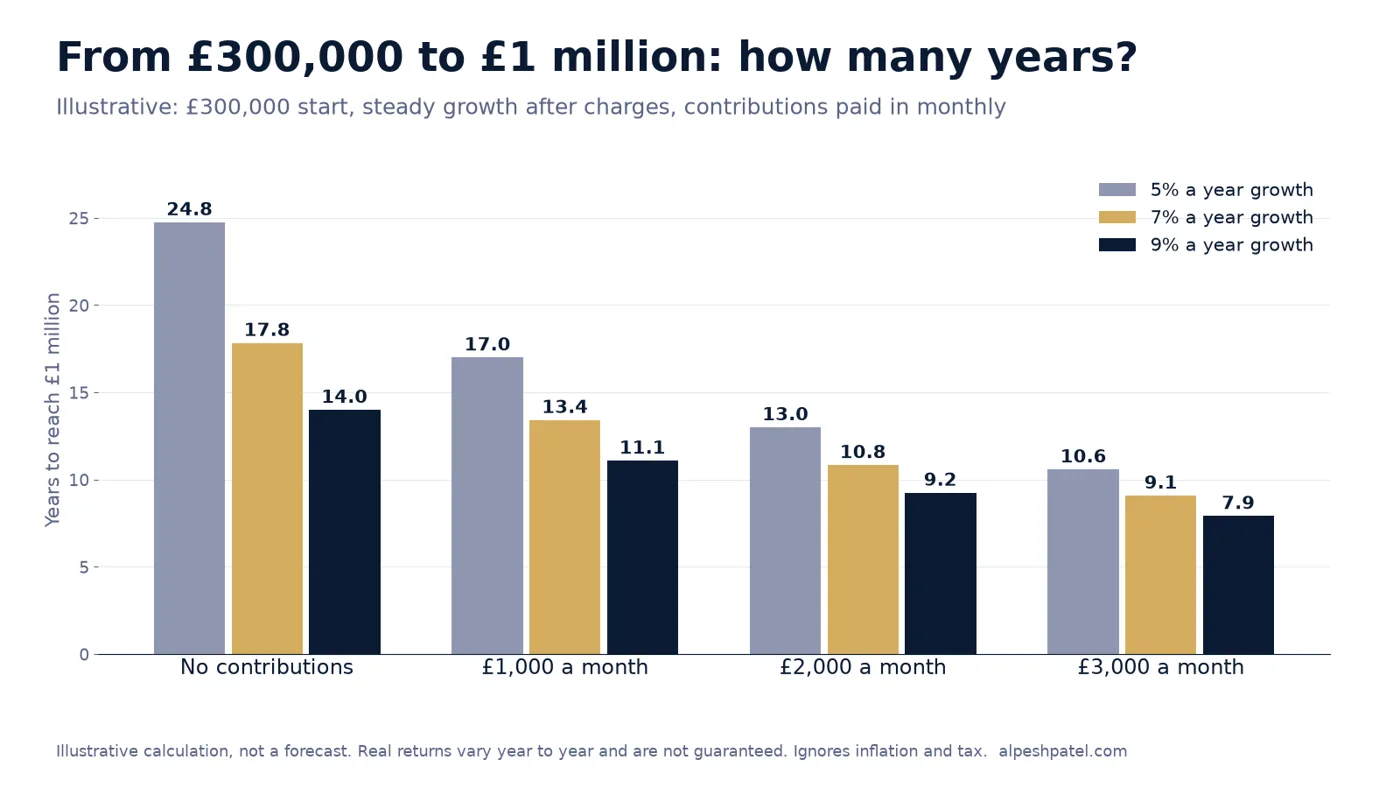
Source: illustrative calculation by alpeshpatel.com. Not a forecast.
Moving from 5% to 9% a year with nothing added saves about 11 years. Adding £3,000 a month at the same 5% saves about 14. The contribution does more than the extra return, and it does not depend on markets being kind.
What could £300,000 become by 65?
Most people in their mid-50s have a rough date in mind. Here is what the same scenarios produce after 10 years, roughly the gap between 55 and 65.
| Illustrative: pot after 10 years from £300,000 | 5% a year | 7% a year | 9% a year |
|---|---|---|---|
| No contributions | £489,000 | £590,000 | £710,000 |
| £1,000 a month | £643,000 | £761,000 | £900,000 |
| £2,000 a month | £797,000 | £932,000 | £1,090,000 |
| £3,000 a month | £952,000 | £1,103,000 | £1,279,000 |
Illustrative calculation on the same basis as above, rounded to the nearest £1,000. Not a forecast.
Two things stand out. Without contributions, even 9% a year leaves the pot short of £1 million after a decade. And with £2,000 to £3,000 a month, the target comes within reach across a wide range of returns. That makes the plan far less dependent on any single fund or market.
How much can you pay into a pension each year?
Pensions are the natural home for most of those contributions, because of the tax relief. The annual allowance is £60,000 this tax year, and it covers everything paid in by you and your employer. You may be able to carry forward unused allowance from the previous three tax years, according to GOV.UK's annual allowance guidance (opens in a new tab).
There are limits to watch. You can only get tax relief on contributions worth up to 100% of your annual earnings, as GOV.UK's pension tax relief page (opens in a new tab) explains. The allowance is tapered if your threshold income is over £200,000 and your adjusted income is over £260,000. And if you have already flexibly accessed a pension, for example by taking cash from drawdown, the lower money purchase annual allowance may apply.
£3,000 a month is £36,000 a year, comfortably inside the standard allowance.
How tax relief boosts each pound you save
With a personal pension or SIPP, your provider claims tax relief at the basic 20% rate and adds it to your pot. This is called relief at source, as GOV.UK (opens in a new tab) sets out. In practice, £800 from your bank account becomes £1,000 in the pension.
If you pay tax at 40% or 45% in England, Wales or Northern Ireland, you can claim a further 20% or 25% on your Self Assessment return, up to the amount of income taxed at those rates. Scotland has its own bands and rates. For a higher-rate taxpayer, a £1,000 contribution in the pension can cost around £600 after the extra relief. A tax specialist can confirm how this works for your own income.
What about salary sacrifice?
Salary sacrifice means you give up part of your salary and your employer pays the same amount into your pension. Today it can save National Insurance as well as Income Tax. That is changing. From April 2029, only the first £2,000 a year of employee contributions made through salary sacrifice will be exempt from National Insurance, under the government's announced changes (opens in a new tab).
Contributions through salary sacrifice will still be free of Income Tax, subject to the usual limits, and employer contributions outside salary sacrifice stay free of National Insurance. If you are in your mid-50s, the years before 2029 are part of your saving window, so ask your employer whether salary sacrifice is on offer.
Is it better to retire later or take more risk?
When the numbers fall short, there are three levers: put more in, give it longer or aim for a higher return. Only the third depends on markets. Take an illustrative case from the first table, with £1,000 a month going in at 5% a year, which takes 17 years.
- Take more risk: lifting the return to 7% a year cuts it to about 13.4 years. But a higher-return portfolio usually means bigger falls, and the S&P 500 lost 36.55% in 2008 alone, according to the NYU Stern historical returns data (opens in a new tab).
- Save more: doubling to £2,000 a month at the same 5% cuts it to about 13 years, with no extra market risk.
- Work longer: at 7% a year with £1,000 a month, the pot is about £761,000 after 10 years and about £897,000 after 12. Two extra years of work add both contributions and growth, and mean two fewer years to fund from the pot.
The timing of risk matters as much as the amount. A large fall in the final years before retirement, or the first years of drawing income, can do lasting damage, because there is less time to recover and you may be selling to pay the bills. My guide on retiring before 57 and the bridge years shows how sequence risk works in practice.
That does not mean avoiding growth investments. It means deciding in advance how much of the pot can sit in higher-risk holdings, and having a rule for reducing it as the date gets closer.
Is £1 million enough to retire on?
It depends on the life you want. The Retirement Living Standards, published by Pensions UK with Loughborough University and updated on 3 June 2026 (opens in a new tab), put yearly spending at three levels. You need enough income after tax to cover these costs, so the income you draw before tax will need to be higher.
| Retirement Living Standards 2026, yearly spending | Minimum | Moderate | Comfortable |
|---|---|---|---|
| One person | £13,900 | £32,700 | £45,400 |
| One person, London | £14,600 | £34,000 | £47,200 |
| Two people | £22,500 | £45,400 | £62,700 |
| Two people, London | £24,100 | £47,000 | £64,800 |
Source: Pensions UK Retirement Living Standards (opens in a new tab), November 2026.
The State Pension covers part of it. The full new State Pension is £241.30 a week, according to GOV.UK (opens in a new tab), about £12,548 a year, though your own amount depends on your National Insurance record.
As an illustration only, a £1 million pot drawing 4% a year would provide £40,000 a year before tax. Add a full State Pension and a single person has about £52,500 a year before tax, close to what the comfortable standard needs once tax is paid. A couple with two full State Pensions would have about £65,000 before tax, in the region of the comfortable standard for two. Whether 4% is sustainable for you depends on your age, your mix of investments and how markets behave, which my comparison of six withdrawal strategies explores.
Remember inflation too. If prices rise at the Bank of England's 2% target (opens in a new tab), £1 million in 12 years would buy roughly what £788,000 buys today. A target set in today's money is a safer target.
Why contributions and time matter more than fund choice
Investors spend a lot of energy hunting for the best fund. The tables above show why that is often the wrong priority for someone in their mid-50s. The difference between a decent fund and a great one is worth less than a steady £1,000 or £2,000 a month, and you control one of those but not the other.
Costs are the exception, because they are certain. A charge of 1% a year on a growing pot adds up to tens of thousands of pounds over a decade, as my guide to what 1% a year really costs shows.
This is also where managing your own money earns its keep. In a self-run SIPP you see every holding and every charge. You set the level of risk for your own date and target, rather than accepting a default fund built for an average saver. The run your own SIPP guide covers the practical steps.
What makes it work is a written process: what you buy, how much goes in each holding, when you rebalance and how you will cut risk as retirement approaches. You do not need to be a professional. You need the plan written down before markets test it.
What to do next
- Add up what you have today: every pension, ISA and investment account, with the yearly charge for each in pounds.
- Set a target in today's money, using the Retirement Living Standards as a guide, and decide the age you want to reach it.
- Run the numbers. The free Pension Plan (opens in a new tab) tool tests contributions, returns and retirement dates. Portfolio Odds (opens in a new tab) helps you explore how a mix has behaved over different periods, and more calculators sit on the tools page.
- Check your allowance and relief. Confirm your annual allowance, any carry forward and whether salary sacrifice is available before 2029.
- Write down your process for investing the contributions, sizing each holding and reducing risk as your date approaches. The build a retirement income guide shows how to plan the switch from saving to drawing.
Want a written plan for getting from where you are to your retirement number? Book your free call with Alpesh's team. We will show you how self-directed investors pick investments, size positions and decide when to sell, so your contributions are working to a plan. There is nothing to buy on the call.
Frequently asked questions
Can I turn £300,000 into £1 million in 10 years?
Without adding money, it needs about 12.8% a year after charges, which is well above long-run market returns. With £2,000 to £3,000 a month going in, illustrative growth of 7% to 9% a year gets close to or above £1 million in about 10 years.
How much do I need to save each month to reach £1 million by retirement?
It depends on your starting pot, years left and returns. In an illustrative example from £300,000, £2,000 a month at 7% a year takes about 10.8 years, and £3,000 a month takes about 9.1 years.
Is it better to save more or take more investment risk?
Saving more is the more reliable lever because it does not depend on markets. In an illustrative case, doubling contributions from £1,000 to £2,000 a month at 5% saved about four years, slightly more than lifting the return from 5% to 7%.
How much can I put into my pension in my 50s?
The annual allowance is £60,000 this tax year, including employer contributions, and you may carry forward unused allowance from the previous three years. Tax relief is limited to 100% of your earnings, and lower limits can apply to high earners or after flexibly accessing a pension.
Is £1 million enough for a comfortable retirement in the UK?
For many people, yes. The 2026 Retirement Living Standards put comfortable spending at £45,400 a year for one person and £62,700 for two, or £47,200 and £64,800 in London. An illustrative 4% a year from £1 million plus a full State Pension gets a single person close to the comfortable level once tax is paid.
About Alpesh Patel OBE
Alpesh Patel OBE is Founding Principal of Rootbridge Capital, an author and Dealmaker for the UK Government's Department for Business. He is a former Visiting Fellow in Business, Corpus Christi College, Oxford University, where he worked on technology to improve financial education.
Sources
- GOV.UK, Annual allowance (opens in a new tab)
- GOV.UK, Pension tax relief (opens in a new tab)
- GOV.UK, Changes to salary sacrifice for pensions from April 2029 (opens in a new tab)
- GOV.UK, The new State Pension: what you'll get (opens in a new tab)
- Pensions UK, Retirement Living Standards: the detail (opens in a new tab)
- Pensions UK, Retirement Living Standards news (opens in a new tab)
- UBS, Global Investment Returns Yearbook 2026: public summary edition (opens in a new tab)
- NYU Stern, Aswath Damodaran, Historical returns on stocks, bonds and bills (opens in a new tab)
- Bank of England, Inflation and the 2% target (opens in a new tab)
- Alpesh Patel OBE, 10 Ways People Boost Their Pension from 100k to 1m (opens in a new tab) (YouTube)
Important: This article is for education only and is not personal financial advice or a recommendation to buy or sell any investment. This article is general investment education only and is not regulated investment advice. The value of investments can go down as well as up, and you may get back less than you invest. Past performance is not a reliable indicator of future results.
Important: this article is education and information only. It is not financial advice or a personal recommendation, and it does not take your circumstances into account. The value of investments and pensions can fall as well as rise, and you may get back less than you put in. Past performance is not a reliable indicator of future results. Figures were correct when the article was written and may have changed. If you are unsure what is right for you, speak to a regulated financial adviser.