Should You Move Your Pension Out of L&G? Costs, Returns and the Skills You Need
A saver five to seven years from retirement recently put two questions to my team. Am I in the right fund? And could I manage this better myself? Their pension sits in the L&G 2035–2040 Lifetime Advantage Fund, the default many workplace savers never chose.
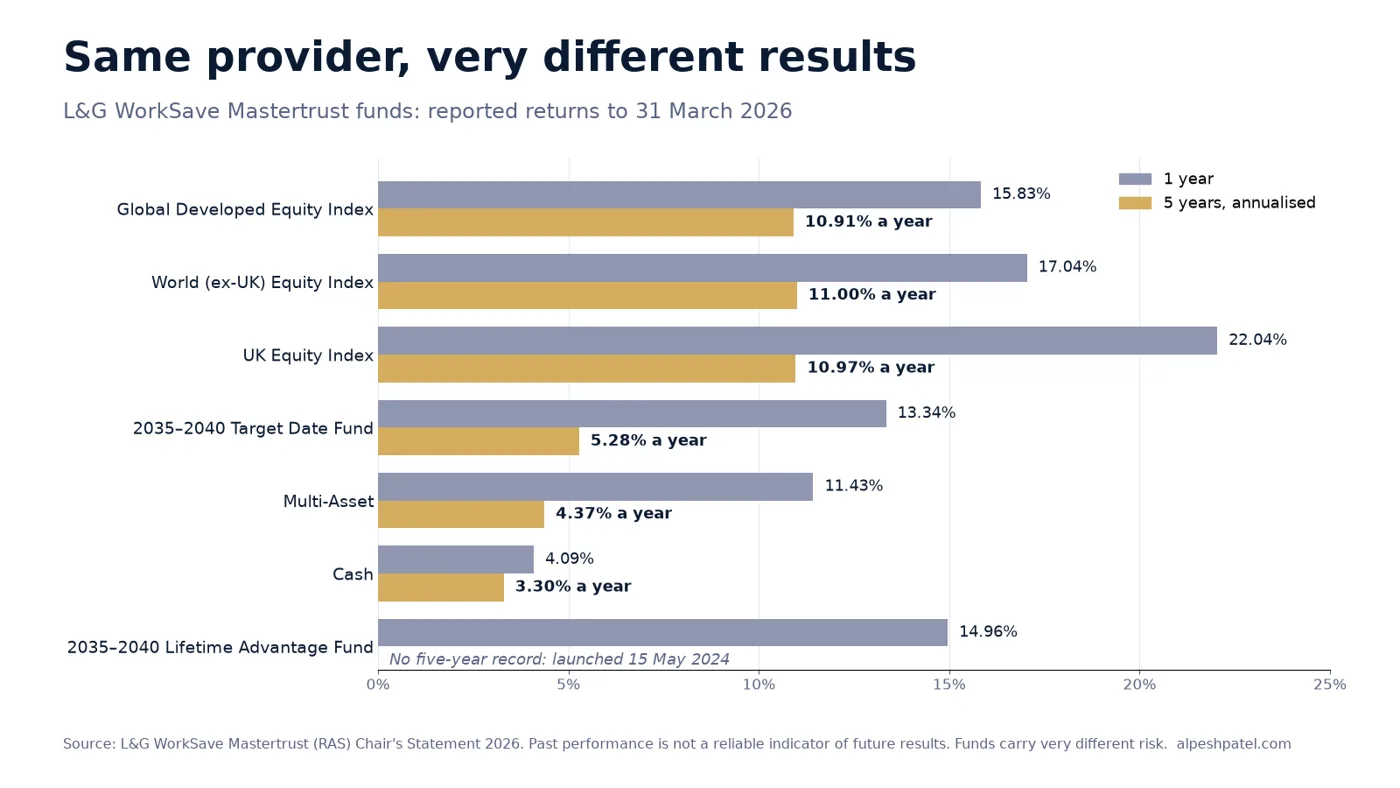
Here is the surprising part. Inside the same L&G scheme, the Global Developed Equity Index Fund returned 10.91% a year over the five years to 31 March 2026. The 2035–2040 Target Date Fund, the older fund for the same retirement band, returned 5.28% a year. Same provider, same scheme, same five years. The difference came from the mix of investments, not the name on the statement. L&G WorkSave Mastertrust chair's statement 2026 (opens in a new tab)
So the decision to move your pension out of L&G is really two decisions. Which mix of investments fits the job your money has to do? And who should be making that choice: L&G, or you?
Short answer: L&G's workplace charges are low, so moving your pension out of L&G rarely saves much on fees alone. The real reasons to move are control and transparency: choosing your own mix, seeing every holding and building around your own spending dates and risk. That only pays if you have, or learn, a written process and the discipline to stick to it.
Weighing up whether to stay with L&G or take control yourself? Book your free call with Alpesh's team. We will walk through the process self-directed investors use to choose, size and review their investments. There is nothing to buy on the call.
How do L&G's own funds compare on cost and return?
The best place to start is L&G's own annual chair's statement for the WorkSave Mastertrust. It lists the returns of every fund members can pick and the range of total charges members pay. Your exact charge depends on the deal your employer agreed with L&G, which is why each fund shows a range rather than one figure. L&G WorkSave Mastertrust chair's statement 2026 (opens in a new tab)
| L&G fund (WorkSave Mastertrust) | Total charge range (TER) | 1 year | 3 years, a year | 5 years, a year |
|---|---|---|---|---|
| PMC 2035–2040 Lifetime Advantage Fund 3 | 0.30%–0.45% | 14.96% | N/A | N/A |
| PMC 2035–2040 Target Date Fund 3 | 0.15%–0.52% | 13.34% | 9.43% | 5.28% |
| PMC Multi-Asset 3 | 0.13%–0.50% | 11.43% | 7.84% | 4.37% |
| MT Global Developed Equity Index Fund | 0.10%–0.47% | 15.83% | 14.22% | 10.91% |
| PMC World (Ex-UK) Equity Index 3 | 0.12%–0.49% | 17.04% | 14.55% | 11.00% |
| PMC UK Equity Index 3 | 0.10%–0.47% | 22.04% | 13.29% | 10.97% |
| PMC Cash 3 | 0.09%–0.46% | 4.09% | 4.77% | 3.30% |
Source: L&G WorkSave Mastertrust (RAS) chair's statement 2026 (opens in a new tab), Appendix 2 (returns to 31 March 2026) and Appendix 3 (charges for the year to 31 March 2026, sole governance section). Past performance is not a reliable indicator of future results.
Source: L&G WorkSave Mastertrust (RAS) chair's statement 2026.
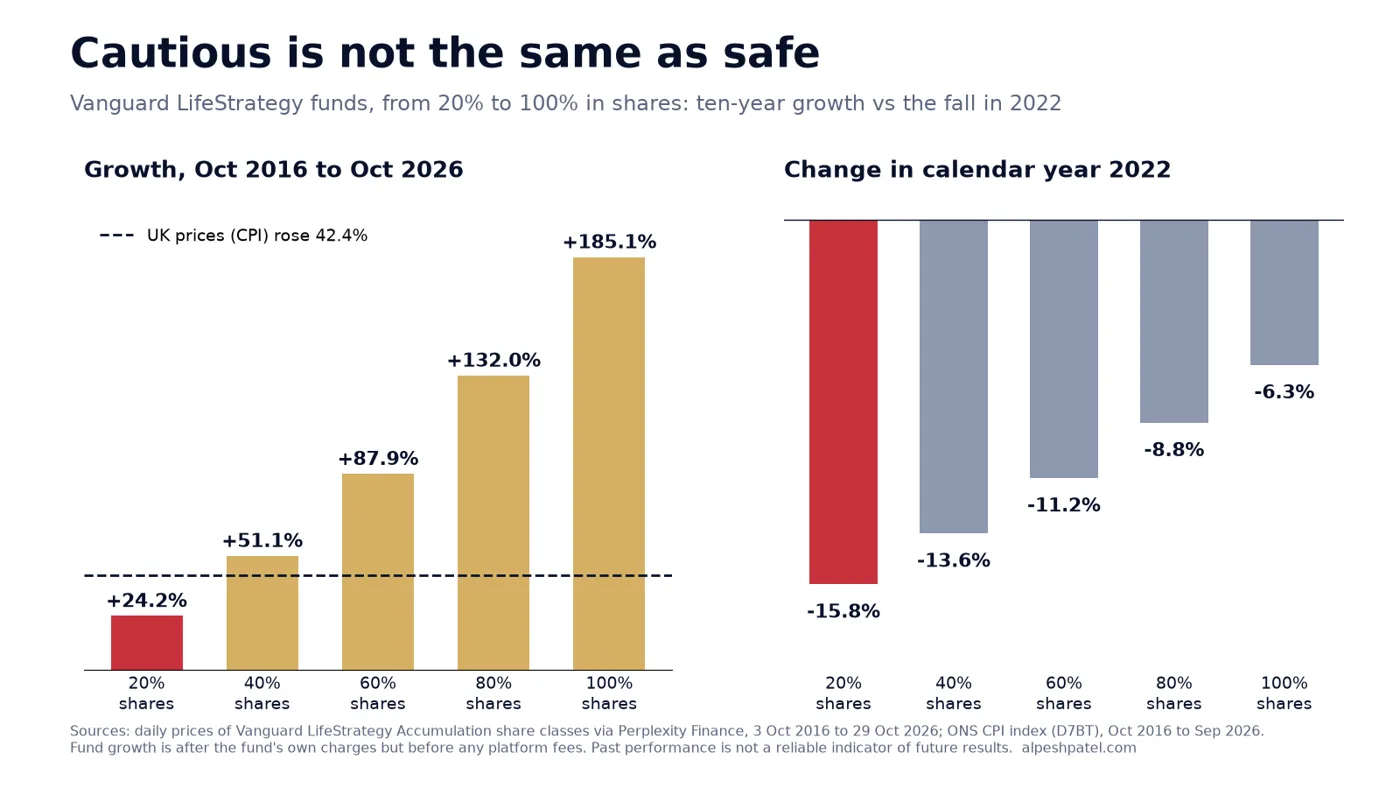
Two things stand out. First, the index funds that hold only shares beat the mixed funds by a wide margin over five years. That is the reward for carrying more risk, and it will not happen in every five-year period. A fund that is all shares can fall much harder in a crash than one that holds bonds and cash.
Second, five years at 10.91% a year compounds to about 68% growth. Five years at 5.28% a year compounds to about 29%. On an illustrative £350,000 pot, that is the difference between roughly £587,000 and £453,000 before any contributions. Choosing a fund is not a minor admin task.
Why the Lifetime Advantage Fund has no long record yet
The 2035–2040 Lifetime Advantage Fund launched on 15 May 2024. That is why the chair's statement shows no three- or five-year figures. Its one-year return of 14.96% was 6.44 percentage points ahead of its comparator, an encouraging start for a short record. L&G WorkSave Mastertrust chair's statement 2026 (opens in a new tab)
The trustees are also candid about cost. In the same statement they lowered their own rating for costs and charges from "Excellent" to "Good". One reason they gave: charges for the new Lifetime Advantage Funds are "slightly less competitive" than those of other providers that also invest in private markets. They also say they believe the funds can produce better long-term outcomes for most members. L&G WorkSave Mastertrust chair's statement 2026 (opens in a new tab)
Private markets are the key difference. The Lifetime Advantage range holds more unlisted assets, such as private equity, private debt, infrastructure and property, than the older Target Date Funds. These are harder to value daily and harder to see through. My earlier review, L&G Lifetime Advantage Fund: why a retirement date is not a plan, explains what that means for someone a few years from retirement.
Is it worth moving your pension out of L&G to save on fees?
Usually not on fees alone. On an illustrative £350,000 pot, the Lifetime Advantage Fund's charge range of 0.30% to 0.45% works out at £1,050 to £1,575 a year. Switching to L&G's Global Developed Equity Index Fund inside the same scheme, at 0.10% to 0.47% depending on your employer, would cost £350 to £1,645.
Now compare a self-invested personal pension (SIPP). AJ Bell charges 0.25% a year on the first £250,000 of funds and 0.10% on the next £250,000, so about £725 a year on £350,000, plus £1.50 a fund deal and the funds' own charges. AJ Bell SIPP charges (opens in a new tab) Vanguard's Personal Pension charges 0.15% a year, capped at £375, plus its fund charges. Vanguard Personal Pension (opens in a new tab)
Workplace schemes the size of L&G's buy at wholesale prices. A SIPP can be cheaper or dearer depending on the platform, the pot size and what you hold. My guide to the cheapest SIPP for drawdown compares five platforms in pounds.
If cost is not the reason, what is?
What do you gain by managing your own pension?
Control. In a default fund, L&G decides how much sits in shares, bonds, cash and private assets, and how that changes as your date approaches. It cannot see your ISA, your other pensions or the year you plan to take a lump sum. When you run your own portfolio, you set the mix around your own plan.
Transparency. You can see every holding, its weight and every charge in pounds. You know exactly why your portfolio rose or fell last year. With a fund that holds other funds and private assets, that takes far more digging.
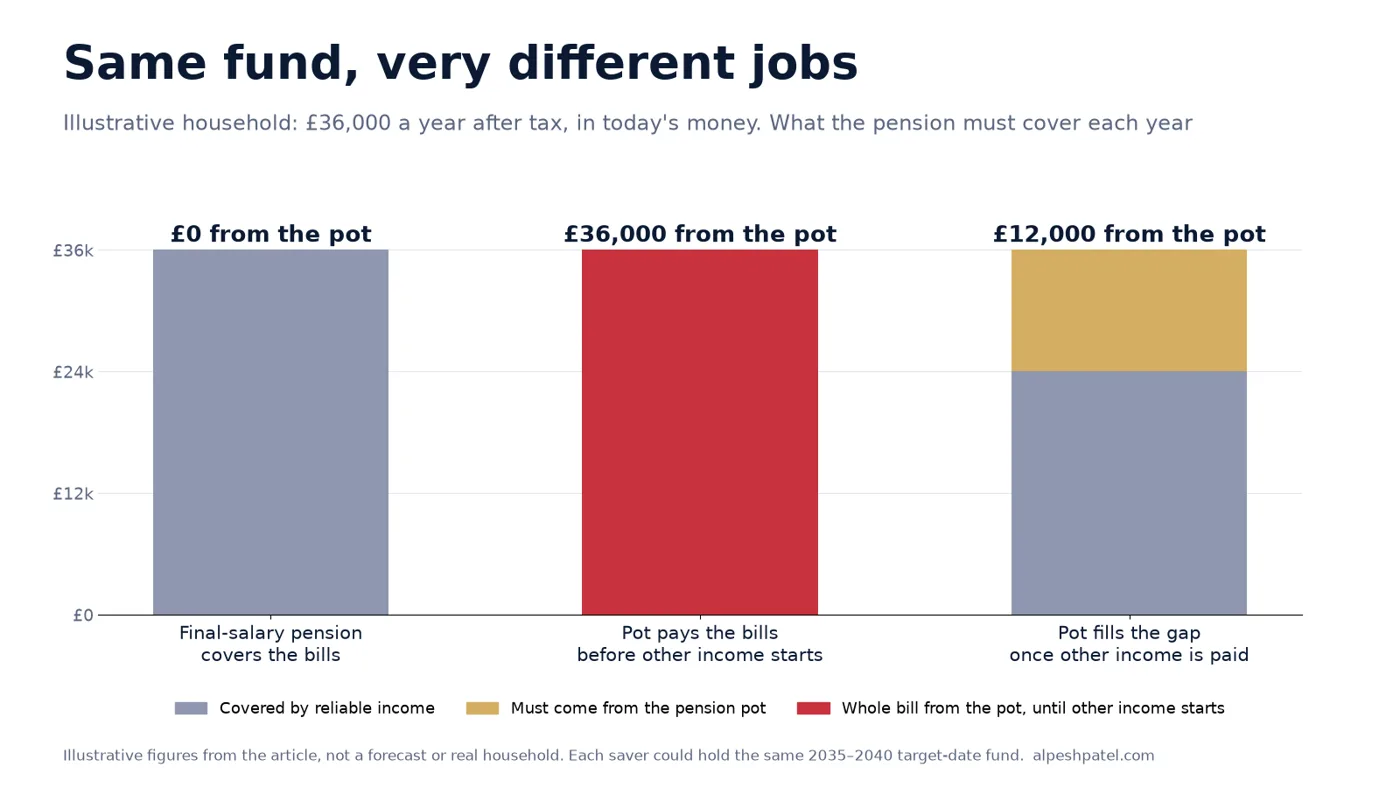
A portfolio built for you. Two people retiring in 2038 can need very different portfolios. One has a final-salary pension covering the bills. The other needs the pot to pay them from day one. A self-run portfolio can be shaped to your own risk profile and spending dates, not an average saver's.
That is the trade. You give up having someone else make the decisions. In exchange you get control, transparency and a portfolio that fits you. Whether that trade is worth it depends on the skills you bring.
What skills do I need to manage my own pension?
You do not need to be a professional. You do need a process, written down before you move a penny. These are the six skills I would want any self-directed investor to have.
1. Knowing your number and your dates
Work out how much you will spend each year, when your State Pension and any other income starts, and the gap your portfolio must fill. Use the free Pension Plan (opens in a new tab) tool to test contributions and growth rates, FIRE (opens in a new tab) to test an early retirement date and the build a retirement income guide to plan withdrawals.
2. Choosing a mix and sizing positions
Decide what share of your money goes into shares, bonds and cash, and the most you will hold in any one fund, share or market. Portfolio Odds (opens in a new tab) lets you explore the chance of a loss for a given mix under its assumptions.
3. Selecting investments by rules, not tips
Know what each fund or share is there to do, what it costs and what would make you replace it. Check that two funds with different names do not own the same companies.
4. Rebalancing and selling to a plan
Write down when you will rebalance and what would make you sell. A pension you can change at any time is only an advantage if you do not change it every time markets give you a fright.
5. Staying disciplined when markets fall
This is the hardest skill. Morningstar estimates that the average dollar invested in US funds earned 8.7% a year over the ten years to 31 December 2025, about 1.2 percentage points a year less than the funds themselves returned. The gap came from the timing of investors' buying and selling. Morningstar Mind the Gap (opens in a new tab) Investors in set-and-forget strategies such as target-date funds captured the largest share of their funds' returns. Morningstar Magazine (opens in a new tab) If you cannot sit still, a default fund may serve you better.
6. Running the admin
Pick a platform whose charges suit your pot size, keep records and know the tax rules on withdrawals. The run your own SIPP guide covers the practical steps.
Before you move anything: the checks
You may not need to leave L&G to get more control. Most workplace schemes let you switch to other funds within the scheme. Check what your employer's section offers in the L&G Fund Centre (opens in a new tab) first.
Keep your employer's contributions. If you are still working, your employer pays into the workplace scheme. Moving your existing pot does not have to mean stopping new contributions. Ask whether you can transfer what you have built up while staying in the scheme.
Get the details in writing. Before any transfer, ask L&G and your employer in writing whether you would lose anything. That includes guarantees, guaranteed annuity rates, protected tax-free cash or a protected pension age, bonuses, death benefits and exit fees.
Know the advice rule. If you have safeguarded benefits, such as a final-salary pension, worth more than £30,000, the law requires you to take advice from an FCA-authorised adviser before transferring them. FCA (opens in a new tab) A standard workplace pot like the Lifetime Advantage Fund is usually not safeguarded, but check whether any part of your pension is.
Watch for scams. Action Fraud figures cited by The Pensions Regulator show £17.7 million was reported lost to pension fraud in 2023, an average of nearly £47,000 per person. The FCA estimates fewer than one in five scams are reported. The Pensions Regulator (opens in a new tab) Be wary of cold calls, "free pension reviews" from firms you have not heard of, promises of guaranteed high returns and pressure to act quickly. Check any firm on the FCA Register.
What to do next
- Find your fund code and charge. Your annual statement or your employer's L&G website shows the exact fund and what you pay.
- Compare like with like. Use the table above to see how other funds in your scheme have done, and remember that higher returns came with higher risk.
- Put numbers on your plan. Run your spending and dates through Pension Plan (opens in a new tab) and FIRE (opens in a new tab).
- Score yourself on the six skills. Be honest about the discipline one. If a skill is missing, learn it before you move.
- Check in writing before any transfer. Benefits, fees, employer contributions and the firm you are moving to.
Want a disciplined process you can run yourself? Book your free call with Alpesh's team. We will show you how self-directed investors choose a mix, size positions and decide when to sell, so the control you gain is matched by a plan you can stick to.
Frequently asked questions
Can I move my pension out of L&G?
Usually yes. Most workplace pots can be transferred to another pension such as a SIPP, and many schemes also let you switch funds without leaving. Ask L&G in writing about exit fees and any benefits you might lose first.
Are L&G pension charges high?
Generally not. In the WorkSave Mastertrust, total charges for the 2035–2040 Lifetime Advantage Fund ranged from 0.30% to 0.45% a year, and from 0.10% to 0.47% for the Global Developed Equity Index Fund, depending on the employer. The trustees did note that the Lifetime Advantage Funds are slightly less competitive on cost than some rivals' private-markets funds.
Which L&G fund has performed best?
Over the five years to 31 March 2026, the share-only index funds led the funds compared here, at around 11% a year. They also carry the most risk and can fall hardest in a crash. Past performance is not a reliable indicator of future results.
What skills do I need to manage my own pension?
Knowing your spending number and dates, choosing a mix and sizing positions, selecting investments by rules, rebalancing and selling to a plan, staying disciplined in falling markets and handling the admin. Discipline matters most: investors lose returns by buying and selling at the wrong times.
Do I need financial advice to transfer my L&G pension?
The law requires advice only for safeguarded benefits worth more than £30,000, such as a final-salary pension. A standard workplace pot is usually not safeguarded, but check in writing before you transfer.
About Alpesh Patel OBE
Alpesh Patel OBE is Founding Principal of Rootbridge Capital, an author and Dealmaker for the UK Government's Department for Business. He is a former Visiting Fellow in Business, Corpus Christi College, Oxford University, where he worked on technology to improve financial education.
Sources
- Legal & General, WorkSave Mastertrust (RAS) chair's statement 2026 (opens in a new tab), returns to 31 March 2026 and charges for the year to 31 March 2026
- Legal & General, Workplace employee Fund Centre: Lifetime Advantage (opens in a new tab)
- AJ Bell, SIPP charges and rates (opens in a new tab)
- Vanguard, Personal Pension (opens in a new tab)
- Morningstar, Mind the Gap US 2026 (opens in a new tab)
- Morningstar Magazine, Green bonds have conventional appeal (opens in a new tab) (Mind the Gap findings on target-date funds)
- Financial Conduct Authority, Advising on pension transfers: our expectations (opens in a new tab)
- The Pensions Regulator, Working together to strengthen our defences against scams (opens in a new tab)
- Alpesh Patel OBE, Start Here: How to Take Control of Your Own Pension (opens in a new tab) (YouTube)
Important: This article is for education only and is not personal financial advice or a recommendation to buy or sell any investment. This article is general investment education only and is not regulated investment advice. The value of investments can go down as well as up, and you may get back less than you invest. Past performance is not a reliable indicator of future results.
Important: this article is education and information only. It is not financial advice or a personal recommendation, and it does not take your circumstances into account. The value of investments and pensions can fall as well as rise, and you may get back less than you put in. Past performance is not a reliable indicator of future results. Figures were correct when the article was written and may have changed. If you are unsure what is right for you, speak to a regulated financial adviser.