One-Off Fee or a Percentage Every Year? What Each Really Costs Over 20 Years
A question came up on a call with my team this month that I hear more and more. Someone with a portfolio of around half a million pounds had been offered two very different ways to pay for help. One was a percentage of the portfolio every year. The other was a single fixed fee, paid once. Which one, they asked, actually costs less?
It sounds like a small choice. It is not. The Financial Conduct Authority found that the average ongoing advice charge was 0.8% a year (opens in a new tab), and that over 80% of ongoing advice fees were set at 0.5%, 0.75% or 1%. On half a million pounds, 1% is £5,000 in the first year alone, and it grows as your portfolio grows.
This article puts the one-off fee vs percentage fee question into pounds. It runs the numbers on illustrative £250,000, £500,000 and £1 million portfolios over 10 and 20 years, shows what each type of fee buys you, and lists the costs that never go away whichever you choose.
Short answer: On an illustrative £500,000 portfolio growing at 6% a year, a 1% ongoing fee costs about £276,000 over 20 years, against £15,000–£30,000 for a one-off £5,000–£10,000 fee. But a one-off fee does not remove platform, fund, dealing or FX costs, and it only makes sense if you have a process to run the money yourself.
Weighing up an ongoing fee against running your own portfolio? Book your free call with Alpesh's team. We will show you how self-directed investors pick, size and review their investments with a written process. There is nothing to buy on the call.
One-off fee vs percentage fee: what is the difference?
A percentage fee, often called an ongoing adviser charge, is taken from your portfolio every year. It is usually quoted as something like 0.75% or 1%. You rarely write a cheque for it. It is deducted quietly, monthly or quarterly, so many investors never see the total in pounds.
A one-off fee is a fixed sum paid once. It might buy a plan, a portfolio review, a piece of advice, or education that helps you run the money yourself. After that, nothing more is due unless you choose to pay for more.
The key difference is what happens as your money grows. A percentage fee grows with your portfolio. A fixed fee does not. The FCA's own rules recognise this: firms must make clear that a percentage-based ongoing charge may increase as the fund grows (opens in a new tab).
What do financial advisers typically charge in the UK?
The best independent data comes from the regulator. In its evaluation of the Retail Distribution Review, the FCA found average charges of 2.4% of the amount invested for initial advice and 0.8% a year for ongoing advice (opens in a new tab). Those figures do not include the underlying platform and fund charges.
An earlier FCA survey of advice firms found the median ongoing charge for investment advice was between 0.5% and 0.75% (opens in a new tab), depending on how much was invested. For £500,000 or more, the middle 90% of firms charged between 0.3% and 1%.
Once you add the investment costs underneath, the total climbs. The FCA has said that total annual fees for holistic financial advice, covering both advice and investment charges, are approximately 1.9% (opens in a new tab), against about 0.8% for automated advice.
So the 0.75% to 1% range used below is not a worst case. It is the adviser layer alone, before anything else is added.
What does a percentage fee cost over 10 and 20 years?
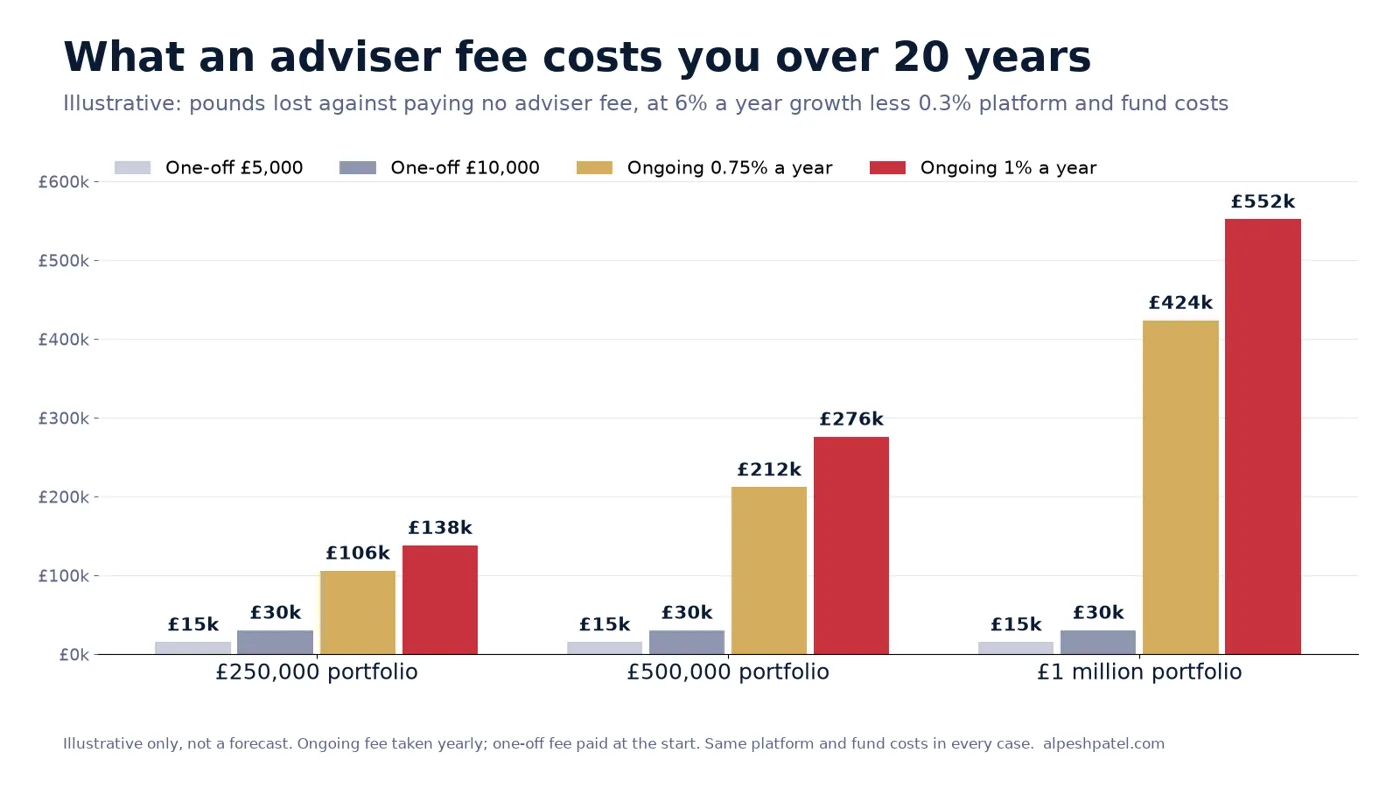
Here is the comparison in pounds. The example is illustrative: it assumes 6% a year growth before costs, every year, with no withdrawals or top-ups. Every scenario pays the same 0.3% a year in platform and fund costs, roughly what a capped platform and a low-cost global index fund might cost. The only thing that changes is the adviser fee.
The one-off fees of £5,000 and £10,000 are round illustrative numbers, not any firm's price. They are taken from the portfolio on day one, so you also lose the growth on that money.
| Illustrative | Years | No adviser fee | One-off £5,000 | One-off £10,000 | Ongoing 0.75% a year | Ongoing 1% a year |
|---|---|---|---|---|---|---|
| £250,000 | 10 | £435,201 | £426,497 | £417,793 | £403,641 | £393,588 |
| £250,000 | 20 | £757,600 | £742,448 | £727,296 | £651,704 | £619,646 |
| £500,000 | 10 | £870,402 | £861,698 | £852,994 | £807,282 | £787,176 |
| £500,000 | 20 | £1,515,199 | £1,500,047 | £1,484,895 | £1,303,407 | £1,239,292 |
| £1,000,000 | 10 | £1,740,804 | £1,732,100 | £1,723,396 | £1,614,563 | £1,574,352 |
| £1,000,000 | 20 | £3,030,399 | £3,015,247 | £3,000,095 | £2,606,814 | £2,478,584 |
Illustrative only, not a forecast. Growth of 6% a year less 0.3% platform and fund costs; ongoing fee deducted at the end of each year. Returns are not guaranteed and real portfolios rise and fall.
Now look at the gap. On £500,000 over 20 years, a 1% ongoing fee leaves you about £276,000 worse off than paying no adviser fee. At 0.75% the gap is about £212,000. A one-off £10,000 costs about £30,000 by the end, once you count the growth that money would have earned.
Source: Alpesh Patel OBE calculations, November 2026. Illustrative; assumes 6% a year growth before costs and 0.3% a year platform and fund costs in every case.
Why the gap grows so fast
Two things happen at once. First, the fee itself rises because it is a percentage of a growing pot. On £1 million, the 1% fee in year one is about £10,600, and by year 20 it is well over £24,000 a year.
Second, every pound taken in fees stops compounding. On £500,000 at 1%, the fees actually deducted over 20 years add up to about £168,000. The other £108,000 of the gap is growth those fees would have earned had they stayed invested. That second part never appears on a statement.
Where is the break-even point?
A fixed fee is front-loaded, so the ongoing fee looks cheaper at first. On £500,000, a 0.75% fee is roughly £4,000 in year one. A one-off £10,000 is matched in under three years. On £1 million, it is matched in little more than a year.
Over a short period, say one or two years, a percentage fee can cost less. Over a decade or more, it almost never does on these sizes. This is why the length of time you expect to pay matters more than the headline rate.
What hidden costs does a one-off fee not remove?
This is the part most comparisons leave out. A one-off fee replaces the adviser layer. It does not touch the other layers, and you keep paying those whichever route you choose.
- Platform fee. The account charge for holding your investments. AJ Bell's SIPP charges 0.25% on the first £250,000 of funds and 0.10% on the next £250,000 (opens in a new tab), with no charge above £500,000. Vanguard's Personal Pension charges 0.15% a year, capped at £375 (opens in a new tab).
- Fund charges (OCF). The ongoing charges figure of each fund you hold. A broad index fund such as the Vanguard FTSE Global All Cap Index Fund charges 0.23% (opens in a new tab). Many active funds charge far more.
- Dealing charges. A fee each time you buy or sell. AJ Bell charges £1.50 a fund deal and £5 a share deal (opens in a new tab) online.
- FX charges. Buying US shares means converting pounds to dollars. Hargreaves Lansdown charges 0.99% on the first £10,000 of each deal (opens in a new tab), falling on larger amounts. On a £5,000 US share purchase that is about £50 before dealing.
- Stamp duty. Buying UK shares electronically usually costs 0.5% Stamp Duty Reserve Tax (opens in a new tab). No fee structure avoids it.
Even the 0.3% in the table above is not small. On £500,000 over 20 years at 6% growth, that 0.3% costs about £88,000 compared with no costs at all. Low is not zero, which is why it pays to check platform and fund charges with the same care as the adviser fee. My post on the three layers of True Potential fees shows how to add these up in pounds from a real statement.
What do you get for each kind of fee?
Cost only matters next to what you get. The two kinds of fee buy different things, and it is worth being clear about which one you need.
An ongoing percentage fee usually buys a continuing relationship: regular reviews, rebalancing, someone to call, and in many cases the adviser choosing and managing the investments. The FCA says firms can only take an ongoing charge if they actually provide an ongoing service (opens in a new tab), and must tell you how to cancel it.
The FCA has reviewed whether firms are delivering the ongoing services that consumers have paid for (opens in a new tab). If you pay every year, you are entitled to ask what you received last year.
A one-off fee usually buys something defined: a plan, a single piece of advice, a review, or education that teaches you a method. After that, the decisions are yours. That is the point. You keep the control, and you keep the compounding.
The catch is obvious. A one-off fee only beats an ongoing fee if you will actually run the money well afterwards. Without a process, a one-off fee can leave you with a plan you never follow. With one, it can save you six figures over 20 years.
What should you ask before paying either fee?
Before you sign up for either, put these questions to the firm in writing. A good firm will answer them clearly.
- What is the total cost in pounds this year? Adviser fee, platform fee, fund charges and transaction costs, added together. Not a range of percentages.
- What exactly do I get for the fee? How many reviews a year, what is in each one, and who makes the investment decisions.
- How does the fee change as my portfolio grows? Is there a cap or a tier that falls on larger sums?
- Is a one-off fee really one-off? Ask whether further fees apply for reviews, updates or extra support later.
- What does it cost to leave? Exit fees, transfer fees and any charges for selling funds that only exist on one platform.
- What will I be able to do myself afterwards? If you are paying for education or a plan, ask what written process you will have at the end.
My earlier piece on what 1% a year really costs in wealth management fees has more questions for your next annual review.
Why owning your process matters more than the fee
Fees are the easy part to measure. What really decides the outcome is whether you have a written process and stick to it: how you choose an investment, how much you put in each one, and when you sell or rebalance.
That is what lets you take the cheaper route with confidence. Someone with a clear process can keep platform and fund costs low, avoid paying a percentage for decisions they can make themselves, and build a portfolio that fits their own risk profile rather than a model portfolio built for thousands of clients.
It also gives you transparency. When you run your own portfolio, you can see every holding and every charge. There is no layer you do not understand.
You can test how different fees affect your own numbers with the free calculators on my tools page, and see the range of outcomes your portfolio might face with Portfolio Odds (opens in a new tab). If fees are the main thing that brought you here, my guide on how to cut fees and charges is a good next read.
What to do next
- Find your total cost in pounds. Take last year's statements and add the adviser fee, platform fee, fund charges and transaction costs. Most people are surprised by the total.
- Run the 20-year version. Put your own portfolio size and fee into the table approach above, or into one of the free calculators on my tools page.
- Ask the six questions in writing. Whether you are paying a percentage now or being offered a one-off fee, get the answers on paper.
- Check the hidden layers. Compare your platform fee and fund charges with low-cost alternatives. These stay with you on either route.
- Write your process down. One page: how you pick, how you size, when you sell. If you cannot write it, that is what to work on first. My guide on how to review your adviser can help you start.
Want to see what owning your own process looks like? Book your free call with Alpesh's team. We will talk through how self-directed investors keep costs down and decisions clear. There is nothing to buy on the call.
Frequently asked questions
Is a one-off fee cheaper than a percentage fee?
Over long periods it usually is, because a percentage fee grows with your portfolio and compounds against you. In the illustrative example above, 1% a year on £500,000 costs about £276,000 over 20 years, against about £30,000 for a one-off £10,000. Over one or two years, a percentage fee can cost less.
What is a typical ongoing adviser charge in the UK?
FCA research found an average ongoing advice charge of 0.8% a year, and over 80% of ongoing fees were set at 0.5%, 0.75% or 1%. That excludes platform and fund charges, which are added on top.
Does a one-off fee remove platform and fund charges?
No. You still pay the platform's account charge, the ongoing charges of the funds you hold, dealing fees, FX fees on overseas shares and stamp duty on UK shares. Check these separately, because they can add up to tens of thousands of pounds over 20 years.
Can I cancel an ongoing adviser charge?
Firms must tell you how to cancel an ongoing service. Check your client agreement for notice periods and whether your investments can stay where they are if you leave.
How do I work out what my fees cost in pounds?
Add every layer from your annual cost and charges statement: adviser, platform, funds and transactions. Then multiply the percentage by your portfolio value, and remember that the cost grows as the portfolio grows.
About Alpesh Patel OBE
Alpesh Patel OBE is Founding Principal of Rootbridge Capital, an author and Dealmaker for the UK Government's Department for Business. He is a former Visiting Fellow in Business, Corpus Christi College, Oxford University, where he worked on technology to improve financial education.
Sources
- Financial Conduct Authority, Evaluation of the impact of the Retail Distribution Review and the Financial Advice Market Review (opens in a new tab) (December 2020)
- Financial Conduct Authority, CP22/24: Broadening access to financial advice for mainstream investments (opens in a new tab) (November 2022)
- Financial Conduct Authority, Survey of firms providing financial advice (opens in a new tab) (April 2016)
- Financial Conduct Authority, Adviser charging rules (opens in a new tab)
- Financial Conduct Authority, Ongoing financial advice services (opens in a new tab)
- FCA Handbook, COBS 6.1A Adviser charging and remuneration (opens in a new tab)
- AJ Bell, SIPP charges and rates (opens in a new tab) (checked 20 November 2026)
- Vanguard, Personal Pension (opens in a new tab) (checked 20 November 2026)
- Vanguard, FTSE Global All Cap Index Fund (opens in a new tab) (checked 20 November 2026)
- Hargreaves Lansdown, Overseas share dealing (opens in a new tab) (checked 20 November 2026)
- GOV.UK, Tax when you buy shares (opens in a new tab)
- Alpesh Patel OBE, Hidden Pension Fees: Print This Before Investing (Simple Steps!) (opens in a new tab) (YouTube)
Important: This article is for education only and is not personal financial advice or a recommendation to buy or sell any investment. This article is general investment education only and is not regulated investment advice. The value of investments can go down as well as up, and you may get back less than you invest. Past performance is not a reliable indicator of future results.
Important: this article is education and information only. It is not financial advice or a personal recommendation, and it does not take your circumstances into account. The value of investments and pensions can fall as well as rise, and you may get back less than you put in. Past performance is not a reliable indicator of future results. Figures were correct when the article was written and may have changed. If you are unsure what is right for you, speak to a regulated financial adviser.