Rathbone Global Opportunities Fund Review: Returns, Costs and Control
Since James Thomson took charge in November 2003, the Rathbone Global Opportunities Fund has returned 1,246.59%, against 649.30% for the average fund in its IA Global sector, according to Hargreaves Lansdown's August 2026 fund update (opens in a new tab) (Lipper data to 31 July 2026). Few UK fund managers can show a record like that over more than two decades.
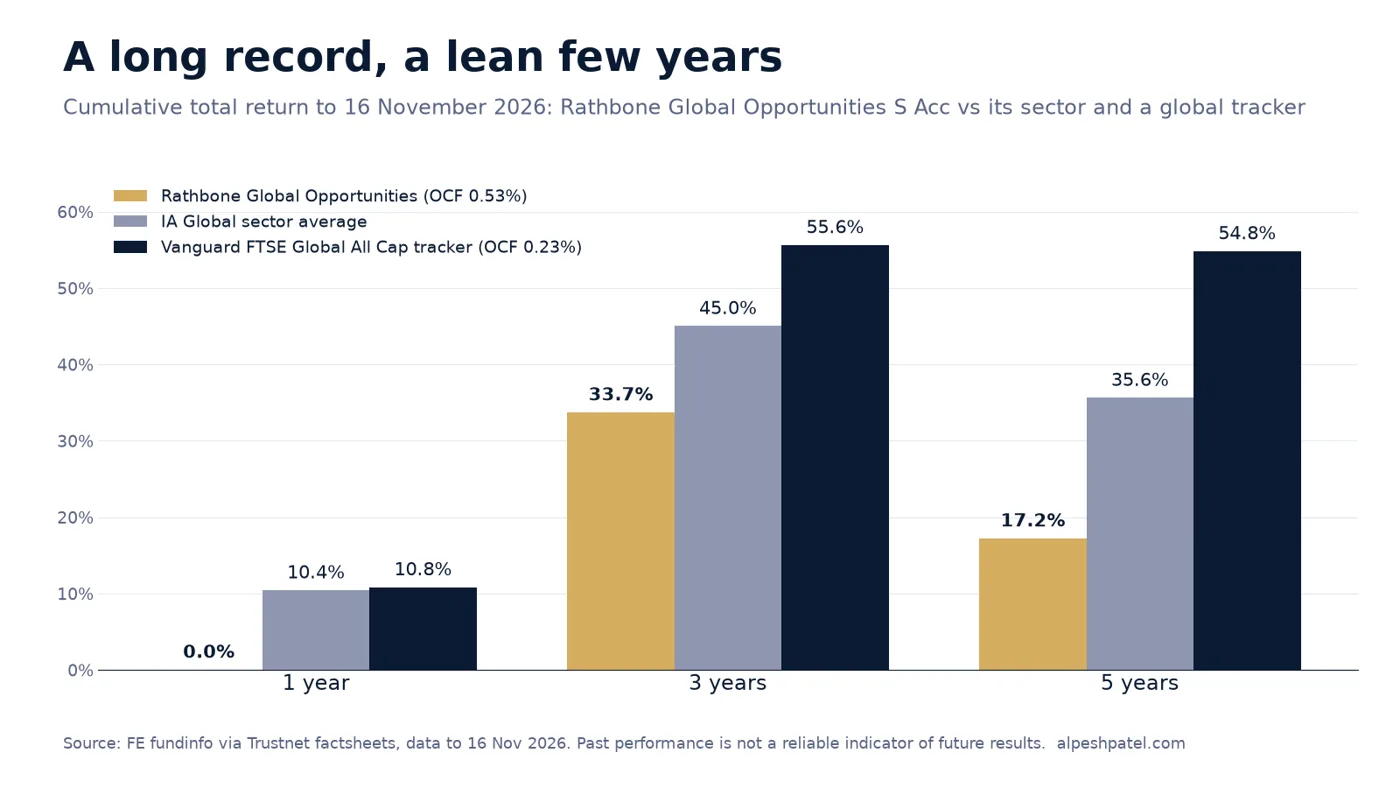
Now the surprising part. Over the five years to 16 November 2026, the same fund returned 17.2%. The IA Global sector average returned 35.6%, and a low-cost global tracker, Vanguard FTSE Global All Cap, returned 54.8% (Trustnet, Rathbone Global Opportunities S Acc (opens in a new tab); Trustnet, Vanguard FTSE Global All Cap (opens in a new tab)).
Both facts are true at once. That is why a Rathbone Global Opportunities Fund review is really a question about who makes your investment decisions, what you pay them and how much of the process you can see. Many investors hold the fund directly; many more hold it inside a Rathbones discretionary portfolio, where a second layer of fees sits on top.
Short answer: The Rathbone Global Opportunities Fund is a concentrated, growth-focused global share fund with a strong long-term record under James Thomson, but it has trailed its sector and global trackers over one, three and five years. Its ongoing charge is 0.53% to 0.79% depending on share class. Inside a Rathbones Bespoke portfolio, Rathbones' own example puts total costs at 1.80% a year on £500,000.
Holding a well-known fund or a wealth manager and wondering what you are really paying for? Book your free call with Alpesh's team. We will walk through the process self-directed investors use to choose, size and review their investments. There is nothing to buy on the call.
What is the Rathbone Global Opportunities Fund?
It is a UK unit trust launched on 9 May 2001 and run by Rathbones Asset Management, the fund arm of Rathbones Group. Its stated aim is to beat the IA Global sector, after fees, over any five-year period, investing at least 80% in global shares (Fidelity key statistics (opens in a new tab); Trustnet (opens in a new tab)).
James Thomson has been lead manager since 1 November 2003, with Sammy Dow as deputy manager since July 2014. The fund was worth £2,954 million on 16 November 2026 (Trustnet (opens in a new tab)), down from £4,063 million in Rathbones' September 2025 factsheet (Rathbones factsheet, 30 September 2025 (opens in a new tab)).
The style is quality growth. Rathbones describes it as a stock-picking fund that searches developed markets for "innovative and scalable businesses that are growing fast", avoids emerging markets and commodity companies, and keeps a defensive bucket of steadier businesses (Rathbones factsheet (opens in a new tab)). Fidelity's September 2026 review puts that defensive allocation at about 20% of the fund and describes a portfolio of 40 to 60 companies (Fidelity (opens in a new tab)).
What does the fund own?
These were the ten largest holdings at 30 September 2026, as published on Trustnet (opens in a new tab):
| Holding | Weight |
|---|---|
| CrowdStrike | 3.87% |
| Nvidia | 3.87% |
| Amphenol | 3.85% |
| Alphabet | 3.35% |
| Arm Holdings | 3.02% |
| Apple | 2.75% |
| Amazon | 2.62% |
| Microsoft | 2.61% |
| Schneider Electric | 2.48% |
| Next | 2.31% |
| Top ten combined | 30.73% |
Source: Trustnet (FE fundinfo) (opens in a new tab), holdings at 30 September 2026. Top-ten total is the sum of the listed weights.
No single holding is above 4%, so the fund is concentrated by number of companies rather than by any one bet. Its September 2025 factsheet listed 50 holdings, 74.2% in the US and 94.14% in large companies (Rathbones factsheet (opens in a new tab)).
In its September 2026 quarterly update, Rathbones said the fund held around 26% in technology against about 37% for the FTSE World index, and that it has never owned emerging markets or Japan, or oil and gas producers (Rathbones quarterly update, September 2026 (opens in a new tab)). Those deliberate gaps explain much of the recent shortfall.
How has the Rathbone Global Opportunities Fund performed?
Source: FE fundinfo via Trustnet factsheets, data to 16 November 2026. Past performance is not a reliable indicator of future results.
| To 16 November 2026 | 1 year | 3 years | 5 years | Ongoing charge |
|---|---|---|---|---|
| Rathbone Global Opportunities S Acc | 0.0% | 33.7% | 17.2% | 0.53% |
| IA Global sector average | 10.4% | 45.0% | 35.6% | n/a |
| Vanguard FTSE Global All Cap Index A Acc | 10.8% | 55.6% | 54.8% | 0.23% |
| Fund's sector quartile | 4th | 3rd | 4th |
Sources: Trustnet, Rathbone Global Opportunities S Acc (opens in a new tab); Trustnet, Vanguard FTSE Global All Cap (opens in a new tab). Cumulative total returns in sterling.
Rathbones' own figures tell the same story. To 30 September 2026, the I-class units returned -0.9% over one year, 33.9% over three years and 21.7% over five, against 13.3%, 47.5% and 44.3% for the sector (Rathbones quarterly update (opens in a new tab)). Thomson called it "a frustrating year", saying the market has rewarded AI, semiconductors and energy, areas the fund deliberately underweights or avoids.
The long view is kinder. Using Fidelity's year-by-year figures for the I-class to 30 September, the fund grew about 179% over the ten years to 30 September 2026, roughly 10.8% a year (Fidelity performance (opens in a new tab)). Trustnet reported in October 2026 that it had slipped to the second quartile of its sector over ten years, despite five calendar years of top-quartile returns in the past decade (Trustnet (opens in a new tab)).
So the fund has done what concentrated growth funds do. It had a strong run, then a long patch where its style was out of favour. Nobody knows in advance when that turns.
What are the risks?
The fund published a risk category of 6 on the 1-to-7 scale in its Key Investor Information Document, as shown in its 2025 annual report (Rathbone Global Opportunities annual report 2025 (opens in a new tab)). That is towards the higher end, as you would expect from an all-share fund.
FE fundinfo shows three-year volatility of 11.42% and an FE fundinfo Risk Score of 106 (Trustnet (opens in a new tab)). In calendar 2022 the S-class fell 20.4% while the sector fell 11.1%. Growth funds can fall harder than the average when interest rates rise.
There is also concentration in a theme. Several top holdings are linked to AI and US technology. Anyone who also holds a global tracker will own many of the same companies twice.
Rathbones as a wealth manager: what does it cost?
Rathbones Group is not only a fund house. It is one of the UK's largest discretionary wealth managers. Its combination with Investec Wealth & Investment (UK) completed on 21 September 2023 (Rathbones (opens in a new tab)), and the group reported £121.1 billion of funds under management and administration and more than 118,000 clients at 30 September 2026 (Rathbones investment case (opens in a new tab)).
In a discretionary service, the investment manager buys and sells for you without asking first. Rathbones' October 2026 schedule of charges for direct Bespoke clients sets the annual management fee, plus VAT, at (Rathbones schedule of charges (opens in a new tab)):
| Portfolio value band | Annual fee (plus VAT) |
|---|---|
| First £1,000,000 | 1.10% |
| Next £1,000,000 | 1.00% |
| Next £2,000,000 | 0.75% |
| Balance over £4,000,000 | 0.60% |
| Minimum fee | £750 a quarter |
The fee covers dealing, custody and reporting, with no set-up, exit or platform charges. Fund charges and stamp duty come on top (Rathbones schedule of charges (opens in a new tab)).
Rathbones' own brochure gives a worked example for £500,000 in a Bespoke portfolio, investment management only: £5,500 fee, £1,100 VAT and £2,400 typical third-party charges, a total of £9,000 or 1.80% a year. With wealth management (financial planning) added, the example rises to £10,800, or 2.16% (Rathbones private client brochure, March 2024 (opens in a new tab)).
What would that cost over 10 and 20 years?
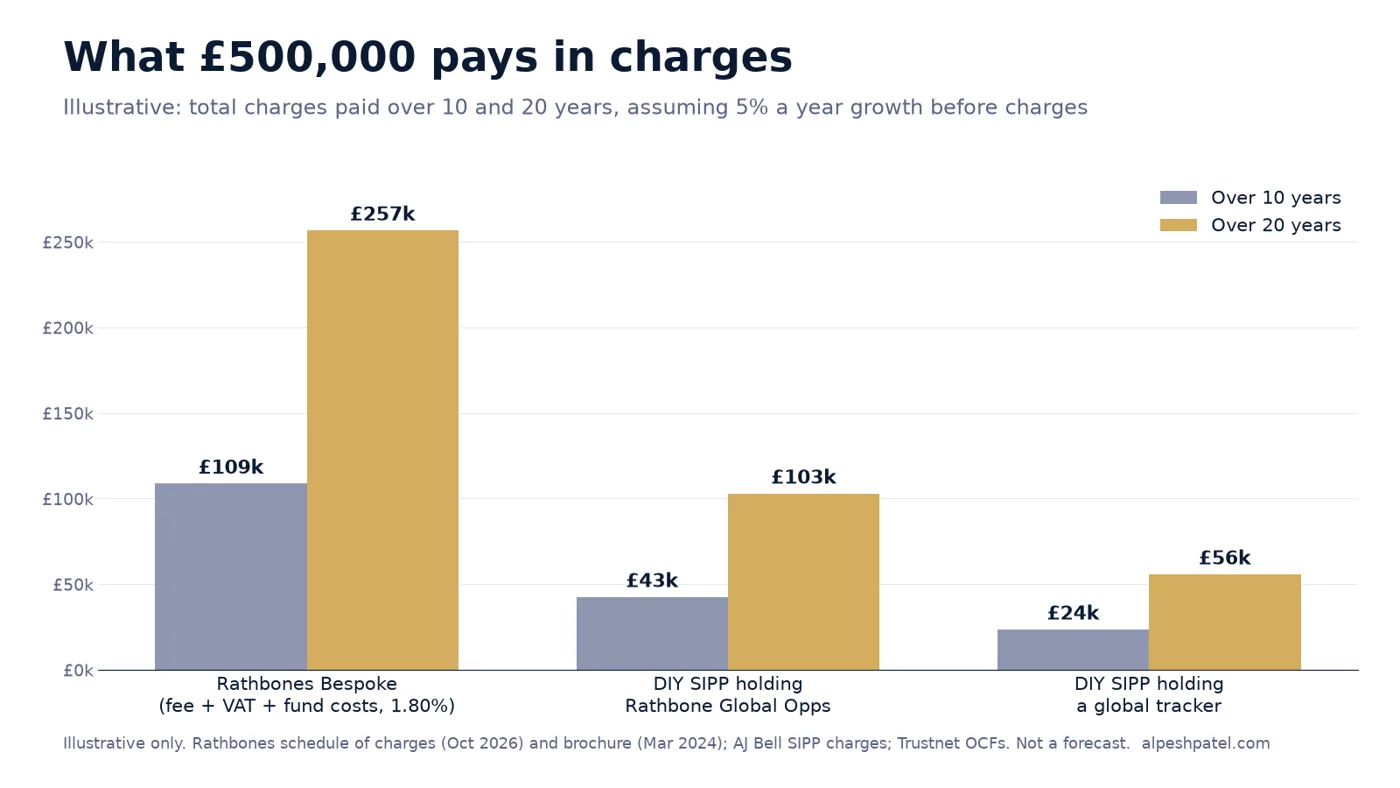
Source: illustrative calculation using the Rathbones schedule of charges (October 2026) and brochure (March 2024), AJ Bell SIPP charges and Trustnet ongoing charges. Not a forecast.
This is an illustration, not a prediction. It assumes £500,000 growing at 5% a year before charges, with charges taken each year on the portfolio value.
| Illustrative, £500,000 at 5% a year before charges | First-year charges | Charges paid over 10 years | Value after 10 years | Charges paid over 20 years | Value after 20 years |
|---|---|---|---|---|---|
| Rathbones Bespoke: 1.10% fee + VAT + 0.48% fund costs | £9,000 | £108,884 | £679,169 | £256,785 | £922,541 |
| AJ Bell SIPP holding Rathbone Global Opportunities (0.53%) | £3,525 | £42,605 | £761,573 | £103,050 | £1,165,596 |
| AJ Bell SIPP holding a global tracker (0.23%) | £2,025 | £23,659 | £785,025 | £55,880 | £1,238,733 |
Assumptions: Rathbones tiers and VAT from its schedule of charges (opens in a new tab); 0.48% typical third-party charges from its brochure (opens in a new tab); AJ Bell at 0.25% on the first £250,000, 0.10% on the next £250,000 and nil above £500,000, excluding £1.50 fund deals (AJ Bell (opens in a new tab)). Same returns before charges in every row.
Over 20 years, the gap between the first and last rows is about £316,000 in this illustration. Part of that is what you pay for having a professional manage your money, meet you and take the decisions. Whether that is good value depends on what the service does for you, not on the number alone. My guide to what a 1% wealth management fee really costs works through the same maths at other pot sizes.
How much do you see and decide with a wealth manager?
With a discretionary manager, you agree a mandate and risk level, and the manager makes the trades. Rathbones says Bespoke clients get direct access to their investment manager, a personalised portfolio, 24/7 online access and an annual costs report in their December valuation (Rathbones schedule of charges (opens in a new tab)).
That suits many people. You do not have to research, trade or hold your nerve alone in a crash, and that has real value.
What you give up is the decision itself. You see what was bought after it was bought. You may hold in-house funds, such as Rathbones' own, alongside direct shares, and you rely on the manager's judgement of your risk.
What do you gain by managing your own money?
Control. You decide what to own, how much of each and when to sell. You can hold a fund like Rathbone Global Opportunities if its style fits your plan, or not.
Transparency. Every holding and every charge is visible in pounds, on your own platform statement. You know why your portfolio moved.
A portfolio bespoke to your own risk profile. It is built around your spending dates, other pensions, ISAs and how much of a fall you can tolerate, not a model portfolio's average client.
That is the trade-off. You give up having someone do it for you. In exchange you get control, transparency and a portfolio shaped to you. It can be done, but only with a written process: how you pick, how you size positions and when you sell. Our run your own SIPP guide and the cheapest SIPP for drawdown comparison cover the practical side.
The free tools help you test a plan before moving a penny. Pension Plan (opens in a new tab) projects contributions and growth, FIRE (opens in a new tab) tests an early retirement date and Portfolio Odds (opens in a new tab) shows the chance of a loss for a given mix under its assumptions.
Before you move anything: the checks
Ask for your full costs in writing. Request your latest annual costs and charges statement, and any exit or transfer charges. Rathbones' Bespoke schedule says it does not charge set-up, exit or transfer fees (Rathbones (opens in a new tab)), but check your own terms.
Think about tax. Selling shares outside an ISA or pension can create a capital gains tax bill. Ask whether holdings can be moved "in specie", without selling.
Check pension benefits. If any money is in a pension, ask in writing whether you would lose guarantees, protected tax-free cash or a protected pension age. If you have safeguarded benefits, such as a final-salary pension, worth more than £30,000, you must take advice from an FCA-authorised adviser before transferring them (FCA (opens in a new tab)).
Watch for scams. Action Fraud figures cited by The Pensions Regulator show £17.7 million was reported lost to pension fraud in 2023, an average of nearly £47,000 per person, and the FCA estimates fewer than one in five scams are reported (The Pensions Regulator (opens in a new tab)). Be wary of cold calls and promises of guaranteed returns, and check any firm on the FCA Register.
What to do next
- Find your share class and charge. I-class and S-class units of the same fund carry different ongoing charges, from 0.79% to 0.53% (Trustnet, I Acc (opens in a new tab); Trustnet, S Acc (opens in a new tab)).
- Compare like with like. Check the fund against its sector and a global tracker over one, three, five and ten years. The disappointing funds page tracks well-known funds that trail their sector.
- Add up your total costs in pounds. Management fee, VAT, fund charges and any platform fee, on your own portfolio value.
- Decide who should make the decisions. If you want control, write down how you will pick, size and sell before you move.
- Test your plan. Run your numbers through Pension Plan (opens in a new tab) and the build a retirement income guide.
Want a disciplined process you can run yourself? Book your free call with Alpesh's team. We will show you how self-directed investors choose a mix, size positions and decide when to sell, so the control you gain is matched by a plan you can stick to.
Frequently asked questions
Is the Rathbone Global Opportunities Fund a good fund?
It has a strong record since James Thomson took over in 2003, but it has trailed the IA Global sector over one, three and five years to 16 November 2026. Whether it suits you depends on your plan, your other holdings and whether you accept long spells when its growth style is out of favour.
What is the ongoing charge of Rathbone Global Opportunities?
Trustnet lists 0.53% for the S Acc units and 0.79% for the I Acc units. Fidelity lists 0.55% for the S Acc units plus 0.06% transaction costs. Platform or wealth manager fees come on top.
How much does Rathbones charge to manage my money?
For direct Bespoke clients, Rathbones' October 2026 schedule charges 1.10% a year on the first £1 million, 1.00% on the next £1 million, then lower rates, plus VAT, with a £750 quarterly minimum. Fund charges are extra; Rathbones' own £500,000 example totals 1.80% a year.
Did Rathbones merge with Investec?
Yes. Rathbones Group combined with Investec Wealth & Investment (UK) in an all-share deal that completed on 21 September 2023, when Investec Wealth & Investment (UK) became part of the Rathbones Group.
About Alpesh Patel OBE
Alpesh Patel OBE is Founding Principal of Rootbridge Capital, an author and Dealmaker for the UK Government's Department for Business. He is a former Visiting Fellow in Business, Corpus Christi College, Oxford University, where he worked on technology to improve financial education.
Sources
- Trustnet (FE fundinfo), Rathbone Global Opportunities Fund S Acc GBP (opens in a new tab), performance to 16 November 2026, holdings at 30 September 2026
- Trustnet (FE fundinfo), Rathbone Global Opportunities Fund I Acc GBP (opens in a new tab)
- Trustnet (FE fundinfo), Vanguard FTSE Global All Cap Index A Acc GBP (opens in a new tab)
- Rathbones Asset Management, Rathbone Global Opportunities quarterly update, September 2026 (opens in a new tab)
- Rathbones Asset Management, Rathbone Global Opportunities factsheet, S-class, 30 September 2025 (opens in a new tab)
- Rathbones Asset Management, Rathbone Global Opportunities Fund annual report 2025 (opens in a new tab)
- Fidelity, Rathbone Global Opportunities S Acc key statistics (opens in a new tab) and I Acc performance (opens in a new tab)
- Fidelity, Rathbone Global Opportunities: a tried and tested approach (opens in a new tab)
- Hargreaves Lansdown, Rathbone Global Opportunities: August 2026 fund update (opens in a new tab)
- Trustnet, Rathbone Global Opportunities: six signs the market will keep broadening out (opens in a new tab)
- Rathbones Investment Management, Schedule of charges for direct private clients (Bespoke), October 2026 (opens in a new tab)
- Rathbones, Private client brochure, March 2024 (opens in a new tab)
- Rathbones, Completion of the combination with Investec Wealth & Investment UK (opens in a new tab)
- Rathbones, Investment case (opens in a new tab)
- AJ Bell, SIPP charges and rates (opens in a new tab)
- Financial Conduct Authority, Advising on pension transfers: our expectations (opens in a new tab)
- The Pensions Regulator, Working together to strengthen our defences against scams (opens in a new tab)
- Alpesh Patel OBE, DIY Investing vs Fund Managers: The Real Numbers (opens in a new tab) (YouTube)
Important: This article is for education only and is not personal financial advice or a recommendation to buy or sell any investment. This article is general investment education only and is not regulated investment advice. The value of investments can go down as well as up, and you may get back less than you invest. Past performance is not a reliable indicator of future results.
Important: this article is education and information only. It is not financial advice or a personal recommendation, and it does not take your circumstances into account. The value of investments and pensions can fall as well as rise, and you may get back less than you put in. Past performance is not a reliable indicator of future results. Figures were correct when the article was written and may have changed. If you are unsure what is right for you, speak to a regulated financial adviser.