Danica Pension Review: Why Medium Risk Can Be the Costliest Place to Sit for 22 Years
A question I hear more and more from savers in Denmark, and from people who have moved abroad with a Danish pension, goes like this. "I have about 22 years until I retire. My pension is with Danica and it sits in the medium-risk option. Is that sensible?"
It sounds like the safe, grown-up choice. Not too much risk, not too little. In this Danica Pension review I want to show why, for someone two decades from retirement, medium risk is often a compromise that behaves exactly like one. The falls are barely softened, while the gains are noticeably trimmed.
I will also look at the second thing almost nobody checks on a Danish pension: the full annual cost, including the insurance you are paying for inside the scheme.
Short answer: Danica's medium-risk profile fell 14.2% in 2022, slightly more than global shares, yet captured only about 60% to 80% of their gains in the strong years since. With 22 years to go, that trade-off compounds into a large gap. Check your total yearly cost, including insurance premiums, before deciding anything.
Sitting in a medium-risk pension with 20 years or more to go? Book your free call with Alpesh's team. We will walk through how self-directed investors choose, size and review their investments. There is nothing to buy on the call.
What is Danica Pension and how does Danica Balance work?
Danica Pension is one of Denmark's largest pension companies. It sells largely through its partnership with Danske Bank and managed DKK 549 billion of customer savings at the end of the third quarter of 2026, according to its Q1–Q3 2026 interim report (opens in a new tab). That is roughly €74 billion or £61 billion.
Its main market-rate product is Danica Balance (opens in a new tab), which the company describes as its most widely used pension product. You pick a risk profile (low, medium or high) and the mix of shares and bonds then shifts automatically as you get closer to retirement. Many workplace scheme members never make that choice actively; they simply end up in the default.
For readers outside Denmark, I will give rough euro and sterling figures alongside kroner. The krone is pegged to the euro at a central rate of 7.46038 DKK per euro (opens in a new tab), and the ECB reference rate (opens in a new tab) was about £0.83 per euro on 17 November 2026. So DKK 1 million is roughly €134,000, or about £112,000.
How has Danica's medium-risk option actually performed?
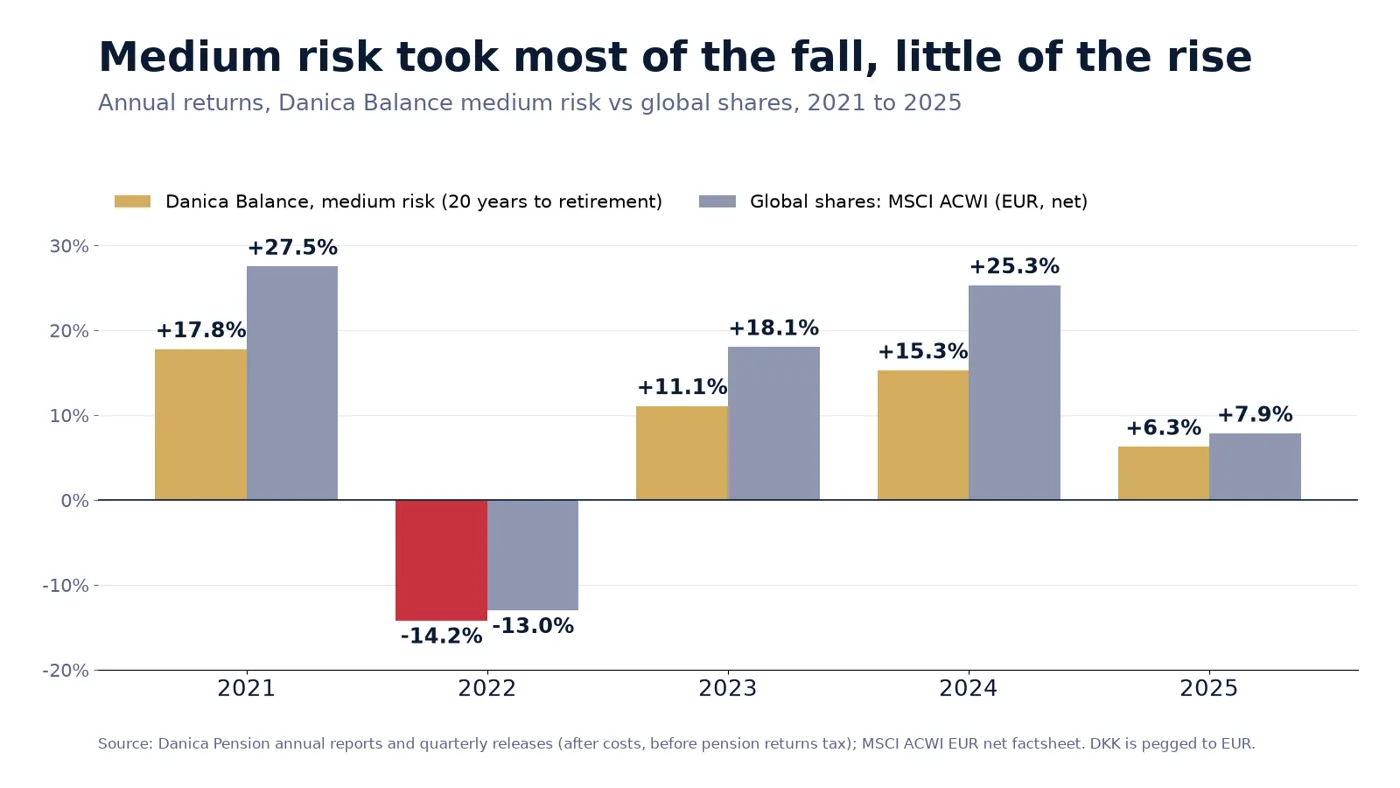
Here are the published returns for Danica Balance with medium risk, for a saver 20 years from retirement. These are after costs but before Denmark's 15.3% pension returns tax (PAL). Next to them I have put global shares, measured by the MSCI ACWI index in euros.
| Year | Danica Balance, medium risk (20 yrs to retirement) | Global shares (MSCI ACWI, EUR, net) | Share of the move captured |
|---|---|---|---|
| 2021 | +17.8% | +27.5% | about 65% |
| 2022 | −14.2% | −13.0% | about 109% of the fall |
| 2023 | +11.1% | +18.1% | about 61% |
| 2024 | +15.3% | +25.3% | about 60% |
| 2025 | +6.3% | +7.9% | about 80% |
Sources: Danica's 2022 annual report (opens in a new tab), 2023 results release (opens in a new tab) and 2025 results release (opens in a new tab); MSCI ACWI EUR net factsheet (opens in a new tab). The "captured" column is my own calculation.
Source: Danica Pension annual reports and results releases; MSCI ACWI EUR net factsheet.
Look at 2022. That was the year that was supposed to justify holding a medium-risk mix. Shares fell, but bonds fell hard too, so the "cushion" did not cushion. Danica's medium profile lost 14.2%, a touch more than global shares at −13.0%. Its own 2022 annual report (opens in a new tab) shows even the low-risk profile fell 13.1% for the same saver.
Then look at the good years. In 2023 and 2024 the medium profile captured roughly six-tenths of what global shares delivered. Compounded from 2022 to 2025, DKK 100 in the medium profile became about DKK 117, while the same amount in global shares became about DKK 139. Over the full five years from 2021, it was about DKK 138 against DKK 177.
Why does medium risk behave like a compromise?
A medium-risk mix is sold as balance. In practice it is a blend of two things that can both go wrong at once. When inflation and interest rates rose in 2022, bonds and shares fell together, so the investor took most of the downside anyway.
When markets recovered, the bond half of the portfolio was a drag. So the saver got diluted upside without much protection on the downside. That is the trade I would question hardest for anyone with two decades still to invest.
It is not only my view that Danica's medium option has lagged. A WTW review of 2025 Danish pension returns (opens in a new tab) for medium-risk savers 15 years from retirement put Danica Balance at 5.7%, against 10.9% at AP Pension's comparable product, 10.7% at Nordea and 9.8% at PFA. WTW linked much of the gap to Danica hedging only around half of its currency exposure in a year the dollar fell.
To be fair, 2026 has been better. Danica reported that a medium-risk saver 20 years from retirement made 9.6% in the first nine months of 2026, up from 4.7% a year earlier, in its Q1–Q3 2026 report (opens in a new tab). For comparison, the MSCI ACWI in euros was up about 17% in the year to the end of October 2026, according to its factsheet (opens in a new tab). One good year does not change the structure of the product.
Danica itself has also moved. From 1 April 2026 it raised the share of equities (opens in a new tab) in its Mix medium-risk profile. I read that as a quiet admission that the old mix was too timid for younger savers.
What does 22 years in the wrong mix cost?
This is where compounding turns a small-looking difference into a large one. The figures below are illustrative only, not forecasts of any fund.
Take a pot of DKK 1 million (about €134,000 or £112,000) and leave it for 22 years with no new money. At 5% a year it grows to about DKK 2.9 million. At 7% a year it grows to about DKK 4.4 million. The two-point gap is worth about DKK 1.5 million, roughly €200,000 or £168,000, on the same starting sum.
Now remember the pattern in the table. If your option loses roughly as much as shares in a bad year but gains only around 60% to 80% as much in a good one, a gap of a point or two a year is not an extreme assumption. Over 22 years, that is the costliest place to sit.
There is a counter-argument and it deserves a hearing. Higher equity exposure means bigger falls in bad years, and some people will panic and sell at the bottom. If that is you, a more cautious mix may genuinely be better than a strategy you abandon. The answer is a written plan you will stick to, not a default you never chose.
What are the real costs on a Danica pension?
Danish pensions bundle several things into one product: administration, investment and insurance. To compare them, Danish providers publish ÅOP (annual costs as a percentage) and ÅOK (annual costs in kroner). Danica's cost statement methodology (opens in a new tab) explains that total ÅOK is made up of costs on savings plus costs on insurance, and ÅOP is that total divided by your year-end balance.
On the investment side, Danica says expected 2026 ÅOP for its Balance funds ranges from 0.42% to 1.17%, on its Danica Balance page (opens in a new tab). On top of that, its list of direct charges for company schemes (opens in a new tab) shows a contribution charge of 3.0% to 4.0% of regular premiums up to DKK 63,200 a year, a minimum administration charge of DKK 84 a month and a guarantee charge of 0.25% a year if you choose a guarantee.
Here is the part most people miss. Under Danica's method, only the administration loading on your insurance counts in ÅOK and ÅOP. The insurance premiums themselves, for loss of earning capacity, death cover, critical illness and health insurance, are shown as separate lines in your account summary. So a headline ÅOP of under 1% can sit alongside an insurance bill that, for some members, is a bigger annual deduction than the investment charge.
As an illustrative example only: on a DKK 600,000 pot, an all-in ÅOP of 0.8% is DKK 4,800 a year. If your insurance premiums add another DKK 6,000 a year, the true annual deduction is closer to DKK 10,800, or about €1,450 (£1,200). Your own figures will differ. The point is to look.
| Cost line on a Danish pension | Where to find it | What to ask |
|---|---|---|
| ÅOP / ÅOK (savings) | Annual statement, provider website | Is this above 0.5% for a mostly passive mix? |
| Contribution charge | Scheme's list of charges | What percentage of each payment is taken? |
| Insurance premiums | Account summary (kontooversigt) | What cover do I have, and do I still need all of it? |
| Guarantee charge | List of charges | Am I paying for a guarantee I did not choose? |
| Exit or transfer fee | List of charges | What would it cost to move? |
Should you cancel the insurance inside your pension?
No, not on the strength of this article. Cover for loss of earning capacity can be valuable, especially if you have a family or a mortgage, and it may be hard or expensive to replace privately at an older age. In many workplace schemes some cover is compulsory.
What I suggest is simpler. Know what you are paying for, check whether the cover sums still match your life and ask whether any optional elements duplicate cover you already have elsewhere. Make changes only with replacement cover in place and, ideally, after speaking to a Danish pension specialist.
Can you move or change a Danica pension?
Within Danica Balance you can usually change risk profile, and Danica charges a fee of DKK 1,050 for a change of strategy, according to its list of charges (opens in a new tab). The same document lists a transfer or early payout fee of DKK 2,225.
Moving a Danish pension out of the scheme, or to another country, is a different matter. The rules depend on whether it is a workplace or private scheme, how it has been taxed and where you now live. A Danish pension and tax specialist should confirm what is possible for your scheme before you act. Be wary of anyone who contacts you out of the blue offering to "unlock" a pension.
How I would think about it with 22 years to go
My own approach is to manage my money with a written process: how I pick what to own, how much of each and when I sell or rebalance. That gives control, transparency and a portfolio built around my own risk profile rather than a default.
For a long horizon, that usually means a larger share in low-cost global shares, with any defensive holdings there because you chose them, not because a product bundled them in. I have written about using a global equity index fund for retirement income and about what a 1% yearly fee really costs. A broad index fund such as the Vanguard FTSE Global All Cap (opens in a new tab), which has an ongoing charge of 0.23%, shows what low cost can look like in the UK, though Danish savers will have their own local options.
If you want to stress-test a plan, the portfolio odds tool (opens in a new tab) and the probability calculator (opens in a new tab) let you see a range of outcomes rather than one hopeful number. There are more on the tools page.
What to do next
- Log in to your Danica account and write down your risk profile, years to retirement and the last five years of returns.
- Find your ÅOP and ÅOK, then list each insurance premium separately from your account summary.
- Compare your option's returns with a global share index over the same years, as in the table above.
- Decide, in writing, how much risk you actually want for a 22-year horizon and what you will do in a 20% fall.
- Before moving or cancelling anything, ask a Danish pension and tax specialist to confirm the consequences for your scheme.
If you also hold pensions in the UK, my guide on whether to combine your pensions and the build a retirement income goal page may help.
Want a second pair of eyes on your pension's risk level and costs? Book your free call with Alpesh's team. We will show you how a written process for picking, sizing and reviewing investments works in practice. There is nothing to buy on the call.
Frequently asked questions
Is Danica Pension a bad pension provider?
Not necessarily. Danica is large and regulated, and its returns in 2026 so far have been respectable. The issue in this review is narrower: whether a medium-risk default suits someone with two decades to invest, and whether you know your full annual cost.
What did Danica Balance medium risk return in 2022?
For a saver 20 years from retirement, Danica reported a loss of 14.2% after costs and before pension returns tax in its 2022 annual report. Global shares in euros fell about 13.0% that year, so the medium mix did not soften the fall.
What is ÅOP on a Danish pension?
ÅOP is the annual cost as a percentage of your savings, and ÅOK is the same cost in kroner. Under Danica's method they include administration, investment costs and the admin loading on insurance, but not the insurance premiums themselves, which appear as separate lines.
Should I switch from medium to high risk?
That depends on your time horizon, other savings and how you would react to a large fall. With 22 years to go, the case for more equity exposure is strong for many people, but only if you would hold through bad years. Write the rule down before you switch.
About Alpesh Patel OBE
Alpesh Patel OBE is Founding Principal of Rootbridge Capital, an author and Dealmaker for the UK Government's Department for Business. He is a former Visiting Fellow in Business, Corpus Christi College, Oxford University, where he worked on technology to improve financial education.
Sources
- Danica Pension, Q1–Q3 2026 interim report (opens in a new tab)
- Danica Pension, Annual Report 2022 (opens in a new tab)
- Danica Pension, 2023 results press release (opens in a new tab)
- Danica Pension, 2025 results press release (opens in a new tab)
- Danica Balance product page (Danish) (opens in a new tab)
- Danica: changes to the Mix medium-risk profile (opens in a new tab)
- Danica Balance returns (English) (opens in a new tab)
- Danica Balance list of direct charges (opens in a new tab)
- Danica cost statement methodology 2025 (Danish) (opens in a new tab)
- WTW, 2025 Danish pension returns review (opens in a new tab)
- MSCI ACWI Index (EUR, net) factsheet (opens in a new tab)
- Danmarks Nationalbank, exchange rates (opens in a new tab)
- ECB euro reference rate, GBP (opens in a new tab)
- Vanguard FTSE Global All Cap Index Fund (opens in a new tab)
- YouTube: Your Pension Trapped in the Wrong Fund? (opens in a new tab)
Important: This article is for education only and is not personal financial advice or a recommendation to buy or sell any investment. This article is general investment education only and is not regulated investment advice. The value of investments can go down as well as up, and you may get back less than you invest. Past performance is not a reliable indicator of future results.
Important: this article is education and information only. It is not financial advice or a personal recommendation, and it does not take your circumstances into account. The value of investments and pensions can fall as well as rise, and you may get back less than you put in. Past performance is not a reliable indicator of future results. Figures were correct when the article was written and may have changed. If you are unsure what is right for you, speak to a regulated financial adviser.