Fisher Investments Purisima Fund: What a New Retiree Should Check Before Drawdown
Someone who has just retired asked my team a simple question recently. Most of their pension, somewhere between £500,000 and £1 million, sits in one managed fund: the Fisher Investments Purisima Global Total Return Fund, B shares. The rest is in a couple of small exchange-traded funds, including a world quality-factor ETF. Drawdown starts next April. Is this the right set-up for the years ahead?
Here is the figure that frames the answer. The B shares carry an ongoing charge of 1.51% a year, according to Fidelity's factsheet (opens in a new tab). On £500,000 that is about £7,550 a year, every year, before any pension wrapper charge. A broad global index fund such as the Vanguard FTSE Global All Cap Index Fund (opens in a new tab) charges 0.23%, or £1,150.
To be fair to Fisher, the fund has beaten that index fund over most recent years, after its higher charges. This is not a story about a bad fund. It is about what changes when the money starts paying you an income, and whether you want one manager making every decision.
Short answer: The Fisher Investments Purisima Global Total Return Fund is a UK OEIC run by Fisher with an ongoing charge of 1.51% (B shares). Its net returns have mostly beaten a global index fund since 2018, but it is 100% shares, rated 6 out of 7 for risk, and fell harder in 2022. Before drawdown, check cost, concentration and a cash buffer.
About to start drawdown with most of your pension in one fund? Book your free call with Alpesh's team. We will walk through how self-directed investors build, size and review a retirement portfolio. There is nothing to buy on the call.
What is the Fisher Investments Purisima fund?
Purisima Investment Funds is a UK open-ended investment company (OEIC), registered number IC 162 and authorised by the FCA as a UCITS fund. It has three sub-funds: Global Total Return, UK Total Return and EAFE Total Return. Fisher Investments, the US firm founded by Ken Fisher, is the investment manager, as it explains on its own Purisima page (opens in a new tab). The fund's operator, or authorised corporate director, is Waystone Management (UK) Limited, according to the FCA register (opens in a new tab).
The Global Total Return Fund launched in April 2002 and held about £16.3 billion at 31 October 2026, of which £13.5 billion sat in the B share class (ISIN GB0031428468), according to the FT fund tearsheet (opens in a new tab). Its comparison index is the MSCI World. No individual fund manager is named; the manager is listed as "Not Disclosed".
The fund's objective is a total return over a "typical market cycle", which Fisher defines as seven years. Its policy allows it to move into bonds and cash when the manager is worried about a severe or prolonged downturn, and its key information says it may not suit people who plan to withdraw their money within seven years, as the This is Money fund page (opens in a new tab) quotes. That last line matters for anyone about to start drawing an income.
How much does Fisher Investments charge?
For UK private clients, Fisher usually manages the money inside this OEIC. Fisher's client relationship summary filed with the US SEC (dated 25 March 2024) sets out the terms: on assets in the fund, Fisher takes an annual management fee of 1.50% through the B shares for holdings up to £1,999,999, and 1.25% through the A shares from £2 million. Its separate account fee is waived on money in the fund. There is also an initial fee of 0.25% to 2.25% on money you put in, up to £3 million, reduced by Fisher Investments UK's £825 initial adviser charge. SEC Form CRS (opens in a new tab)
In other words, the 1.51% ongoing charge on the B shares already includes Fisher's management fee. The A shares, for £2 million or more, show an ongoing charge of 1.26% on Fidelity's A share factsheet (opens in a new tab). Fidelity lists transaction costs of a further 0.10% a year. What sits on top is the pension wrapper. Fisher's UK clients hold pensions through third-party SIPP providers, and Fisher does not publish those charges on its UK website. Ask for them in writing, in pounds.
| Illustrative yearly cost on £500,000 | Fund charge | Platform or wrapper | Total |
|---|---|---|---|
| Purisima Global Total Return B | £7,550 (1.51%) | Not published by Fisher | £7,550 plus SIPP fee |
| AJ Bell SIPP + global index fund | £1,150 (0.23%) | £875 | £2,025 |
| Vanguard Personal Pension + global index fund | £1,150 (0.23%) | £375 | £1,525 |
Sources: Fidelity (opens in a new tab); AJ Bell SIPP charges (opens in a new tab) (0.25% on the first £250,000 in funds, 0.10% on the next £250,000, nil above £500,000); Vanguard Personal Pension (opens in a new tab) (0.15%, capped at £375); Vanguard FTSE Global All Cap Index (opens in a new tab) (0.23%), an example, not a recommendation. Illustrative; excludes dealing costs.
What does 1.51% cost over 10 and 20 years?
Take an illustrative £500,000 growing at 5% a year before charges, with no withdrawals. At 1.51% a year, charges would total about £92,600 over ten years and £222,200 over twenty. At the AJ Bell example cost, they would total about £23,700 and £55,900. The pot at the higher cost would be about £85,500 smaller after ten years and about £260,100 smaller after twenty.
That assumes the same return before charges, which will not happen. The point is that 1.51% is the hurdle Fisher must clear each year just to match a cheap index fund. My guide to what a 1% wealth management fee really costs shows the same maths at other fee levels.
Has the Purisima fund beaten a global index fund?
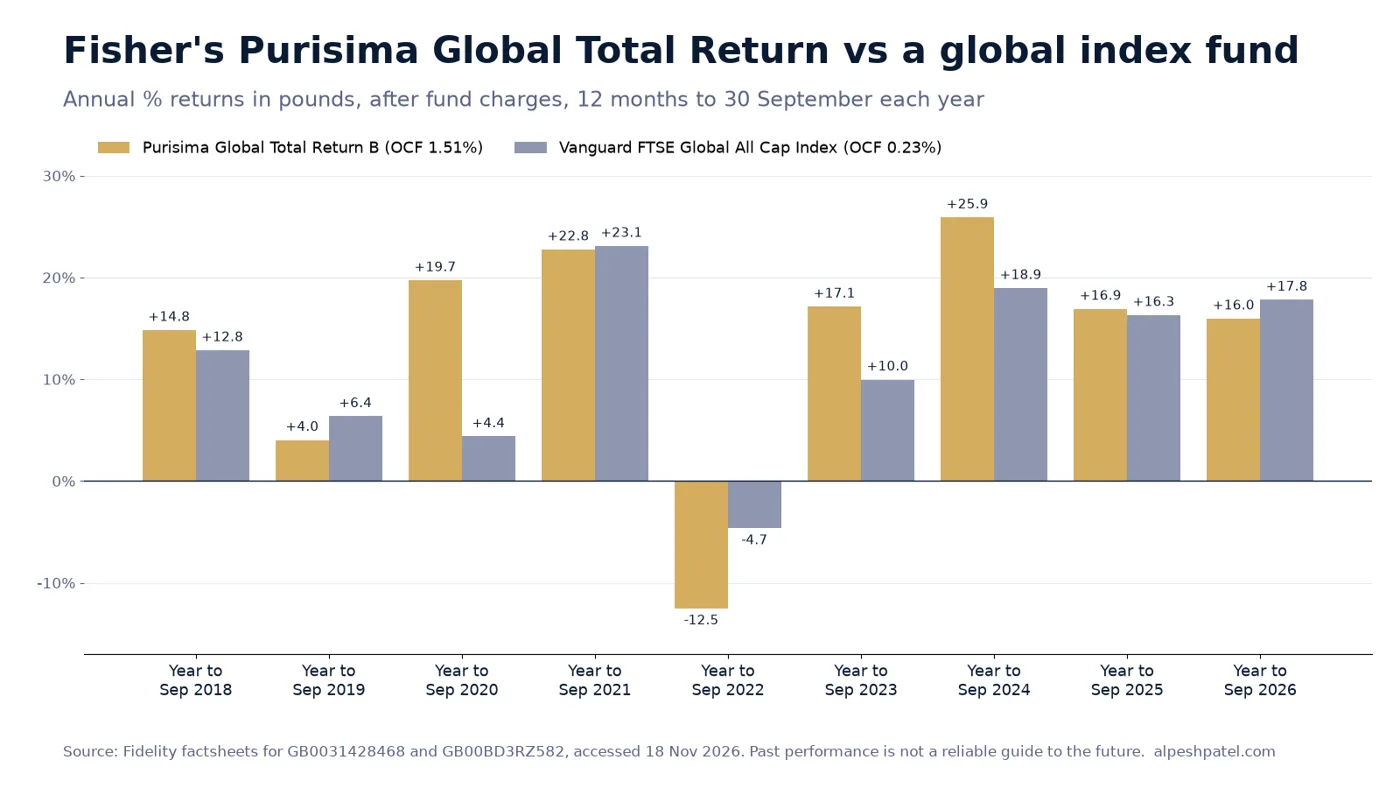
On the figures Fidelity publishes, mostly yes. In the nine years to 30 September 2026, the B shares beat the Vanguard FTSE Global All Cap Index Fund in six, after charges. Compounding Fidelity's annual figures, the fund roughly tripled (+207%) against +163% for the index fund. Over the five years to 30 September 2026, it returned about +75% against +71%.
Source: Fidelity performance pages for Purisima Global Total Return B (opens in a new tab) and Vanguard FTSE Global All Cap Index (opens in a new tab), accessed 18 November 2026. Past performance is not a reliable indicator of future results.
Look at the shape, not only the total. The gap swings widely: +15 points ahead in the year to September 2020, 8 points behind in the year to September 2022, when the fund fell 12.5% and the index fund fell 4.7%. Fidelity puts the fund's five-year tracking error against its index at about 6% a year and its five-year volatility at 13.6%, with a risk indicator of 6 on a scale of 1 to 7. Fidelity risk and rating (opens in a new tab)
That is fine for a saver with decades to wait. It is harder to live with when you are selling units every month to pay the bills.
What does the fund actually hold?
At 30 September 2026 the fund was 100% in shares across 99 holdings, with about 31% in the top ten, according to Morningstar's factsheet (opens in a new tab). Nvidia was the largest at about 6%, followed by Microsoft, Alphabet, Amazon, Caterpillar, Broadcom, ASML, Merck and Goldman Sachs. Over 97% was in giant and large companies, against about 84% for its benchmark.
So "global" here means a large-cap portfolio with a heavy US technology tilt. The small quality-factor ETF alongside it, the iShares Edge MSCI World Quality Factor UCITS ETF (opens in a new tab) (IWFQ, 0.25% a year, 289 holdings), owns many of the same giant companies. The combined portfolio may be less diversified than it looks.
Is it risky to have 85% of your pension with one manager?
This is not about safety: the fund's assets are held by an independent depositary, Bank of New York Mellon (International), according to Trustnet (opens in a new tab). It is about decision risk. With about 85% in one fund, one investment committee decides your country mix, your sector bets, your top holdings and, crucially, when to move to cash. If that committee gets a big call wrong, there is nothing else in the portfolio to offset it.
Then there is how much you see and decide. You see a fund price and a monthly factsheet. You do not choose what is bought or sold, and you cannot keep a cash pot inside the fund for your next two years of income. For many people that is the point of paying a manager. For someone about to rely on the money, it is worth deciding consciously.
What is sequence-of-returns risk at the start of drawdown?
Sequence-of-returns risk is the danger that a bad year arrives just as you start withdrawing. Early losses do more damage than later ones, because units sold at low prices never recover for you.
Here is an illustration using the fund's real figures. Suppose £500,000 had started drawdown in October 2021, taking £25,000 (5%) in the first year. With the fund's 12.5% fall in the year to September 2022, the pot would have ended the year at about £412,000. With the index fund's 4.7% fall, about £452,000. That is a £40,000 gap from one year, before any recovery. Illustrative; it ignores charges outside the fund, timing of withdrawals and tax.
Three things reduce this risk, whoever runs the money.
- A cash or income buffer. Hold one to three years of planned withdrawals in cash or short-dated bonds, so you are not forced to sell shares in a falling year.
- A sensible withdrawal rate. The higher the rate, the less room for a bad start. Test your own rate rather than relying on a rule of thumb.
- A rule for bad years. Decide in advance what you will cut, and by how much, if the portfolio falls, and write it down before the first withdrawal.
The build a retirement income guide works through each of these, and my piece on using a global equity index fund for retirement income shows how a buffer changes the outcome.
Should you manage your own money instead?
This is the real trade-off. Managing your own pension means giving up having someone do it for you. In return you get three things.
Control. You decide the mix of shares, bonds and cash, how much sits in any one fund or share, and when you take income. Your buffer sits exactly where you want it.
Transparency. You see every holding and every charge in pounds, on your own platform. You know why the pot rose or fell last year.
A portfolio built for you. A pooled fund is run for thousands of clients at once. A self-run portfolio can be shaped around your own risk profile, your income needs and the date each pound will be spent.
Discipline is the catch. Morningstar's Mind the Gap 2026 study (opens in a new tab) found US fund investors earned 8.7% a year on their average dollar over the ten years to 31 December 2025, against 9.9% for the funds themselves, because of badly timed buying and selling. Doing it yourself only pays if you have a written process and stick to it.
You can test a plan with free tools first. Pension Plan (opens in a new tab) models how long a pot lasts at different withdrawal rates. Portfolio Odds (opens in a new tab) and Probability (opens in a new tab) show how often a given mix has lost money over different holding periods, under their assumptions, and the FIRE calculator (opens in a new tab) tests your income target. All are on the free tools page. The run your own SIPP guide covers the practical steps, and the cheapest SIPP for drawdown compares platform costs.
What should you check before moving away from Fisher?
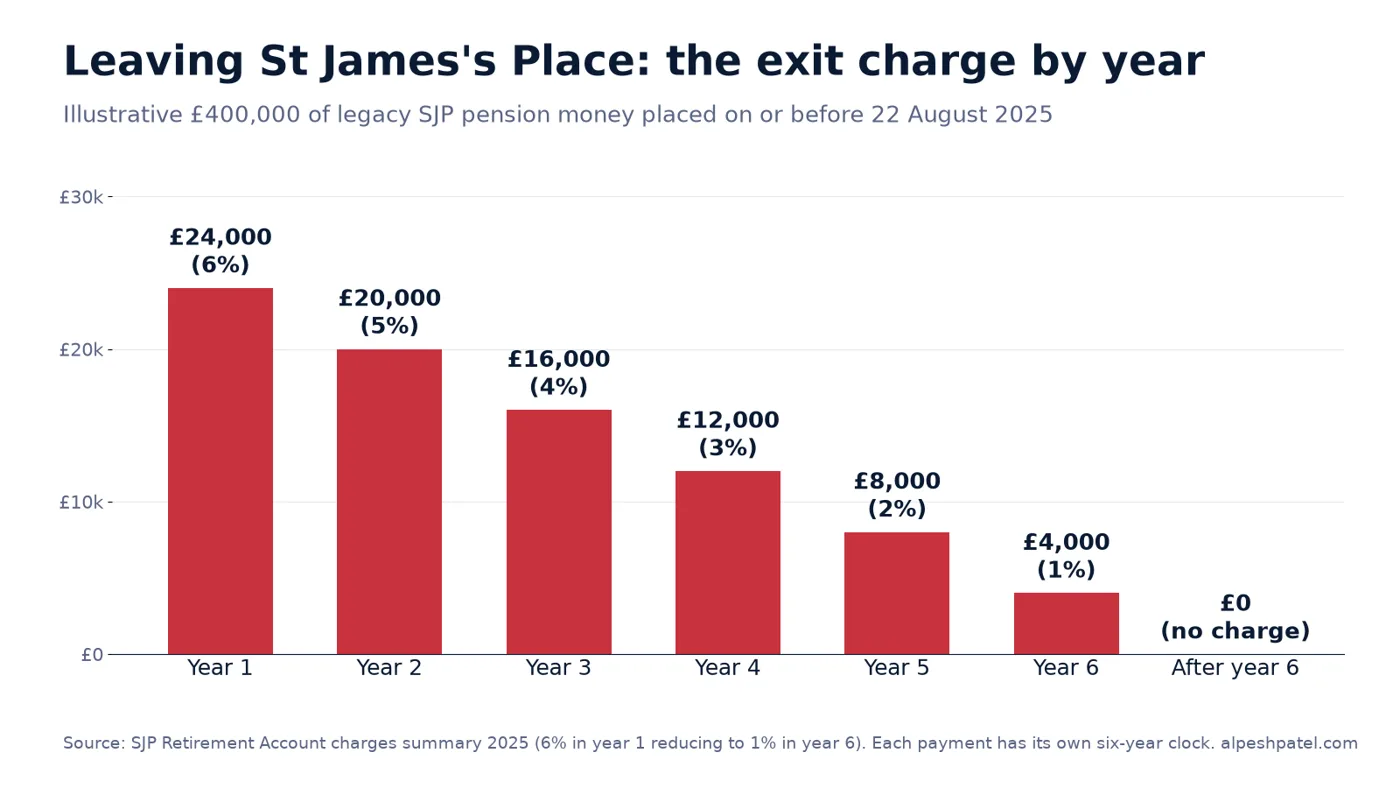
Ask what you would lose, in writing. Ask Fisher and your SIPP provider for every exit fee, any initial fee you would not get back, and any guarantee or protected benefit attached to the pension. Most SIPPs holding an OEIC have none, but confirm it before you move.
Check for safeguarded benefits. If any part of your pension has safeguarded benefits, such as a final salary pension, worth more than £30,000, you must take advice from an FCA-authorised adviser before transferring it. FCA (opens in a new tab)
Watch for scams. Action Fraud figures cited by The Pensions Regulator show £17.7 million was reported lost to pension fraud in 2023, an average of nearly £47,000 per victim, and fewer than one in five scams are thought to be reported. The Pensions Regulator (opens in a new tab) Be wary of cold calls, "free pension reviews" from firms you do not know and pressure to act fast. Check any firm on the FCA Register.
What to do next
- Get your full cost in pounds. Ask Fisher and your SIPP provider for every charge on your pension last year: fund, transaction, SIPP and any initial fees.
- Map what you actually own. Combine the fund's top holdings with your ETFs and see how much sits in the same giant companies.
- Plan your first three years of income. Decide your withdrawal rate and how much to hold in cash or short-dated bonds before next April.
- Test it. Run the plan through Pension Plan (opens in a new tab) and Portfolio Odds (opens in a new tab), including a bad first year.
- Write your process down. Whether you stay or self-manage, note what you hold, why, how much, and what would make you change it.
Want a written process for running your own retirement income? Book your free call with Alpesh's team. We will show you how self-directed investors pick investments, size positions, hold an income buffer and decide when to sell.
Frequently asked questions
What is the Fisher Investments Purisima fund charge?
The B shares have an ongoing charge of 1.51% a year and the A shares, for holdings of £2 million or more, 1.26%. These include Fisher's management fee. Transaction costs, initial fees and your SIPP provider's charges are extra.
Has the Purisima fund performed well?
After charges, it beat the Vanguard FTSE Global All Cap Index Fund in six of the nine years to September 2026, on Fidelity's figures. It also fell further in the year to September 2022. Past performance is not a reliable guide to the future.
Is the Purisima fund suitable for drawdown?
That depends on your plan. It is 100% shares and its own documents say it may not suit people withdrawing within seven years, so a separate cash or bond buffer for income matters.
Do I need advice to transfer my pension away from Fisher?
Not usually for a SIPP holding funds. You must take regulated advice if you have safeguarded benefits, such as a final salary pension, worth more than £30,000.
About Alpesh Patel OBE
Alpesh Patel OBE is Founding Principal of Rootbridge Capital, an author and Dealmaker for the UK Government's Department for Business. He is a former Visiting Fellow in Business, Corpus Christi College, Oxford University, where he worked on technology to improve financial education.
Sources
- Fisher Investments, Purisima: A name rooted in history and values (opens in a new tab)
- Financial Conduct Authority, FCA register: Purisima Investment Funds (opens in a new tab)
- Fisher Investments, Form ADV Part 3: Client Relationship Summary (opens in a new tab) (25 March 2024)
- Fidelity, Purisima Global Total Return B: key statistics (opens in a new tab)
- Fidelity, Purisima Global Total Return B: performance (opens in a new tab)
- Fidelity, Purisima Global Total Return B: risk and rating (opens in a new tab)
- Fidelity, Vanguard FTSE Global All Cap Index: performance (opens in a new tab)
- Fidelity, Purisima Global Total Return A: key statistics (opens in a new tab)
- Trustnet, Purisima Global Total Return PCG B factsheet (opens in a new tab)
- Financial Times, Purisima Global Total Return B tearsheet (opens in a new tab)
- Morningstar, Purisima Global Total Return B factsheet (opens in a new tab)
- This is Money, Purisima Global Total Return B overview (opens in a new tab)
- iShares, Edge MSCI World Quality Factor UCITS ETF (opens in a new tab)
- AJ Bell, SIPP charges and rates (opens in a new tab)
- Vanguard, Personal Pension (opens in a new tab)
- Vanguard, FTSE Global All Cap Index Fund (opens in a new tab)
- Morningstar, Mind the Gap 2026 (opens in a new tab)
- Financial Conduct Authority, Advising on pension transfers: our expectations (opens in a new tab)
- The Pensions Regulator, Working together to strengthen our defences against scams (opens in a new tab)
- Alpesh Patel OBE, Wealth Extraction vs. Accumulation: Why Most Retirees Get It Wrong (opens in a new tab) (YouTube)
Important: This article is for education only and is not personal financial advice or a recommendation to buy or sell any investment. This article is general investment education only and is not regulated investment advice. The value of investments can go down as well as up, and you may get back less than you invest. Past performance is not a reliable indicator of future results.
Important: this article is education and information only. It is not financial advice or a personal recommendation, and it does not take your circumstances into account. The value of investments and pensions can fall as well as rise, and you may get back less than you put in. Past performance is not a reliable indicator of future results. Figures were correct when the article was written and may have changed. If you are unsure what is right for you, speak to a regulated financial adviser.