Help Your Children Buy a Home or Fund Your Pension? Why Two Goals Need Two Plans
Almost a third of first-time buyers in England now get money from family or friends towards their deposit. The English Housing Survey 2024-25 (opens in a new tab) puts it at 31%, and the average first-time buyer deposit was £78,131. If you want to help your children buy a home, you are far from alone.
A situation my team hears often goes like this. Someone has built up four separate pension and investment pots over the years. They have two goals: a comfortable retirement, and helping their children onto the property ladder. One pot sits in a target-date fund aimed at 2035 to 2040. They want to know what "average growth" they can expect, and whether the money will be there for both.
The honest answer starts somewhere else. Before any growth rate, you need to know which pot is paying for which goal, and when. Two goals need two plans, and the pension is usually the worst pot to pay for a house.
Short answer: To help your children buy a home without damaging your retirement, give each goal its own plan. Write down roughly how much each child gets and when. Pension money is hard to reach before 57 from April 2028 and is mostly taxed as income, so house money usually works better coming from ISAs, savings or a child's own Lifetime ISA.
Trying to fund your retirement and help your children at the same time? Book your free call with Alpesh's team. We will look at how self-directed investors give each goal its own dates, pots and written process. There is nothing to buy on the call.
Why do two goals need two plans?
Retirement and a house deposit look like one pile of money. They are not. They have different dates, different amounts and different tolerance for a bad year in the markets.
Retirement income is a long goal. You may draw on it for 25 or 30 years, so most of it can stay invested through the ups and downs. A deposit is a short, fixed goal. If your child is buying in four years, a 20% fall in year three is a real problem, because there is no time to wait for a recovery.
When both goals share the same pots, one of two things tends to happen. Either the house money is invested too boldly for its date, or the retirement money is held too cautiously because part of it "might be needed soon". Separating them fixes both.
When can you actually get at your pension?
This is the part many people miss. Pension money is the hardest money you own to give away early.
Most personal pensions cannot normally be accessed before 55, according to GOV.UK (opens in a new tab). That age is rising. The normal minimum pension age increases from 55 to 57 on and after 6 April 2028, as set out in HMRC's policy paper (opens in a new tab). Some people have a protected pension age, so check your own scheme.
Then there is tax. You can usually take up to 25% of a pension as a tax-free lump sum, up to a maximum of £268,275, and the rest is usually taxed as income (GOV.UK lump sum allowance (opens in a new tab)). For 2026/27, income above the £12,570 personal allowance is taxed at 20%, 40% from £50,271 and 45% over £125,140 (GOV.UK Income Tax rates (opens in a new tab)).
So if you are still working and a higher-rate taxpayer, every pound you take out of a pension to hand to a child may lose 40p on the taxable part. That is before you count the growth the money would have earned for your own retirement.
Which pot should you use to help your children buy a home?
Start with a short list. For each child, write the rough amount and the rough year. "£40,000 for our eldest in about 2030" is enough. Then match each amount to the pot that can pay it on that date with the least tax and the least risk.
| Pot | When you can reach it | Tax when it comes out | Fit for a house deposit |
|---|---|---|---|
| Pension (SIPP, workplace, personal) | Not normally before 55, rising to 57 from 6 April 2028 | 25% usually tax-free; rest taxed as income | Poor, unless you are past minimum pension age and in a low tax band |
| Stocks and shares or cash ISA | Any time | None | Good: flexible and tax-free |
| General investment account | Any time | Capital gains tax may apply on gains | Reasonable; check gains first |
| Child's own Lifetime ISA | For their first home, 12 months after first payment | None if rules met; 25% bonus added | Very good if your child is 18 to 39 and buying up to £450,000 |
| Cash savings | Any time | Interest may be taxable | Good for money needed within a few years |
Sources: GOV.UK personal pensions (opens in a new tab), GOV.UK minimum pension age (opens in a new tab), GOV.UK ISAs (opens in a new tab), GOV.UK Lifetime ISA (opens in a new tab). A tax specialist should confirm how this applies to you.
ISAs are the natural home for money with a date. The ISA allowance is £20,000 for 2026/27 (GOV.UK (opens in a new tab)), and you can take money out at any time without tax. If you are building a deposit fund for a child over several years, an ISA keeps it separate, visible and easy to reach.
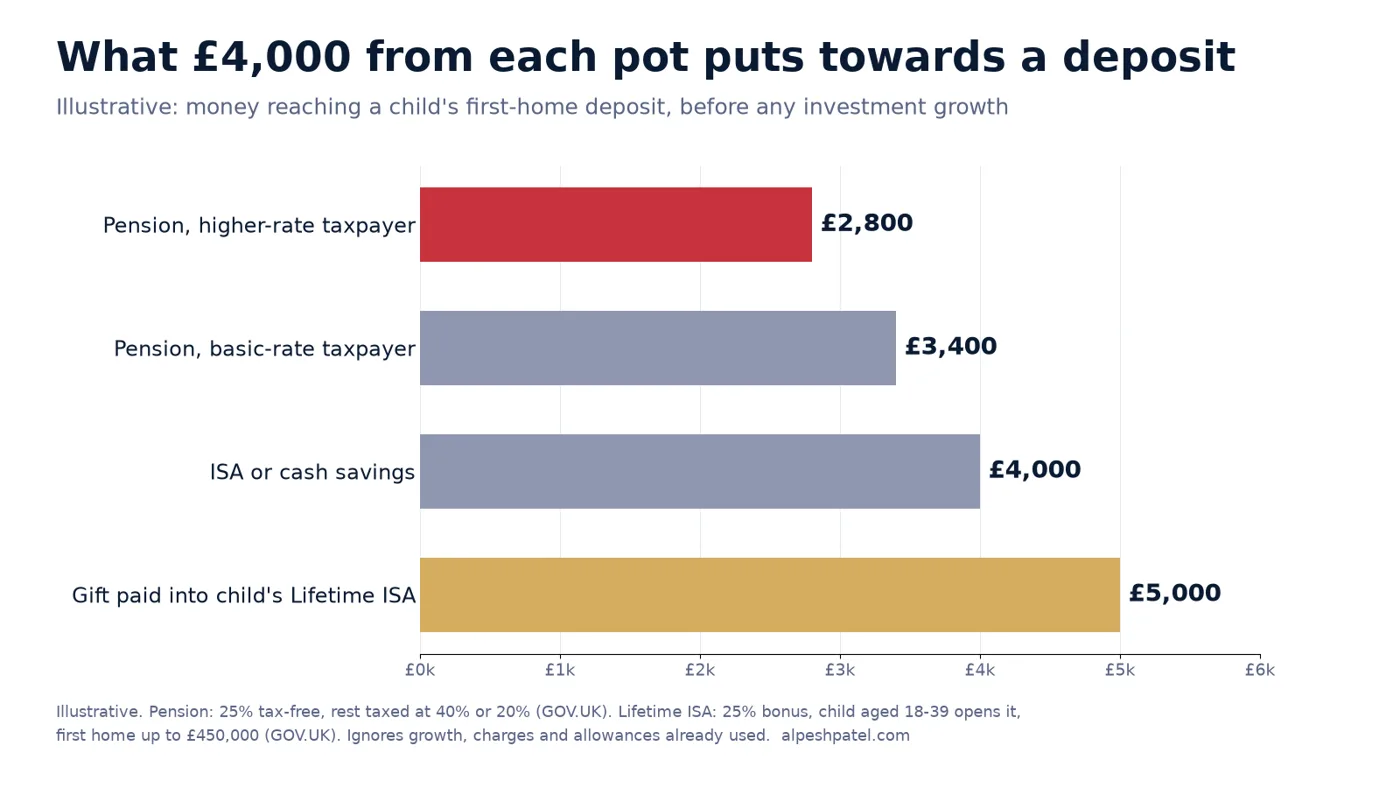
What does £4,000 from each pot actually deliver?
Source: GOV.UK lump sum allowance, Income Tax rates and Lifetime ISA pages, November 2026. Illustrative: assumes 25% of each pension withdrawal is tax-free and the rest is taxed at your top rate, and ignores investment growth, charges and allowances already used.
The gap is wide. In this illustrative example, the same £4,000 puts £2,800 towards a deposit if it comes from a higher-rate taxpayer's pension, and £5,000 if it is gifted to a child who pays it into their own Lifetime ISA.
How does the Lifetime ISA help first-time buyers?
Your child, not you, opens the Lifetime ISA. They must be 18 or over but under 40 to open one, can pay in up to £4,000 a year until 50, and the government adds a 25% bonus, up to £1,000 a year (GOV.UK Lifetime ISA (opens in a new tab)).
To use it for a first home without a charge, they must buy at least 12 months after their first payment, buy with a mortgage through a conveyancer or solicitor, and the property must cost £450,000 or less. Since 29 October 2026, buying above £450,000 means a 20% withdrawal charge rather than 25%, (GOV.UK Lifetime ISA withdrawals (opens in a new tab)). Other early withdrawals still carry a 25% charge.
The product is changing. The government will introduce a new First Time Buyer ISA from April 2029, with £4,000 a year of contributions, a 25% bonus capped at £20,000 in total and the £450,000 price cap retained (HMRC tax-free savings newsletter, October 2026 (opens in a new tab)). Existing Lifetime ISA holders can keep theirs, so a child aged 18 to 39 may want to open one before then. Check the latest rules before acting.
What are the rules on gifting money to children?
Gifts are where Inheritance Tax comes in. You can give away £3,000 a year in total under the annual exemption, and carry forward any unused amount for one tax year. You can also give a child up to £5,000 as a wedding gift. Regular gifts from surplus income, such as paying rent for a child, can be exempt with no limit, as long as you can afford them after your usual living costs (GOV.UK gifts and Inheritance Tax (opens in a new tab)).
Larger gifts are usually fine too, under the seven-year rule. No tax is due on a gift if you live for seven years after giving it, unless it is part of a trust. If you die within seven years and your gifts total more than the £325,000 threshold, taper relief can reduce the tax (GOV.UK (opens in a new tab)). Keep a simple written record of every gift: date, amount, who received it.
One change makes this more pressing. From 6 April 2027, most unused pension funds and death benefits will be counted in your estate for Inheritance Tax (GOV.UK (opens in a new tab)). For years, many people treated the pension as the pot to leave untouched and pass on. That logic is weaker now, which is one more reason to plan what each pot is for. A tax specialist should confirm the right approach for your estate.
What growth should you expect from a target-date fund?
Back to the question of "average growth". It is the natural first question, and it is the wrong one to start with.
A target-date fund, such as one aimed at 2035 to 2040, moves money out of shares and into lower-risk assets on a timetable set for its target date. It does this whatever your own plans are. It cannot see your other three pots, your children's purchase dates or the fact that you may not touch this money for 20 years. I covered this in detail in my review of the L&G Lifetime Advantage Fund, and why a retirement date alone is not a plan.
That creates two possible mismatches. If you plan to keep the pension invested long after 2040 and draw on it slowly, the fund may be reducing your growth assets earlier than you need. If you were hoping that same pot would pay a deposit in 2029, it is still invested for a date a decade later, and it is locked behind the minimum pension age anyway.
So check the date in the fund's name against when you actually need the money. Then look at what it holds today and what it charges. My earlier piece on the L&G target date fund shows how to read the factsheet.
As for growth, no one can tell you what a fund will return. Past returns are not a reliable guide. What you can do is test a range. Our free Pension Plan (opens in a new tab) tool lets you try different contributions and growth rates, and Portfolio Odds (opens in a new tab) shows how likely a loss is over different holding periods for a given mix, under its assumptions.
How do four pots become one clear plan?
Four pots are not a problem in themselves. Four pots with no stated job are. Here is how a self-directed investor might give each one a role.
The house fund. Money for the children, held in ISAs, cash or a child's Lifetime ISA. The closer the purchase date, the less of it sits in shares. If a child is buying within three years, much of it might be in cash.
The retirement core. The pensions, invested for a long horizon, with a written plan for how you will take income later. The build a retirement income guide sets out the steps, and my comparison of six withdrawal strategies shows how the choices differ.
The overlap. If you will be past minimum pension age before a child buys, the tax-free part of a pension can become a sensible source. Plan that deliberately, with the tax in your numbers, rather than reaching for it in a hurry.
You may also find that some pots can be combined. Fewer pots mean fewer charges and a clearer view, but check each pension for guarantees and exit fees first. My guide on whether to combine your pensions lists the checks. Be wary of anyone offering an unsolicited "free pension review" or promising guaranteed returns: Action Fraud figures cited by The Pensions Regulator (opens in a new tab) show £17.7 million reported lost to pension fraud in 2023, an average of nearly £47,000 per victim.
Why run this yourself?
A fund manager runs one fund. You are the only person who sees all four pots, both goals and every date. That is the real case for managing your own money: control over which pot does which job, transparency over what you hold and what it costs, and a portfolio built around your own risk profile rather than an average saver's.
It does not need to be complicated. It does need to be written down: what you hold in each pot and why, how much goes into any one investment, when you rebalance, and what would make you sell. The invest a lump sum guide is a good place to start if you are moving money into a new structure.
What to do next
- Write down both goals. For each child, a rough amount and year. For retirement, a target age and yearly income.
- List your four pots. Provider, value, what it holds, total yearly charge and the earliest date you can reach it.
- Match money to dates. House money from ISAs, savings or a child's Lifetime ISA where possible; pensions for retirement.
- Check any target-date fund against when you will really need that money, and what it holds now.
- Record every gift and ask a tax specialist to confirm your Inheritance Tax position, especially with pensions entering estates from April 2027.
Want a written plan that funds your retirement and your children's first homes? Book your free call with Alpesh's team. We will show you how self-directed investors match each pot to a goal and decide what to hold, how much and when to sell. There is nothing to buy on the call.
Frequently asked questions
Can I use my pension to help my child buy a house?
Only once you reach minimum pension age, normally 55 and rising to 57 from 6 April 2028. Usually 25% of what you take is tax-free and the rest is taxed as income, so it is often a costly source while you are still earning.
How much can I gift my children tax-free?
You can give £3,000 a year under the annual exemption, plus up to £5,000 to a child on their wedding, and regular gifts from surplus income can also be exempt. Larger gifts are free of Inheritance Tax if you live seven years after making them.
Can I open a Lifetime ISA for my child?
No, your child opens it themselves, aged 18 to 39. You can gift them money to pay in, up to £4,000 a year, and the government adds a 25% bonus.
Is a target-date fund right if I need money before the target date?
Not usually. It is invested for its own date and reduces shares on that timetable, so money needed earlier may be in the wrong place. Check the fund's date against your own dates.
What happens to the Lifetime ISA after April 2029?
The government plans to replace it for new savers with a First Time Buyer ISA from April 2029. Existing Lifetime ISA holders can keep using theirs under current rules.
About Alpesh Patel OBE
Alpesh Patel OBE is Founding Principal of Rootbridge Capital, an author and Dealmaker for the UK Government's Department for Business. He is a former Visiting Fellow in Business, Corpus Christi College, Oxford University, where he worked on technology to improve financial education.
Sources
- GOV.UK, English Housing Survey 2024 to 2025: housing costs and affordability (opens in a new tab)
- GOV.UK, Personal pensions: how you can take your pension (opens in a new tab)
- HMRC, Increasing normal minimum pension age (opens in a new tab)
- GOV.UK, Lump sum allowance (opens in a new tab)
- GOV.UK, Income Tax rates and Personal Allowances (opens in a new tab)
- GOV.UK, Individual Savings Accounts (opens in a new tab)
- GOV.UK, Lifetime ISA (opens in a new tab)
- GOV.UK, Lifetime ISA: withdrawing money (opens in a new tab)
- HMRC, Tax-free savings newsletter 24, October 2026 (opens in a new tab)
- GOV.UK, Inheritance Tax: gifts (opens in a new tab)
- GOV.UK, Inheritance Tax on unused pension funds and death benefits (opens in a new tab)
- The Pensions Regulator, Working together to strengthen our defences against scams (opens in a new tab)
- Alpesh Patel OBE, ISA or SIPP First? Don't Get This Wrong! (opens in a new tab) (YouTube)
Important: This article is for education only and is not personal financial advice or a recommendation to buy or sell any investment. This article is general investment education only and is not regulated investment advice. The value of investments can go down as well as up, and you may get back less than you invest. Past performance is not a reliable indicator of future results.
Important: this article is education and information only. It is not financial advice or a personal recommendation, and it does not take your circumstances into account. The value of investments and pensions can fall as well as rise, and you may get back less than you put in. Past performance is not a reliable indicator of future results. Figures were correct when the article was written and may have changed. If you are unsure what is right for you, speak to a regulated financial adviser.