Adviser Model Portfolio Fees: What a 2% All-In Cost Really Buys (Quilter, Tatton, Transact)
Adviser model portfolio fees are one of the most common things people bring to a call with my team. The pattern is familiar. A financial adviser recommended a platform such as Quilter, Transact or Wealthtime, placed the money in a model portfolio service (MPS) run by Quilter, Tatton or BlackRock, and the yearly statement now shows something close to 2% all in.
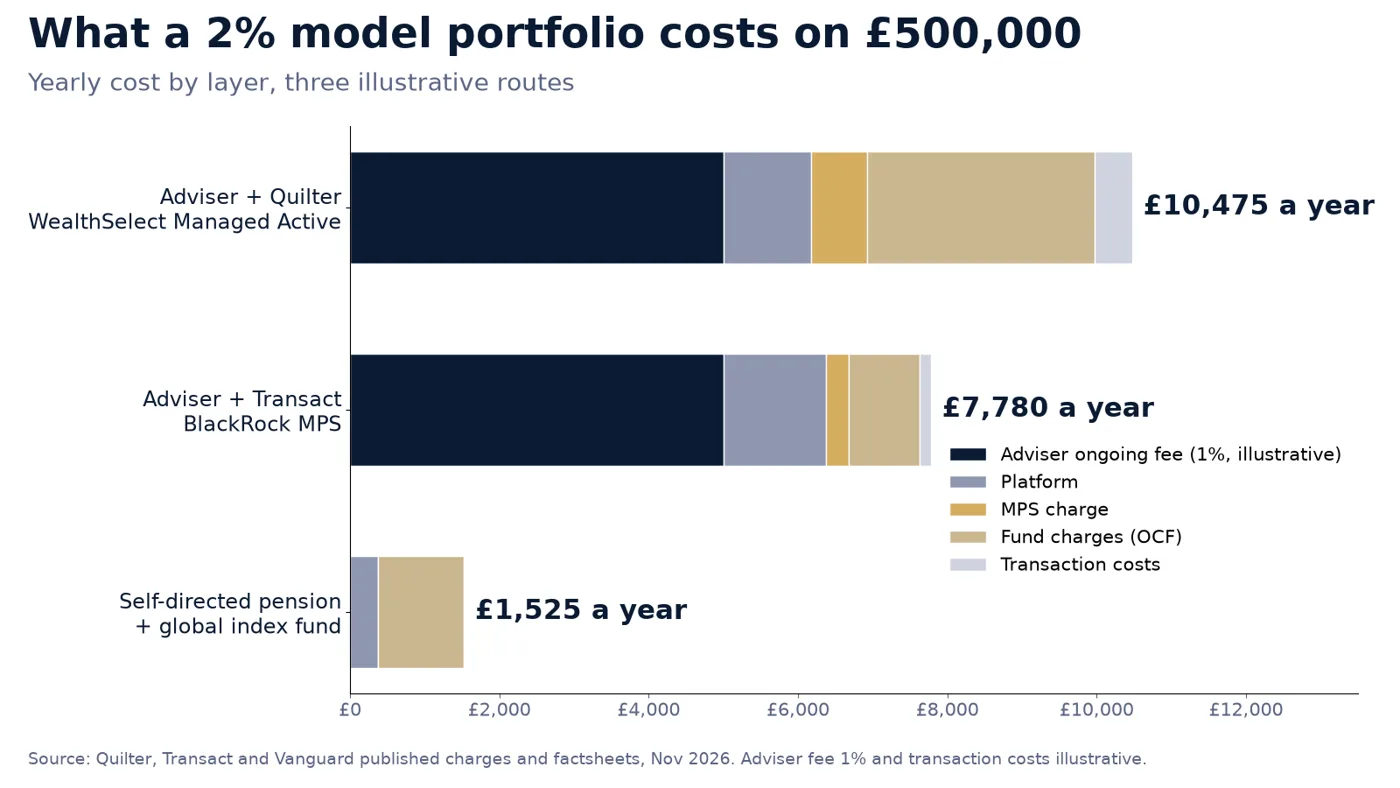
Nobody set out to pay 2%. Each layer looked small on its own: an adviser fee here, a platform charge there, a modest MPS fee and some fund charges that are rarely added up. Stack them and, on £500,000, you can be paying more than £10,000 a year.
This article takes the published rate cards and factsheets, rebuilds the total layer by layer, and asks a fair question. What does that money buy, and is there a cheaper way to get the parts you actually value?
Short answer: A 2% all-in cost on an adviser model portfolio is usually about half adviser fee and half platform, MPS, fund and trading costs. On £500,000 that can be £10,000 a year. Ask for your MiFID costs statement in pounds, decide which layers you value, and check exit costs and guarantees in writing before moving anything.
Not sure what your model portfolio really costs you each year? Book your free call with Alpesh's team. We will walk through how self-directed investors choose, size and review their investments with a written process. There is nothing to buy on the call.
What are the layers in adviser model portfolio fees?
Most advised model portfolios have five layers. Two are set by your adviser and three by the firms they chose for you. Each is quoted as a percentage, which is exactly why the total is easy to miss.
- Adviser ongoing fee. Paid to the adviser firm for reviews and planning. Quilter's own guidance says adviser charges on its platform can be up to 1.5% a year (opens in a new tab) for ISAs and collective retirement accounts. Many firms charge around 0.5% to 1%; we use 1% below as an illustration.
- Platform charge. The fee for holding the wrapper (SIPP, ISA or general account). Quilter, Transact and Wealthtime all publish tiered rates.
- MPS or discretionary charge. The fee for the firm that builds and rebalances the model.
- Fund charges. The ongoing charges figure (OCF) of each fund inside the model, weighted by how much you hold.
- Transaction costs. The cost of buying and selling inside the funds and the model. These are real but rarely shown on factsheets.
We covered a similar three-layer structure in True Potential fees: the three layers of cost. The same logic applies here, with one extra layer for the model manager.
What does Quilter WealthSelect cost?
Quilter charges a tiered platform fee across your whole holding: 0.35% on the first £50,000, 0.25% from £50,000 to £250,000, 0.20% from £250,000 to £750,000 and 0.15% above that, according to its platform fees and charges page (opens in a new tab). Quilter's own total cost of ownership page (opens in a new tab) shows how the tiers blend down as the pot grows.
On top, the WealthSelect managed portfolio service costs 0.15% a year for the Managed Active, Blend and Passive ranges, and 0.20% for the Responsible and Sustainable ranges, per Quilter's WealthSelect portfolio information (opens in a new tab) as at 3 September 2026. Quilter's WealthSelect due diligence guide (opens in a new tab) states that the service is VAT exempt.
The fund layer is where the ranges differ most. The WealthSelect Managed Active 6 factsheet (opens in a new tab) (30 September 2026) shows a weighted fund charge of 0.61%. The Managed Passive 5 factsheet (opens in a new tab) (31 August 2026) shows about 0.08%. Choosing active over passive inside the same service can cost more than the MPS charge itself.
What does Tatton charge, and is it 0.15% plus VAT?
Tatton states that its model portfolio service costs 0.15% a year and has been priced there since launch in 2013, in its 2026 fair value assessment (opens in a new tab). The same document cites Defaqto data showing an average on-platform discretionary fee of 0.21% and a median of 0.20% at 28 February 2026, so Tatton is cheaper than the typical rival.
You will still see "0.15% plus VAT" quoted in older material. Historically the fee was presented with VAT, but Money Marketing reported (opens in a new tab) that Tatton's models were later treated as VAT exempt. Check your own costs statement to see what is being taken.
Tatton's fund layer depends on the range. Its fair value assessment gives average model OCFs of 0.56% for Managed, 0.36% for Core and 0.16% for Tracker. The Tatton Managed (opens in a new tab) and Tatton Tracker (opens in a new tab) product pages show figures of 0.50% and 0.18% for the Balanced models at an earlier date, which shows how these move over time.
How do Transact and Wealthtime platform charges compare?
Transact charges 0.26% on the first £600,000, 0.17% from £600,000 to £1.2 million, 0.07% to £5 million and 0.05% above, for portfolios of £100,000 or more, according to its charges page (opens in a new tab). Its charges schedule (opens in a new tab) (June 2026) adds a SIPP wrapper fee of £20 a quarter, an ISA fee of £3 a quarter and dealing charges of up to £3.75.
The Transact–BlackRock MPS is one of the cheaper advised models. The Growth 70 factsheet (opens in a new tab) (30 September 2026) shows a fund OCF of 0.19%, fund transaction costs of 0.03% and an annual BlackRock payment of 0.06%. The investor brochure (opens in a new tab) says the OCF target is a maximum of 0.20%.
Wealthtime, formerly Novia, charges 0.30% on the first £500,000, 0.20% from £500,000 to £1 million and 0.10% above that, with a £100 annual minimum, per its charges schedule (opens in a new tab) effective 14 April 2026. Income drawdown in its SIPP adds £62.50 plus VAT a year. On £500,000 the platform layer alone is £1,500 a year before any MPS or fund charge.
How much is 2% in pounds at £250k, £500k and £1m?
The table rebuilds two advised routes from the rate cards above, with a self-directed route for comparison. The adviser fee of 1% and the transaction costs are illustrative; your own figures will differ.
| Layer (yearly) | Quilter WealthSelect Managed Active, £250k | £500k | £1m | Transact + BlackRock MPS, £500k | Self-directed, £500k |
|---|---|---|---|---|---|
| Adviser ongoing fee (1%, illustrative) | £2,500 | £5,000 | £10,000 | £5,000 | £0 |
| Platform | £675 | £1,175 | £2,050 | £1,380 | £375 |
| MPS charge | £375 | £750 | £1,500 | £300 | £0 |
| Fund charges (OCF) | £1,525 | £3,050 | £6,100 | £950 | £1,150 |
| Transaction costs (illustrative) | £250 | £500 | £1,000 | £150 | £0 |
| Total | £5,325 (2.13%) | £10,475 (2.10%) | £20,650 (2.07%) | £7,780 (1.56%) | £1,525 (0.31%) |
Sources: Quilter platform charges (opens in a new tab), WealthSelect MPS charge (opens in a new tab) and Managed Active 6 factsheet (opens in a new tab) (0.61% weighted fund charge); Transact charges (opens in a new tab) including the £80 SIPP wrapper fee, and BlackRock MPS Growth 70 factsheet (opens in a new tab) (0.06% MPS payment, 0.19% OCF, 0.03% transaction costs); self-directed uses the Vanguard Personal Pension (opens in a new tab) (0.15% capped at £375) and the 0.23% OCF of the Vanguard FTSE Global All Cap Index Fund (opens in a new tab) as an example, not a recommendation. Illustrative; excludes VAT where it may apply and dealing charges.
Source: Quilter, Transact and Vanguard published charges and factsheets, November 2026. Adviser fee and transaction costs illustrative.
Two things stand out. First, the adviser fee is the biggest single layer in every advised route, roughly half the total. Second, the MPS charge, the one people tend to argue about, is the smallest. Switching from an active model to a passive one can save more than switching MPS provider.
What does a 2% all-in cost actually buy?
It is worth being fair. For the adviser fee you should get a financial plan, a risk profile, an annual suitability review, help with tax wrappers, drawdown and inheritance planning, and someone to call when markets fall. Some people value that highly, and for complex situations it can be worth it.
The FCA's review of ongoing advice (opens in a new tab) at 22 of the largest firms, published in February 2025, found that suitability reviews were delivered about 83% of the time. About 15% of clients declined or did not respond, and in under 2% of cases no attempt was made. The FCA's advice market research (opens in a new tab) also notes that around nine in ten advised clients are placed into ongoing arrangements.
So the question is not whether advice has value. It is whether you are using the service you pay for each year, and whether the investment part, which a model portfolio largely automates, needs to cost what it does. For many people the model is a standard risk-graded mix that is not truly bespoke to them.
How do you ask for your MiFID costs statement?
Under MiFID II rules, your adviser firm must give you ex-ante (before) and ex-post (after) costs and charges, at least once a year, aggregated as a cash amount and a percentage, with an illustration of the effect on your return. You can ask for an itemised breakdown. The FCA sets this out in its guidance for retail investment advice firms (opens in a new tab) and its costs and charges disclosures review (opens in a new tab).
A simple request works. Ask for "the ex-post costs and charges statement for the last 12 months, in pounds, itemised by adviser, platform, discretionary manager, fund charges and transaction costs". If the totals do not match the layers above, ask why. The FCA is consulting on simplifying these disclosures in CP26/24 (opens in a new tab), but the right to the figures is already there.
Once you have one number in pounds, compare it with what the same money would cost in a low-cost setup. Our article on wealth management fees in the UK shows how a 1% gap compounds over ten or twenty years.
What should you check before leaving an adviser model portfolio?
Leaving is not free of risk, and the details matter more than the headline fee. Work through these points in writing with each provider before you act.
- Notice and adviser fees. Check your client agreement for notice periods and whether ongoing fees stop on the day you leave.
- Time out of the market. A cash transfer can leave you uninvested for weeks. Ask whether an in-specie transfer (moving the holdings themselves) is possible; many MPS funds are platform-specific share classes that cannot move.
- Capital gains tax. Selling holdings in a general account can trigger capital gains tax. Pensions and ISAs do not.
- Guarantees and protected benefits. Older pensions may carry guaranteed annuity rates, protected tax-free cash or a protected pension age. These can be lost on transfer, so get loss-of-benefit checks in writing.
- Safeguarded benefits. If you hold safeguarded benefits, such as a final salary pension, worth more than £30,000, you must take regulated advice before transferring, as the FCA explains in advising on pension transfers (opens in a new tab).
Then watch for scams. The Pensions Regulator says £17.7 million was lost to pension fraud in 2023 (opens in a new tab), with an average loss of nearly £47,000 and fewer than one in five victims reporting it. Never move money because of a cold call, a deadline or a promise of unusually high returns.
Our guide to combining pensions covers the transfer checks in more detail, and the cheapest SIPPs for drawdown compares platform charges if you decide to move.
Why would you manage the investment part yourself?
Paying less is only half of it. The other half is control and transparency: you see every holding, you know why each one is there, and the mix is set around your own risk tolerance and income needs rather than a generic model number. That is what most people on our calls say they want.
Doing it yourself does need a written process. Decide how you pick investments, how much goes into each, and the rules for when you sell or rebalance. Write them down before markets test you. If you want a starting point, our run your own SIPP and review your adviser pages set out the steps.
Free tools can help you check whether the plan holds up. The pension planner (opens in a new tab) shows whether a pot can support the income you want, and the portfolio odds tool (opens in a new tab) gives a probability view of different mixes. More are on the tools page.
What to do next
- Ask your adviser firm for the ex-post costs and charges statement for the last 12 months, in pounds, itemised by layer.
- Rebuild your total with the table above and check whether you are on an active or passive model range.
- List what the adviser fee covers and how often you use it: reviews, tax planning, drawdown, inheritance planning.
- Before any move, get exit costs, guarantees and protected benefits confirmed in writing by each provider.
- If you want to take control of the investment part, write a simple process for picking, sizing and rebalancing first.
Want to see what running your own pension with a written process looks like? Book your free call with Alpesh's team. We will show you how self-directed investors set rules for what to buy, how much and when to sell. There is nothing to buy on the call.
Frequently asked questions
Is 2% a year too much for an adviser model portfolio?
It depends on what you get for it. On the published rate cards, the platform, MPS and fund layers alone can come to around 1% on an active model, and an adviser fee often doubles that. If you rarely use the advice, 2% buys mostly portfolio administration.
Is Tatton cheaper than Quilter WealthSelect?
Both charge 0.15% a year for their main model ranges, so the MPS layer is similar. The bigger difference is the fund layer and the platform each sits on, which your costs statement will show.
Are transaction costs included in the OCF?
No. The ongoing charges figure excludes the cost of trading inside a fund, which is shown separately as transaction costs where disclosed. Your MiFID costs statement should include both.
Can I keep my adviser but cut the fees?
Often, yes. You can ask about a passive model range, a lower ongoing fee, or paying a fixed fee for occasional advice rather than a percentage. Get any change confirmed in writing.
About Alpesh Patel OBE
Alpesh Patel OBE is Founding Principal of Rootbridge Capital, an author and Dealmaker for the UK Government's Department for Business. He is a former Visiting Fellow in Business, Corpus Christi College, Oxford University, where he worked on technology to improve financial education.
Sources
- Quilter, Platform fees and charges (opens in a new tab)
- Quilter, Total cost of ownership (opens in a new tab)
- Quilter, What options are there for adviser fees? (opens in a new tab)
- Quilter, WealthSelect portfolio information (opens in a new tab)
- Quilter, WealthSelect due diligence guide (opens in a new tab)
- Quilter, WealthSelect Managed Active 6 factsheet (opens in a new tab)
- Quilter, WealthSelect Managed Passive 5 factsheet (opens in a new tab)
- Tatton Investment Management, Fair Value and Target Market Assessment 2026 (opens in a new tab)
- Tatton Investment Management, Tatton Managed (opens in a new tab) and Tatton Tracker (opens in a new tab)
- Money Marketing, Tatton VAT refund sees rivals review arrangements (opens in a new tab)
- Transact, Our charges (opens in a new tab) and Charges schedule (opens in a new tab)
- Transact, Transact–BlackRock MPS Growth 70 factsheet (opens in a new tab) and investor brochure (opens in a new tab)
- Wealthtime, Charges schedule (opens in a new tab)
- Vanguard, Personal Pension (opens in a new tab) and FTSE Global All Cap Index Fund (opens in a new tab)
- Financial Conduct Authority, Ongoing financial advice services: multi-firm review (opens in a new tab)
- Financial Conduct Authority, Understanding the financial advice market (opens in a new tab)
- Financial Conduct Authority, MiFID II: retail investment advice firms (opens in a new tab)
- Financial Conduct Authority, MiFID II costs and charges disclosures: review findings (opens in a new tab)
- Financial Conduct Authority, CP26/24 (opens in a new tab)
- Financial Conduct Authority, Advising on pension transfers: our expectations (opens in a new tab)
- The Pensions Regulator, Working together to strengthen our defences against scams (opens in a new tab)
- Alpesh Patel OBE, IFAs Destroying Pensions with Wealth Manager Conflicts (opens in a new tab) (YouTube)
Important: This article is for education only and is not personal financial advice or a recommendation to buy or sell any investment. This article is general investment education only and is not regulated investment advice. The value of investments can go down as well as up, and you may get back less than you invest. Past performance is not a reliable indicator of future results.
Important: this article is education and information only. It is not financial advice or a personal recommendation, and it does not take your circumstances into account. The value of investments and pensions can fall as well as rise, and you may get back less than you put in. Past performance is not a reliable indicator of future results. Figures were correct when the article was written and may have changed. If you are unsure what is right for you, speak to a regulated financial adviser.