Aegon Pension Review: Universal Balanced Collection, Lifestyle and Target-Date Funds
If you have an Aegon or Scottish Equitable pension, there is a good chance part of it sits in the Universal Balanced Collection. It is one of the largest pension funds most savers have never heard of: the pension version held £14,991 million at 30 September 2026. Aegon factsheet (opens in a new tab)
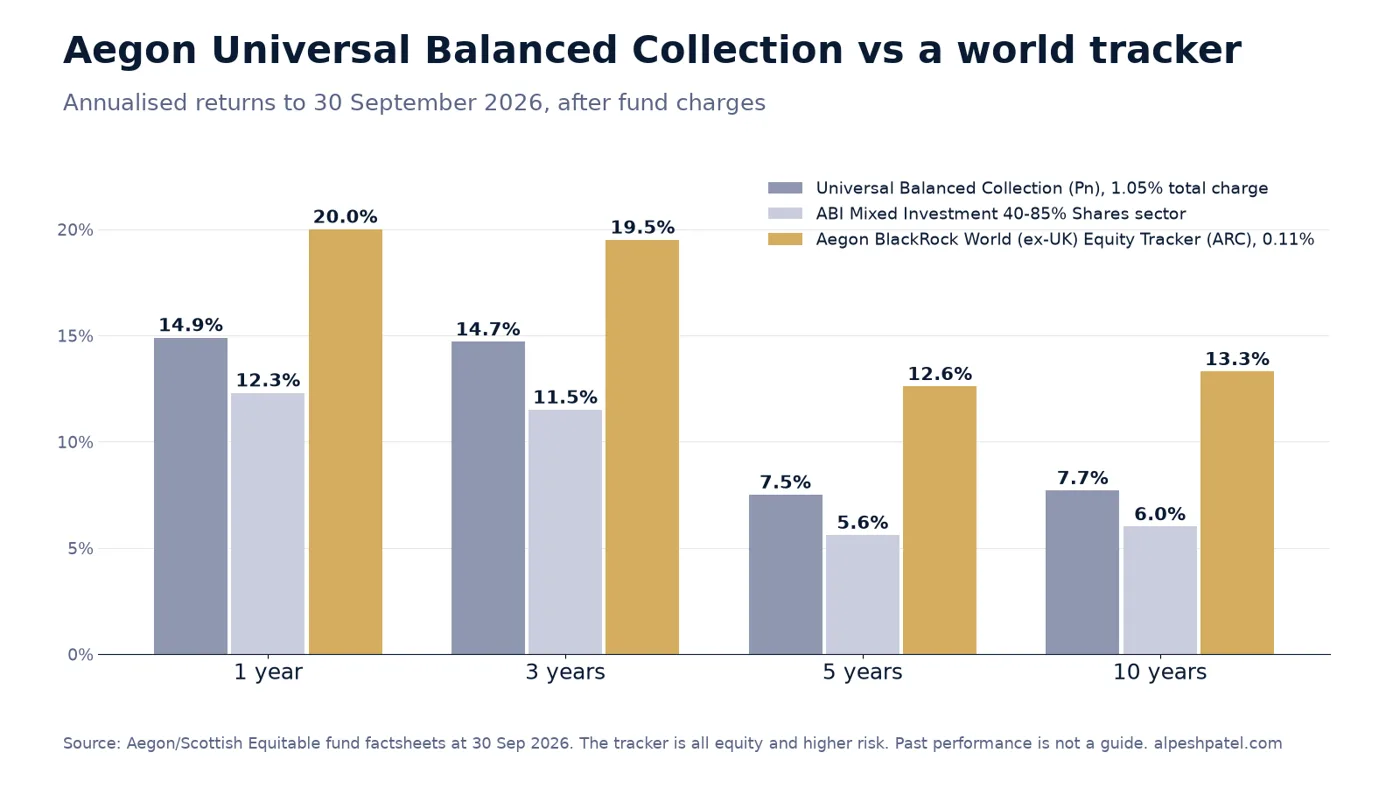
On the face of it, the record is good. Over ten years the fund returned 7.7% a year against 6.0% for its sector benchmark, and it sat in the top quartile over one, three, five and ten years. But Aegon's own developed-world equity tracker returned 13.3% a year over the same ten years. Aegon factsheet (opens in a new tab), Aegon tracker factsheet (opens in a new tab)
So this Aegon pension review asks a practical question. Beating the average of similar funds is one test. Is it the right test for your money, your timescale and your retirement plans? Here is what the Universal Balanced Collection holds, what it costs, how Aegon's lifestyle and target-date funds change as you get older, and how to switch if you decide to.
Short answer: Aegon's Universal Balanced Collection is a multi-manager fund with roughly 79% in listed shares, over half in the US, and some private markets. The pension version charges 1.05% a year in total and beat its sector over ten years, but trailed a low-cost world equity tracker by more than five points a year.
Wondering whether your Aegon pension fund is right for you? Book your free call with Alpesh's team. We will show you how self-directed investors compare their funds, set a risk level and build a written plan. There is nothing to buy on the call.
What is Aegon's Universal Balanced Collection?
The Universal Balanced Collection is run by Aegon, and the pension version is a Scottish Equitable plc fund launched on 29 June 2001. Its objective is "long-term capital growth by investing in an internationally diversified portfolio, largely made up of equities". It invests through a mix of funds from different managers, using both active and passive management. Aegon factsheet (opens in a new tab)
It is designed to be used as a default fund for workplace pensions, which is why so many people hold it without choosing it. Its benchmark is the ABI Mixed Investment 40-85% Shares sector, a peer group average rather than a market index. Aegon factsheet (opens in a new tab)
The pension factsheet shows the codes you need to check your own statement: ISIN GB0030656648, SEDOL 3065664 and Citicode AZ32. If your statement shows a different code, you may hold another version with a different charge. My guide to cautious, balanced and adventurous pension funds explains how labels such as "balanced" are used across the industry.
What does the Universal Balanced Collection invest in?
At 30 September 2026, the pension fund's asset mix was as follows. Aegon factsheet (opens in a new tab)
| Asset class | Weight |
|---|---|
| US equities | 55.8% |
| International equities | 12.7% |
| Alternatives | 8.1% |
| Europe ex UK equities | 7.0% |
| Global corporate fixed interest | 3.7% |
| UK equities | 2.4% |
| Irish fixed interest | 1.4% |
| Japanese equities | 1.0% |
| UK fixed interest | 1.0% |
| Other | 6.9% |
Source: Aegon Universal Balanced Collection Pn factsheet, 30 September 2026 (opens in a new tab).
Add up the share lines and you get about 79% in listed equities, with just over 6% in bonds. That is a lot of stock market risk for a fund labelled "balanced", and well over half the money is in US shares. Underneath, the fund held three Aegon funds: Aegon Diversified Fund at 78.6%, Aegon Diversified – Private Markets at 16.0% and Aegon AAM Multi Asset Credit at 5.4%. Aegon factsheet (opens in a new tab)
The private markets slice includes long-term asset funds, which invest in assets that are not traded on a stock exchange. These can add diversification, but they are harder to value and sell quickly. You do not need to avoid them, but you should know they are there.
What are the Aegon Universal Balanced Collection charges?
The pension version has a total charge of 1.05% a year. Aegon says this includes its standard 1% product charge plus a fixed management fee and expenses, and that you may pay a different product charge. Aegon factsheet (opens in a new tab) Many workplace members will pay less, because employers often negotiate a lower charge and default funds used for automatic enrolment are capped at 0.75% a year. GOV.UK (opens in a new tab)
On the Aegon Retirement Choices (ARC) platform, the same strategy is available with a fund charge of 0.15%, taken on top of the ARC product charge and any adviser charge. Aegon ARC factsheet (opens in a new tab) The ARC version's returns run roughly one point a year higher than the pension version's, which is about the size of the charge difference.
In an illustrative example, a £200,000 pot at 1.05% a year costs £2,100 a year before any adviser charge. Ask Aegon for your exact charges in pounds, not just percentages. My guide to what 1% a year really costs your portfolio shows how that compounds over a working life.
How has the Universal Balanced Collection performed?
Here are the annualised returns to 30 September 2026 for the pension version, its sector benchmark, the ARC version and Aegon's own developed-world equity tracker on the same platform and dates.
| Fund | Charge | 1 year | 3 years | 5 years | 10 years |
|---|---|---|---|---|---|
| Universal Balanced Collection (Pn) | 1.05% total | 14.9% | 14.7% | 7.5% | 7.7% |
| ABI Mixed Investment 40-85% Shares sector | n/a | 12.3% | 11.5% | 5.6% | 6.0% |
| Universal Balanced Collection (ARC) | 0.15% fund charge | 15.9% | 15.8% | 8.5% | 8.7% |
| Aegon BlackRock World (ex-UK) Equity Tracker (ARC) | 0.11% fund charge | 20.0% | 19.5% | 12.6% | 13.3% |
Sources: Aegon UBC Pn factsheet (opens in a new tab), Aegon UBC ARC factsheet (opens in a new tab), Aegon BlackRock World (ex-UK) Equity Tracker factsheet (opens in a new tab), all at 30 September 2026. ARC returns are after the fund charge only, not the ARC product charge.
Source: Aegon and Scottish Equitable fund factsheets at 30 September 2026, linked above.
The tracker is not a like-for-like comparison. It holds only developed-market shares outside the UK, with 71.9% in the US, and follows an ESG-screened FTSE index. Aegon tracker factsheet (opens in a new tab) An all-equity fund should beat a mixed fund in rising markets. The question is what the mixed fund gives you in exchange.
The year to September 2022 is the test. The Universal Balanced Collection fell 11.8%, more than its sector's 10.1% fall, while the equity tracker fell 3.6%. Aegon factsheet (opens in a new tab), Aegon tracker factsheet (opens in a new tab) Part of that was a weak pound boosting overseas shares, and one year proves little. But it shows that "balanced" did not mean a smaller fall in that particular year.
In an illustrative example, £100,000 growing at 7.7% a year for ten years reaches about £210,000. At 13.3% a year it reaches about £348,600. Past performance is not a guide to the future, and the higher figure came with all-equity risk. Still, that gap is why it pays to look beyond the sector ranking.
How do Aegon's lifestyle options work?
The Universal Balanced Collection has two lifestyle versions for people approaching retirement: Flexible Target and Annuity Target. Aegon's adviser pages say the mix changes gradually in the seven years before retirement. Aegon adviser page (opens in a new tab) Its customer guide describes a progressive move into less risky investments in the six years before your target retirement year, with cash in the final two years to cover 25% tax-free cash, and the Annuity Target version moving towards long-dated gilts and cash. Aegon customer guide (opens in a new tab) Check your own plan literature for the exact timings.
The key point is that the target matters. A Flexible Target fund suits someone who expects to stay invested and draw an income. An Annuity Target fund suits someone who plans to buy an annuity. If your retirement date or plans have changed, your lifestyle fund may now be steering you towards the wrong destination.
Is Aegon LifePath a good target-date fund?
Many Aegon workplace members are not in the Universal Balanced Collection at all. The standard default for Aegon's TargetPlan is Aegon LifePath Flexi, which is also used by the Aegon Master Trust. There are three LifePath versions, aimed at drawdown (Flexi), buying an annuity (Retirement) and taking cash (Capital). Aegon customer page (opens in a new tab), Aegon employer page (opens in a new tab)
These funds were previously called Aegon BlackRock LifePath. Each targets a retirement date range, and earlier factsheets said de-risking starts from ten years before the fund's maturity date. Aegon 2025 LifePath factsheet (opens in a new tab) For a young saver, the LifePath Flexi 2064-2066 fund returned 19.9%, 18.7% and 10.9% a year over one, three and five years to 30 September 2026, ahead of its benchmark, with a risk rating that falls from 5 towards 3 by the target retirement age. Aegon LifePath Flexi 2064-2066 factsheet (opens in a new tab)
The factsheet describes an all-inclusive annual management charge without stating the rate, because it depends on your scheme, so ask your employer or Aegon for yours. Aegon is also closing the LifePath Mature and LifePath Retirement Year funds in the TargetPlan range, effective 8 January 2027. Aegon fund updates (opens in a new tab) My review of an L&G target date fund shows how the same kind of fund can trail a simple index by a wide margin.
How do you switch funds with Aegon?
For most Aegon plans, including ARC and workplace pensions, you can switch funds online. On ARC, your money can be out of the market for up to two working days while a switch completes. Aegon how to switch (opens in a new tab) Older plans may need the alteration of fund choice form, which says switch constraints and charges are set out in your policy conditions. Aegon form (opens in a new tab)
Switching inside Aegon is different from transferring out. If you are 55 or over, FCA rules cap early exit charges on existing personal pensions at 1%, and contracts taken out since 31 March 2017 cannot have them. FCA (opens in a new tab) Aegon says it does not charge a fee for transfers to or from its platform, but check your own plan. Aegon transfers guide (opens in a new tab)
What guarantees could you lose?
Some older Scottish Equitable policies have valuable guarantees. Aegon says with-profits guarantees can be lost if you switch, transfer or cash in early, and a market value reduction may apply. Aegon with-profits guarantees (opens in a new tab) Its with-profits report notes minimum pension guarantees, including guaranteed annuity options, mainly in contracts from the 1970s and 1980s. Aegon with-profits report (opens in a new tab)
Aegon's own transfer form asks about guaranteed annuity rates, guaranteed minimum pensions, protected tax-free cash above 25% and a protected pension age. Aegon transfer form (opens in a new tab) Ask Aegon in writing whether your plan has any of these before you move a pound. If a pension has safeguarded benefits worth more than £30,000, you must take advice from an FCA-authorised adviser before transferring. FCA (opens in a new tab)
Watch out for scams. The Pensions Regulator reports that £17.7 million was lost to pension fraud in 2023, an average of nearly £47,000 per victim, and fewer than one in five scams are reported. The Pensions Regulator (opens in a new tab) Never act on a cold call, and check any firm on the FCA Register (opens in a new tab).
Should you keep your Aegon pension or run it yourself?
The Universal Balanced Collection is a respectable default that has beaten its peers. But a default is built for thousands of people at once, not around your risk tolerance, your retirement date or where you plan to live. If you expect to retire abroad or draw income in another currency, my post on pensions in different countries explains why that should shape your plan before any fund choice.
The alternative is to take control of some or all of it: choose your own mix, know exactly what you pay and follow a written process for what to buy, how much of each and when to sell or rebalance. If you have several old pots, should I combine my pensions? covers the checks first. The free Portfolio Odds (opens in a new tab) tool lets you test how different mixes might behave.
What to do next
- Find your fund code. Check your Aegon statement for the fund name, ISIN or Citicode and confirm which version and charge you have.
- Get your charges in pounds. Ask Aegon, and any adviser, for your total annual cost as a cash figure.
- Compare like with like. Put your fund's five and ten-year returns next to a global index fund over the same dates, allowing for the difference in risk.
- Check your lifestyle target. Make sure your retirement date and Flexible, Annuity or Capital option still match your plans.
- Ask about guarantees in writing before any switch or transfer, and never act on a cold call.
Want a clear, written process for your Aegon pension? Book your free call with Alpesh's team. We will show you how self-directed investors pick, size and rebalance a portfolio built around their own risk profile. There is nothing to buy on the call.
Frequently asked questions
Is the Aegon Universal Balanced Collection a low-risk fund?
No. Despite the "balanced" name, about 79% was in listed shares and more than half in US shares at 30 September 2026. In the year to September 2022 it fell 11.8%.
What does the Aegon Universal Balanced Collection cost?
The pension version has a total charge of 1.05% a year, including Aegon's standard 1% product charge, though you may pay a different product charge. On ARC the fund charge is 0.15%, plus the ARC product charge and any adviser charge.
Can I switch out of an Aegon default fund?
Yes. Most Aegon members can switch online, and the 0.75% workplace charge cap stops applying once you choose a fund yourself. Check for guarantees, switch limits or charges in your policy conditions first.
Is Scottish Equitable the same as Aegon?
Yes, in practice. Scottish Equitable plc is an Aegon company, and many older Aegon pensions, including the Universal Balanced Collection pension fund, are Scottish Equitable products under the Aegon brand.
About Alpesh Patel OBE
Alpesh Patel OBE is Founding Principal of Rootbridge Capital, an author and Dealmaker for the UK Government's Department for Business. He is a former Visiting Fellow in Business, Corpus Christi College, Oxford University, where he worked on technology to improve financial education.
Sources
- Aegon, Universal Balanced Collection Pn factsheet (30 September 2026) (opens in a new tab)
- Aegon, Universal Balanced Collection ARC factsheet (30 September 2026) (opens in a new tab)
- Aegon, Aegon BlackRock World (ex-UK) Equity Tracker ARC factsheet (30 September 2026) (opens in a new tab)
- Aegon, Universal Balanced Collection (adviser) (opens in a new tab)
- Aegon, Choosing a different fund (opens in a new tab)
- Aegon, What is a default fund? (TargetPlan) (opens in a new tab)
- Aegon, Aegon LifePath strategies (opens in a new tab)
- Aegon, LifePath factsheet (2025) (opens in a new tab)
- Aegon, LifePath Flexi 2064-2066 factsheet (30 September 2026) (opens in a new tab)
- Aegon, Fund updates (opens in a new tab)
- Aegon, How to switch funds (opens in a new tab)
- Aegon, Alteration of fund choice form (opens in a new tab)
- Aegon, Guide to transfers (opens in a new tab)
- Aegon, With-profits guarantees (opens in a new tab)
- Aegon, Traditional and unitised with-profits report (opens in a new tab)
- Aegon, Additional transfer payment form (opens in a new tab)
- GOV.UK, Review of the default fund charge cap and standardised cost disclosure (opens in a new tab)
- Financial Conduct Authority, FCA introduces cap on early exit pension charges (opens in a new tab)
- Financial Conduct Authority, Advising on pension transfers: our expectations (opens in a new tab)
- The Pensions Regulator, Working together to strengthen our defences against scams (opens in a new tab)
- Financial Conduct Authority, Financial Services Register (opens in a new tab)
- Alpesh Patel OBE, Don't Trust Big Brand Pension Funds; Trust Performance (opens in a new tab) (YouTube)
Important: This article is for education only and is not personal financial advice or a recommendation to buy or sell any investment. This article is general investment education only and is not regulated investment advice. The value of investments can go down as well as up, and you may get back less than you invest. Past performance is not a reliable indicator of future results.
Important: this article is education and information only. It is not financial advice or a personal recommendation, and it does not take your circumstances into account. The value of investments and pensions can fall as well as rise, and you may get back less than you put in. Past performance is not a reliable indicator of future results. Figures were correct when the article was written and may have changed. If you are unsure what is right for you, speak to a regulated financial adviser.