Pensions in Different Countries? Retiring in the UK Is a Design Problem, Not a Performance Problem
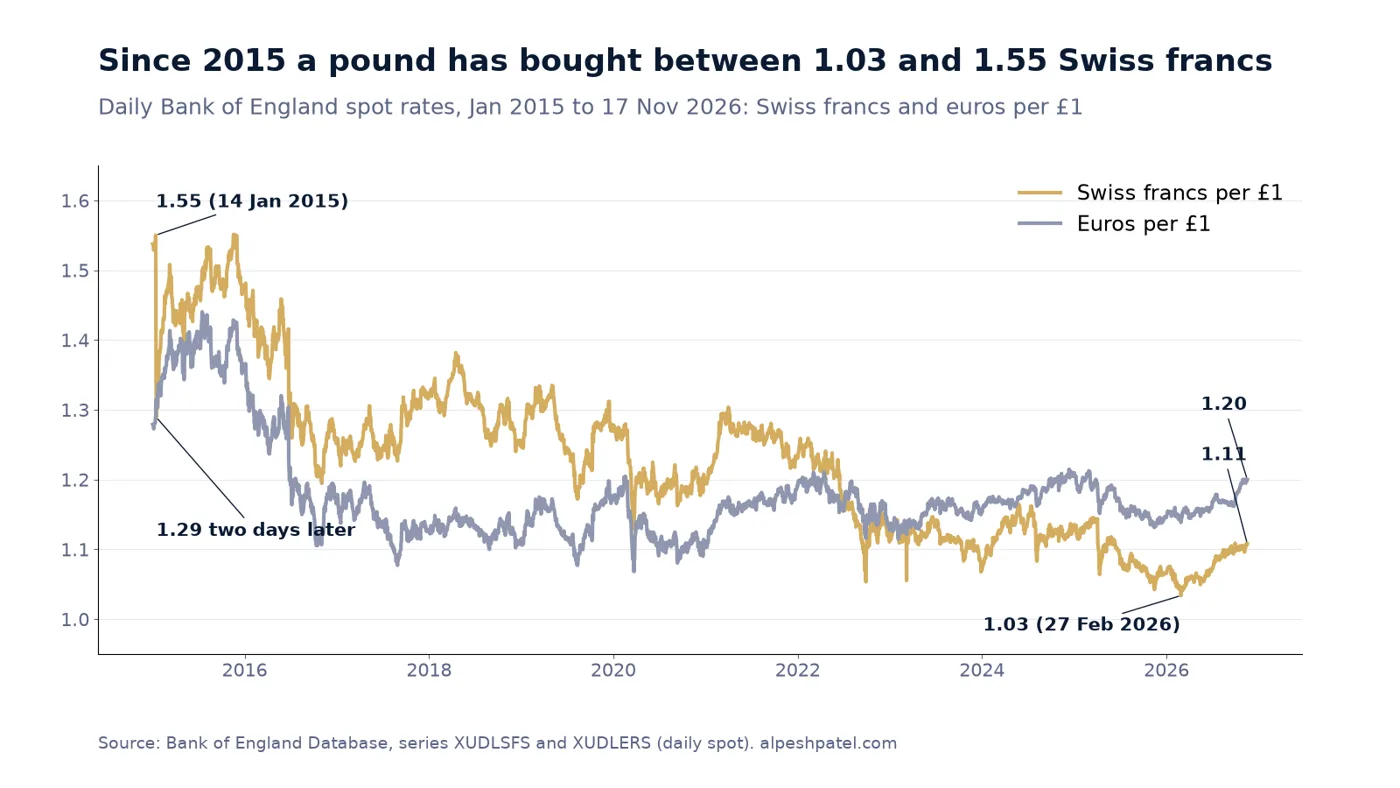
On 14 January 2015 a pound bought 1.55 Swiss francs. Two days later it bought 1.29. That is a 17% swing in two days, in a currency famous for being boring, according to Bank of England daily spot rates (opens in a new tab).
I thought of that number when a question reached my team this month. It came from someone who has worked across borders and now holds pensions in different countries, the UK, Ireland and Switzerland, spread over four providers and three currencies, sterling, euros and Swiss francs. The plan is to retire in the UK. The question was the one I hear most often from people in this position: which of my funds are any good?
It is a fair question, but it is the second one. If you have pensions in different countries and plan to retire in the UK, you do not have a performance problem. You have a design problem. Get the design right and the fund choices become much easier.
Short answer: With pensions in different countries, decide currency first: hold the money you will spend in the next few years in sterling if you are retiring in the UK. Then map every pot on one page: country, account type, currency and any guaranteed income. Settle the tax order with a cross-border tax specialist before you move anything.
Holding pensions in more than one country and planning to retire in the UK? Book your free call with Alpesh's team. We will walk through how self-directed investors design a retirement portfolio, choose and size investments and decide when to rebalance. There is nothing to buy on the call.
Why pensions in different countries are a design problem
Most people with pots in several countries judge them one at a time. Each provider sends its own statement, in its own currency, with its own idea of what "balanced" means.
None of those providers can see the whole picture, and none of them knows you plan to live in the UK. So nobody is checking whether the overall mix makes sense for the income you need, in the currency you will spend it in.
That is the design job: currency, a one-page map and the tax order, in that order. Fund choices come after.
Which currency should your retirement money be in?
Start with a simple rule: spend in the currency you will live in. If you are retiring in the UK, your bills, your food and your council tax are in pounds. The money you will need over the next few years is best held in sterling.
Money held in francs or euros for near-term spending carries currency risk at exactly the wrong time. You are not trying to grow that money. You are trying to make sure it is there, in pounds, when the bills arrive.
The chart shows how far the rates have moved. Since January 2015 a pound has bought as many as 1.55 Swiss francs and as few as 1.03, and on 17 November 2026 it bought about 1.11 francs or 1.20 euros, on Bank of England data (opens in a new tab).
Source: Bank of England Database, series XUDLSFS (Swiss francs per £1) and XUDLERS (euros per £1), daily spot rates.
In an illustrative example, CHF 100,000 set aside for the next two years of UK bills is worth about £90,000 at 1.11 francs to the pound. In the 12 months to 22 March 2021, sterling rose about 13% against the franc on the same Bank of England data. A move like that would cut the same CHF 100,000 to about £79,700. That is around £10,000 less to spend, with no change in the investments at all.
Currency risk cuts both ways, but a retirement budget is not a currency bet. The near-term money is where you can least afford a surprise.
Does long-term money need to be in sterling too?
No. Money you will not touch for ten years or more can sit in any currency, and is often better spread across several. A global share fund already holds businesses earning in many currencies, whatever currency it is priced in.
So the practical split is two buckets. A near-term bucket, roughly the next two or three years of spending, held in sterling. A long-term growth bucket, which can stay invested across currencies and countries. My guide to building a retirement income sets out how the two buckets work together, and living off your investments compares the main ways to draw from the growth bucket.
The one page every cross-border retiree needs
The second step takes an afternoon. Put every pension and investment account on one page, with four columns for each provider:
- Country. Where the scheme or account is based. This decides which tax rules and which regulator apply.
- Account type. SIPP, workplace scheme, Irish ARF or PRSA, Swiss pension fund, vested benefits account or pillar 3a, ISA or ordinary investment account.
- Currency. What the account is valued and paid in.
- Guaranteed income. Whether it carries any guaranteed income for life, and on what terms.
An illustrative version for someone in this position might look like this.
| Illustrative provider | Country | Account type | Currency | Guaranteed income? |
|---|---|---|---|---|
| Provider A | UK | SIPP | Sterling | No, invested drawdown |
| Provider B | UK | Old workplace scheme | Sterling | Check: final salary benefits would be guaranteed |
| Provider C | Ireland | Personal pension, later an ARF | Euros | No, but a minimum yearly withdrawal applies once you are 60 or over for a whole tax year |
| Provider D | Switzerland | Pillar 2 pension fund | Swiss francs | Option: lifelong pension or lump sum |
Illustrative layout only. Your own page will depend on your schemes; check each entry with the provider in writing.
That last column matters most. A guaranteed income is hard to replace. In Swiss occupational pensions, for example, the legal minimum conversion rate on the mandatory part is 6.8%, so every CHF 100,000 of mandatory retirement assets must pay a pension of at least CHF 6,800 a year, according to the Swiss Federal Social Insurance Office (opens in a new tab). Members can usually take all or part as a lump sum instead, depending on the fund's rules. That is a design choice, not a fund choice.
Once the page exists, you can see your real currency mix and how much of your income is guaranteed. Only then does it make sense to ask whether each fund is any good.
How are overseas pensions taxed when you retire in the UK?
This is where the three countries pull in different directions, and where a cross-border tax specialist earns their fee. Settle the order of withdrawals and transfers with them before you move a penny. Here is why.
The UK taxes residents on foreign pensions. If you are UK resident, you normally pay UK tax on your foreign income, including income from pensions held overseas, says GOV.UK (opens in a new tab). Since 6 April 2017 the full amount of a foreign pension paid to a UK resident is taxable, not 90% as before, according to HMRC's Employment Income Manual (opens in a new tab). Double taxation agreements can change where tax is due.
Ireland can make you draw whether you want to or not. Irish approved retirement funds (ARFs) and vested PRSAs are subject to an "imputed distribution". If you are 60 or over for the whole tax year, Revenue treats you as having withdrawn at least 4% of the value a year, 5% if you are 70 or over for the whole year, and 6% of the whole fund if your ARFs and vested PRSAs total more than €2 million, set out in Revenue's Pensions Manual, Chapter 28 (opens in a new tab) and the Revenue notes for guidance (opens in a new tab). Tax is due on that amount even if you leave the money in. So an Irish pot cannot simply be the one you "save till last".
Switzerland taxes lump sums separately, and at source. Swiss pillar 2 and pillar 3a lump sums are taxed separately from other income, and for the direct federal tax at one fifth of the normal rate, according to the Swiss Federal Audit Office (opens in a new tab). Cantonal tax on lump sums can differ by as much as sevenfold between cantons, the same report notes. Lump sums paid abroad from pillar 2 and 3a are always subject to withholding tax, says the Swiss Federal Department of Foreign Affairs (opens in a new tab).
The UK–Swiss treaty treats pensions and lump sums differently. Under Article 18 of the UK–Switzerland double taxation convention (opens in a new tab), regular pensions paid to a UK resident are taxable only in the UK, while a lump sum from a Swiss pension scheme paid to a UK resident is taxable only in Switzerland. Whether you take a pension or a lump sum can therefore change which country taxes you. A specialist should confirm how this applies to you.
Inheritance Tax reaches further from April 2027. From 6 April 2027, most unused pension funds and death benefits will be brought into the value of your estate for Inheritance Tax, according to GOV.UK (opens in a new tab). Separately, since 6 April 2025, if you have been UK resident for at least 10 of the previous 20 tax years, your overseas assets may be within UK Inheritance Tax too, explains GOV.UK guidance on long-term UK residents (opens in a new tab). Leaving a pot untouched "for the children" is not the tax-neutral choice it once seemed.
Put those together and the order matters. Leave the Irish pot till last and you may still be taxed on 4% or 5% a year. Take a Swiss lump sum and the tax may land in Switzerland. Keep a UK pension for inheritance and, from 2027, it may count towards your estate.
Should you transfer overseas pensions into one UK pension?
Consolidating everything into one sterling SIPP sounds tidy. Sometimes it is right, but it is often not possible or not wise, and it should never be the first step.
Check what you would lose. Ask each provider, in writing, whether a transfer would give up a guaranteed pension, a conversion rate, protected tax-free cash, special death benefits or anything else of value. If you have UK safeguarded benefits, such as a final salary pension, worth more than £30,000, you must take advice from an FCA-authorised adviser before transferring, says the FCA (opens in a new tab). My guide, Should I combine my pensions? 7 checks before you move, covers the UK checks.
Know the overseas transfer rules. Moving a UK pension to a qualifying recognised overseas pension scheme (QROPS) can trigger a 25% overseas transfer charge. Since 30 October 2024, transfers to QROPS in the EEA and Gibraltar no longer have an automatic exclusion, and the main exemption is now that you live in the same country as the QROPS, according to GOV.UK (opens in a new tab). Transfers from Ireland or Switzerland into the UK follow those countries' own rules, so a specialist should confirm what each scheme allows.
Watch for scams. Cross-border savers are a favourite target, because the rules are complex and the sums are large. Action Fraud figures cited by The Pensions Regulator show £17.7 million was reported lost to pension fraud in 2023, an average of nearly £47,000 per person, and fewer than one in five scams are thought to be reported, according to The Pensions Regulator (opens in a new tab). Be wary of unsolicited "free pension reviews", promises of guaranteed returns and pressure to act fast. Check any UK firm on the FCA Register.
Where fund choice finally comes in
Once currency, the map and the tax order are settled, fund choice becomes a much narrower question. The question becomes "does this fund do the job this pot has in the plan?"
The sterling bucket needs safety and access, not growth. The long-term bucket needs a diversified, low-cost mix sized to your risk profile. A pot that must pay out 4% a year, like an Irish ARF, needs enough in steady assets that the forced withdrawal never means selling shares at the bottom.
This is where running your own money pays off. No single provider will design around pots in three countries. Managing the plan yourself gives you control over the mix, transparency on every holding and charge, and a portfolio built around your own risk profile and spending currency.
You do need a written process: what you hold and why, how much in each, when you rebalance and what would make you sell. The free Portfolio Odds (opens in a new tab) tool lets you explore how often a given mix has lost money over different periods under its assumptions, and the Pension Plan (opens in a new tab) tool lets you test how long a pot might last at different withdrawal rates. If market falls are your worry, the protect your portfolio in a crash guide sets out a rule-based approach.
Related: Friends Provident and RL360 offshore bonds.
Related: Aegon pension review: Universal Balanced Collection.
What to do next
- Build the one page. Every pension and investment account, with country, account type, currency and guaranteed income, checked against each provider's latest statement.
- Work out your sterling bucket. Estimate two to three years of UK spending and plan how that money will be held in pounds before you retire.
- Ask each provider in writing what you would lose by transferring or by taking a lump sum, and what the minimum withdrawal rules are.
- Take cross-border tax advice on the order. A specialist covering the UK, Ireland and Switzerland should confirm which pot to draw first, what to take as a lump sum and what Inheritance Tax means for your estate from April 2027.
- Write your investing process down. Fund choice, position sizes, rebalancing dates and sell rules, so the long-term bucket runs to a plan.
Want a written process for a retirement portfolio spread across countries? Book your free call with Alpesh's team. We will show you how self-directed investors pick investments, size positions and decide when to rebalance or sell, so your plan works in the currency you will live in.
Frequently asked questions
Can I keep pensions in different countries if I retire in the UK?
Usually, yes. Many people keep overseas pensions where they are and draw from them in retirement. A tax specialist should confirm how each pot is taxed.
Is a foreign pension taxed in the UK?
If you are UK resident, the full amount of a foreign pension is normally taxable in the UK. A double taxation agreement may change this, and lump sums can be treated differently from regular pension income.
What is the minimum withdrawal from an Irish ARF?
Revenue treats ARF and vested PRSA holders aged 60 or over for the whole tax year as withdrawing at least 4% a year, rising to 5% from age 70. If the total value is over €2 million, the rate is 6% regardless of age.
Can I transfer my UK pension abroad without tax?
A transfer to a QROPS can trigger a 25% overseas transfer charge. The main exemption is living in the same country as the QROPS, within your overseas transfer allowance, so check with the scheme and a specialist first.
About Alpesh Patel OBE
Alpesh Patel OBE is Founding Principal of Rootbridge Capital, an author and Dealmaker for the UK Government's Department for Business. He is a former Visiting Fellow in Business, Corpus Christi College, Oxford University, where he worked on technology to improve financial education.
Sources
- Bank of England Database, daily spot exchange rates: Swiss franc and euro into sterling (XUDLSFS, XUDLERS) (opens in a new tab)
- Swiss Federal Social Insurance Office, Switzerland's old-age insurance system (2026) (opens in a new tab)
- GOV.UK, Tax on foreign income (opens in a new tab)
- HMRC, EIM75500: the taxation of pension income: foreign pensions (opens in a new tab)
- Revenue, Pensions Manual Chapter 28: imputed distributions (opens in a new tab)
- Revenue, Notes for guidance, Part 30: pensions (opens in a new tab)
- Swiss Federal Audit Office, Taxation of lump-sum payments from pillars 2 and 3a (opens in a new tab)
- Swiss Federal Department of Foreign Affairs, EU/EFTA: taxes (opens in a new tab)
- GOV.UK, UK–Switzerland double taxation convention, as amended by the 2017 protocol (opens in a new tab)
- GOV.UK, Inheritance Tax: unused pension funds and death benefits (opens in a new tab)
- GOV.UK, Inheritance Tax if you're a long-term UK resident (opens in a new tab)
- GOV.UK, Transferring to an overseas pension scheme (opens in a new tab)
- Financial Conduct Authority, Advising on pension transfers: our expectations (opens in a new tab)
- The Pensions Regulator, Working together to strengthen our defences against scams (opens in a new tab)
- Alpesh Patel OBE, Your Pension Problem Fits Into One Of These 6 Patterns (opens in a new tab) (YouTube)
Important: This article is for education only and is not personal financial advice or a recommendation to buy or sell any investment. This article is general investment education only and is not regulated investment advice. The value of investments can go down as well as up, and you may get back less than you invest. Past performance is not a reliable indicator of future results.
Important: this article is education and information only. It is not financial advice or a personal recommendation, and it does not take your circumstances into account. The value of investments and pensions can fall as well as rise, and you may get back less than you put in. Past performance is not a reliable indicator of future results. Figures were correct when the article was written and may have changed. If you are unsure what is right for you, speak to a regulated financial adviser.