Most of Your Wealth Is in Buy-to-Let? What It Means for Your Retirement
Picture someone within a decade of retirement. Most of their wealth, well into seven figures, sits in a buy-to-let portfolio built up over two decades. Alongside it there are some pension and ISA savings. On paper they are wealthy. In practice, almost everything they own is one asset class, in one country, often in one town.
A second, similar situation comes up just as often: commercial property plus a few hundred thousand pounds of cash, waiting for a decision. Both people are asking the same question. If most of my wealth is in buy-to-let, what does that mean for my retirement?
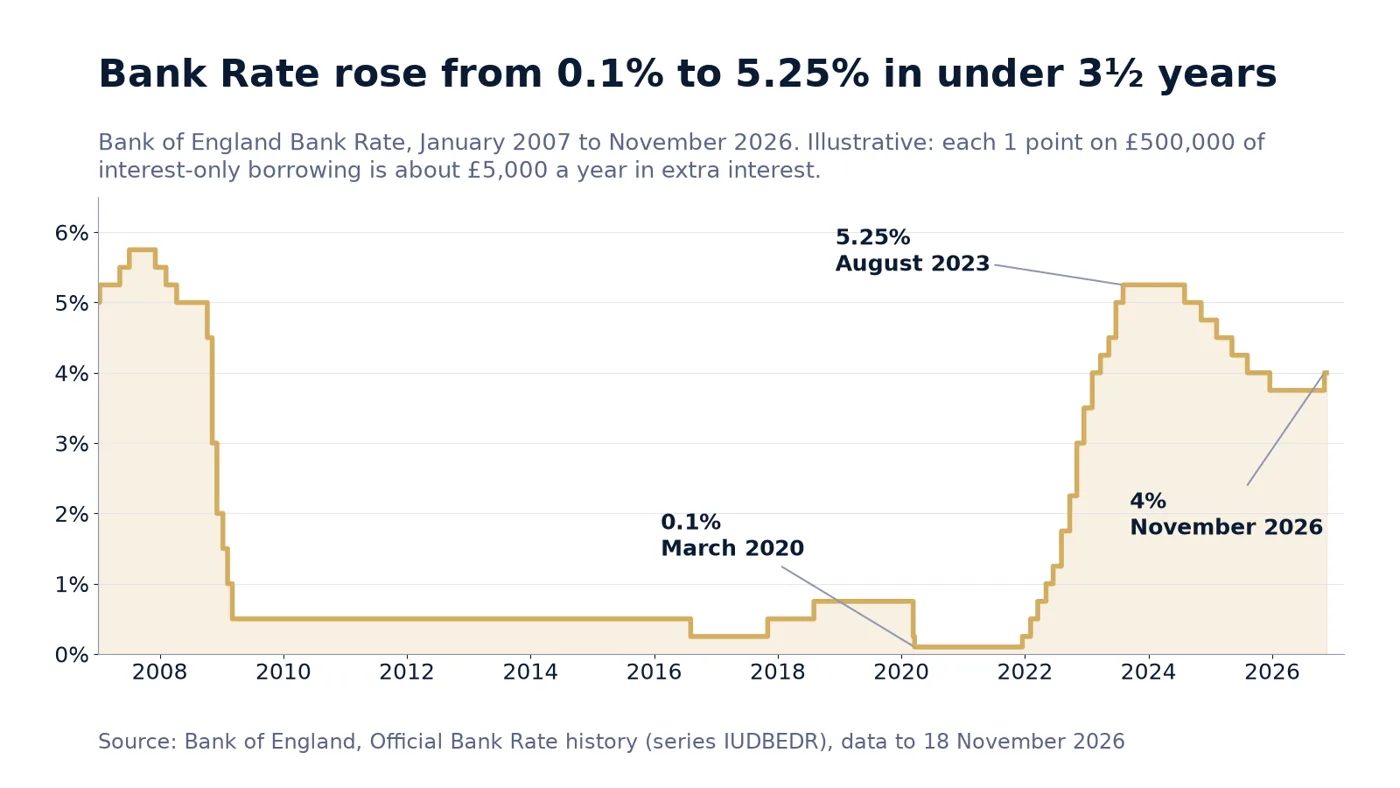
Here is the surprising part. Between March 2020 and August 2023, Bank of England Bank Rate (opens in a new tab) rose from 0.1% to 5.25%. For a landlord with large interest-only mortgages, that single change could turn a comfortable income into a thin one, without a single tenant leaving. A portfolio that feels like a pension can behave very differently from one.
Short answer: A buy-to-let portfolio can fund retirement, but it concentrates your wealth in one illiquid, often leveraged asset that is taxed heavily and sits in your estate. The fix is gradual: use pension and ISA allowances, phase sales across tax years, and follow a written process to build a liquid, diversified portfolio sized to your risk profile, with a drawdown plan.
Is most of your wealth tied up in rental property? Book your free call with Alpesh's team. We will walk through how self-directed investors build a liquid portfolio alongside property, with a written process for what to own, how much and when to rebalance. There is nothing to buy on the call.
Why is a buy-to-let portfolio a retirement risk?
Property has made many landlords wealthy. The issue is what happens when the job of your wealth changes from growing to paying you an income for 25 or 30 years. Four risks matter more then: concentration, liquidity, leverage and tax.
Concentration: one asset, one country, often one area
A typical buy-to-let portfolio is UK residential property, frequently in one or two postcodes the owner knows well. Your rent depends on the same local employers, the same local rules and the same local housing market.
A global equity fund might hold thousands of companies across dozens of countries. Shares are not safer in every year, but when one thing goes wrong in a concentrated portfolio, it goes wrong for almost all of your wealth at once.
Liquidity: you can't sell a bathroom
If you need £4,000 next month, you can sell £4,000 of a fund in a SIPP or ISA in a few days. You cannot sell a bathroom. Property comes in large, indivisible lumps, and selling one takes months.
The rules now make that slower. Under the Renters' Rights Act, section 21 "no fault" evictions ended on 1 May 2026 (opens in a new tab) and landlords must use a section 8 ground, with a notice period that is often 4 months. The tenant guidance (opens in a new tab) adds that a landlord cannot use the selling ground in the first 12 months of a tenancy. Then you still need a buyer, a survey and completion.
That is fine for a planned sale, but not when you need money for a roof or a care bill and everything you own is in bricks.
Leverage: why interest rates matter so much
Most portfolios that reach seven figures were built with mortgages. Leverage magnifies gains when prices rise, but it also makes your income highly sensitive to interest rates.
Source: Bank of England, Official Bank Rate history (opens in a new tab), data to 18 November 2026.
Bank Rate stayed at 0.5% or below for most of 2009 to 2022, then climbed to 5.25% in August 2023. After a run of cuts to 3.75%, it rose back to 4% on 5 November 2026 (opens in a new tab). In an illustrative example, every one point rise on £500,000 of interest-only borrowing adds around £5,000 a year in interest. A five-point swing is £25,000 a year.
How are landlords taxed in the UK?
Tax is where many landlords find that their gross yield and their spendable income are very different numbers. These are the main rules, checked against GOV.UK in November 2026.
| Rule | What it means for a landlord | Source |
|---|---|---|
| Mortgage interest restriction (Section 24) | Residential finance costs are not deducted from rent. Instead you get a tax reduction at the basic rate, currently 20%. Fully in place from 6 April 2020. | GOV.UK (opens in a new tab) |
| Property income tax rates from April 2027 | Separate property rates apply in England, Wales and Northern Ireland: legislated at 22%, 42% and 47%, with Budget 2026 proposing 24%, 44% and 49% from 6 April 2027. Finance cost relief is given at the property basic rate. | Finance Act 2026, s.7 (opens in a new tab); HMRC technical note (opens in a new tab); Budget 2026 measure (opens in a new tab) |
| Capital Gains Tax rates | 18% on gains within the basic rate band, 24% above it and for higher and additional rate taxpayers. | GOV.UK (opens in a new tab) |
| CGT annual exempt amount | £3,000 a year per person (2026 to 2027 and 2027 to 2028). | Budget 2026 Annex A (opens in a new tab) |
| 60-day reporting | Report and pay CGT on a UK residential property sale within 60 days of completion. | GOV.UK (opens in a new tab) |
| Property income allowance | Up to £1,000 a year tax-free, used instead of actual expenses, not alongside them. Restricted if you claim the finance cost tax reducer. | GOV.UK (opens in a new tab) |
| Stamp Duty higher rates | Additional residential property in England and Northern Ireland pays 5% on the first £125,000, rising to 17% above £1.5 million (from 1 April 2025). | GOV.UK (opens in a new tab) |
For a seven-figure portfolio the property allowance is a rounding error. The rules that matter are Section 24, the new property rates and CGT on the way out.
Gross yield or net yield: which one funds your retirement?
Landlords often quote gross yield: annual rent divided by the property's value. Your retirement is funded by net yield after every cost and after tax.
Here is an illustrative flat worth £250,000, let at £1,100 a month, with a £150,000 interest-only mortgage at 5%. These numbers are illustrative, not typical or average.
| Illustrative single flat | £ a year |
|---|---|
| Rent | 13,200 (gross yield 5.3%) |
| Letting and management (12%) | −1,584 |
| Repairs, insurance, safety checks and voids | −2,400 |
| Profit before mortgage interest | 9,216 (3.7% of value) |
| Mortgage interest at 5% | −7,500 |
| Cash left before tax | 1,716 |
| Tax for a higher-rate taxpayer today: 40% of £9,216, less 20% of £7,500 | −2,186 |
| Cash after tax | −470 |
A 5.3% gross yield became a small loss after tax, because Section 24 taxes the higher-rate landlord on profit before interest and only gives basic-rate relief on the interest. When the separate property rates start in April 2027, the gap widens slightly.
Your figures will differ, and many landlords have little mortgage left. The method is what matters: net yield after tax, property by property.
How much time does a portfolio of tenancies take?
A handful of tenancies is a part-time job, even with a letting agent. Gas appliances need an annual gas safety check (opens in a new tab) by a Gas Safe registered engineer, and electrical installations must be inspected at least every 5 years (opens in a new tab). Deposits must be protected within 30 days (opens in a new tab), and rent increases now follow the Form 4A section 13 process with at least 2 months' notice (opens in a new tab).
Add repairs, voids and arrears. At 55 this may be a pleasure; at 75 it may be a burden.
By comparison, a diversified portfolio of funds and shares can be reviewed in a few hours a month if you follow a written process. I set out how much time that really takes in how much time it takes to manage your own portfolio.
What happens to rental property and pensions for inheritance tax?
Property you own personally is part of your estate. The Inheritance Tax threshold (opens in a new tab) is £325,000, rising to £500,000 if you leave your home to children or grandchildren, with 40% on the excess. The residence nil-rate band of £175,000 starts to be withdrawn for estates above £2 million (opens in a new tab), which is exactly where a large buy-to-let portfolio puts many families.
For years, the standard answer was to spend property and other assets first and leave the pension untouched, because pensions sat outside the estate. That changes on 6 April 2027, when most unused pension funds and death benefits come into scope of Inheritance Tax (opens in a new tab).
So the inheritance tax reason to favour pensions over property is weaker. The liquidity, diversification and income reasons are not. I compared the options in more detail in drawdown or annuity after the 2027 IHT change.
How do you rebalance away from buy-to-let gradually?
Selling everything at once bunches gains into one tax year, wastes allowances and leaves you investing a large lump sum on one day. A gradual plan over several tax years usually works better.
1. Use pension and ISA allowances first
The pension annual allowance (opens in a new tab) is £60,000, with carry forward from the previous three tax years. But tax relief on your own contributions is limited to the greater of £3,600 and your relevant UK earnings, and HMRC's pensions tax manual (opens in a new tab) lists employment and trading income, not rent. If you still work, salary or self-employment income is what opens the door.
The ISA allowance (opens in a new tab) is £20,000 a year each. For a couple, that is £40,000 a year, or £320,000 over eight tax years, all growing and paying out free of UK tax. Each sale can feed the next ISA subscription.
2. Phase sales across tax years
Selling one property per tax year uses a fresh £3,000 annual exempt amount (opens in a new tab) each time and, in a lower-income year, may let part of the gain fall in the 18% band rather than 24%. Remember the 60-day deadline to report and pay.
In an illustrative example, a £100,000 gain for a higher-rate taxpayer would cost (£100,000 − £3,000) × 24% = £23,280. That money is due within 60 days, so plan the cash before you exchange.
Ownership between spouses, the order of sales and the timing around retirement can all change the bill. A tax specialist should confirm the right sequence for you before you sell anything.
3. Follow a written process for the new portfolio
The money released needs a home with a rulebook. Mine is written down and covers three questions. What do I own? How much of each? When do I sell or rebalance?
A typical process sets a target mix sized to your own risk profile, a cash buffer for one to two years of spending, and limits on how much any single fund, share or theme can be. It also says how you invest a sale's proceeds: all at once, or in planned stages. My guide to investing a lump sum covers that choice.
This is the case for managing your own money. You control what you own, you see every holding and charge, and the portfolio fits your risk profile rather than a model built for thousands of other people. Before you commit, test your plan's odds with Portfolio Odds (opens in a new tab).
4. Write a drawdown plan
Decide which pot pays first, the rent, the ISA or the SIPP, how much you take each year and what you do in a bad year for markets.
My comparison of six withdrawal strategies sets out the options, and building a retirement income shows how the pieces fit. If part of your wealth is commercial property, read commercial property in a SIPP: fees, rent and what to check as well.
How much do I need to retire?
Before you sell anything, work out the number you are aiming for. The free Pension Plan tool (opens in a new tab) estimates how much you need for the income you want and whether you are on track. My other free tools help with the rest of the plan. Once you know your number, you may find you need far fewer properties than you own.
What to do next
- List every property with its value, mortgage, rent, costs and original purchase price, then work out net yield after tax for each.
- Use the Pension Plan tool (opens in a new tab) to set your retirement income target and the size of liquid portfolio you need.
- Map your allowances for the next eight tax years: ISA, pension (if you have earnings) and the CGT annual exempt amount.
- Draft a sale order, weakest net yield first, and ask a tax specialist to confirm the CGT, income tax and IHT position.
- Write your investing process: target mix, position sizes, cash buffer, rebalancing rules and drawdown plan.
Want a clear plan for moving from landlord to investor? Book your free call with Alpesh's team. We will show you how self-directed investors pick investments, size positions and decide when to sell, so the money from your property builds a portfolio you control. There is nothing to buy on the call.
Frequently asked questions
Is buy-to-let a good retirement plan?
It can provide income, but on its own it concentrates your wealth in one illiquid, often leveraged asset that is taxed heavily. Most people are better served by holding property alongside a liquid, diversified portfolio and a written drawdown plan.
Should I sell my buy-to-let before I retire?
There is no single answer, and this article is not advice to sell. Many landlords phase sales over several tax years, starting with the weakest net yields, to spread CGT and use ISA and other allowances. A tax specialist should confirm the timing for you.
How much Capital Gains Tax will I pay on a rental property?
Gains are taxed at 18% within the basic rate band and 24% above it, after a £3,000 annual exempt amount. On a UK residential property, you must report and pay within 60 days of completion.
Can I pay my rental income into a pension?
You can pay money from any source into a pension, but tax relief on your own contributions is limited to the greater of £3,600 and your relevant UK earnings. Rental income is not relevant UK earnings, so earned income is what sets the limit.
Do pensions still avoid inheritance tax?
Not for long. From 6 April 2027 most unused pension funds and death benefits come into scope of Inheritance Tax, so both your property and your pension may count towards your estate.
About Alpesh Patel OBE
Alpesh Patel OBE is Founding Principal of Rootbridge Capital, an author and Dealmaker for the UK Government's Department for Business. He is a former Visiting Fellow in Business, Corpus Christi College, Oxford University, where he worked on technology to improve financial education.
Sources
- Bank of England, Official Bank Rate history (opens in a new tab)
- GOV.UK, Tax relief for residential landlords: how it's worked out (opens in a new tab)
- legislation.gov.uk, Finance Act 2026, section 7: property rates of income tax for 2027-28 (opens in a new tab)
- HMRC, Change to tax rates for property, savings and dividend income: technical note (opens in a new tab)
- HMRC, Income Tax: changes to tax rates for property and savings income (Budget 2026) (opens in a new tab)
- HM Treasury, Budget 2026 Annex A: rates and allowances (opens in a new tab)
- GOV.UK, Capital Gains Tax rates (opens in a new tab)
- GOV.UK, Report and pay Capital Gains Tax on UK property (opens in a new tab)
- GOV.UK, Tax-free allowances on property and trading income (opens in a new tab)
- GOV.UK, Higher rates of Stamp Duty Land Tax (opens in a new tab)
- GOV.UK, Renters' Rights Act: an overview for landlords (opens in a new tab)
- GOV.UK, Renters' Rights Act: overview for tenants (opens in a new tab)
- Health and Safety Executive, Gas safety: landlords and letting agents (opens in a new tab)
- GOV.UK, Electrical safety standards in the private and social rented sectors (opens in a new tab)
- GOV.UK, Tenancy deposit protection (opens in a new tab)
- GOV.UK, How Inheritance Tax works (opens in a new tab)
- GOV.UK, Inheritance Tax: unused pension funds and death benefits (opens in a new tab)
- GOV.UK, Pensions annual allowance (opens in a new tab)
- HMRC, Pensions Tax Manual PTM044100: tax relief for members (opens in a new tab)
- GOV.UK, Individual Savings Accounts (opens in a new tab)
- Alpesh Patel OBE, Strong Portfolios vs Weak Ones: The Brick House Test (opens in a new tab) (YouTube)
Important: This article is for education only and is not personal financial advice or a recommendation to buy or sell any investment. This article is general investment education only and is not regulated investment advice. The value of investments can go down as well as up, and you may get back less than you invest. Past performance is not a reliable indicator of future results.
Important: this article is education and information only. It is not financial advice or a personal recommendation, and it does not take your circumstances into account. The value of investments and pensions can fall as well as rise, and you may get back less than you put in. Past performance is not a reliable indicator of future results. Figures were correct when the article was written and may have changed. If you are unsure what is right for you, speak to a regulated financial adviser.